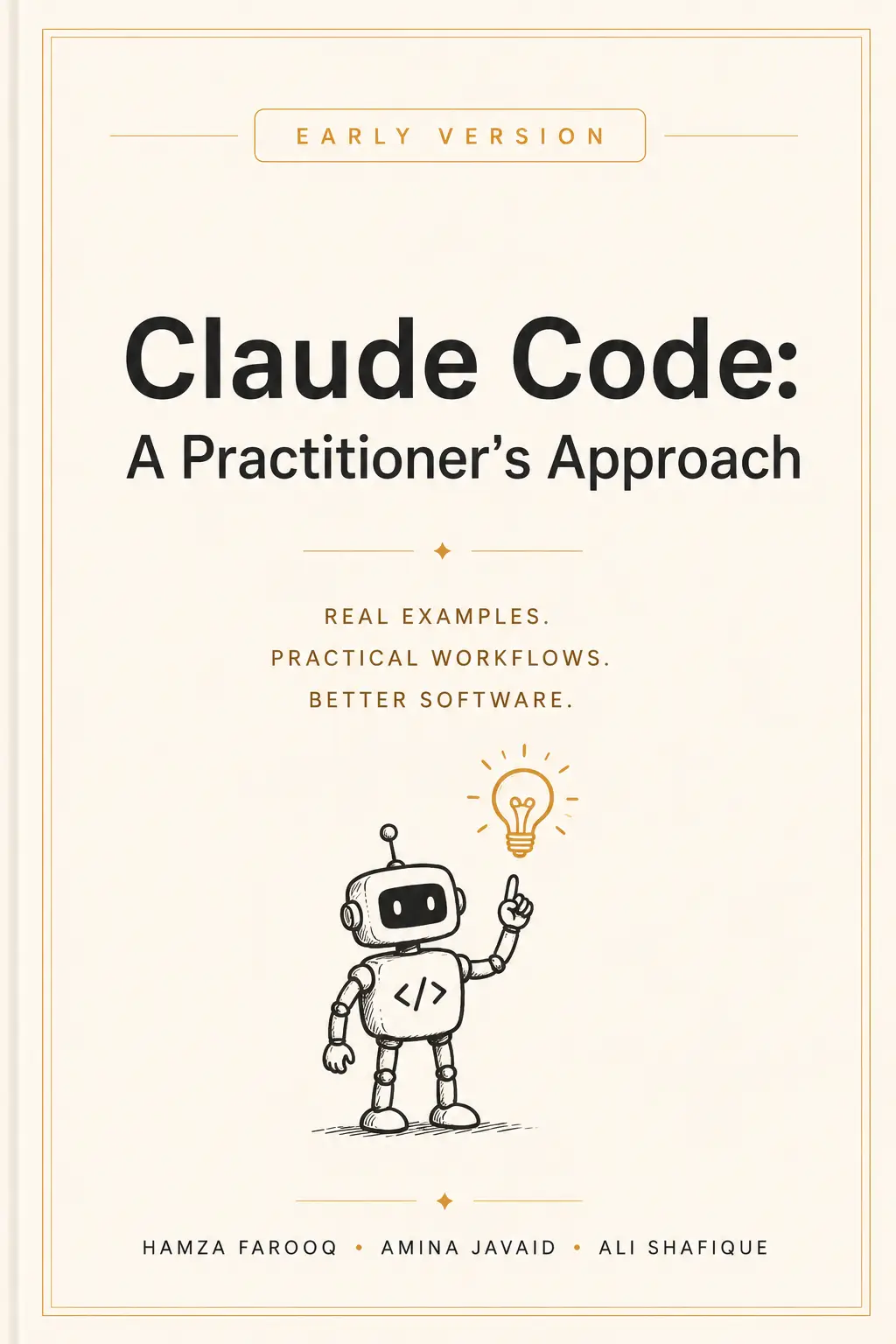
Claude Code: A Practitioner's Approach
How Product Builders Use Claude Code to Ship Faster Than Engineers
A hands-on guide that takes product builders from zero to a deployed, working product with Claude Code, writing PRDs an AI can execute, building multi-agent workflows, and testing what you ship so it holds up in the real world.
4.9615 reviews
"The best product managers in 2026 aren't writing code. They're directing it."
A Note Before We Begin
This book wasn't written for developers.
It was written for the moment, somewhere past 10pm, when an idea finally clarifies itself in your head and there is no one to hand it to. The PM who has been told for a decade that building "isn't your job." The founder tired of trading two weeks of sprint capacity for a hypothesis worth a single afternoon's test. The operator who can see, with painful clarity, what should be automated, and has never learned to ask for it in a language a machine understands.
There is a particular loneliness to this state. The idea is real to you and to no one else yet, and the evening ends, again, with nothing shipped.

We've taught more than 10,000 students between UCLA, the University of Minnesota, Coursera, DataCamp, and Maven. The single most common thing we hear, from PMs at Google, founders at YC-backed startups, executives at Fortune 100 companies, is this:
"I just want to build the thing. How do I get out of my own way?"
Claude Code is the answer.
Not because it makes coding easier. Because it makes coding optional.
This guide takes you from zero to a deployed, working product. Along the way you'll write PRDs an AI can execute, build multi-agent workflows, connect Claude to the tools you already use, and learn how to test what you ship so it works in the real world, not just in a demo.
Every chapter ends with a Build It Now exercise. Do them. The students who get the most out of our courses are the ones who build alongside the reading. Forty-five minutes of hands-on work beats ten hours of passive reading.
Let's go.
What Claude Code Actually Is
The simplest version:
Claude Code is an AI agent that lives in your terminal, reads your entire project, and does what you tell it to in plain English.
Not autocomplete. Not a chatbot you paste code into. An agent. Something that takes a goal, reasons about how to get there, and executes across files, commands, and tools until the job is done.
You type something like:
Build me a landing page for a B2B analytics tool called Orbit.
Hero section, three feature blocks, pricing with three tiers, contact form.
Clean, modern, Tailwind CSS.
Within about ninety seconds, Claude Code has created the project folder, written the HTML and CSS, set up Tailwind, built a responsive layout, and opened a local preview in your browser.
You didn't install a framework. You didn't google a Tailwind component. You didn't write a tag.
That's Tuesday morning in 2026.
The how (install, first session, troubleshooting) lives in Chapter 1. The why-it-works (CLAUDE.md, prompts, the build loop) lives in Chapter 2. This intro just frames it.
Why It's Different From Every AI Tool Before It
If you've used GitHub Copilot, Cursor, or ChatGPT to write code, you might be thinking: isn't this just another one of those?
No. Here's the distinction.
GitHub Copilot is autocomplete on steroids. It suggests the next line while you type. You're the driver, it's the passenger.
Cursor is an IDE with AI baked in. Fast, smart inside its editor. But it still operates file by file. You steer every step.
ChatGPT and Claude.ai chat write code in a conversation window. But they have no idea what's already in your project. Every response starts from a blank slate. You copy-paste. You fix the import errors. You try to make it fit your codebase manually.
Claude Code is different in one way: it operates on your actual project, end to end, with full context.
It doesn't suggest, it executes. It doesn't give you code to paste, it writes directly to your files. It doesn't guess at your project structure, it reads it. And it doesn't stop at one file. It reasons across your whole codebase like a senior engineer who's been on your team for a year.
A 2026 developer survey put Claude Code at a 46% "most loved" rating among AI coding tools. Cursor came in at 19%. GitHub Copilot at 9%. The gap isn't about intelligence. It's about agency.
The Numbers That Should Make You Sit Up
Before you install anything, look at what's actually at stake.
According to Anthropic's research on agent autonomy, Claude Code at "Level 3 autonomy" can complete tasks end-to-end without human checkpoints for several hours of complex work. That's not a chatbot. That's a junior engineer who never sleeps, never gets distracted, and gets faster every month.
For PMs, the workflow shift is real.
Before Claude Code: Idea → spec → engineering queue → sprint → review → deployed. Weeks to months.
After Claude Code: Idea → PRD → Claude Code → deployed prototype. Hours to days.
That compression isn't incremental. It's a category change in what a PM can do alone.
PMs running Claude Code in our Maven cohorts report:
- Building functional prototypes in under 2 hours from a blank PRD
- Running user tests on working products instead of static Figma mockups
- Shipping internal tools without ever filing a Jira ticket
Engineering teams still ship the production code. What changes is what you can put in front of real users without waiting on them.
How to Read This Book
Every chapter has two titles. The first is in the spirit of the show Beef (yes, that one, season 2): emotionally loaded, slightly literary, a phrase that hopefully sticks in your head. The second is a plain one-liner that tells you what the chapter actually does. If you only read the plain titles, you'll still know the curriculum.
If you're brand new, read in order:
Chapter 1: A New Starting Point for Further Builds. Install Claude Code, run your first command, understand the interface. Ten minutes.
Chapter 2: Oh, the Comfort of a File That Already Knows You. Write your CLAUDE.md, the file that gives Claude persistent context about your project. Build your first real tool. One session.
Chapter 3: Those Blue Remembered Layers. Frontend, backend, AI backend. Enough architecture to read code you didn't write and ask Claude better questions.
Chapter 4: I Am Refactoring My Day Without Them. Skills. One-word commands for the workflows you do most.
Part II (Chapters 5-7): A Small Army You Never Hired, Everything Now Passes Through Other Hands, The Models We Reach For at 2am. Sub-agents, pipelines, picking Opus vs Sonnet vs Haiku. This is where Claude Code stops feeling like a tool and starts feeling like a team.
Part III (Chapters 8-10): The Increasing Flimsiness of "It Looked Good to Me", The Hour of First Deploy, It Will Stay This Way and the Pager Will Ring. Evals, deployment, production. How you go from "it works on my machine" to "it's live and someone is paying for it."
Part IV (Chapters 11-13): The Mornings We Kept Promising Ourselves, We Were Always Going to Build Beside Them, All the Things We're Never Going to Finish. The PM playbook. Daily workflows, working alongside engineering, what comes next.
Every chapter ends with an exercise. The chapters that move fastest assume you did the previous one's. If you skip, you'll feel it.
Hamza's Note: What I Use Claude Code For Every Day
I run an 18-person company (traversaal.ai) and teach at UCLA. Here's a real sample of what I use Claude Code for every week. None of it required me to write a line of code.
- Internal dashboards for our team (API usage, costs, uptime)
- HTML slide decks generated from a rough outline
- Data analysis scripts run against CSV exports from our database
- Prototypes of new product features before specs go to engineering
- Live client demo environments built and shared inside two hours
The question I ask myself before every task now isn't "can I do this?" It's "should I do this myself, or should I direct Claude Code to do it?"
Most of the time, it's the second one.
Turn the page. Chapter 1 starts where every Claude Code journey starts: installing the thing.
Sources used in this introduction:
- A New Starting Point for Further BuildsOpen Claude Code in VS Code and Run Your First Command
- Oh, the Comfort of a File That Already Knows YouSet Up CLAUDE.md and Go from Idea to Working MVP in One Session
- Those Blue Remembered LayersSee the Harness, See the Layers, Build with Both
- I Am Refactoring My Day Without ThemBuild One-Command Automations for Your Most Repeated PM Workflows
- A Small Army You Never HiredSpin Up Specialist Sub-Agents, One for Each Kind of Work
- Everything Now Passes Through Other HandsChain Agents Into One Command That Does an Afternoon of Work
What readers are saying.
- 5★548
- 4★65
- 3★2
- 2★0
- 1★0
Read it? Share your take.
- RyanConsultant·Sixblocks
- TTJ KongResearch Scientist·Minnesota Department of Health
- Ravi MTedt·Test
- JJonathan Campbell
The three-chapter arc felt natural and useful.


