
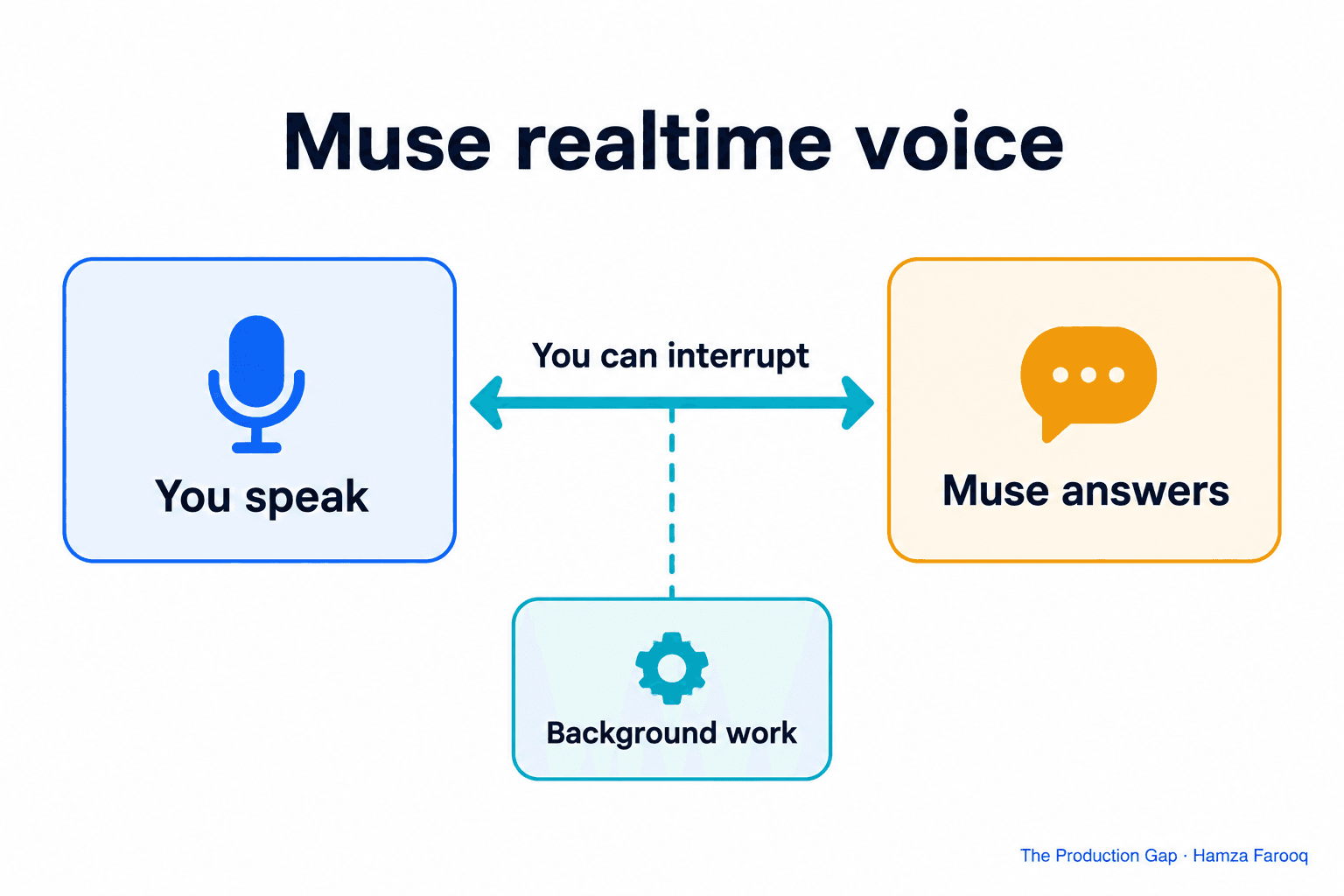
Realtime AI voice conversation means you speak to an AI, hear it answer right away, and can cut in while it is talking. Meta's newsroom post, dated 5 November 2026 and updated 6 November, says it is rolling out in the Muse app in the US to start, on mobile, web and Mac. You tap the phone icon in the top-right corner to begin.
TL;DR: Meta says Muse now supports realtime voice: you speak, hear responses right away, and can interrupt. It offers hundreds of voice styles and can keep working in the background while you talk. Meta's newsroom post gives no latency figure or voice data policy. A separate Meta research post reports about 870 ms for its avatar system, and a later post lists Australia.
Key Takeaways
- Interruption is stated: Meta's newsroom post says "You can even interrupt if you need to."
- Voice has styles: Meta says there are hundreds of voices, with a New Yorker and a pirate as examples, and you can change them at any time.
- Work continues while you talk: Meta says Muse handles tasks in the background as you speak.
- Numbers come from a different page: the newsroom post has no latency, but Meta's research post reports approximately 870 ms for the avatar system.
- Data handling is not covered: the voice posts I read do not say how voice audio is stored or used.
What does realtime voice mean compared with a voice assistant?
Realtime voice means the conversation behaves like a call: you speak, listen and break in, rather than issue one command and wait for one reply. That contrast is my description of older voice assistants, and no Meta page makes the comparison. What Meta's newsroom post does say is that you can "talk through an idea" with your Muse without worrying about the exact prompt, and that you hear responses right away.
What can you do in Muse voice today?
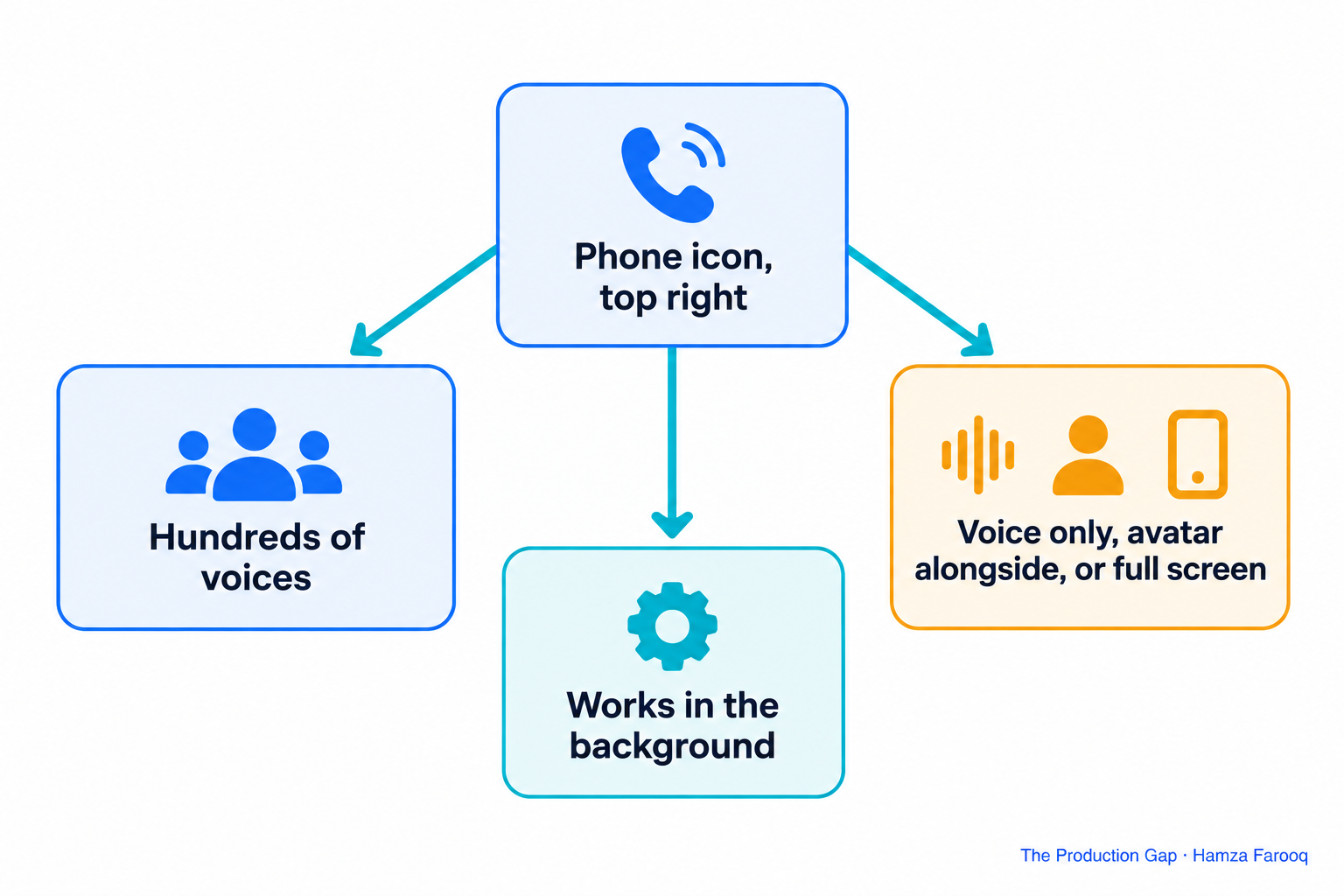
Meta's newsroom post states five things. You start from the phone icon. You can interrupt. You can pick from hundreds of voices and switch whenever you want. Muse can keep working in the background while you talk. You choose how visible the avatar is: voice only, the avatar alongside your conversation, or full screen.
The avatar is a separate layer. Meta says it uses subtle expressions and gestures that match the tone of the conversation, and reacts while you talk. Meta's research page adds a caveat: its examples illustrate model capability and do not all reflect avatars available in the Muse app.
What does Meta say about speed and models?
The newsroom post says you hear responses right away but gives no number. Meta's research post, dated 23 September 2026, does give one for the avatar system. Meta reports that Muse Realtime Avatar streams 448x768 portrait video at 25 frames per second with approximately 870 ms of latency, measured from the end of a user's turn to the first byte of the synchronized voice-and-video response.
That figure is vendor-reported. It describes the avatar system, and the pages I read do not state whether voice-only mode has the same latency. It was also published before the 5 November rollout post, so my inference is that it does not measure the shipped app.
On models, the newsroom post names Muse Realtime Avatar and Muse Realtime Voice as the technology. The research post says the two form a single streaming system, and a video caption there says the avatar combines Muse Spark and Muse Presence.
Where is it available, and what is coming next?
At launch, Meta said voice and avatars were rolling out in the US to start. Meta's Australia post, dated 17 November 2026, says real-time conversations with your Muse are now possible on mobile, web or Mac there. The research post says Muse is for users aged 18 and over. The newsroom post says voice conversations are coming soon to AI Glasses and Muse Charm, with no dates.
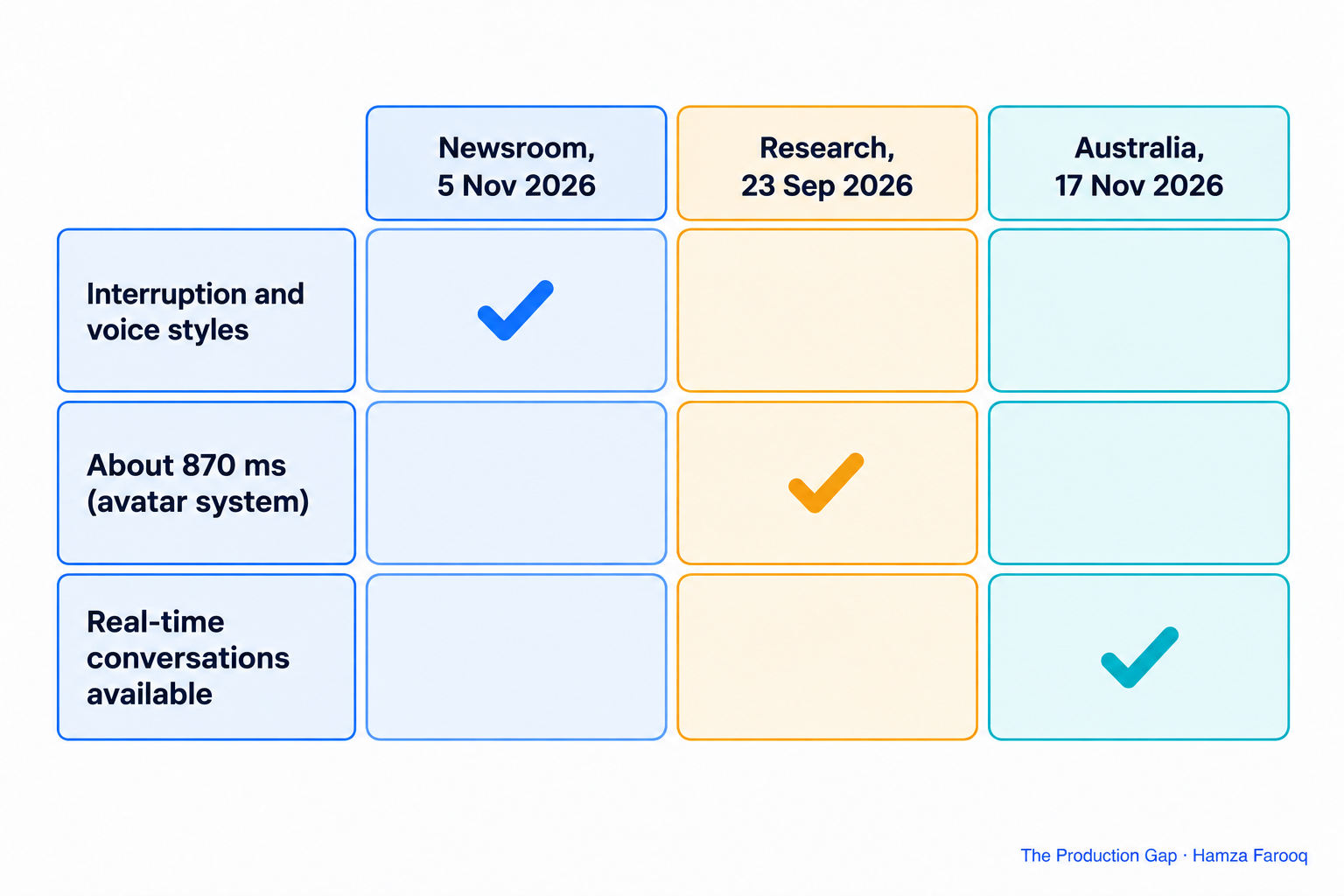
| Item | What the page states | Source |
|---|---|---|
| Realtime voice, interruption | Rolling out in the US to start; you can interrupt; hear responses right away | Meta newsroom, 5 Nov 2026 |
| Avatar latency | Approximately 870 ms, end of user turn to first byte (avatar system) | Meta research, 23 Sep 2026 |
| Other countries | Australia: real-time conversations now possible | Meta Australia post, 17 Nov 2026 |
| Glasses and Charm | Coming soon, no dates given | Meta newsroom, 5 Nov 2026 |
What should you check before talking to an AI out loud?
Meta's voice announcement does not say how voice audio is stored, whether it is used for training, or how the AI voice and avatar are disclosed as AI. I found no statement on those points in the newsroom post or the research post. The research post does say Muse Realtime Avatar embeds a durable, invisible watermark in generated video using Meta Video Seal.
The Australia post says Muse checks with you before sensitive actions such as sending an email or making a purchase. It describes Muse generally, and the text I read does not tie that statement to voice.
My suggestion: before using voice for anything private, read the app's privacy settings and Meta's privacy policy. Review any background task work before relying on it.
Frequently Asked Questions
Can you interrupt Meta's Muse while it is talking?
Yes, according to Meta. The newsroom post says "You can even interrupt if you need to."
How fast is Muse voice?
Meta's newsroom post says you hear responses right away but gives no figure. Meta's research post reports approximately 870 ms for its avatar system, measured from the end of your turn to the first byte of the response. That is a vendor-reported number, not an independent measurement of the app.
Is Muse voice available outside the US?
At launch Meta said the US to start. Meta's 17 November 2026 Australia post says real-time conversations are now possible there. The pages I read do not list other countries, so check the app.
Does Meta say how Muse handles voice audio?
The pages I read do not. Neither the voice announcement nor the research post states how voice audio is stored or used. Check the app's privacy settings and Meta's privacy policy.
Conclusion
Meta has confirmed realtime voice, interruption, hundreds of voice styles and background work in the Muse app, in the US at launch and, per a later post, in Australia. On the pages I read, it has not said how voice data is handled or what latency the shipped app delivers. If voice AI is new to you, try it on low-stakes tasks and look up the data answers before you rely on it.
Learn from me
Agent Engineering Bootcamp: Developers Edition, my Maven cohort. Advanced agentic RAG, multi-agent orchestration, memory, evals, and guardrails. Take agents from prototype to production. Join the next cohort →
Hire us
Traversaal.ai. We're a team of forward deployed engineers solving the toughest AI problems for Fortune 100 companies: document intelligence, agentic data platforms, and real-time web intelligence, deployed in production. Work with our team to deploy your next agentic ecosystem. Talk to Traversaal.ai →
Join us
Want to solve these problems with us? We're always looking for forward deployed engineers who want to ship production AI. jobs@traversaal.ai
