
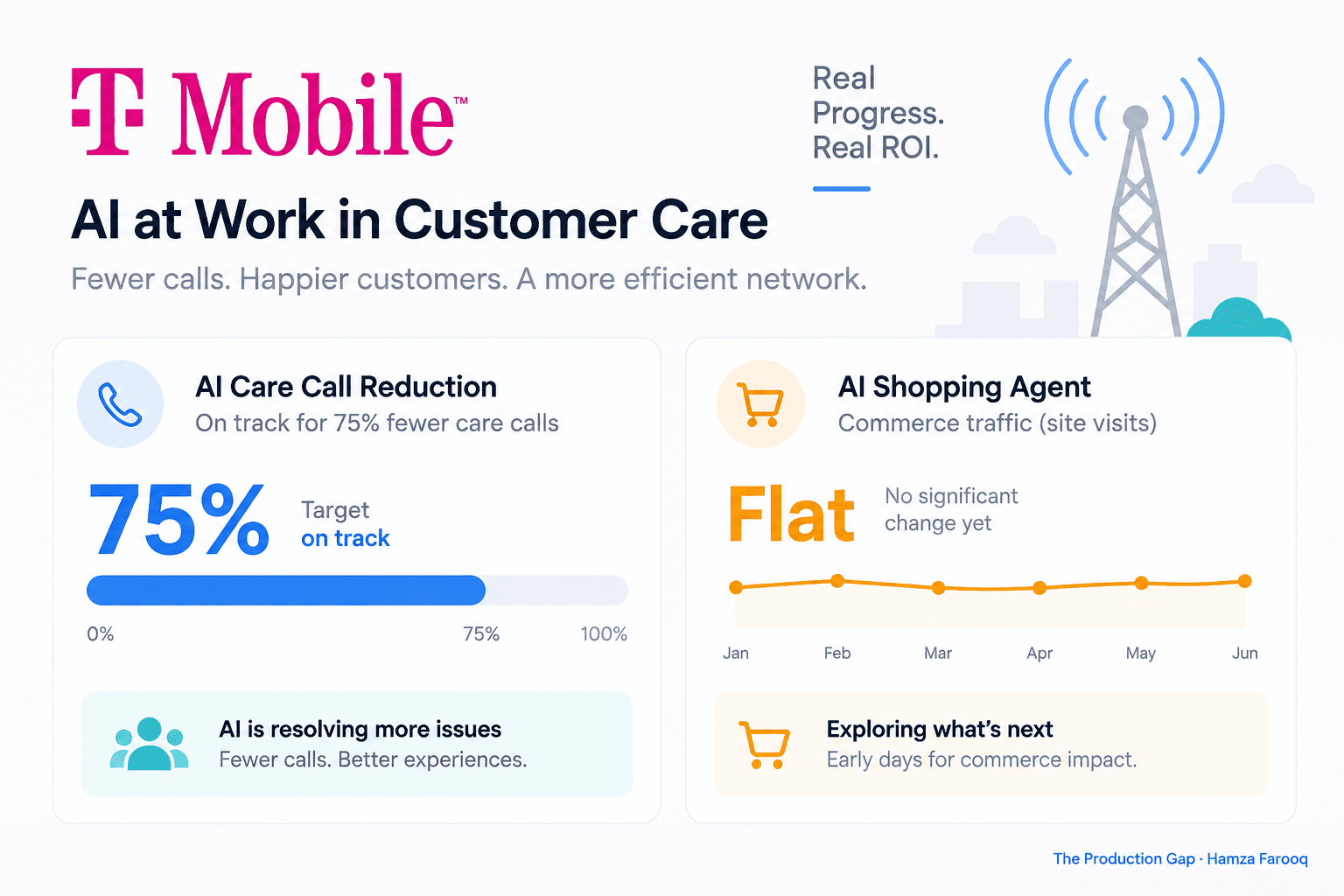
TL;DR: T-Mobile has publicly pursued a substantial reduction in customer care call volume, with the T-Life app's embedded AI assistant as the primary delivery channel and documented agentic AI infrastructure at the network layer. Leadership has confirmed the program is progressing, though no independently verified completion percentage appears in the public sources reviewed here. The care channel has visible investment behind it. A comparable AI commerce initiative does not. That gap is the most instructive signal telecom operators can take from T-Mobile's publicly available disclosures.
Key Takeaways
- A significant care call reduction target has been publicly signaled: T-Mobile leadership has indicated the program is progressing, but no specific completion percentage has been confirmed by the sources reviewed here.
- Prevention beats deflection: T-Mobile's documented strategy aims to stop calls before they form, not redirect frustrated customers away from agents after call intent has already developed.
- T-Life app is the delivery engine: The AI assistant and self-service care experience are built and expanding there.
- Human escalation is the hidden risk: The primary customer experience risk of AI-first care is that customers unable to reach a human agent after failed AI interactions churn silently, invisible in call-volume metrics until retention data surfaces the loss.
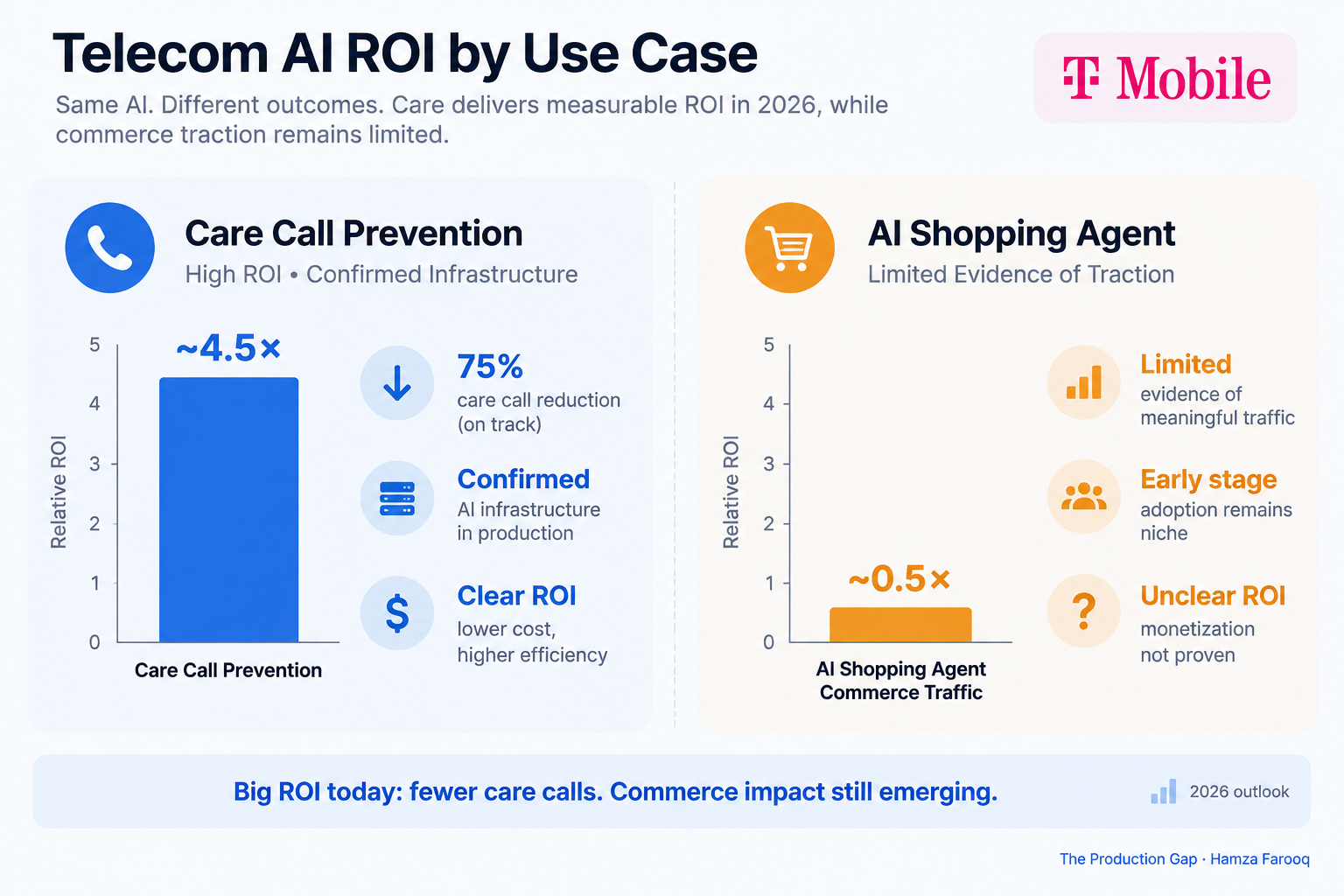
- Telecom's real AI ROI appears to be in care, not commerce: T-Mobile's publicly documented investments point clearly to that split.
Introduction
T-Mobile has made AI a centerpiece of two distinct strategic bets: reducing customer care call volume through proactive AI, and driving commerce through AI shopping agents. Publicly available signals suggest these two bets are producing very different results. One AI strategy has documented infrastructure behind it. The other lacks evidence of traction.
That split is worth examining carefully, because vendor case studies rarely show both sides. Operator-level disclosures and community feedback do.
What exactly has T-Mobile committed to, and what has been confirmed so far?
T-Mobile has publicly pursued a substantial reduction in customer care call volume, with the T-Life app's embedded AI assistant serving as the primary delivery channel, though no independently verified completion percentage has been confirmed by the sources reviewed here.
The delivery channel is the T-Life app, where an embedded AI assistant lets customers complete care tasks without calling. The infrastructure is documented. The pace of adoption and measurable outcomes remain opaque in public sources.
How is proactive call prevention different from standard call deflection, and why does that distinction change the ROI math?
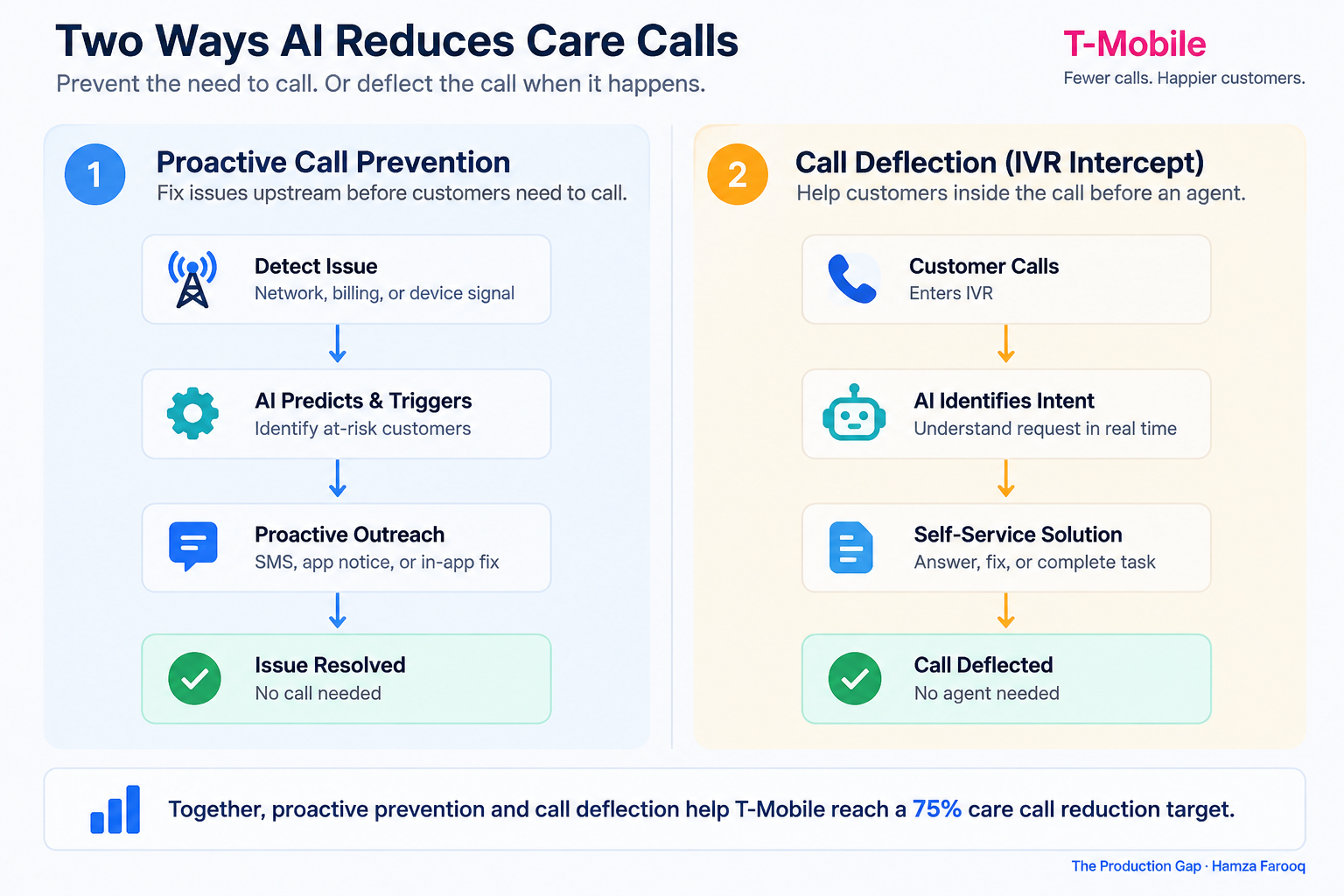
Proactive call prevention stops a customer from needing to call in the first place; deflection redirects a customer already trying to reach an agent into a self-service channel instead, and the two strategies have meaningfully different satisfaction ceilings.
Deflection acts downstream: a customer dials in, AI intercepts before they reach an agent, and friction risk remains intact. Prevention acts upstream: AI detects likely billing confusion and sends a notification before the customer would have called, eliminating demand before it forms. Prevention has a higher satisfaction ceiling because the customer never encounters friction.
T-Mobile's investment in agentic AI at the network layer, including agents built into its core 5G infrastructure, reflects what prevention actually requires at scale. This is not a simple IVR overlay.
Table 1: Call Deflection vs. Proactive Prevention, Author Framework
| Dimension | Call Deflection | Proactive Call Prevention |
|---|---|---|
| When AI acts | After call intent forms | Before call intent forms |
| Customer experience | Friction possible | Invisible when it works |
| Primary metric | Deflection rate | Calls-not-generated |
| Satisfaction risk | High if escalation blocked | Low if prediction is accurate |
| Infrastructure dependency | IVR or chatbot layer | Predictive analytics plus proactive outreach |
| T-Mobile application | T-Life AI assistant intercept | 5G agentic network layer |
As a practical rule of thumb used in this framework: any roadmap that measures deflection rates alone is tracking a lower-ceiling outcome than it could be.
What are the real customer experience risks when AI handles care at scale?
The primary customer experience risk of AI-first care is that customers unable to reach a human agent after failed AI interactions churn silently, invisible in call-volume metrics until retention data surfaces the loss.
Human escalation needs to be explicit, fast, and surfaced from the first interaction, not buried after repeated failed AI attempts. That is not a speculative risk; it is visible in public community signals right now.
Why does the commerce side of AI appear weaker, and what does that tell the industry?
Care tasks such as checking a bill or changing a plan are low-stakes and repeatable, with objectively correct answers. Purchase decisions involve contract risk and comparative judgment, where customers tend to want human validation or at minimum high-confidence AI. The trust conditions for agent-led commerce in telecom are harder to establish than for care.
Any carrier that prioritized AI shopping investment over care automation may have sequenced its resources poorly. The documented gap between T-Mobile's care AI infrastructure and the absence of comparable commerce AI evidence makes that case without requiring speculation.
Frequently Asked Questions
What is T-Mobile's publicly stated direction on AI-driven call reduction? T-Mobile has pursued a reduction in customer care calls through an AI assistant embedded in its T-Life app. Leadership has signaled commitment to the program, though no independently verified completion percentage has been confirmed by sources reviewed here.
How does proactive call prevention differ from call deflection? Prevention stops a customer from forming call intent through predictive outreach; deflection intercepts a customer already trying to reach an agent. Prevention has a higher satisfaction ceiling because the customer never encounters friction. The distinction matters for ROI because preventing a call is structurally cheaper and more satisfying than intercepting one already in progress.
What are the customer experience risks of AI-first care? Customers who cannot reach a human when AI fails them may churn rather than call again, and call-volume metrics will not surface that until retention data arrives. Community-sourced examples of this pattern are already visible in public forums.
Conclusion
T-Mobile's publicly documented AI investments offer the industry one of its cleaner real-world splits: a care channel with documented infrastructure and leadership commitment on one side, and a commerce channel with no comparable evidence of traction on the other. That split is more instructive than most vendor case studies, which rarely show both sides of the ledger.
The author framework used in this guide draws a hard line between deflection and prevention because the two strategies carry different satisfaction ceilings, different infrastructure requirements, and different risk profiles for churn. Operators tracking call volume reduction should also watch escalation accessibility and retention signals. A strong volume number risks masking a retention problem underneath it if human escalation paths are degraded in the process.
The AI with documented momentum in telecom right now keeps existing customers from leaving. That is the finding the public record supports, and it is where the ROI story is actually located
Learn from me
Agentic AI for Product Managers, my Maven cohort. Learn how to design, evaluate, and ship reliable AI systems: the technical fluency PMs need to lead agentic products, no engineering background required. Join the next cohort →
Hire us
Traversaal.ai. We're a team of forward deployed engineers solving the toughest AI problems for Fortune 100 companies: document intelligence, agentic data platforms, and real-time web intelligence, deployed in production. Work with our team to deploy your next agentic ecosystem. Talk to Traversaal.ai →
Join us
Want to solve these problems with us? We're always looking for forward deployed engineers who want to ship production AI. jobs@traversaal.ai
