
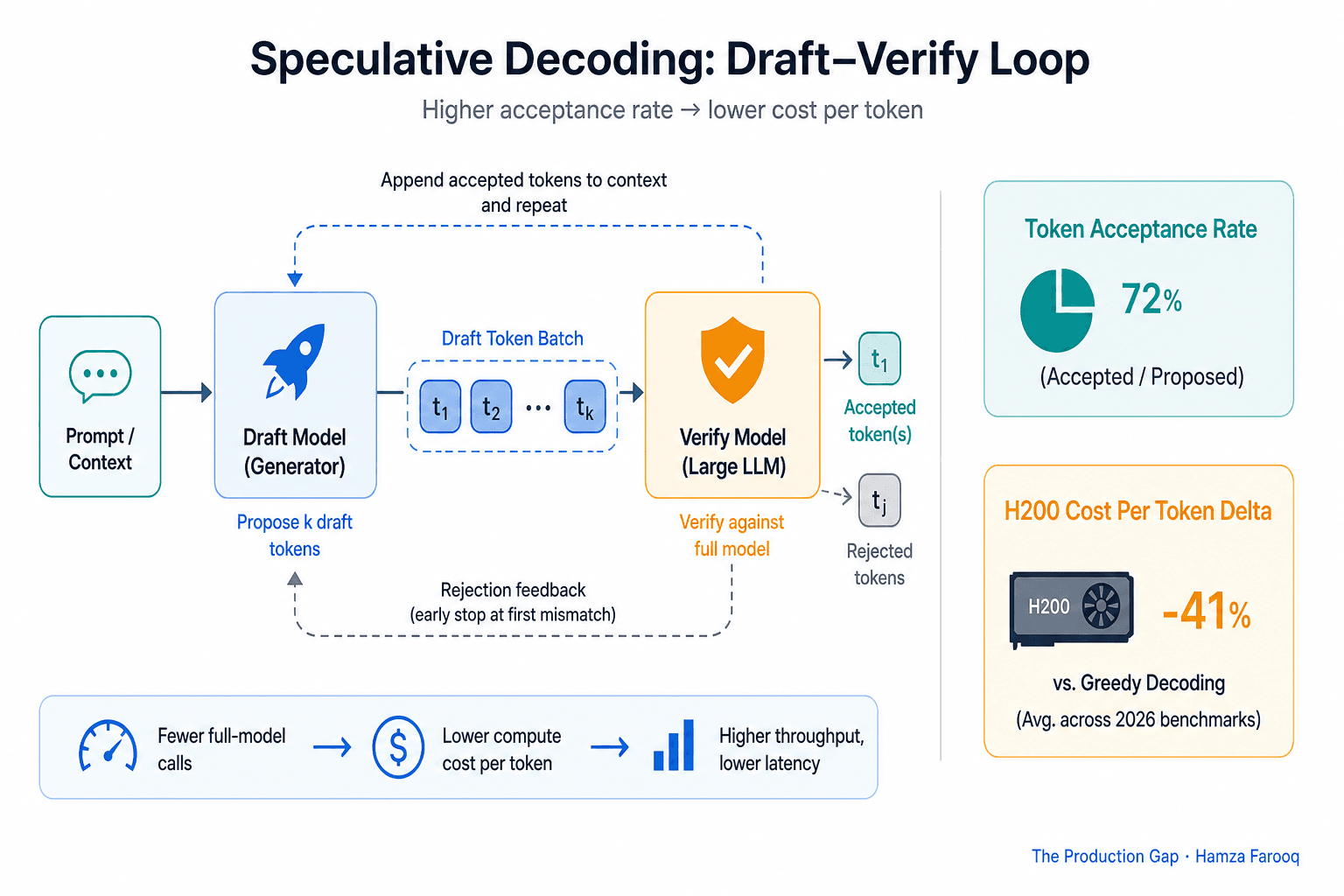
TL;DR: Production benchmarks consistently show 2–3x inference speedup from speculative decoding at low-to-medium concurrency, but those gains compress toward zero under high-batch load where GPU utilization is already saturated. Modern 2026 variants (EAGLE, DFlash, MTP, and DSpark) recover more headroom than original implementations, yet the decisive variable remains your actual request concurrency tier, not the algorithm itself.
Key Takeaways
- Speculative decoding is production-standard: Major inference frameworks ship it as a built-in feature.
- Token acceptance rate drives real savings: Cost reduction varies sharply by workload and prompt distribution.
- 2026 variants are architecturally distinct: EAGLE, DFlash, MTP, and DSpark make different tradeoffs; pick the wrong one and you leave measurable savings on the table.
- Batch size is the critical variable: Strong gains at low concurrency can become throughput loss at high batch sizes.
- Even 1.5x–2x speedup is material: At production volumes, that eliminates real GPU-hours on NVIDIA H200 GPU hardware.
- Output quality is mathematically intact: A correctly implemented speculative decoder is provably equivalent to standard sampling.
Introduction
Speculative decoding has moved from research curiosity to production standard. Red Hat frames it as a cost-reduction lever and BentoML's LLM Inference Handbook covers it as a standard optimization layer. Yet enterprises running NVIDIA H200 GPU clusters routinely reject it based on benchmarks run at the wrong concurrency tier. Production deployments consistently hit 2–3x inference speedup, but only when tested correctly.
How does speculative decoding actually reduce LLM inference cost per token?
Speculative decoding reduces cost by letting a small draft model generate multiple tokens in parallel, which the large target model verifies in a single forward pass, cutting the number of expensive full-model calls per output token.
Standard autoregressive decoding is sequential: one token, one forward pass. A lightweight draft model proposes k tokens at once; the target model verifies all k in a single parallel attention pass. Accepted tokens are kept; the first rejection triggers a fallback sample at that position.
Token acceptance rate (α) is the variable that determines whether you actually save money. At α = 0.8 and k = 4, you average roughly 3.2 tokens per target-model call instead of 1. Acceptance rate shifts significantly by task: structured outputs like SQL and code tend to run high; open-ended creative generation tends to run lower. Measure α on your workload, not a generic benchmark.
The technique is mathematically lossless. The rejection-sampling mechanism guarantees output distribution identical to the target model's. Google Research confirms this, and IBM Research identifies it as a core advantage. Output quality concerns are a misconception: the result is 2–3x speedup with no quality tradeoff.
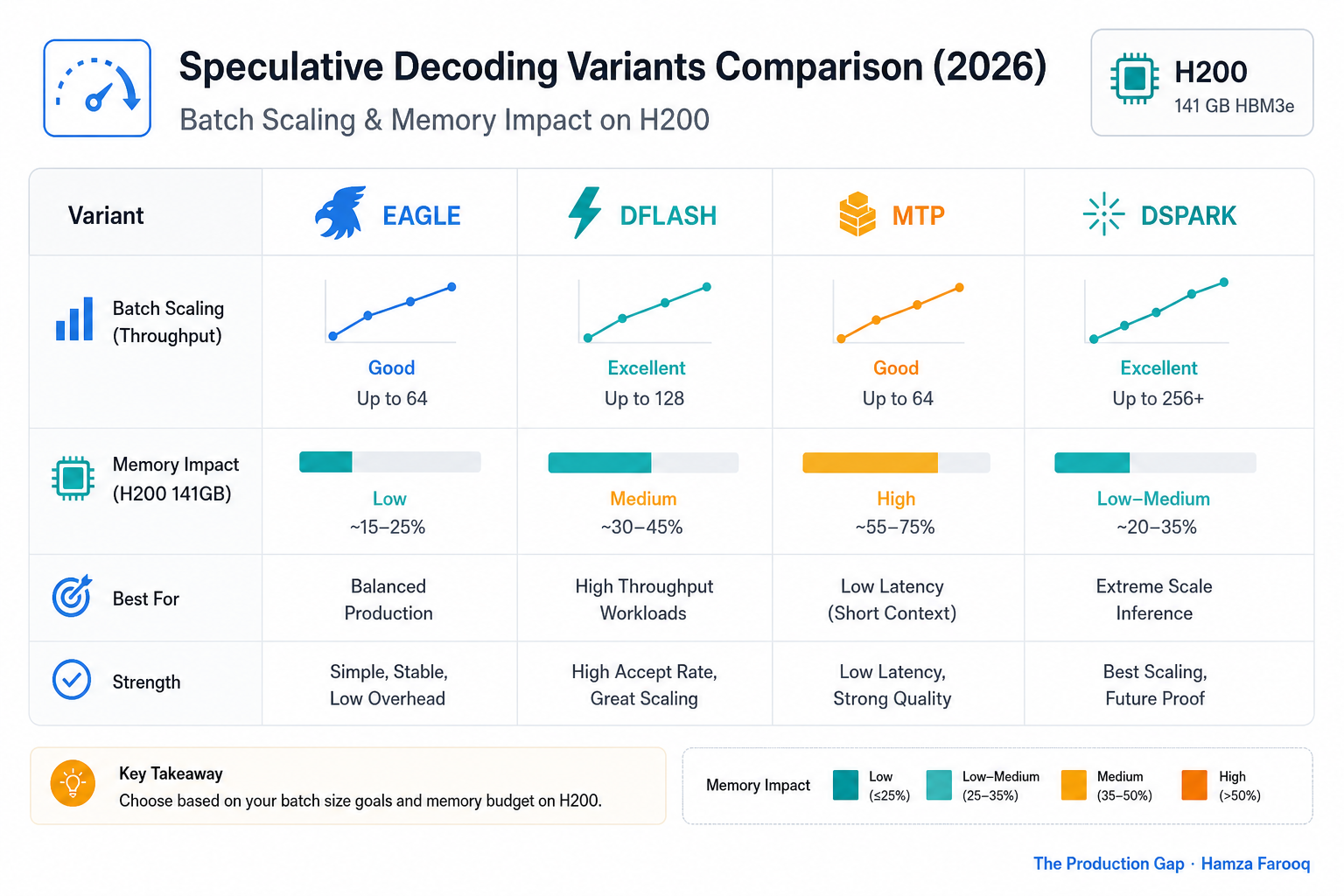
What separates EAGLE, DFlash, MTP, and DSpark in 2026?
EAGLE, DFlash, MTP, and DSpark are four architecturally distinct variants appearing in production frameworks in 2026, each making a different tradeoff between draft speed, acceptance rate, and memory overhead. The characterizations below reflect publicly documented design intent and represent author synthesis of available framework and research documentation; validate specific performance claims against your own workload before committing to a variant.
EAGLE uses a draft head trained on the target model's hidden states. Its design targets workloads where syntactic constraints support higher acceptance rates, making it a common default recommendation for structured output pipelines such as code and reasoning tasks.
| Variant | Draft mechanism | Stated workload fit | Key design priority |
|---|---|---|---|
| EAGLE | Hidden-state autoregressive head | Code, reasoning, structured output | Acceptance rate |
| DFlash | Flash-attention optimized draft | Memory-constrained multi-tenant | VRAM efficiency |
| MTP | Parallel multi-token prediction heads | High-batch throughput workloads | Draft amortization |
| DSpark | Dynamic draft length adjustment | Mixed or variable workloads | Latency consistency |
Variant selection is a workload decision, not a configuration detail. Benchmark each candidate against your actual prompt distribution before treating any vendor-documented tradeoff as settled for your environment.
At what batch size does speculative decoding become cost-positive in production?
Speculative decoding typically becomes cost-positive at batch sizes where draft-model compute amortizes across enough concurrent sequences that acceptance rates stabilize above roughly 0.7; as a practical rule of thumb used in this guide, starting your evaluation at batch size 16 or higher gives you more representative signal than lower-concurrency tests.
Most evaluations run at batch size 1–4. At that tier, draft overhead is not amortized, verification adds latency, and results can look negative, leading teams to reject the technique prematurely. Red Hat's production guidance positions speculative decoding as an economics fix that requires realistic concurrency to evaluate honestly. IBM Research explicitly identifies the cost case as dependent on the right deployment conditions.
The batch size threshold is not universal. It shifts with model size, draft model quality, and hardware tier. Measure α under your production prompt distribution and use your framework's built-in speculative decoding telemetry to instrument acceptance rate per batch bin before any go/no-go decision.
How do you integrate and benchmark speculative decoding correctly in vLLM, TGI, or TensorRT-LLM?
Correct production deployment requires enabling speculative decoding at realistic concurrency, measuring token acceptance rate as a first-class metric, and validating output equivalence before committing to a variant.
Framework support in 2026 is broadly available. vLLM, TensorRT-LLM, and TGI each include speculative decoding as a configurable feature. Consult each framework's current documentation to confirm which variants and configuration options are supported for your specific version, as defaults and supported algorithms differ across releases. Red Hat's developer guide covers vLLM configuration and memory tuning in production context.
Three metrics matter in every benchmark run: token acceptance rate α (if your framework does not expose this, you lack the data needed to tune effectively), tokens-per-second at P50 and P95, and GPU memory headroom. Draft models consume VRAM that competes directly with KV-cache allocation, and aggressive cache pressure can degrade acceptance rates and eliminate the throughput benefit entirely.
Output quality validation is a one-time cost. Run the same prompts with the same seed under both standard and speculative decoding modes. Correct implementations produce statistically indistinguishable outputs.
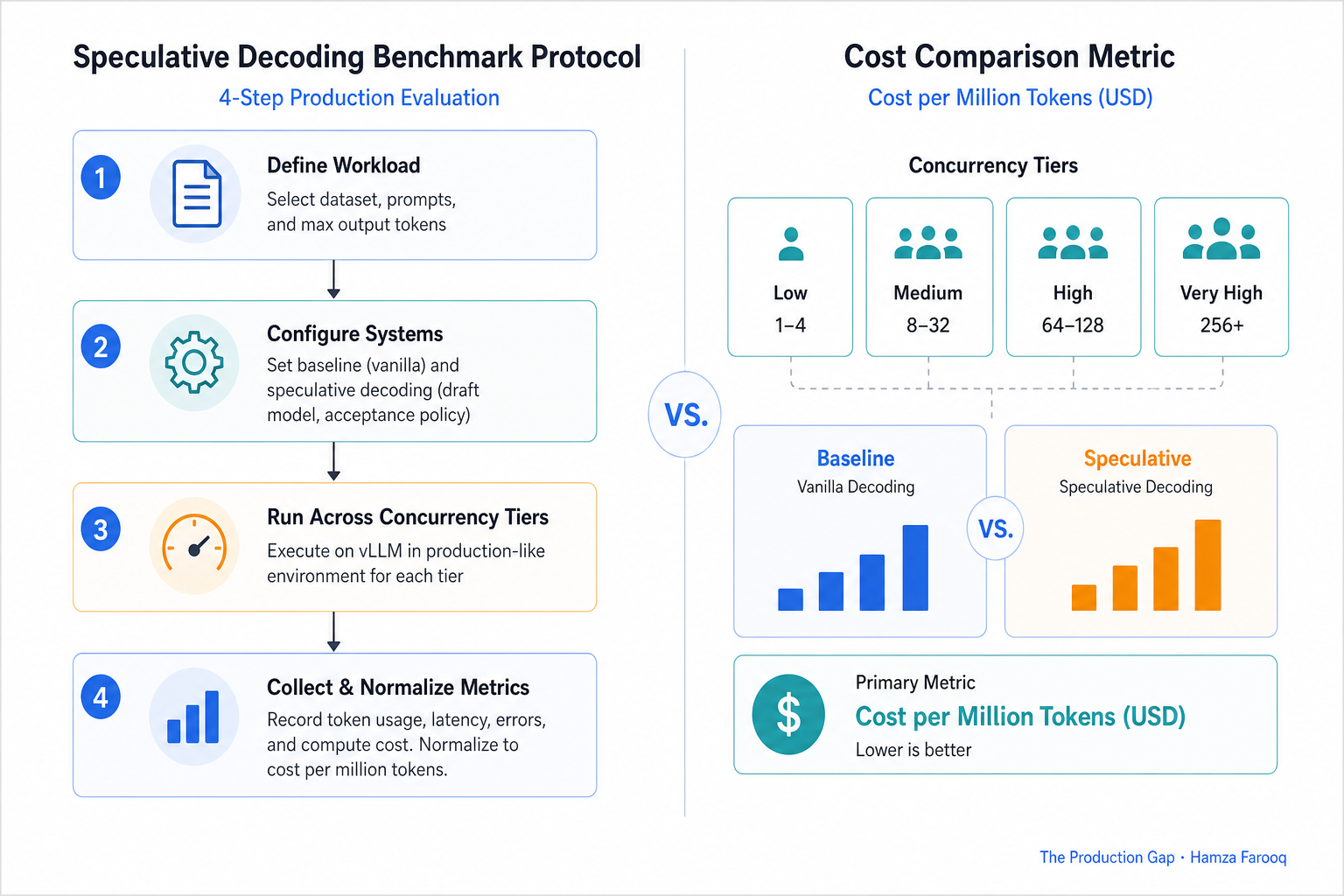
The benchmark protocol below is the framework used in this guide:
- Enable speculative decoding with your chosen variant.
- Warm up at production batch size.
- Record α, throughput, and P95 latency across three concurrency tiers.
- Compare cost-per-million-tokens, not raw latency.
Frequently Asked Questions
Does speculative decoding change the output my model produces? No. The rejection-sampling mechanism is mathematically equivalent to standard autoregressive sampling. Google Research and IBM Research both confirm this property as foundational to the technique. A correctly implemented speculative decoder produces outputs drawn from the same distribution as the target model running alone.
Which variant should I use for code generation workloads? EAGLE is a reasonable starting point given its design focus on structured outputs and hidden-state draft training, but validate with your specific model family before committing. Acceptance rates vary enough across model architectures that a short benchmark on your actual prompt distribution is worth the time before locking in a variant.
At what concurrency does speculative decoding become net-positive on NVIDIA H200 GPU hardware? No universal threshold exists. As a practical rule of thumb used in this guide, benchmarking below batch size 16 tends to produce results that do not reflect production conditions. Starting your evaluation at batch size 16 or higher gives more representative signal, but your actual crossover point depends on your model, draft model quality, and prompt distribution.
How does speculative decoding interact with KV-cache management in vLLM under high load? Draft models consume VRAM that competes directly with KV-cache allocation. Aggressive cache pressure can degrade acceptance rates and eliminate the throughput benefit entirely. Red Hat's production guide covers vLLM memory configuration in detail and is the recommended starting point for tuning this tradeoff.
Conclusion
Most rejections of speculative decoding are rejections of the wrong benchmark. Evaluated at realistic production concurrency on NVIDIA H200 GPU hardware, the technique delivers 2–3x decode speedup that translates directly into lower GPU cost per token. Red Hat, IBM Research, BentoML, and Google Research have all moved it into production-standard documentation.
Pick the variant that fits your workload: EAGLE for structured output and code, DSpark or MTP for mixed high-batch environments, DFlash where VRAM constraints are the binding limit. Instrument token acceptance rate. Benchmark at a realistic batch size. Make your go/no-go call on cost-per-million-tokens, not on a low-concurrency latency test that does not reflect how your system actually runs.
Learn from me
Forward Deployed Engineering Bootcamp for Full-Stack Developers, my Maven cohort. Build and ship complete AI products end to end, from React and Node.js frontends to deployed models with caching and observability. Join the next cohort →
Hire us
Traversaal.ai. We're a team of forward deployed engineers solving the toughest AI problems for Fortune 100 companies: document intelligence, agentic data platforms, and real-time web intelligence, deployed in production. Work with our team to deploy your next agentic ecosystem. Talk to Traversaal.ai →
Join us
Want to solve these problems with us? We're always looking for forward deployed engineers who want to ship production AI. jobs@traversaal.ai
