
As of 2026, the architecture patterns and tooling recommendations in this guide reflect current sovereign AI deployment practice in regulated industries.
TL;DR: Sovereign AI deployment on-premises follows two dominant patterns: fully air-gapped infrastructure and locked-down client VPCs, both requiring model packages transferred via secure media or bastion hosts, dependency mirrors replacing public registries, and monitoring pipelines stripped of outbound telemetry. Fine-tuning workflows and update cadences must be redesigned around disconnected environments to avoid the operational failures that most commonly derail regulated-industry engagements.
Verified context: HPE AI Factory for sovereign deployments supports a range of deployment models designed for secure, sovereignty-focused environments, including on-premises infrastructure.
Key Takeaways
- Two patterns dominate: Air-gapped on-premises and locked-down client VPC require different ingress mechanisms, decisions made before the engagement starts.
- Package before the perimeter: Weights, containers, and dependencies must be signed, checksummed, and bundled offline before crossing.
- Internal mirrors replace every external registry: PyPI, Conda, container registries, and model hubs all need private replicas.
- Fine-tuning pipelines must be egress-free by design: Select every self-hostable tool before the engagement starts.
- Observability runs entirely on local tooling: Prometheus, Grafana, and on-premises drift detection replace SaaS telemetry.
- Change control boards own the update schedule: Rollback and version management are architectural requirements, not afterthoughts.
What are the two dominant sovereign AI deployment patterns, and where does each one break?
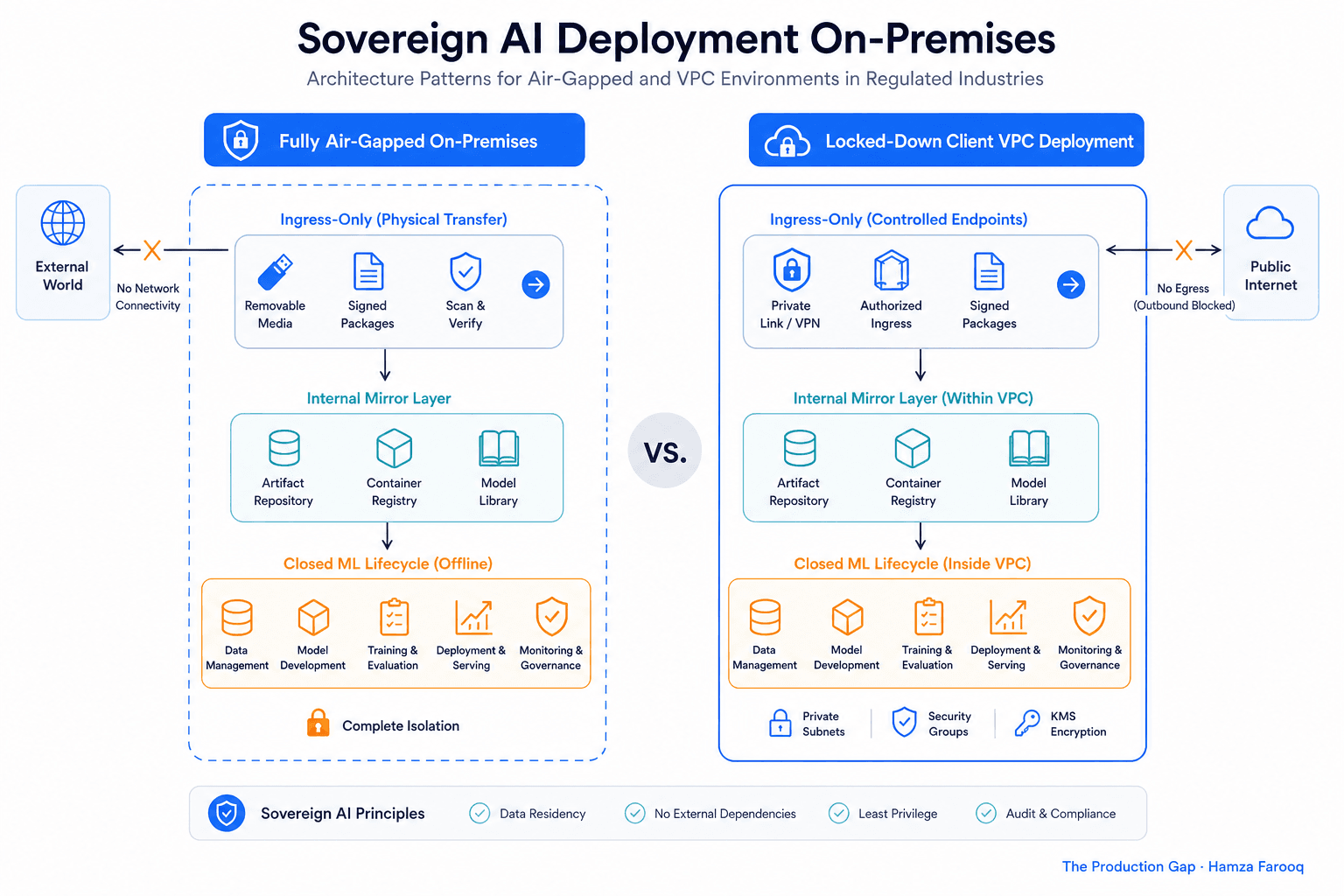
Sovereign AI deployment resolves into two patterns: fully air-gapped on-premises and locked-down client VPC, each with distinct ingress mechanisms and failure modes. Understanding which pattern applies to your engagement determines every tooling decision that follows, and those decisions must be made before the engagement starts.
Pattern 1 is the fully air-gapped on-premises setup: physical perimeter, zero network egress, sneakernet or one-way data diode as the only artifact transfer mechanism. This is standard in defense, classified federal, and ITAR-controlled environments. Every dependency must arrive before the engagement starts or wait for the next approved transfer window.
Pattern 2 is the locked-down client VPC: a network-isolated segment with no outbound internet but controlled internal traffic between subnets. This pattern is common in pharma, financial services, and civilian federal contexts. In practice, model registries cannot reach external model hubs, and monitoring SDKs that assume outbound connectivity fail silently at runtime rather than at setup.
Table 1: Air-Gapped vs. Locked-Down VPC, Key Deployment Dimensions
| Dimension | Air-Gapped On-Prem | Locked-Down Client VPC |
|---|---|---|
| Artifact ingress | Sneakernet / one-way data diode | Controlled internal transfer or bastion |
| Dependency resolution | Pre-bundled offline mirrors only | Internal mirror with subnet routing |
| Fine-tuning compute | Client-owned GPU cluster | VPC-resident GPU instances |
| Update cadence | CCB approval + physical transfer | CCB approval + internal pipeline trigger |
| Primary regulated industry | Defense, ITAR, classified federal | Pharma, financial services, civilian federal |
| Biggest failure mode | Missing dependency discovered post-perimeter | SaaS tooling SDK calling home at runtime |
One failure mode worth planning against explicitly: a team enters a classified environment and discovers that their experiment tracking tool attempts an outbound call on first initialization, not at setup but at runtime. In practice, some monitoring and tracking SDKs include external validation or telemetry calls that are not obvious from documentation alone. The engagement stalls while a self-hosted replacement clears security review. Stack selection must happen before crossing the perimeter.
How do you package and mirror every dependency before crossing the perimeter?
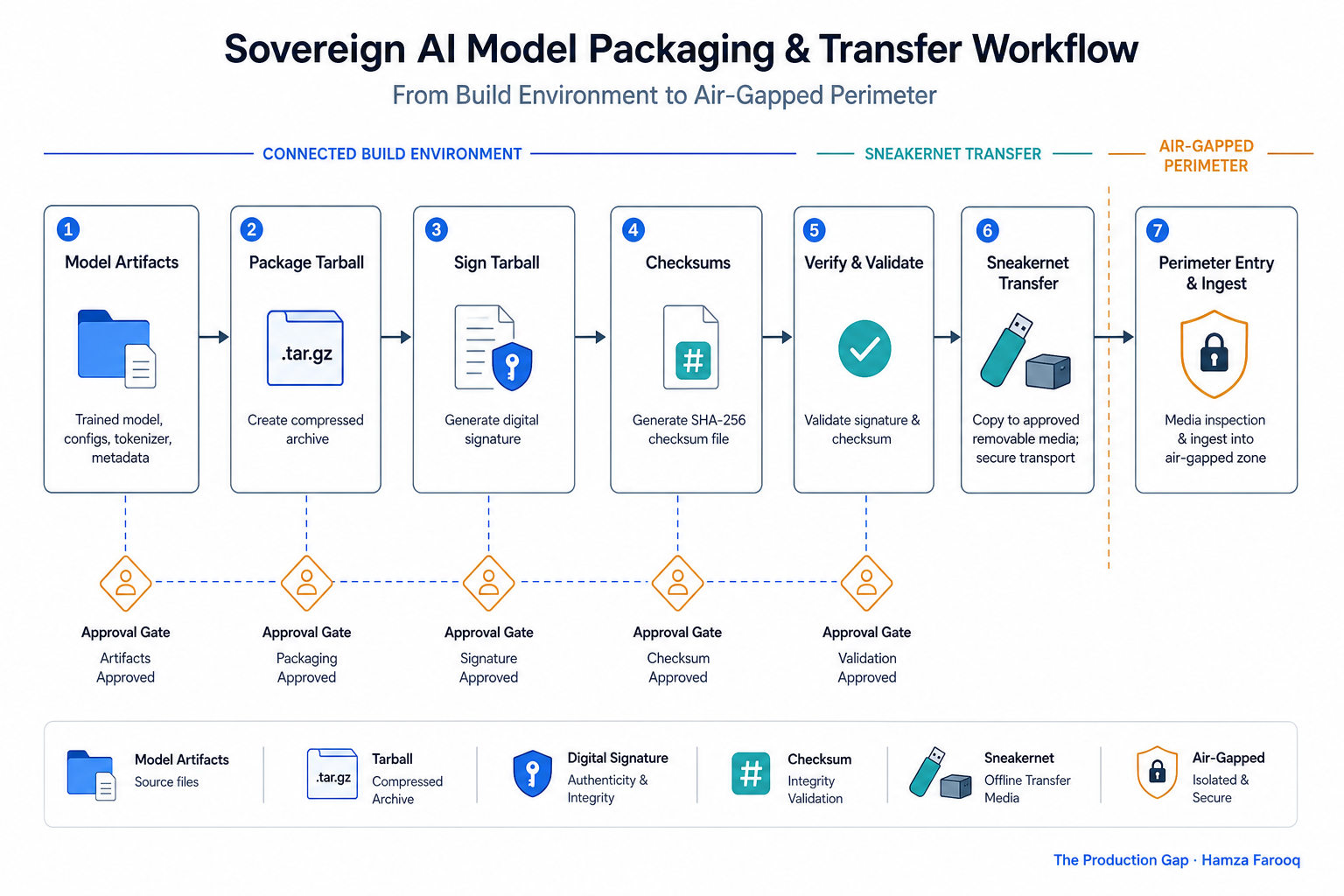
Model packaging requires signing weights, checksumming containers, and pre-bundling every dependency, PyPI packages, Conda environments, container images, and model hub artifacts, into a versioned, offline-transferable bundle before any regulated perimeter is crossed.
For model weights and containers, export checkpoints as signed tarballs with SHA-256 checksums. Use cosign for container image signing. Push every image to an internal OCI-compliant registry (Harbor is the framework used in this guide) before the transfer window closes.
For Python and Conda dependencies, run pip download and conda pack in a clean environment that mirrors the target Python version and OS exactly. Inside the perimeter, point pip to --no-index --find-links against the local bundle. Deviating from the exact environment spec causes dependency resolution to fail silently, surfacing hours into a training run rather than at startup.
For model hub mirroring, the huggingface-hub library supports fully offline snapshot downloads. Pre-download the model card, config, tokenizer, and weights as a single snapshot directory and mount it as a read-only volume inside the perimeter. The pre-perimeter packaging checklist is the release artifact for every model version. Treat it with the same rigor as the model itself.
How do you run fine-tuning and observability pipelines with zero outbound network access?
Fine-tuning an LLM inside a sovereign environment and monitoring it without outbound telemetry both require replacing every SaaS-dependent component with a self-hosted equivalent before the engagement starts, this decision cannot be deferred to post-perimeter.
For the fine-tuning pipeline, a working egress-free stack requires deliberate component selection across every layer:
- Dataset handling: Store training datasets in MinIO, versioned with DVC pointed at the internal MinIO backend.
- Compute orchestration: Kubeflow Pipelines or Argo Workflows on the client's Kubernetes cluster. Hugging Face Accelerate and PEFT for LoRA fine-tuning have no required outbound calls if the model snapshot is pre-staged.
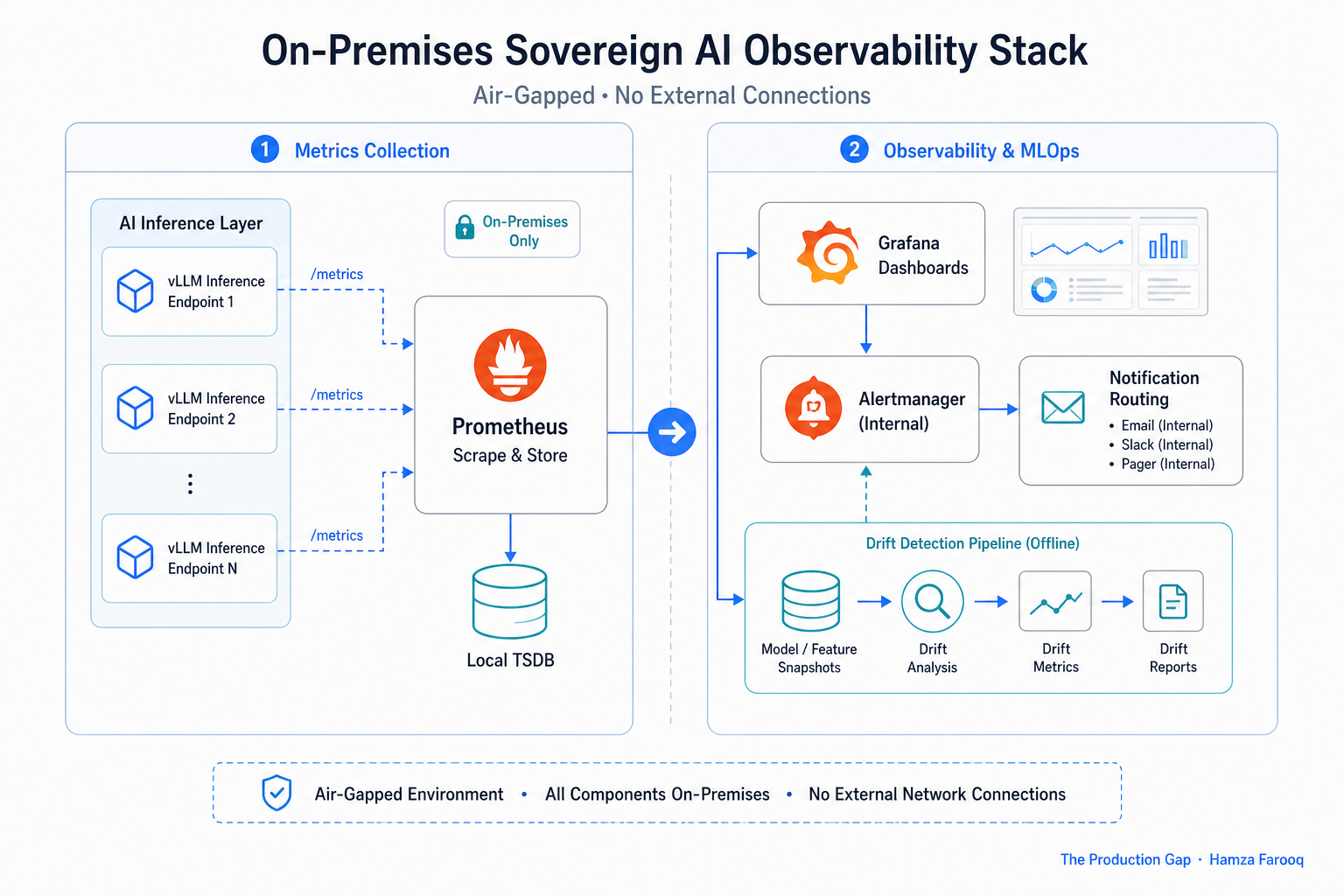
For observability without SaaS telemetry, Prometheus scrapes inference server metrics. Both vLLM and TGI expose native Prometheus-compatible endpoints, so Grafana can visualize them without custom instrumentation. Drift detection runs as a scheduled job comparing live inference distributions against baseline embeddings in an internal vector store. Sovereign AI platforms must span on-premises environments without losing governance, local observability is that governance layer.
How do you manage model version updates and rollbacks when change control boards govern every ingress point?
Model version management must be designed as a slow, gated release pipeline from day one because, in practice, regulated environments require each new version to pass security review before entering the perimeter, making rollback capability and parallel version hosting architectural requirements rather than operational conveniences.
In the framework used in this guide, run an internal model registry, MLflow Model Registry or a Harbor-backed OCI store, holding three concurrent versions: current production, previous production as the rollback target, and the candidate under change control board review. Envoy or nginx traffic routing allows version switching without redeployment. Tag every registered version with its dataset snapshot, training config, and evaluation metrics to support audit trail requirements in your target regulatory framework.
Define rollback as a traffic-weight change, not a redeployment. The previous version's containers and weights must already be resident on the cluster. If rollback requires a fresh artifact transfer through the perimeter, it is not a real rollback, pre-staging the prior version is the architectural requirement, not an optional optimization.
Frequently Asked Questions
How does sovereign AI deployment differ from a standard private cloud deployment? Sovereign AI deployment enforces strict data residency, full audit logging, and zero outbound egress, whereas a standard private cloud deployment retains internet access for registries and SaaS tooling. Every MLOps assumption built around internet connectivity fails immediately in a sovereign environment.
What is the minimum internal mirror set required before entering an air-gapped environment? The minimum internal mirror set for an air-gapped environment is four components: an OCI-compliant container registry (such as Harbor), a PyPI and Conda offline bundle, a Hugging Face model snapshot directory, and an internal object store (such as MinIO). Missing any one of these blocks a distinct phase of the ML lifecycle and cannot be resolved without a new transfer window.
Can you run RLHF fine-tuning pipelines in a fully air-gapped environment? Yes. Using Kubeflow or Argo for orchestration, PEFT and TRL for training, self-hosted MLflow for tracking, and MinIO for datasets, the full pipeline runs without outbound access. The binding constraint is compute: RLHF is GPU-intensive, and on-prem GPU capacity must be scoped and confirmed before the engagement begins.
What monitoring tooling works entirely on-premises for sovereign AI deployments? Prometheus, Grafana, Alertmanager, and a scheduled drift detection job comparing inference distributions against a stored baseline are all fully self-hostable. vLLM and TGI expose native Prometheus endpoints, which eliminates custom instrumentation on the inference layer.
Conclusion
Both patterns share the same root constraint: every tool in a modern MLOps stack assumes internet access, and that assumption fails the moment you cross a regulated perimeter. The teams that succeed are the ones who audited every outbound call before arrival, packaged every dependency before leaving their own network, and built rollback into the architecture from the start.
Build that checklist now, against your current stack, before your next regulated-industry scoping call. The ingress window will be shorter than you expect.
References
Learn from me
Forward Deployed Engineering Bootcamp for Full-Stack Developers, my Maven cohort. Build and ship complete AI products end to end, from React and Node.js frontends to deployed models with caching and observability. Join the next cohort →
Hire us
Traversaal.ai. We're a team of forward deployed engineers solving the toughest AI problems for Fortune 100 companies: document intelligence, agentic data platforms, and real-time web intelligence, deployed in production. Work with our team to deploy your next agentic ecosystem. Talk to Traversaal.ai →
Join us
Want to solve these problems with us? We're always looking for forward deployed engineers who want to ship production AI. jobs@traversaal.ai
