
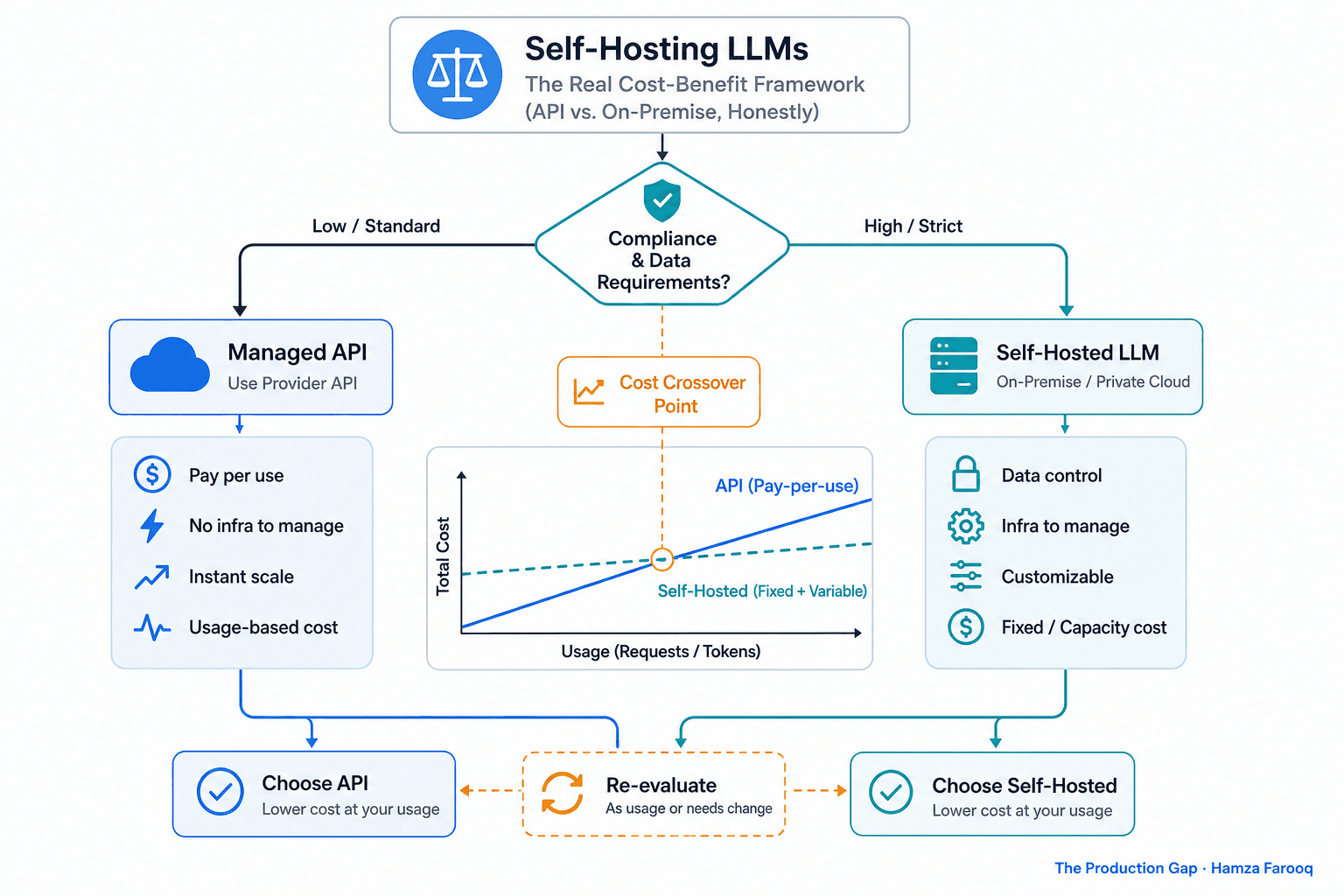
TL;DR: Self-hosting an LLM pays off, using the framework in this guide as a practical rule of thumb, once you exceed roughly 10 to 40 million tokens per day, have ML infrastructure engineers already on staff, and can justify the fully-loaded cost including labor, maintenance, and on-call coverage. Below that threshold, API pricing almost always wins. Compliance requirements can make self-hosting mandatory regardless of the math.
Key takeaways
- Compliance often decides before cost does: HIPAA, GDPR, and data residency rules can make self-hosting mandatory regardless of the economics.
- Open-weight models have closed the gap: Llama 3.x, Qwen 2.5, and Mistral match proprietary API quality on most structured business tasks.
- Hidden ops costs sink most self-hosting plans: GPU maintenance, model updates, monitoring, and on-call coverage are rarely in the spreadsheet, but they usually tip the math back toward APIs.
- API providers have responded: Batch pricing, prompt caching, and tiered plans have raised the volume needed to justify self-hosting.
- Tooling is mature, ownership is not optional: vLLM, Ollama, and llama.cpp reduce setup friction. They do not eliminate the need for someone to own the stack permanently.
The 10-40M tokens/day figure is a practical rule of thumb synthesized for this guide, not a published benchmark. Treat it as a starting point for your own fully-loaded calculation.
Introduction
Self-hosting is technically credible now in a way it was not a few years ago. Open-weight models have closed real quality gaps, and the tooling ecosystem has matured substantially. But API providers have not stood still, batch endpoints, prompt caching, and tiered pricing have all pushed the cost crossover higher than most analyses acknowledge. This framework forces you to count everything.
At what token volume does self-hosting actually beat API pricing?
As a practical rule of thumb synthesized for this guide, self-hosting begins to beat managed API pricing once you exceed roughly 10 to 40 million tokens per day, but only when engineering labor is included in the calculation, not just compute.
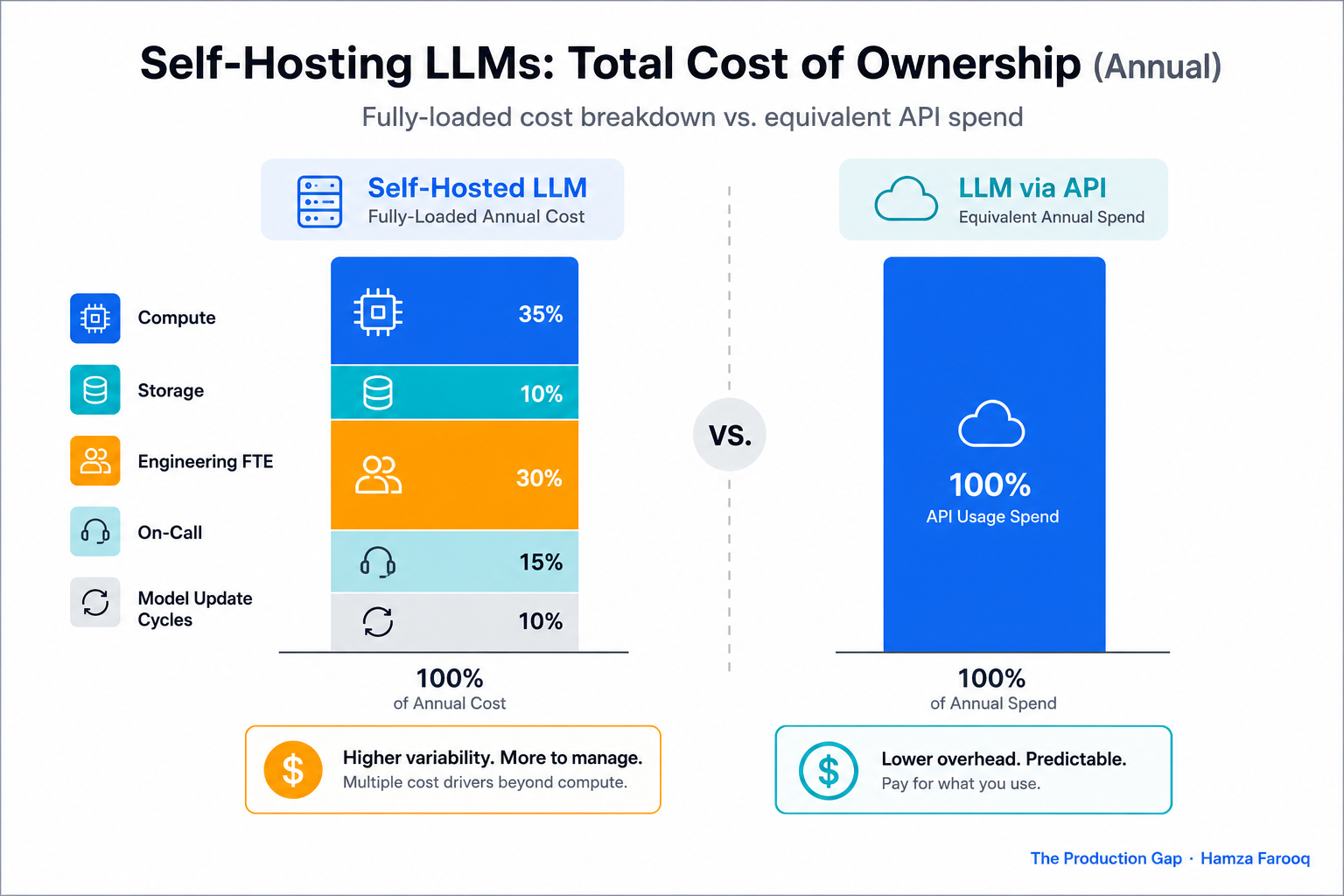
A reserved cloud GPU running 24/7 carries a fixed monthly cost. Against equivalent API spend at high token volumes, compute alone can look like a clean win. Add even one dedicated ML infrastructure engineer, and the true crossover moves much further out, especially for teams without existing ML infrastructure. The compute savings are real. The labor costs are rarely in the initial spreadsheet.
| Scenario | Monthly tokens | API cost (est.) | Self-host compute | Engineering overhead | Verdict |
|---|---|---|---|---|---|
| Low volume | Less than 50M | ~$200-500 | $1,800+ | High relative to savings | Stay on API |
| Mid volume | 100-500M | $1,000-5,000 | $2,000-4,000 | Moderate | Context-dependent |
| High volume | More than 1B | $10,000+ | $4,000-8,000 | Amortized across volume | Self-host wins |
| Compliance-blocked | Any | Disqualified | Any | Irrelevant to decision | Self-host required |
Verify against current provider rate cards. Ranges are based on publicly available infrastructure pricing and are not sourced from a single published study.
Teams running under 100M tokens per month without existing ML infrastructure staff will find the fully-loaded math difficult to make work in self-hosting's favor.
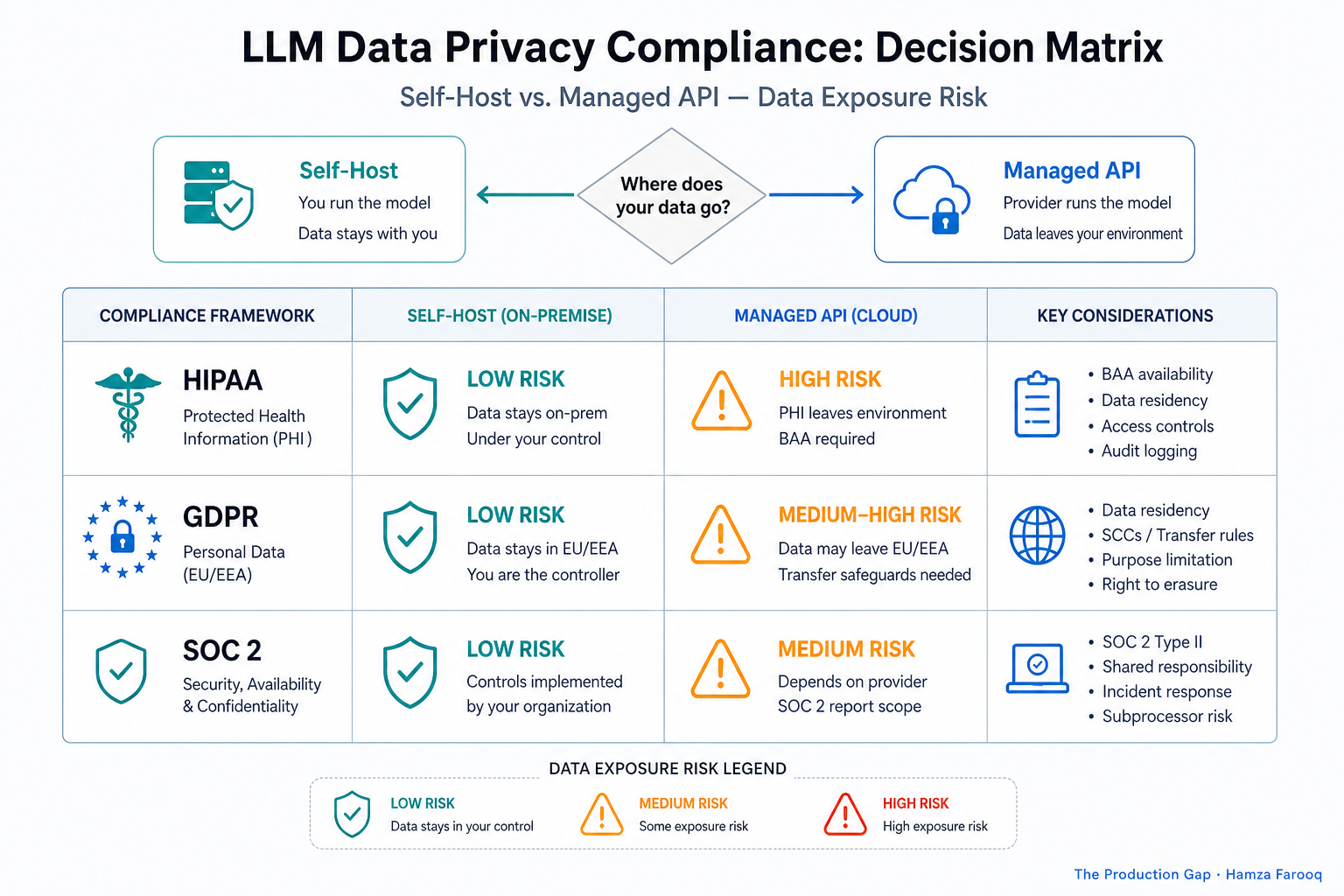
Is compliance reason enough to self-host even when the cost math does not work?
HIPAA requires that protected health information not transit vendor inference infrastructure without a business associate agreement and rigorous controls. Many API providers offer BAAs, but audit trail completeness and training data opt-out scope remain areas worth verifying with your legal team before relying on them for regulated workloads.
EU customers in regulated industries may require that data never leave a specific jurisdiction. API providers with EU endpoints still carry parent-entity access risk that many legal teams will not accept, regardless of contractual assurances. These are legal questions that should be resolved with qualified counsel using current regulatory guidance, the framing here reflects common enterprise legal team concerns, not a definitive regulatory ruling.
SOC 2 and enterprise procurement processes sometimes decide before legal does. Many security teams will not approve third-party LLM API calls for sensitive internal tooling regardless of what contracts say, and self-hosting bypasses that vendor review entirely.
Self-hosting is not a compliance posture by itself. You still need encryption at rest and in transit, role-based access controls, audit logging, and incident response documentation. Infrastructure ownership is necessary, not sufficient.
Do open-weight models actually match proprietary API quality for production tasks?
Document summarization, classification, entity extraction, RAG-based question answering, code completion, and customer-support generation are categories where open-weight models perform competitively. Models including Llama 3.1, Qwen 2.5, and Mistral variants are widely deployed for these use cases, though benchmark standings shift frequently and are worth verifying at publication time.
The more useful question is not whether open-weight models match the best proprietary APIs in the abstract, it is whether a given model is good enough for your specific task. For most mid-market production workloads, the answer is frequently yes.
What hidden operational costs do self-hosting calculators skip?
Model versioning drift. Open-weight releases come frequently. Each version requires re-evaluation, prompt regression testing, and an upgrade-or-freeze decision, a recurring cost that seldom appears in initial projections.
GPU driver and CUDA maintenance. Driver updates, CUDA compatibility issues, and inference framework alignment can break inference silently. Someone has to own this surface permanently.
On-call and incident response. If your LLM sits in a production critical path, you need on-call rotations. That cost almost never appears in self-hosting ROI models.
Expertise retention. The engineers who built the stack hold the institutional knowledge. When they leave, rebuilding costs more than most teams plan for.
Teams that succeed at self-hosting, in the experience reflected in this framework, typically had ML infrastructure engineers in place before they started. With over 148 LLM deployment tools now available, mature tooling reduces setup friction, it does not reduce the ongoing operational responsibility.
Frequently asked questions
When does self-hosting save more money than using the OpenAI or Anthropic API?
Using the framework in this guide as a practical rule of thumb, self-hosting tends to beat managed APIs once you exceed roughly 10 to 40 million tokens per day and already have ML infrastructure engineers on staff. Below that threshold, engineering overhead typically erases compute savings. Evaluate batch API pricing and prompt caching before assuming self-hosting will be cheaper, those options have raised the effective crossover point significantly.
Is self-hosting enough to satisfy HIPAA or GDPR compliance?
No. Self-hosting removes your data from third-party infrastructure, which eliminates one major risk vector. But you still need encryption, role-based access controls, audit logging, and incident response documentation. It is a necessary precondition for certain regulated workloads, not a complete compliance solution on its own. Confirm specifics with qualified legal counsel.
What tooling should I use to deploy a self-hosted LLM in production?
The ecosystem now includes over 148 services, tools, and infrastructure options for running AI locally, covering a wide range of scale and use-case needs. The choice of tool matters less than having someone who owns it long-term. Self-hosting is no longer a research-scale effort when the right model and tooling are in place.
Conclusion
Three questions decide this: Is this a compliance requirement? Do you have engineering capacity to own it long-term? Is token volume large enough that the fully-loaded math holds up?
If compliance is the blocker, self-host and build the controls properly. If you are running high token volumes with ML infrastructure staff already in place, run the fully-loaded numbers, it may well work. If you are below the 10 to 40 million tokens per day threshold synthesized in this guide and building from scratch, the breakeven is higher than it looks, and API providers have responded with pricing structures that raise it further.
Most self-hosting projects fall short not because the model was wrong, but because teams underestimated what production infrastructure ownership costs and overestimated their capacity to staff it.
Run your numbers using the table above. Add an explicit engineering line item. If the case still holds, build it. If it does not, renew your API contract and put that engineering capacity toward the product instead.
Learn from me
Forward Deployed Engineering Bootcamp for Full-Stack Developers, my Maven cohort. Build and ship complete AI products end to end, from React and Node.js frontends to deployed models with caching and observability. Join the next cohort →
Hire us
Traversaal.ai. We're a team of forward deployed engineers solving the toughest AI problems for Fortune 100 companies: document intelligence, agentic data platforms, and real-time web intelligence, deployed in production. Work with our team to deploy your next agentic ecosystem. Talk to Traversaal.ai →
Join us
Want to solve these problems with us? We're always looking for forward deployed engineers who want to ship production AI. jobs@traversaal.ai
