
As of June 2025
Key Takeaways
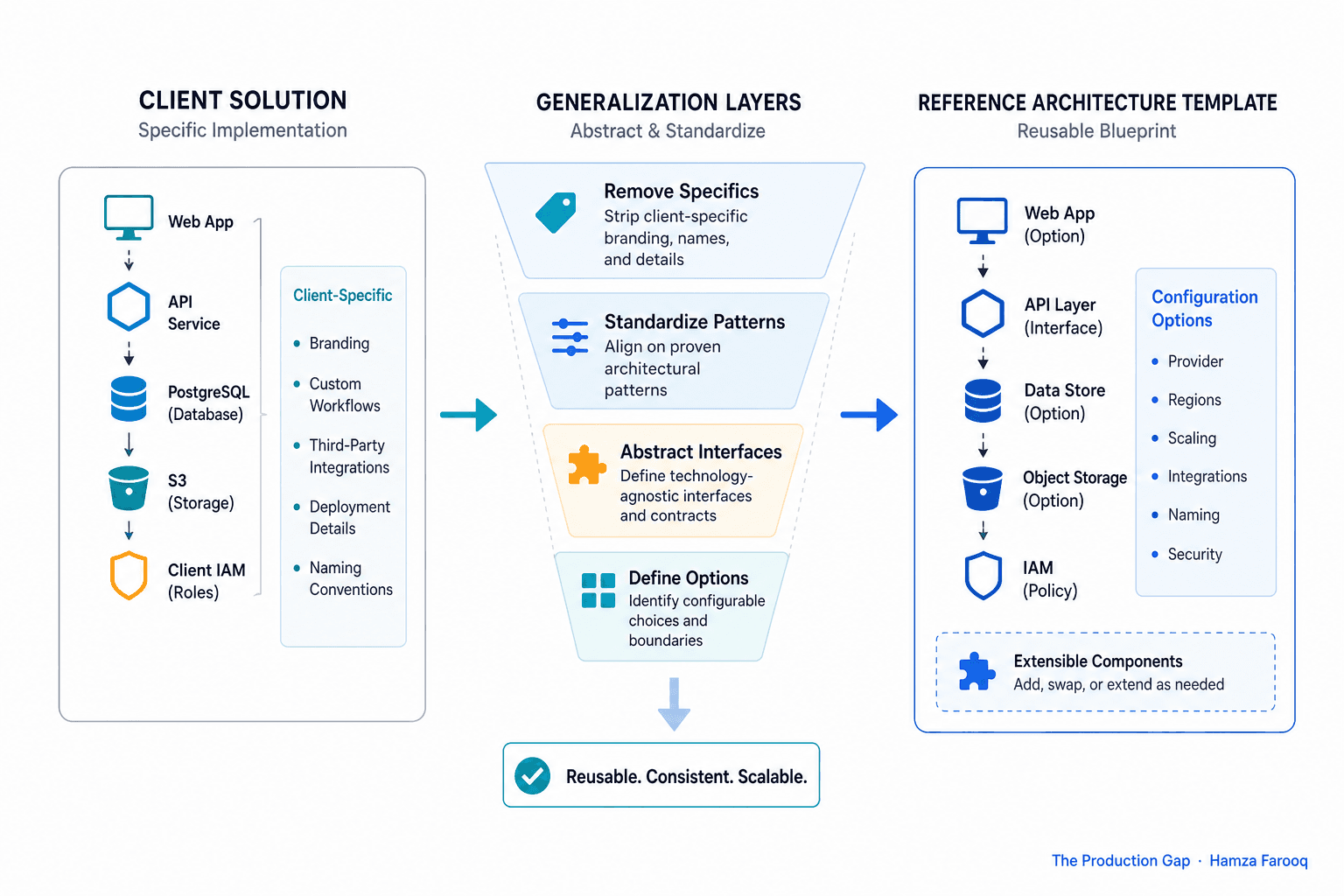
- Reference architecture differs from solution architecture: A solution architecture solves one client's problem; a reference architecture generalizes it into a repeatable pattern.
- Documentation happens during the build, not after: Teams that wait until project close lose the context that makes a template reusable.
- Every engagement is a generalization candidate: Patterns appearing across two or more deployments signal a template worth extracting.
- Governance keeps templates from becoming shelfware: Without a named owner, a versioning policy, and a retirement trigger, reference architectures go stale and engineers stop trusting them.
- Time-to-deploy proves the program works: Successive deployments on the same template should show a measurable drop in ramp time and fewer production surprises.
TL;DR: Forward-deployed engineering teams that build a structured program around reusable reference architecture templates spend less time rebuilding prior solutions and more time solving new problems. The approach requires three disciplined practices: capturing build decisions as generalized patterns in real time, assigning a named owner to each template, and defining an explicit retirement trigger. Teams that do this consistently gain an operational advantage over those that treat every engagement as a greenfield build.
Introduction
Forward-deployed engineering teams are expected to deliver production-grade environments faster and with smaller headcount than previous field generations. Each hour spent rebuilding what a prior engagement already solved is an hour the current budget does not cover. The compounding cost of repeated bespoke work is the core problem this article addresses.
What is the difference between a reference architecture and a solution architecture in an FDE context?
Solution architecture vs. reference architecture
| Dimension | Solution Architecture | Reference Architecture |
|---|---|---|
| Scope | One client, one engagement | Class of problems across clients |
| Reusability | Low (client-specific) | High (parameterized) |
| Owner | Engagement lead | Dedicated template maintainer |
| Audience | Client's engineering team | Internal FDE team |
| Lifetime | Ends with the engagement | Versioned and maintained |
How do you extract a reusable reference architecture template from a live client deployment?
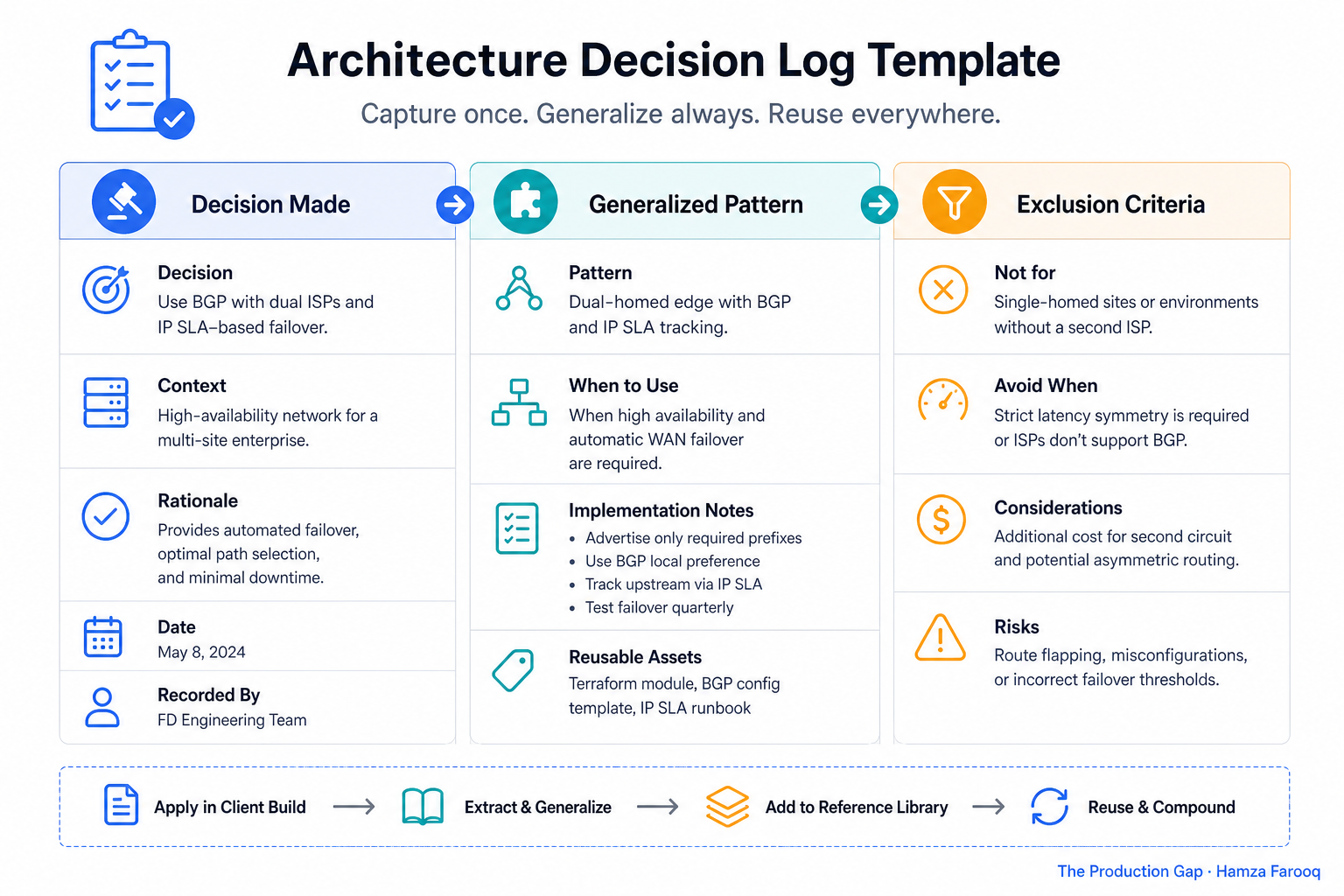
Most FDE teams treat documentation as a retrospective exercise, reconstruct what they built after the fact, and lose the rationale behind each decision. The fix, in the author's experience, is a structured decision log with three fields for every build decision:
- Decision: what was chosen and why
- Generalized pattern: the abstracted form that survives client-specific context being stripped away
- Exclusion criteria: conditions under which this pattern should not be applied
The log gets updated at the moment the decision is made, because rationale that feels obvious during the build is difficult to recover months later. In the author's view, two or more deployments making the same decision under similar constraints is a reasonable trigger to promote a decision record into a template component, though teams should calibrate that threshold against their own deployment cadence.
How do you build and govern a golden-path program that keeps reference architecture templates from going stale?
The operational mechanism the author recommends is the GROVE Framework , defined here as a standalone reference:
| Letter | Step | What it means in practice |
|---|---|---|
| G | Generalize | Strip client-specific detail; parameterize every decision point |
| R | Record | Capture rationale in real-time decision logs, not post-mortems |
| O | Own | Assign a single named maintainer per architecture domain |
| V | Version | Use semantic versioning (MAJOR.MINOR.PATCH) tied to platform breaking changes, not calendar quarters |
| E | Expire | Define a deviation threshold that triggers a MAJOR revision or retirement review |
Governance here means a monthly template review where the owner checks each template against recent deployments. As LinkedIn's reference architecture framing puts it, a reference architecture "describes a reusable architectural approach for a particular class of problems." When a class boundary shifts because a provider deprecates an API or a security standard changes, the template must change with it or become a liability. A template without an owner and a retirement trigger risks falling out of use regardless of how well it was originally built.
How do you measure whether a reference architecture accelerator program is actually reducing time-to-deploy?
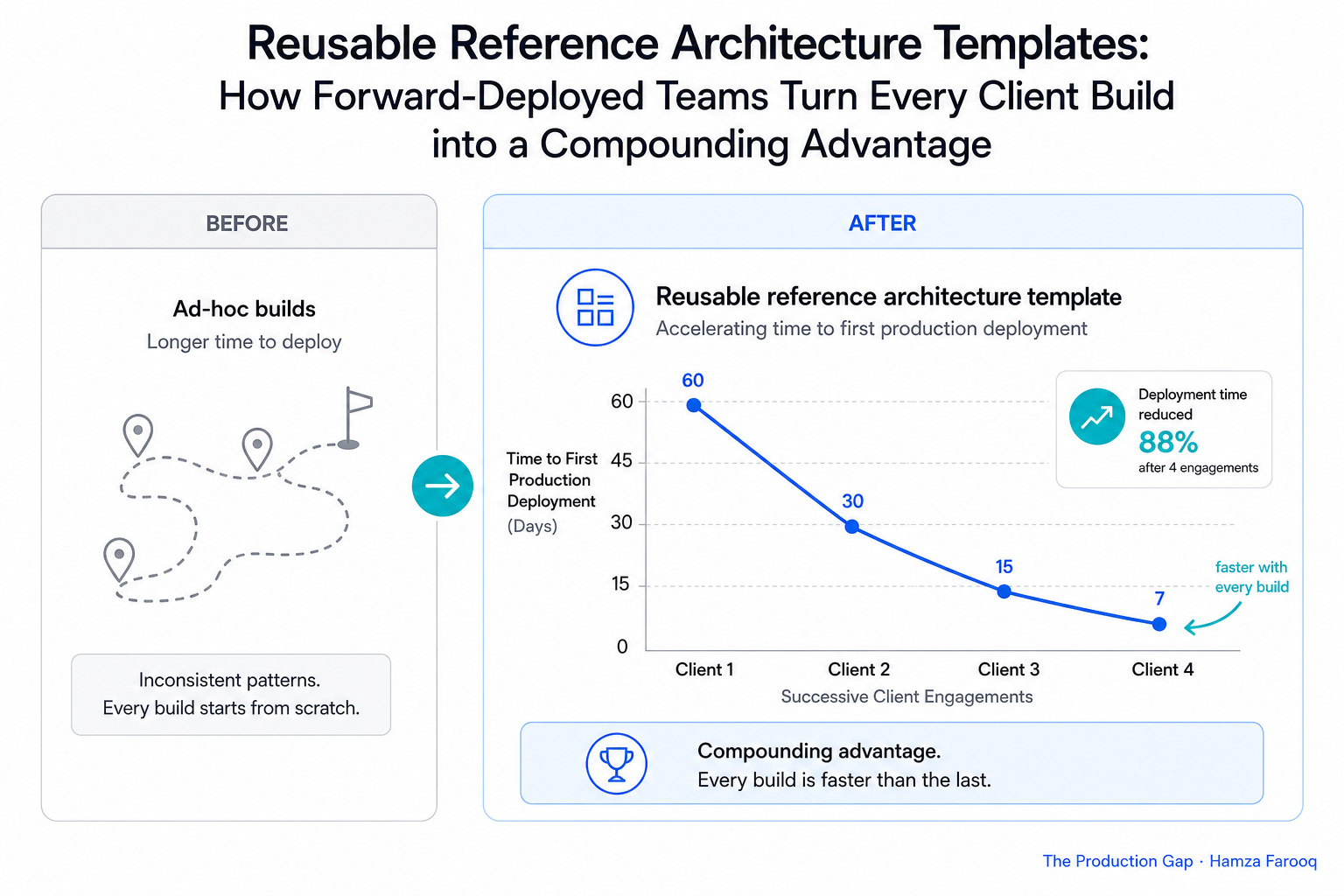
The clearest proof a reference architecture accelerator program is working is a measurable drop in time-to-first-production-deployment across successive engagements on the same template; if that number is not falling, the templates are not being used or are not fit for reuse.
Three metrics the author recommends tracking, offered here as a practical rule of thumb rather than a universal standard:
- Time-to-first-production-deployment (T2P): Baseline on engagement one and track changes across subsequent engagements. Teams should establish their own baseline to determine whether a given template is delivering meaningful compression.
- Deviation rate: The percentage of template components requiring modification during deployment. Persistent high deviation suggests the template is drifting from real-world conditions or was never fully generalized.
- Production surprise rate: Incidents in the first 30 days post-deployment attributable to architectural decisions, used here as a proxy for how well the template encoded hard-won knowledge.
Frequently Asked Questions
What is the difference between a reference architecture and a solution architecture?
A reference architecture generalizes a class of solutions into a reusable, parameterized pattern, while a solution architecture solves one specific client's problem. Packaging a solution architecture as a template without proper generalization is the most common reason template programs fail to deliver value beyond the first deployment.
How do you document a client build for architectural reuse in real time?
Update a structured decision log at the moment each build decision is made, using three fields: what was decided, the generalized pattern it represents, and the exclusion criteria for when not to apply it. Retrospective reconstruction loses the rationale that makes a template trustworthy, which is why the log must be maintained during the engagement, not after it closes.
How many client deployments does it take before a pattern is worth extracting into a template?
In the author's experience, two deployments making the same decision under similar constraints is a reasonable minimum signal that a pattern is worth formalizing. Teams should calibrate this threshold against their own deployment volume and the cost of premature abstraction, since extracting a template too early can lock in constraints that do not yet reflect a stable pattern.
How do you prevent reference architecture templates from going stale?
Apply the GROVE Framework: assign a named owner to each template, use semantic versioning tied to platform breaking changes rather than calendar schedules, and define an explicit deviation threshold that triggers a revision or retirement review. Without all three controls in place, templates accumulate drift silently and engineers route around them.
Conclusion
The golden-path problem was never a tooling problem. The real issue is knowledge decay: the loss of decision rationale between the moment a build decision is made and the moment someone tries to reconstruct it later.
The GROVE Framework (Generalize, Record, Own, Version, Expire) is the author's operational response to that problem. It is a lightweight discipline, used in this guide as a practical framework rather than a formally published standard, that compounds in value across successive engagements. Teams facing repeated client demands for complex integrations from day one have strong practical reasons to get this discipline in place early.
Audit your last three client engagements now. Count how many build decisions were recorded as generalized patterns in real time. If the answer is zero, start the decision log on the next engagement's first day, before the retrospective, before project close.
Learn from me

Forward Deployed Engineering Bootcamp for Full-Stack Developers, my Maven cohort. Build and ship complete AI products end to end, from React and Node.js frontends to deployed models with caching and observability. Join the next cohort →
Hire us
Traversaal.ai. We're a team of forward deployed engineers solving the toughest AI problems for Fortune 100 companies: document intelligence, agentic data platforms, and real-time web intelligence, deployed in production. Work with our team to deploy your next agentic ecosystem. Talk to Traversaal.ai →
Join us
Want to solve these problems with us? We're always looking for forward deployed engineers who want to ship production AI. jobs@traversaal.ai
