
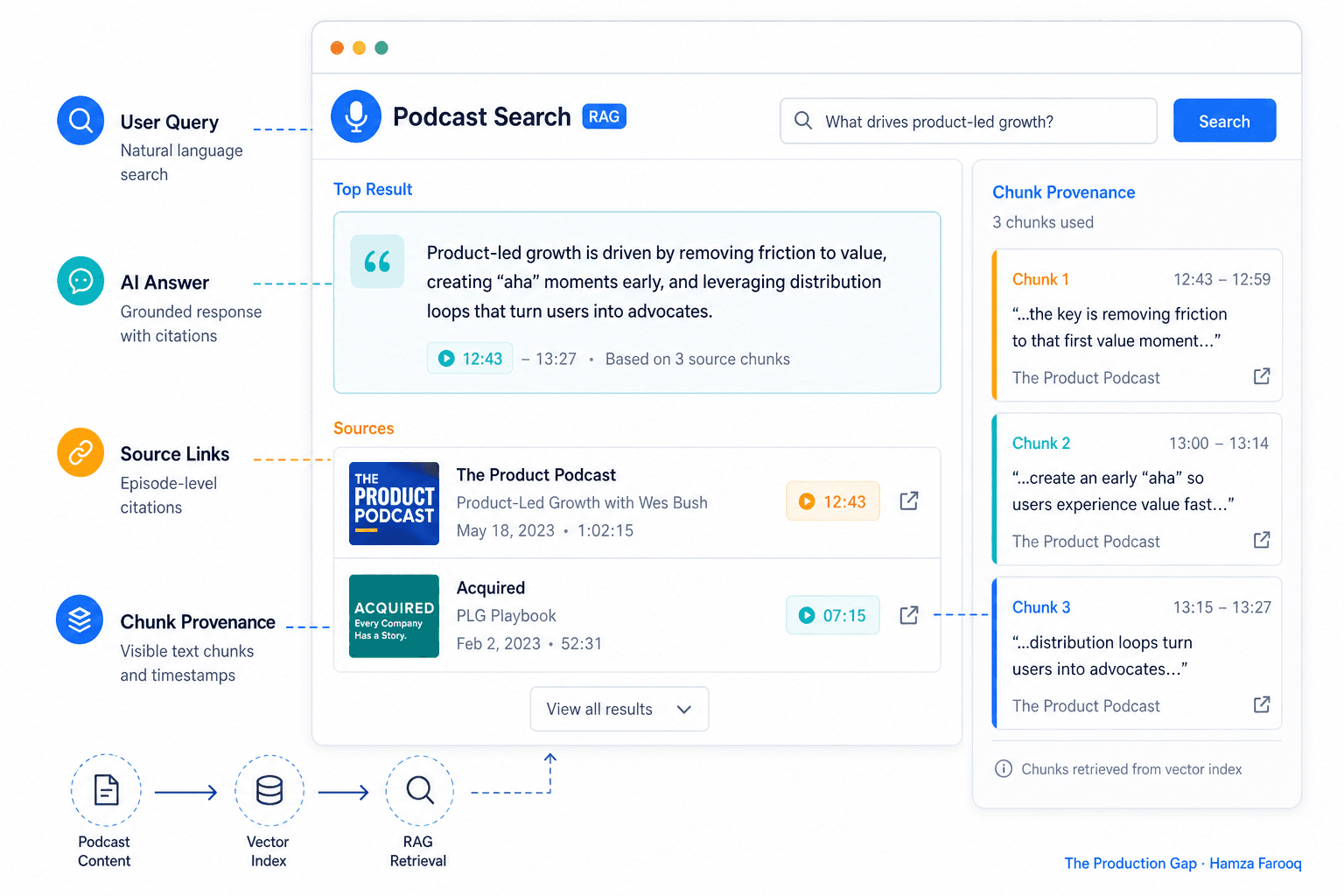
TL;DR: RAG demo best practices start with three non-negotiables: a tightly scoped archive that proves depth over breadth, visible citations that let buyers verify claims themselves, and an architecture diagram simple enough to survive a five-minute pitch. The Moment RAG podcast search engine demonstrates all three, then closes with a clear commercial path that turns a working prototype into a signed contract.
Key Takeaways
- 🎯Narrow archive beats broad pitch: A tight, verifiable dataset builds more buyer trust than promising to index everything.
- 🔗 Timestamped citations close the credibility gap: Showing exactly where an answer came from does more persuasive work than any confidence score.
- 🏗️ Architecture legibility is a sales skill: Walking a mixed room through your retrieval pipeline in plain language turns skeptics into champions.
- 🛡️ Retrieval failures are trust opportunities: Handling a bad result gracefully signals production maturity better than a suspiciously perfect run.
- 🧩 Chunking decisions shape the whole story: How you break up source content determines whether answers feel sharp or vague.
- 🚀 Name a clear next step: A specific, scoped Proof of Concept (POC) proposal converts demo energy into a deal before the room goes cold.
Introduction
Enterprise buyers have sat through hundreds of RAG demos. They've stopped being impressed, now they're stress-testing.
Most demos are still built to impress, not persuade. They hide edge cases, overpromise archive coverage, and end without a commercial ask. If your demo doesn't answer "where did this come from?", you're not in the conversation.
The Moment podcast search engine teardown below shows what a conversion-optimized demo looks like, and the design decisions behind it.
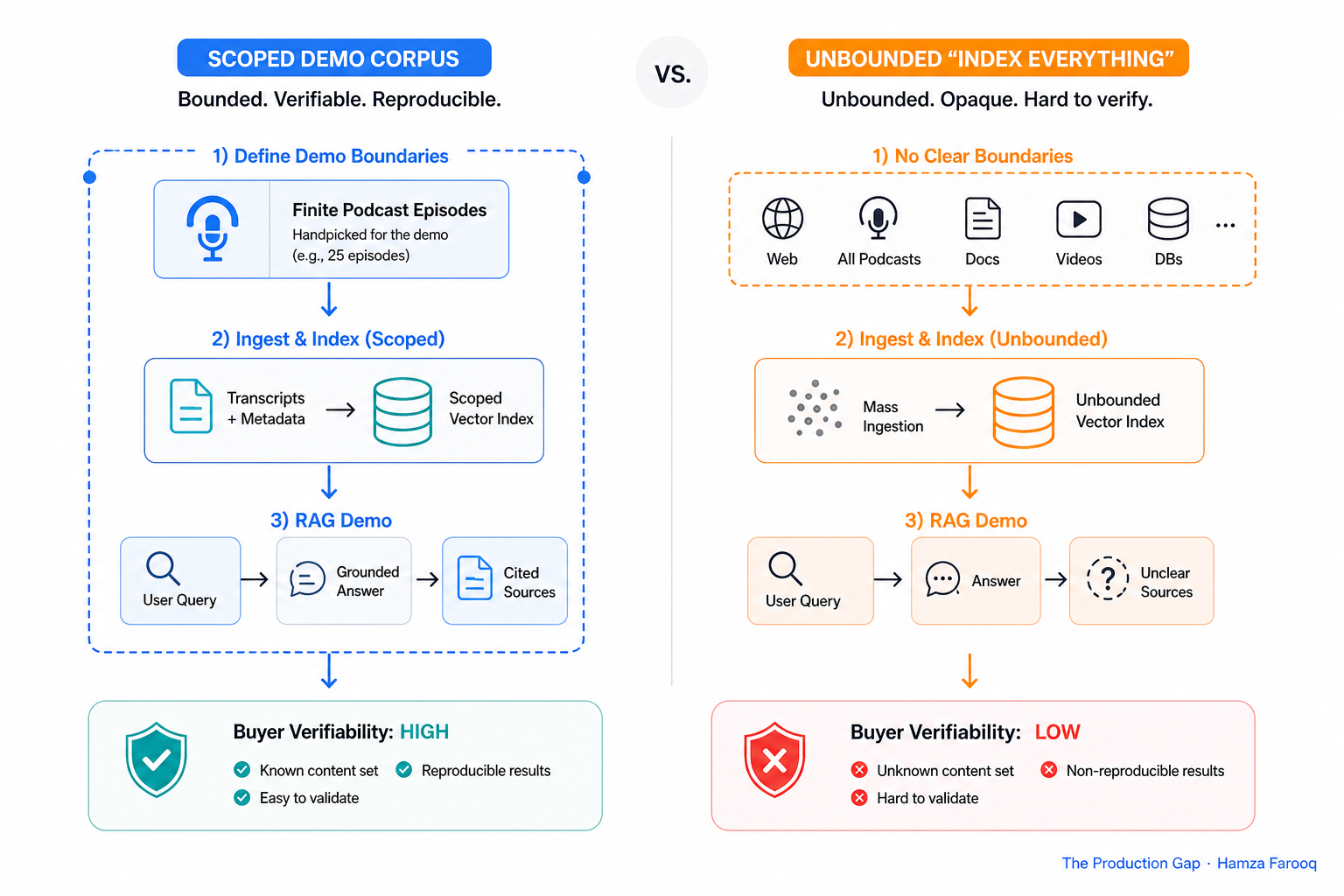
Why does scoping your demo archive to a narrow dataset build more buyer trust than a broad "index anything" pitch?
Scoping your RAG demo to a single, well-understood dataset builds buyer trust because it makes the system's knowledge boundary explicit, predictable, and verifiable.
The "index anything" pitch is a red flag. When a procurement lead can't verify what's in the archive, they assume the worst: hallucination risk, data leakage, compliance exposure. The Moment demo indexed a finite catalog of podcast episodes across a specific date range, buyers could immediately ask "did it answer from episode 47?" and get a checkable answer. That checkability is the trust signal.
The "it looks too small" objection always surfaces. The answer: narrow scope proves the pattern. A credible tight demo beats a sloppy broad one because it shows you understand your own system's limits, which is what buyers need to believe before handing you their data.
Before your next demo: Define your archive in one sentence, source name, date range, document count. If you can't, neither can your buyer.
How do timestamped, source-linked citations actually convert skeptical buyers better than retrieval accuracy benchmarks?
Timestamped, clickable citations convert better than accuracy benchmarks because they shift the buyer's trust model from "I'm told this is accurate" to "I can check this myself, right now."
Buyers don't trust confidence scores. They've seen too many demos where a 94% score preceded a confidently wrong answer. What they trust is provenance: the exact sentence, from the exact source, at the exact timestamp. The Moment demo surfaces the episode name, timestamp, and a playable audio clip link alongside every answer.
| Trust Signal | What Buyer Sees | What Buyer Thinks | Conversion Effect |
|---|---|---|---|
| Confidence score (e.g., 94%) | A number | "Who decided 94%?" | Low, abstract, unverifiable |
| Timestamped citation + source link | Episode, timestamp, clickable link | "I can check this myself" | High, self-verifiable |
| Inline chunk preview | Quoted passage | "That's where it came from" | High, transparent provenance |
| No attribution shown | Clean answer only | "Could be hallucinated" | Negative, actively erodes trust |
Every answer in your demo UI should show: source name, date or timestamp, and a direct link or quoted chunk. That verification click is the demo's most important moment, more important than the answer itself. Citations aren't a UX nicety. They're your primary trust-building mechanism.
How should you structure the architecture walkthrough in a RAG demo for a mixed technical and business audience?
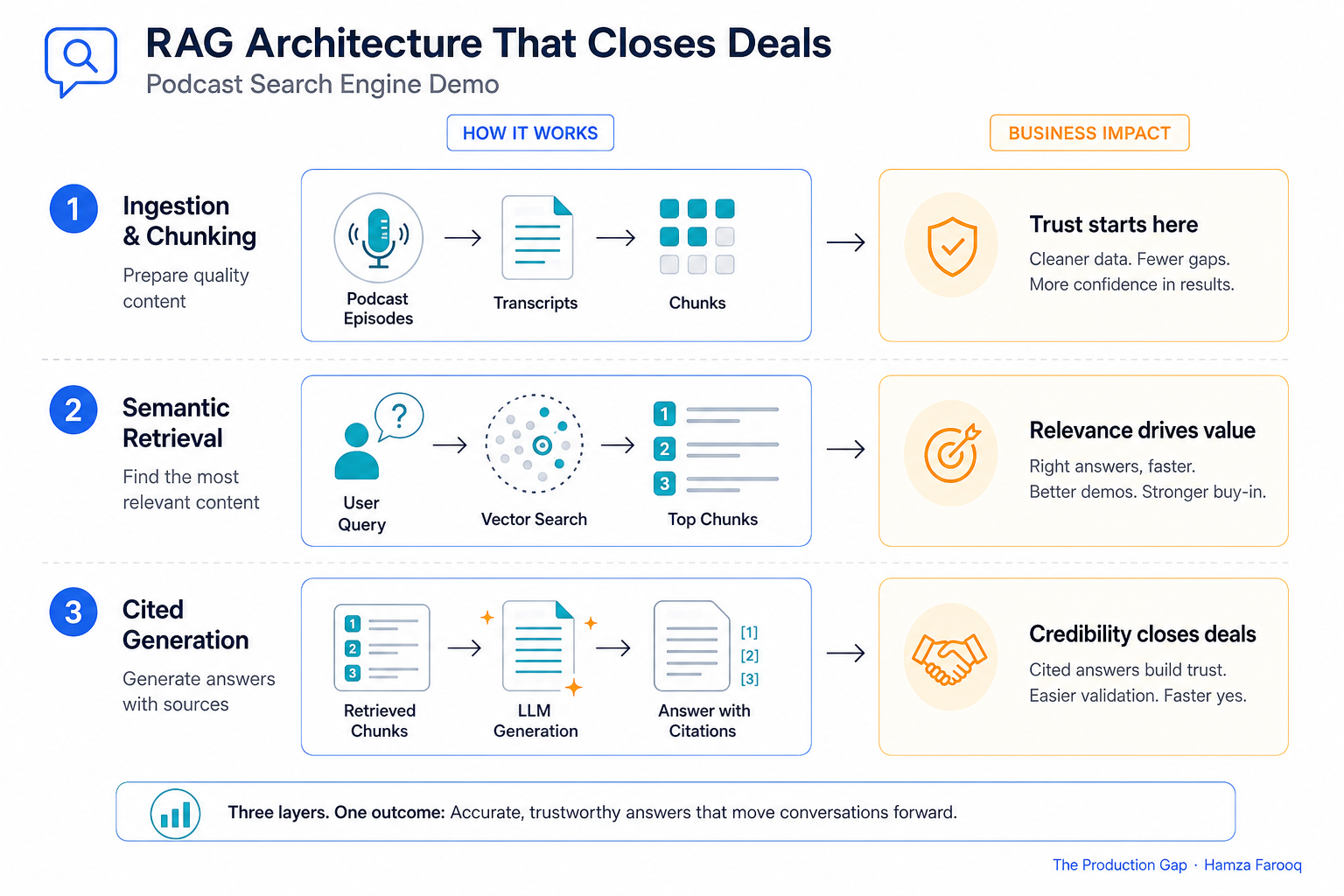
For a mixed audience, structure your RAG architecture walkthrough as a three-layer story (what goes in, how it's retrieved, what comes out) and name the business consequence of each layer before explaining the mechanism.
Lead with consequence, then mechanism. Procurement stakeholders tune out at "cosine similarity."
Ingestion layer: "We break every podcast episode into roughly 90-second segments, each independently searchable." Consequence: no answer pulls from more than 90 seconds of context, so it stays precise.
Retrieval layer: "When you ask a question, we find the three most relevant segments." Consequence: the system never invents sources, it only answers from what it finds.
Generation layer: "We ask the LLM to answer using only those segments, and show you which ones it used." Consequence: if the answer is wrong, you can trace why.
The engineer who can explain RAG to a CFO closes more deals.
What is the right way to handle retrieval failures in a live RAG demo, and why does getting this wrong kill deals?
The right way to handle a retrieval failure is to show it happening, name why it happened, and explain what the system does instead of hallucinating, because sophisticated buyers are now deliberately probing for this moment.
Experienced buyers actively probe edge cases, and when a demo runner dodges, the room reads it as a cover-up.
When the Moment demo receives a query with no strong semantic match, it surfaces: "I didn't find a strong match in the podcast archive for this question." No fabricated answer. That single design decision proves the system won't hallucinate on production data and gives the buyer a story to bring back to their CISO.
Build one deliberate failure query into every demo run. Name it out loud: "Here's what the system does when it doesn't know." That moment often generates more confidence than anything else in the session.
FAQ
What makes a RAG demo actually persuasive to enterprise buyers? Buyers have shifted from evaluating capability to evaluating trustworthiness. Show timestamped citations on every answer, handle a retrieval failure honestly, and scope the corpus to something verifiable, polished outputs with no provenance now actively raise red flags.
How do you scope a RAG corpus to maximize demo credibility without making it look like a toy? Scope by source type and date range, not by miniaturizing your production system. Two hundred well-chosen, relevant documents from a real source beats 10,000 loosely related files, someone in the room should be able to sanity-check an answer against a source they already know.
Why do chunking decisions matter so much to the quality of a RAG demo? Chunking is the invisible design decision that determines whether answers feel sharp or vague. For a podcast search engine, 60-to-120-second segments hit the right balance, specific enough to cite precisely, rich enough to answer a real question. Naming your strategy signals production maturity.
What is the right next step to pitch at the end of a RAG proof-of-concept demo? Name a scoped, time-bounded POC with the buyer's own data before the room goes cold: "We'd like to index your [document type] and run this same demo against it in two to three weeks." A vague "let's explore further" squanders the momentum a good demo builds.
Conclusion
The design decisions that close deals make the system's boundaries visible, not hidden. Narrow corpus over broad pitch. Timestamped citations over confidence scores. Plain-language architecture walkthroughs over jargon. Deliberate failure transparency over curated perfection.
The RAG infrastructure layer is commoditized, vector databases, embedding APIs, and orchestration frameworks are table stakes now. The demo is the differentiator. Build it like a trust artifact, not a technology showcase.
Your next move: Add one deliberate failure query, surface the chunk source on every answer, and re-run your demo with a procurement stakeholder this week.
Learn from me
Forward Deployed Engineering Bootcamp for Full-Stack Developers, my Maven cohort. Build and ship complete AI products end to end, from React and Node.js frontends to deployed models with caching and observability. Join the next cohort →
Hire us
Traversaal.ai. We're a team of forward deployed engineers solving the toughest AI problems for Fortune 100 companies: document intelligence, agentic data platforms, and real-time web intelligence, deployed in production. Work with our team to deploy your next agentic ecosystem. Talk to Traversaal.ai →
Join us
Want to solve these problems with us? We're always looking for forward deployed engineers who want to ship production AI. jobs@traversaal.ai
