
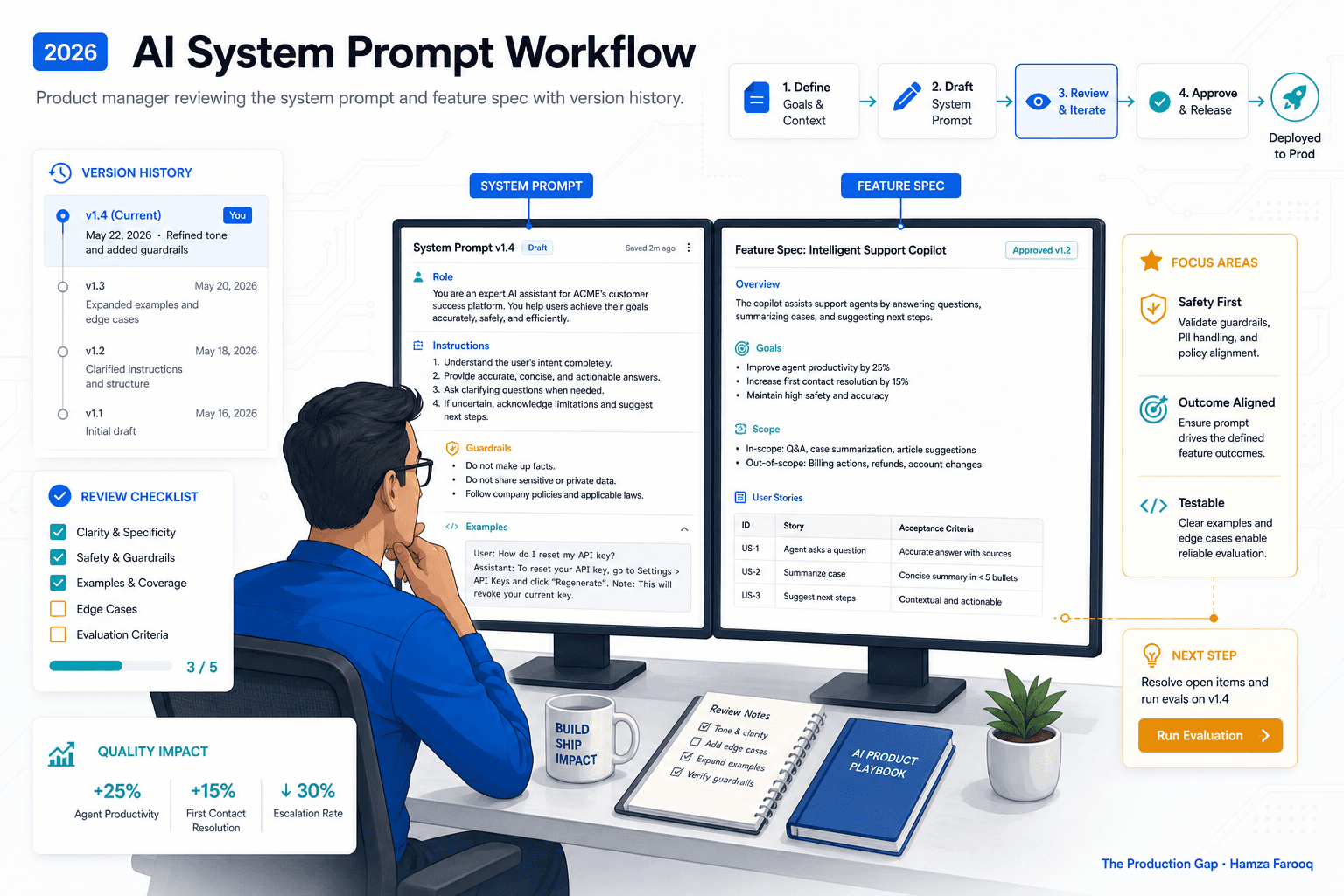
TL;DR: Prompt engineering is product management because system prompts encode core product decisions-tone, scope, guardrails, and user experience-that PMs already own everywhere else. Treating prompts as unversioned engineering afterthoughts hands those decisions to whoever last edited a config file. PMs must claim the prompt layer with formal authorship roles, review workflows, semantic versioning, and eval-based regression testing.
🔑 Key Takeaways
- 🏗️ System prompts are product decisions: Every instruction sets rules for how your product behaves, that belongs to the PM.
- 📋 Prompt ownership needs a named author: Without one, prompts get changed by whoever has access, creating silent quality and compliance risks.
- 🔢 Version your prompts like you version code: Semantic versioning lets teams know what changed, when, and why.
- 🧪 Evals are your regression tests for AI behavior: Structured evaluations catch output drift before it reaches users.
- ⚖️ How your product refuses matters legally: Under current AI regulation, declining a request is a compliance decision, not a UX preference.
- 🔗 Multi-agent chains multiply your blast radius: One poorly worded prompt can corrupt outputs several steps downstream.
Introduction
By mid-2026, embedded LLM layers ship in the majority of consumer and enterprise SaaS products. These are not experiments, they are product surfaces with real users, real consequences, and real legal exposure.
The problem: the instructions governing those surfaces, system prompts, are being written, edited, and shipped by whoever has repo access. No changelog. No named owner.
Prompt drift, when a prompt change silently shifts refusal behavior, tone, or capability claims, is a brand liability and a compliance risk. PMs can close this gap with four ownership practices, none of which require a new tool or a new headcount.
A system prompt is a product decision, so why doesn't the PM own it?
A system prompt is not a configuration file, it is a policy document that governs how your product behaves at scale, and that makes it a PM's job to own it.
The analogy that makes it land
Think of a system prompt as a customer service script stapled to a terms-of-service document. When that script lives in an engineer's repo with no PM visibility, product decisions are being made without the person accountable for product outcomes. At one company, a support copilot's escalation instruction was silently removed; it took three minutes to break and weeks to diagnose. The PM found out when Net Promoter Score (NPS) dropped.
What product decisions actually live inside a prompt
A single system prompt encodes refusal thresholds, persona and tone, scope boundaries, escalation logic, and capability claims, each with downstream consequences for UX, support load, and legal exposure. The clearest test: if a lawyer, brand manager, or customer success lead would care about a change, it is a product decision. System prompts fail that test constantly, and invisibly.
The accountability gap no one is filling
Engineering writes prompts because they have access. Legal reviews inconsistently. AI teams optimize for model metrics that don't map to business outcomes. PMs spec the feature but never see the prompt.
PMs are the only role trained to hold product quality, UX, and business outcomes simultaneously. Claiming the prompt layer isn't overreach, it's closing a gap that currently has no owner.
The four-part prompt ownership framework every AI product team needs
The most effective prompt governance assigns named ownership, enforces versioning, requires structured review, and gates releases on eval results, treating prompts with the same rigor as any other shipped product artifact.
Part 1, Assign a named prompt author for every production prompt
Every production system prompt needs a named author, the same way every feature spec does. The PM owns intent, scope, and refusal logic; engineering owns implementation; the AI team owns model-specific optimization. Build a Prompt Registry, a shared doc listing every production prompt, its PM owner, current version, last review date, and eval suite link. Set it up once, and it will immediately show you which prompts have no owner, usually most of them.
Part 2, Version your prompts like you version code
Prompt versioning means every prompt change is a tracked, reviewable commit. Use semantic versioning: major bumps (v1.0 → v2.0) for refusal or persona changes; minor bumps (v1.1) for tone; patches (v1.0.1) for typos. When a model provider quietly updates their model and your output behavior shifts, version history is the only way to tell whether the drift came from your prompt or theirs. Store prompts in Git or a purpose-built tool like PromptLayer or Weights & Biases , with commit messages explaining why the change was made, not just what.
Part 3, Build a lightweight review process with real gates
A prompt change affecting refusal logic or capability claims needs the same review as user-facing copy. PM approval covers scope, tone, and escalation changes; legal signs off on compliance-relevant refusals; everything goes through a brief async review before production. A pull request with a two-sentence summary and eval results takes ten minutes to review. The gate is not the bottleneck, the absence of one is.
Part 4, Run evals as regression tests before every prompt release
Evals are structured test suites that verify your prompt produces the outputs it's supposed to. Before any prompt ships, run it against a fixed test set covering correct refusals, accurate capability descriptions, and appropriate escalation triggers, then compare against the prior version's baseline. Tools like Braintrust and PromptFoo make this approachable for non-ML teams. A suite of 50–100 representative inputs catches output drift before users do and gives you a rollback path when model updates shift behavior you never touched.
Multi-agent architectures and the multiplying blast radius
In multi-agent systems, a single poorly written system prompt doesn't just affect one interaction, it contaminates every downstream agent that receives its output as context.
When agent A's prompt encodes a scope boundary that agent B treats as a hard constraint, one word change in A can break B in ways that are nearly impossible to debug without full version history across the chain. Individual prompt ownership isn't enough here. You need a prompt dependency map, a simple diagram showing which prompts feed which agents, so every change comes with a known list of downstream behaviors to re-evaluate.
Comparison: Ad hoc prompt management vs. PM-owned prompt governance
| Ad Hoc | PM-Owned Governance | |
|---|---|---|
| Ownership | Whoever has access | Named PM per prompt |
| Change tracking | None | Semantic versioning with commit messages |
| Review process | None | Async PR with PM and legal gates |
| Regression testing | None | Eval suite run before every release |
| Legal paper trail | None | Version history plus review sign-offs |
| Drift detection | Discovered by users | Caught in pre-release evals |
Frequently asked questions
Does this mean PMs need to write the prompts themselves? No. PMs own the decisions encoded in prompts, refusal thresholds, tone, scope, the same way they own the decisions encoded in a PRD without writing the code. Engineers and AI teams handle implementation.
What if our prompts are proprietary and legal won't let us store them in Git? Use a private repo with access controls, or a purpose-built tool like PromptLayer with role-based permissions. The mechanism matters less than the principle: every change is tracked, attributed, and reversible.
How many evals do we actually need to start? Fifty inputs covering your core use cases and known edge cases is enough to catch meaningful drift. Grow the suite as you find new failure modes in production.
What's the first thing to do this week? Build the Prompt Registry. List every production prompt, assign a named PM owner, and record the current version. That single document will show you exactly where your governance gaps are.
Prompt governance isn't a process tax. The difference between finding out your product broke from a version log versus finding out from your NPS score is, at this point, just whether someone bothered to own the prompt. Start with the registry.
Learn from me

Agentic AI for Product Managers, my Maven cohort. Learn how to design, evaluate, and ship reliable AI systems: the technical fluency PMs need to lead agentic products, no engineering background required. Join the next cohort →
Hire us
Traversaal.ai. We're a team of forward deployed engineers solving the toughest AI problems for Fortune 100 companies: document intelligence, agentic data platforms, and real-time web intelligence, deployed in production. Work with our team to deploy your next agentic ecosystem. Talk to Traversaal.ai →
Join us
Want to solve these problems with us? We're always looking for forward deployed engineers who want to ship production AI. jobs@traversaal.ai
