
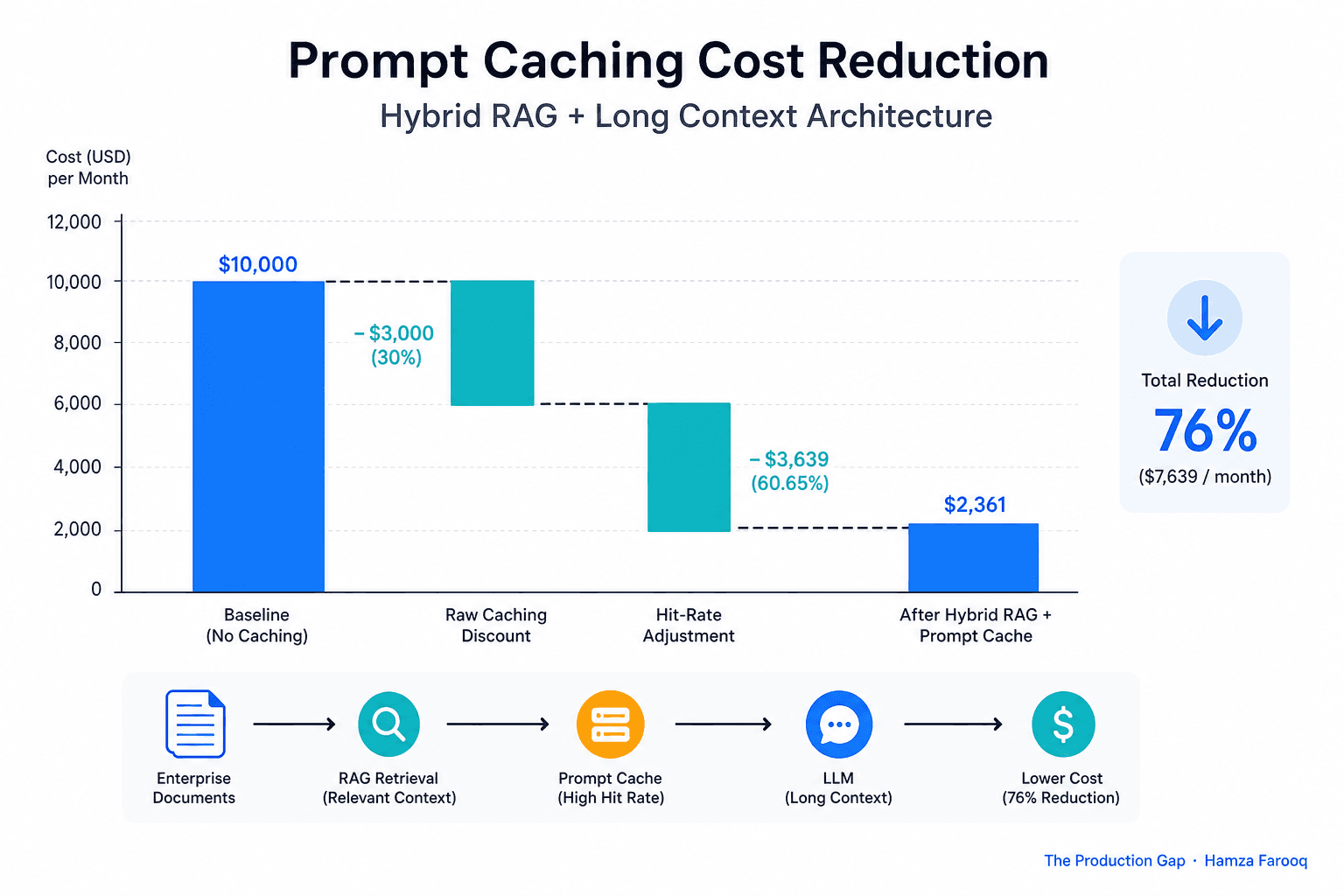
TL;DR: Prompt caching cost reduction of 76% is achievable by combining RAG with a long-context cached prefix, where a 90% discount on cached tokens at a 95% cache hit rate drops a $10,000/month document Q&A workload to roughly $2,361/month. The winning architecture routes stable, high-frequency documents into a cached prefix while reserving dynamic retrieval for volatile or rarely accessed content.
Key takeaways
- 76% bill reduction is modeled math: A 90% cached-token discount at a 95% hit rate on a token-heavy prefix projects a $10K/month workload to ~$2,361; your result depends on your hit rate and provider discount.
- Hybrid RAG + long context beats either alone: Stable documents go in a cached prefix, dynamic content goes through retrieval.
- Prefix stability is the hidden control variable: Small ordering changes kill cache hit rate entirely.
- Document tier drives architecture placement: Static policy docs belong in the prefix; live customer data belongs in retrieval.
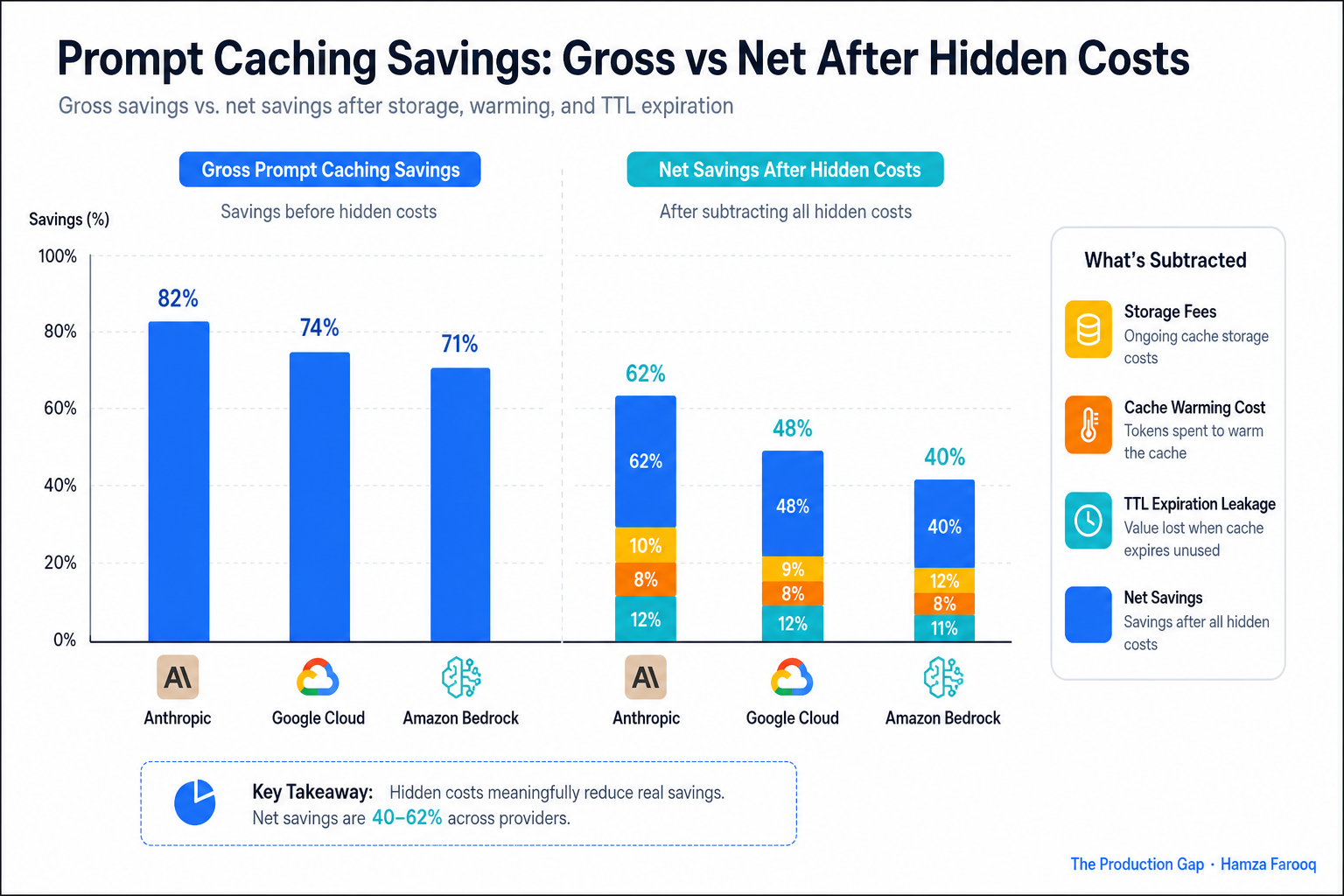
- Hidden costs eat savings: Storage fees, warming overhead, and TTL leakage can consume a meaningful share of projected savings.
Why is prompt caching changing enterprise document Q&A cost models?
Prompt caching is changing enterprise document Q&A cost models because providers now offer discounts as high as 90% on repeated input tokens, making it cheaper to lock a stable document corpus into a cached prefix than to retrieve and reprocess those tokens on every call.
Chunk-level RAG became the default because loading large corpora on every call was expensive. Caching discounts have changed that math. The winning architecture is a hybrid: stable corpus locked into a cached prefix, dynamic data routed through retrieval. The 76% reduction modeled here reflects conservative math at a 95% hit rate, your result will vary based on provider, hit rate, and token distribution.
How does the 90% cached-token discount actually translate to a 76% bill reduction?
A 90% cached-token discount reduces your total bill by 76% only when applied at a 95% hit rate against a token-heavy prompt prefix, the discount applies to most of your tokens, not all of them.
In a policy-heavy system, roughly 80% of total tokens live in the system prompt plus document corpus: $8,000/month in prefix spend. At a 95% hit rate: 0.95 × 0.10 × $8,000 = $760/month. Remaining costs (output tokens, dynamic query tokens, 5% cache misses) total roughly $1,601/month. Combined: ~$2,361/month, a 76.4% reduction.
Provider choice changes this materially. Verify whether your provider offers 50% or 90% off cached tokens before projecting savings.
Table 1: Prompt Caching Cost Model
| Scenario | Cache hit rate | Monthly cost |
|---|---|---|
| No caching (pure RAG) | 0% | $10,000 |
| Naive caching, low hit rate | 60% | $6,280 |
| Engineered prefix, high hit rate | 95% | ~$2,361 |
What determines whether a token prefix is served from cache, and how do you engineer for a 95% hit rate?
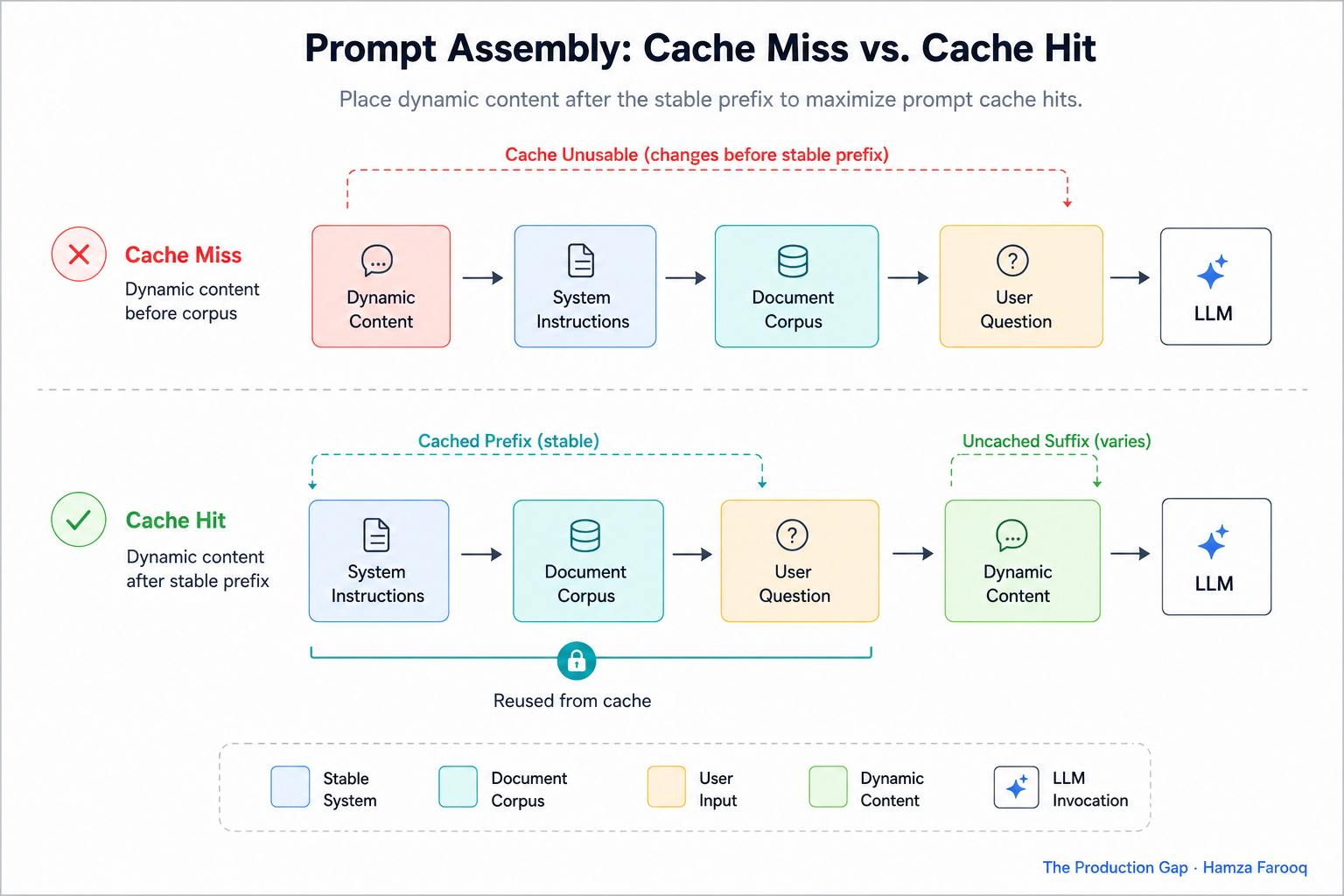
A token prefix is served from cache only when the leading byte sequence of a new request exactly matches a previously cached prefix, any reordering or dynamic injection before the document payload breaks the match and triggers full-cost recomputation.
Prefix locking is foundational: system prompt and document corpus appear first, in a fixed order, on every call. A date stamp at the top of the system prompt invalidates every cached prefix downstream of it, dynamic content belongs in the suffix.
Document ordering must be deterministic. Sort by a stable key (document ID or alphabetical) and enforce that ordering as a deployment artifact. Treat it like a database schema: changes warrant a deliberate process, not an ad-hoc tweak.
TTL management is where operational complexity lives. A cache miss after expiry pays the full input token price on a potentially very large prefix. Warm caches proactively before TTL expiry rather than reactively on the first cold miss.
Which document tiers belong in the cached prefix versus the retrieval layer?
Documents that change less frequently than your cache TTL belong in the cached prefix; documents that change more frequently or are user-specific belong in the retrieval layer.
Table 2: Document Tier Architecture
| Document tier | Churn rate | Example | Placement |
|---|---|---|---|
| Tier 1: Static corpus | Weeks to months | HR policy docs, legal contracts | Cached prefix |
| Tier 2: Slow-moving reference | Days to weeks | Pricing tables, regulatory guidance | Cached prefix with TTL-aware warming |
| Tier 3: High-churn operational | Hours to days | Customer records, live inventory | RAG retrieval layer |
| Tier 4: User-specific | Per-session | Session context, personalization | Dynamic suffix only |
Tier 1 and Tier 2 are where the amortization dividend lives. Placing Tier 3 or Tier 4 content in the cached prefix destroys hit rate and introduces staleness and data isolation risks. The break-even threshold shifts by provider discount rate, pure RAG retains its cost advantage below a certain hit rate.
What are the hidden costs that offset your prompt caching discount?
Storage fees, cache warming overhead, and TTL expiration costs are real line items that can offset a meaningful share of projected savings if not modeled before deployment.
Storage fees are the most underestimated risk. Google Cloud's model charges for cached token storage in ways that surprised practitioners at scale, with documented cases of costs increasing materially for large-corpus workloads. Model storage cost as a function of corpus size, active cache slots, and retention window before committing to a provider.
Cache warming overhead is a real operational expense: cold starts and post-TTL expiry pay full input token price on the entire prefix. Build proactive warming into your operational model.
TTL expiration leakage hits variable-traffic systems hardest. If query volume drops overnight, caches expire and the subsequent surge pays full price until warm again. Model this as a daily cold-start tax proportional to your TTL window and peak-to-trough traffic ratio.
Frequently asked questions
What is the break-even cache hit rate where prompt caching becomes cheaper than RAG? It shifts based on your provider's cached-token discount rate, so run the break-even math against your specific pricing before assuming caching wins.
How do you structure a document corpus to maximize cache hit rate without exceeding context window limits? Sort documents by a stable, deterministic key, freeze that ordering as a deployment artifact, and audit total corpus token count against your provider's cache-eligible ceiling, anything over that limit routes to retrieval regardless of churn rate.
What is the biggest mistake teams make when first implementing prompt caching? Injecting dynamic content (timestamps, user IDs, session variables) before the document corpus, which collapses hit rate toward zero, move every dynamic element to the suffix and lock that structure.
Conclusion
The hybrid RAG + cached prefix architecture reduces enterprise document Q&A costs by up to 76% by applying a 90% cached-token discount to the stable majority of prompt tokens, modeled here against a $10,000/month baseline at a 95% hit rate.
The decision that matters is not "RAG versus long context", it is "what is my cache hit rate on the expensive prefix, and have I structured my prompts to protect it?" The hybrid pattern captures the input token amortization dividend without pure long-context risk, but it requires prefix discipline, tiered document placement, and honest accounting of storage and TTL costs.
Teams still paying full price mostly haven't revisited cost assumptions built before caching was widely available. Run your current prompt through a token counter, calculate what percentage lives in a stable repeatable prefix, and apply the cost model above to your actual provider pricing.
Learn from me

Agent Engineering Bootcamp: Developers Edition, my Maven cohort. Advanced agentic RAG, multi-agent orchestration, memory, evals, and guardrails. Take agents from prototype to production. Join the next cohort →
Hire us
Traversaal.ai. We're a team of forward deployed engineers solving the toughest AI problems for Fortune 100 companies: document intelligence, agentic data platforms, and real-time web intelligence, deployed in production. Work with our team to deploy your next agentic ecosystem. Talk to Traversaal.ai →
Join us
Want to solve these problems with us? We're always looking for forward deployed engineers who want to ship production AI. jobs@traversaal.ai
