
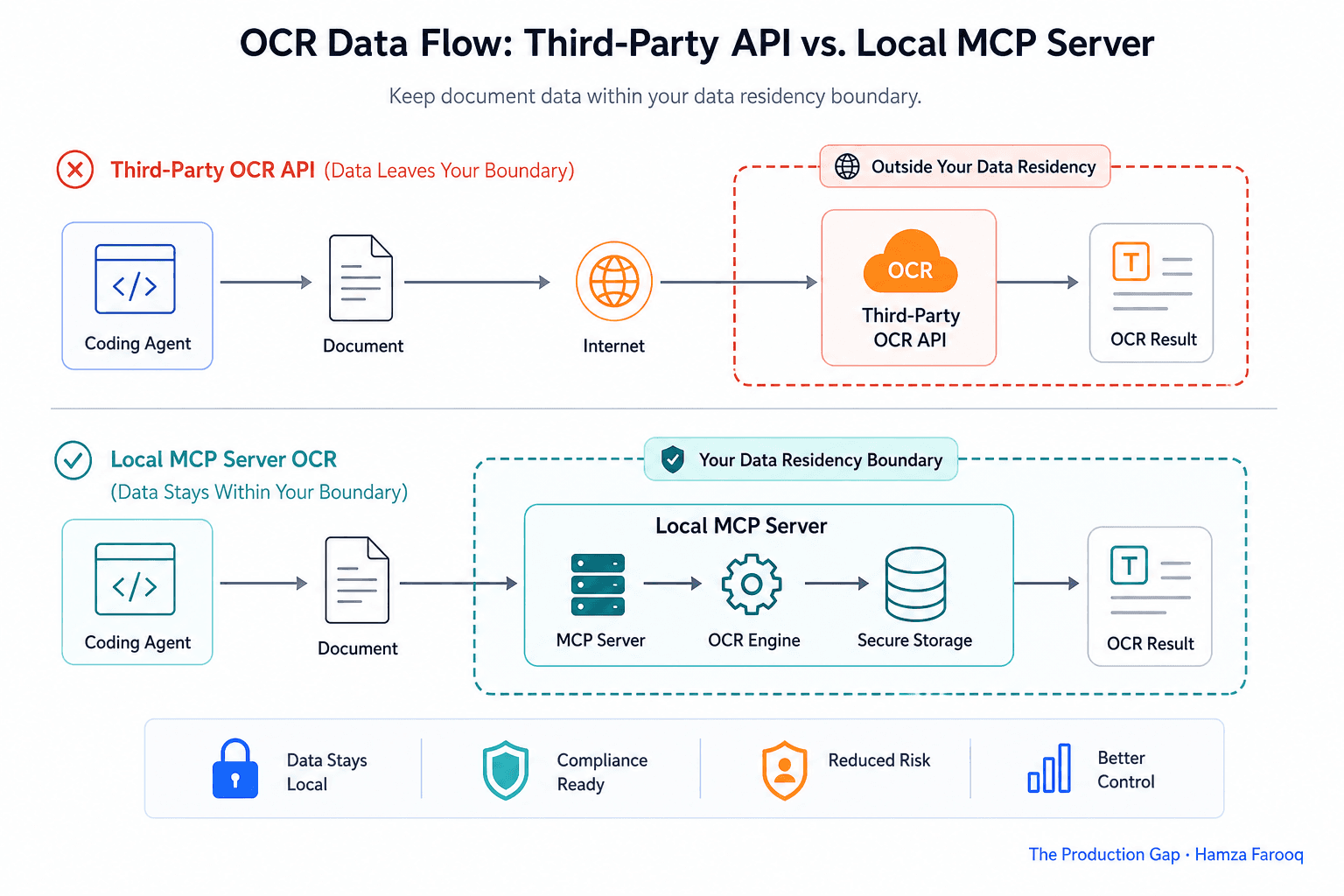
TL;DR: Private OCR enterprise compliance requirements, including data-residency mandates, HIPAA, and GDPR, are pushing teams to move document intelligence off third-party APIs and onto locally-hosted MCP servers so sensitive files never leave the corporate network. The shift is fundamentally an integration-surface decision: where extraction runs and how it is exposed to internal tooling, not which underlying model performs the extraction.
TL;DR: Private OCR enterprise compliance requirements, especially data-residency mandates, HIPAA, and GDPR, are pushing teams to move document intelligence off third-party APIs and onto locally-hosted MCP servers so sensitive files never leave the corporate network. The shift is fundamentally an integration-surface decision: where extraction runs and how it is exposed to internal tooling, not which underlying model performs the extraction.
What You Will Learn
- Why third-party OCR API calls create compliance exposure that BAAs and DPAs often fail to cover at the contractual level.
- Why choosing a private OCR model and choosing a private OCR integration architecture are two separate decisions, and why conflating them leads teams to solve the wrong problem first.
- How running OCR locally via an MCP server changes your SOC 2 Type II vendor risk scope and data-residency posture in practical terms.
- What a compliant local MCP OCR deployment looks like in an agentic coding pipeline.
Introduction
MCP is now standard plumbing for wiring tools to coding agents, and a compliance problem has been building underneath it. Every agent call to a third-party OCR API fires a data egress event that most BAAs and DPAs do not explicitly cover. The HHS Office for Civil Rights enforces HIPAA, and any undocumented data-handling touchpoint is immediately high-stakes as of 2026. The core issue is not which OCR model you pick. It is where you put the integration surface.
Why Does Sending Documents to a Third-Party OCR API Create a Compliance Gap That BAAs and DPAs Do Not Cover?
A BAA and DPA gap is the real risk when you route documents through a third-party OCR API: not the model quality, not the vendor's reputation, but the contractual boundary the API call silently crosses.
A BAA covers a defined Business Associate performing a defined function. An ad-hoc OCR API call invoked dynamically by a coding agent falls outside that scope by definition. The same logic applies to GDPR DPAs: when an agent processes raw intermediate representations, including bounding-box coordinates, confidence scores, and partial text buffers, those are PHI or PII in transit to an uncontrolled processor, not the final output your legal team negotiated around. Surviving an HHS OCR audit requires correct protocols at every data-handling touchpoint, and ad-hoc API calls are the undocumented gap that surfaces first in audit reviews. The compliance problem is in the contractual boundary the API call crosses, not in the OCR model itself.
What Specific Regulations Restrict Sending Document Content to External OCR APIs?
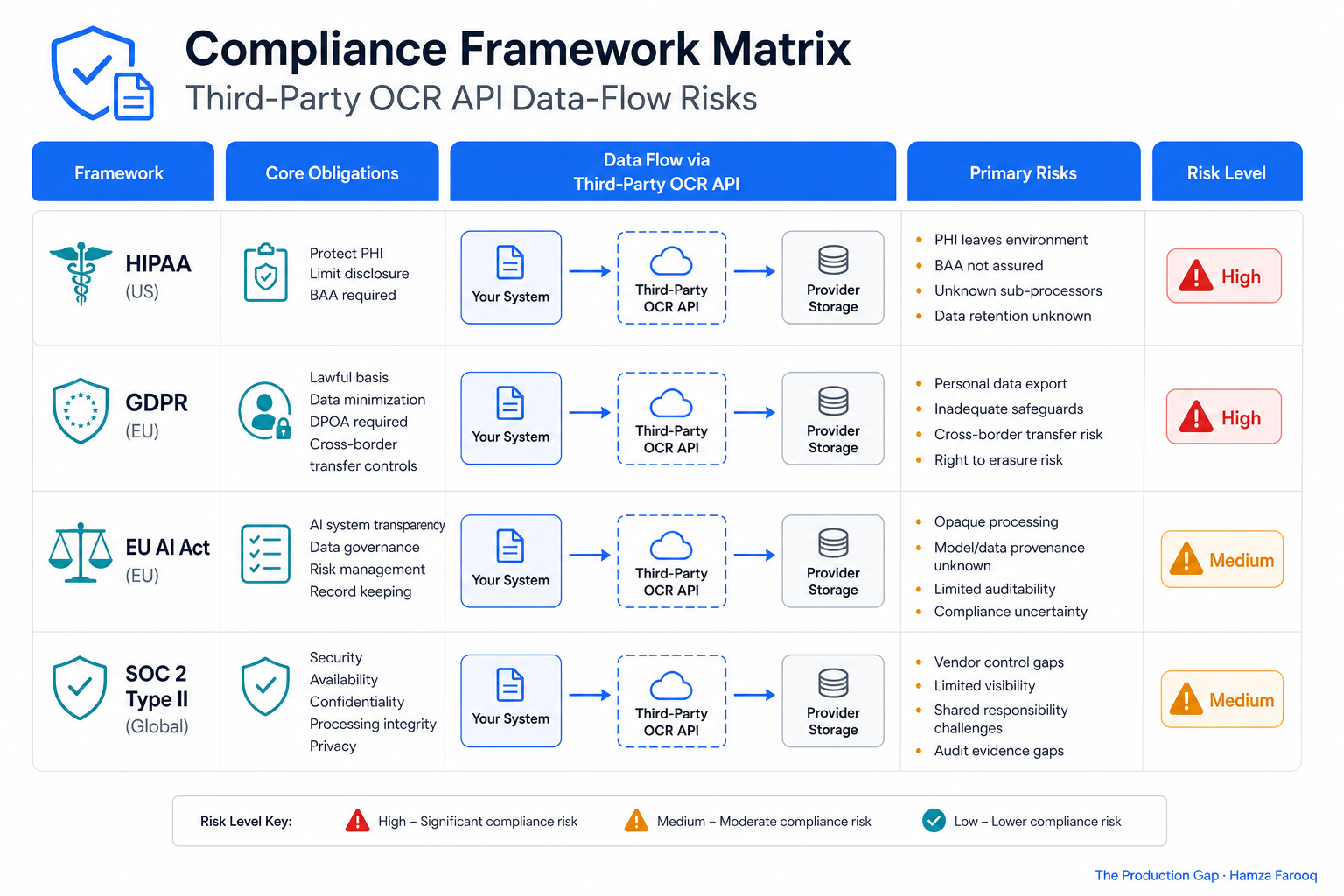
HIPAA, GDPR, and the EU AI Act each impose distinct but overlapping obligations that restrict or complicate routing PHI or PII through third-party OCR APIs, especially when the consumer is an autonomous coding agent. The table below reflects the author's synthesis of how each framework applies to agentic OCR pipelines as of 2026.
Table 1: Regulatory Gaps Created by Third-Party OCR APIs in Agentic Pipelines, 2026
| Regulation | Key obligation triggered | Gap created by third-party OCR API |
|---|---|---|
| HIPAA | BAA required for every PHI processor | Ad-hoc API calls fall outside BAA scope |
| GDPR | Sub-processor chain disclosure required | Dynamic API calls go undocumented in DPA |
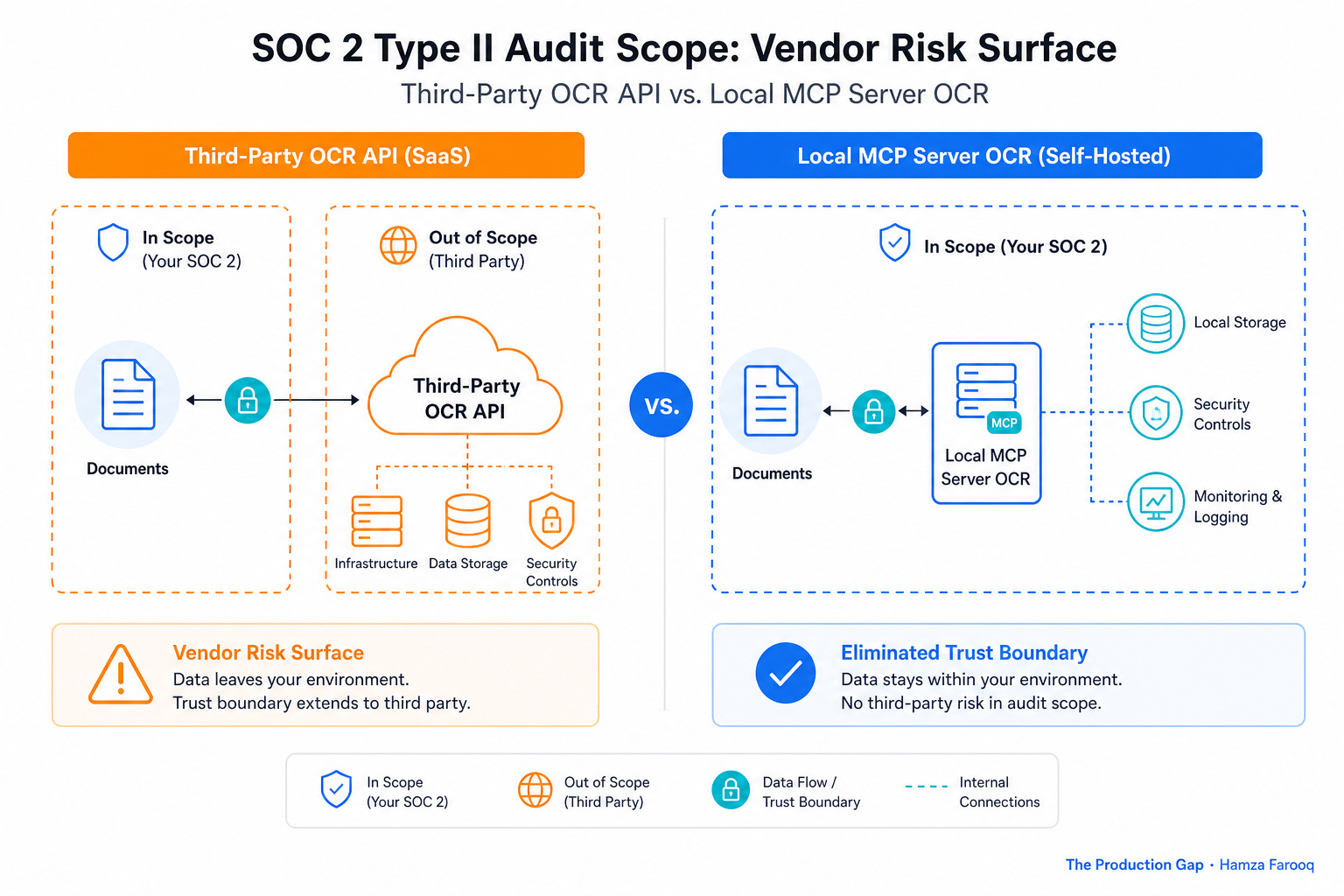
| SOC 2 Type II | Vendor risk management scope | Third-party API introduces an uncontrolled trust boundary into the vendor inventory |
On the EU AI Act specifically: document-processing pipelines may fall within its high-risk scope depending on application domain. Whether a given pipeline qualifies is a legal determination, not a technical one, and teams should treat that question as unresolved until their legal counsel reviews it against the August 2026 effective date for high-risk provisions.
Private OCR Model vs. MCP Integration Architecture: What Is the Difference?
An open-source OCR model called through a third-party hosted inference endpoint reintroduces the same compliance exposure as any SaaS API. The model is the engine. The MCP server determines whether document data travels over your private infrastructure or an external one. Compliance cares about the road, not the engine.
Once you decide to run OCR locally, you expose it to your coding agent via a local MCP tool endpoint. No external API call is required, and no document bytes leave your controlled infrastructure. Agentic OCR solutions like LlamaParse are already evaluated for enterprise production use cases including dense manufacturing specs and nested tables. As a practical rule of thumb used in this guide: solve the integration surface problem first, then select the model that fits within that boundary.
How Does Running OCR Locally via an MCP Server Change Your SOC 2 Type II Audit Scope and Data-Residency Posture?
Running OCR locally through an MCP server removes a third-party vendor from your data-flow diagram entirely, which shrinks your SOC 2 Type II vendor risk scope and eliminates the sub-processor disclosure gap in your GDPR DPA.
For data residency, documents either leave your jurisdiction or they do not. There is no mostly-private configuration that satisfies data sovereignty requirements. Audit logging, access controls, and data-at-rest encryption are only enforceable when processing stays inside your audit boundary. The SOC 2 Type II characterization above reflects the framework used in this guide for scoping vendor risk; your specific audit scope will depend on your controls environment and auditor interpretation.
Key Takeaways
Third-party OCR APIs create compliance exposure: Every document sent externally is a potential uncontrolled data egress point that appears as an undocumented processor gap in audit reviews.HIPAA, GDPR, and the EU AI Act are the forcing functions as of 2026: Real enforcement is pushing enterprises to rethink how document content moves through AI pipelines, particularly with EU AI Act high-risk provisions taking effect in August 2026.MCP servers solve the integration problem, not the model problem: Choosing a private OCR model and choosing how to expose it to a coding agent are separate decisions most teams conflate.Local OCR plus MCP is production-ready: Agentic OCR tooling is now evaluated for enterprise production use cases including dense specs and complex document structures.BAA and DPA gaps are the audit trigger: These agreements often do not cover intermediate document representations processed by third-party OCR vendors at runtime.Data residency stays intact when OCR runs locally: Sensitive content never crosses a boundary your compliance team cannot control.
Frequently Asked Questions
What is the difference between OCR the technology and OCR the regulatory body in enterprise compliance discussions?
Optical character recognition extracts text from images and PDFs. The HHS Office for Civil Rights enforces HIPAA. They share the acronym. Teams building document AI pipelines face both simultaneously: the technology choice, and the audit risk from the enforcement body that shares its name. Assuming an OCR compliance discussion is about character recognition rather than federal enforcement is a mistake with real operational consequences.
Does running a third-party OCR API inside my own VPC make it compliant for PHI processing?
No. Routing document bytes to an external service endpoint crosses your controlled boundary even within a VPC, invalidating BAA and data-residency compliance. Document bytes leave your controlled boundary the moment your agent sends them to an external service, regardless of your VPC perimeter. OCR processing must run inside your controlled boundary to satisfy BAA and data-residency requirements.
How do you expose a locally-hosted OCR engine to a coding agent using an MCP server?
Run your OCR model as a local service, wrap it in an MCP server exposing a process_document tool, and your coding agent calls that tool via MCP, receiving structured extraction results without sending raw document bytes to any external endpoint.
Conclusion
Engineering teams routinely wire agents to third-party OCR APIs for speed, then legal finds the DPA gap, infosec flags it in the next audit, and remediation follows. Moving OCR behind a local MCP server breaks that cycle, not because local models are inherently better, but because local deployment removes the external trust boundary that HIPAA, GDPR, and the EU AI Act each treat as a distinct regulatory exposure point as of 2026.
Audit one agentic pipeline this week. Trace every document and ask: does it cross a trust boundary your BAA or DPA explicitly covers? If not, that is your starting point. The compliance cost of leaving that question unanswered is higher than most teams realize until an auditor asks it for them.
Learn from me
Forward Deployed Engineering Bootcamp for Full-Stack Developers, my Maven cohort. Build and ship complete AI products end to end, from React and Node.js frontends to deployed models with caching and observability. Join the next cohort →
Hire us
Traversaal.ai. We're a team of forward deployed engineers solving the toughest AI problems for Fortune 100 companies: document intelligence, agentic data platforms, and real-time web intelligence, deployed in production. Work with our team to deploy your next agentic ecosystem. Talk to Traversaal.ai →
Join us
Want to solve these problems with us? We're always looking for forward deployed engineers who want to ship production AI. jobs@traversaal.ai
