
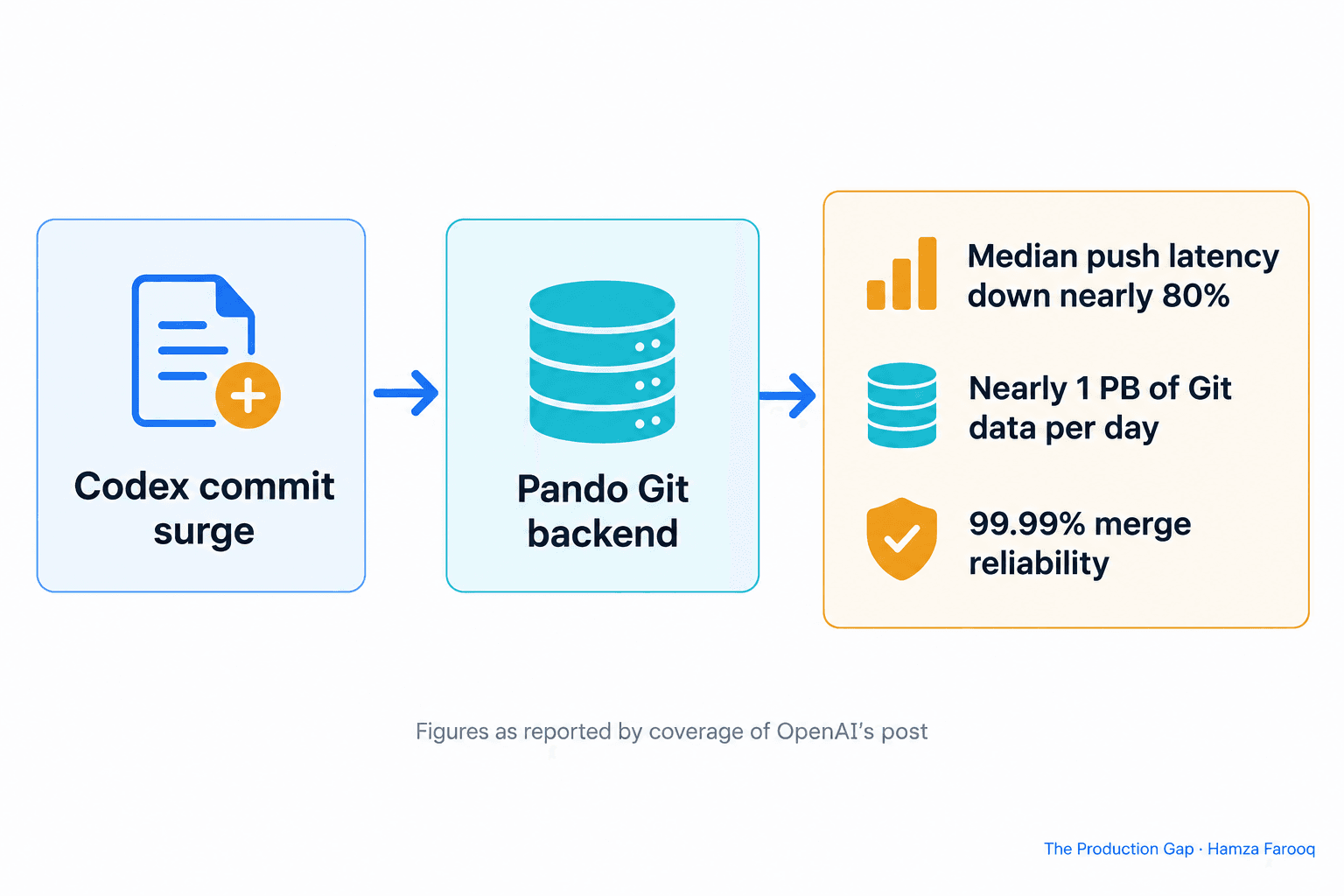
OpenAI has described Pando, an internal Git backend for its monorepo, and reports that it cut median push latency by nearly 80% and serves close to a petabyte of Git data per day, according to an AI Weekly summary of OpenAI's post. Coverage says the post names a surge of commits from Codex as what pushed the earlier source control setup past its limits. I could not open OpenAI's own post, so each figure here comes from write-ups of it and counts as a vendor claim.
TL;DR: Coverage says OpenAI's internal Git backend Pando cut median push latency by nearly 80% and serves close to a petabyte of Git data per day. Outlets differ on commit growth (1,378% per AI Weekly, 2,442% per Interesting Engineering) and on the post date (2 or 3 November); I treat neither as settled. Pando is not public, so test the numbers against your own repositories.
Key Takeaways
- Trigger: Write-ups dated 2 and 3 November say OpenAI attributes the strain on its source control to commit volume from Codex.
- Headline result: OpenAI reports median push latency down nearly 80%.
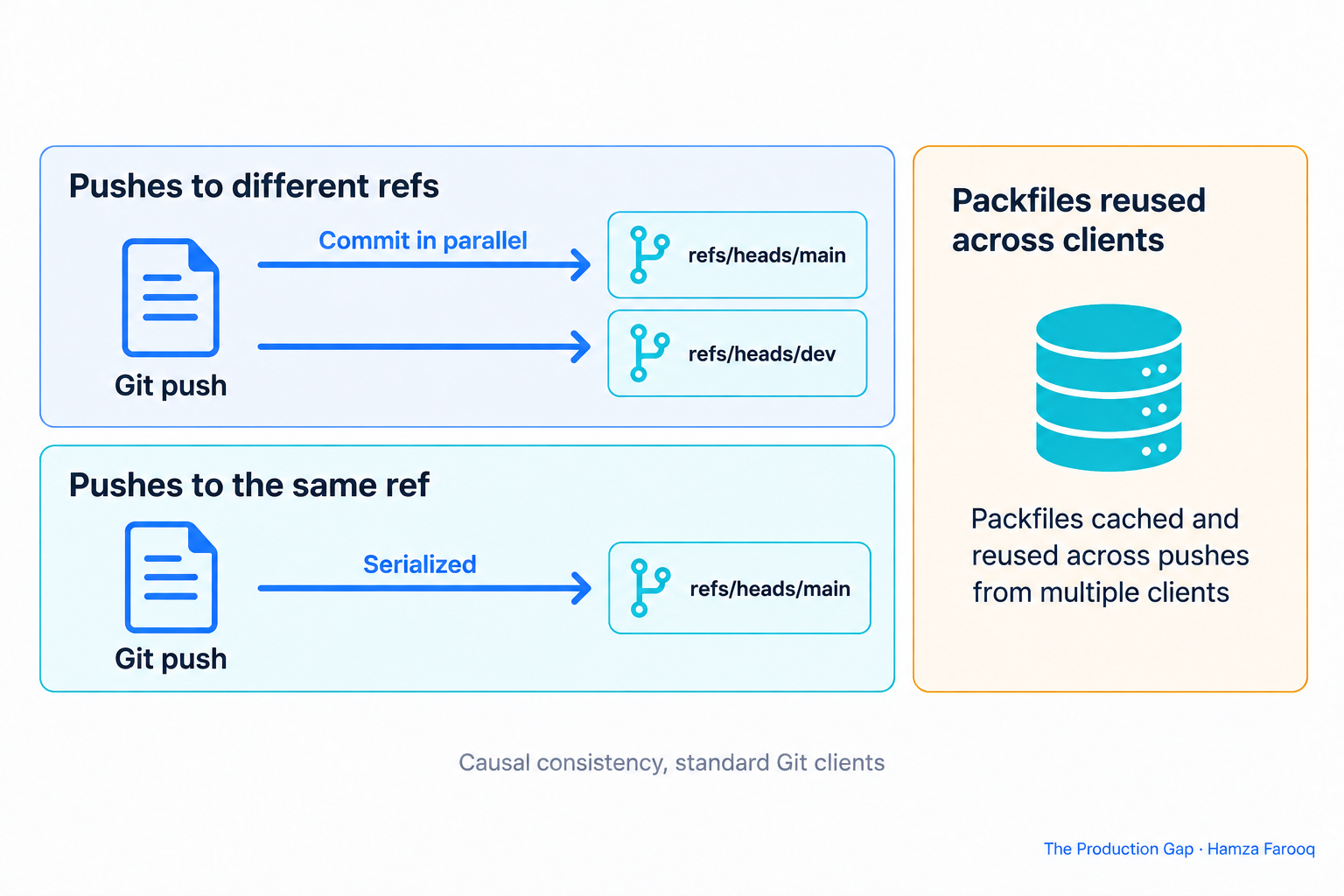
- Design: Coverage describes causal consistency, with pushes to different refs committing in parallel and pushes to the same ref serialized.
- Trade-off: AI Weekly paraphrases the authors as warning that reads across several branches may not reflect a single point in time.
- Discrepancies: Outlets differ on the commit-growth figure and on the date of OpenAI's post, and neither is settled here.
- Limits: Pando is internal, the numbers are self-reported, and the pages I read leave several questions open.
What did OpenAI report about Pando?
OpenAI reports a Rust Git backend called Pando that keeps standard Git clients and workflows. According to AI Weekly, it went from kickoff to production in 10 weeks, with one engineer designing the core, teams of agents implementing it, and a handful of engineers deploying it.
The coverage disagrees on dates. Crypto Briefing published on 2 November and AI Weekly on 3 November, Crypto Briefing and Developers Digest date OpenAI's post 2 November, and Interesting Engineering's embed shows 3 November. I could not settle the exact date of OpenAI's post from the pages I read.
Why did Codex commit volume strain the earlier setup?
Coverage of the post reports that OpenAI says Codex produced a surge of commits that pushed its existing source control setup past its limits. AI Weekly reports that reliability at times fell below 90%. It also reports that commits on master grew 1,378% from Q1 2024 to Q3 2026, and that OpenAI estimates the Q4 2026 figure at 2,442%. Interesting Engineering gives 2,442% to Q4 2026, and Crypto Briefing gives 1,378% plus a forecast of roughly 2,400% for the end of 2026. The outlets period the figure differently, and none is settled here.
Developers Digest says Codex means more branches, pushes, merges and fetches, and Interesting Engineering lists branch updates, reviews, merges and downloads as the pressure points. My inference, not an OpenAI finding, goes one step further: the bottleneck moved from writing code to pushing and merging it, because many agents working in parallel send more branches, pushes and merges to the shared Git server.
Which Pando figures are reported, and by whom?
Each figure below is OpenAI's own, relayed by a secondary outlet, and none is independently verified in the pages I read.
| Metric | Reported value | Source |
|---|---|---|
| Commit growth on master (outlets differ) | 1,378% to Q3 2026 (AI Weekly); 2,442% to Q4 2026 (Interesting Engineering); about 2,400% forecast for end of 2026 (Crypto Briefing) | AI Weekly, Interesting Engineering, Crypto Briefing |
| Median push latency | About 80% lower | Crypto Briefing |
| Peak hour | More than 57 TB of packfiles, over 99% from local cache | Interesting Engineering |
| Merge reliability | 99.99% | AI Weekly |
| Build time | About 10 weeks, production in April 2026 | Crypto Briefing |
The same Crypto Briefing page says Pando serves nearly one petabyte of Git data per day. The coverage I read does not describe the methodology behind the 57 TB peak.
How does Pando work, according to the coverage?
Pando uses causal consistency instead of repository-wide consistency, and pushes to different refs commit in parallel while pushes to the same ref stay serialized. Write-ups also describe packfiles being reused across clients instead of built per request. A Developers Digest write-up of the post says each push is stored as an immutable packfile in a blob store, and each branch move records a ref version in a metadata store. It adds that clients are pointed to earlier packs through Git's packfile-uri feature, served from regional caches, with background compaction merging small packs into larger ones.
Whether the split helps your repository depends on how your agents push.
What can't we confirm yet?
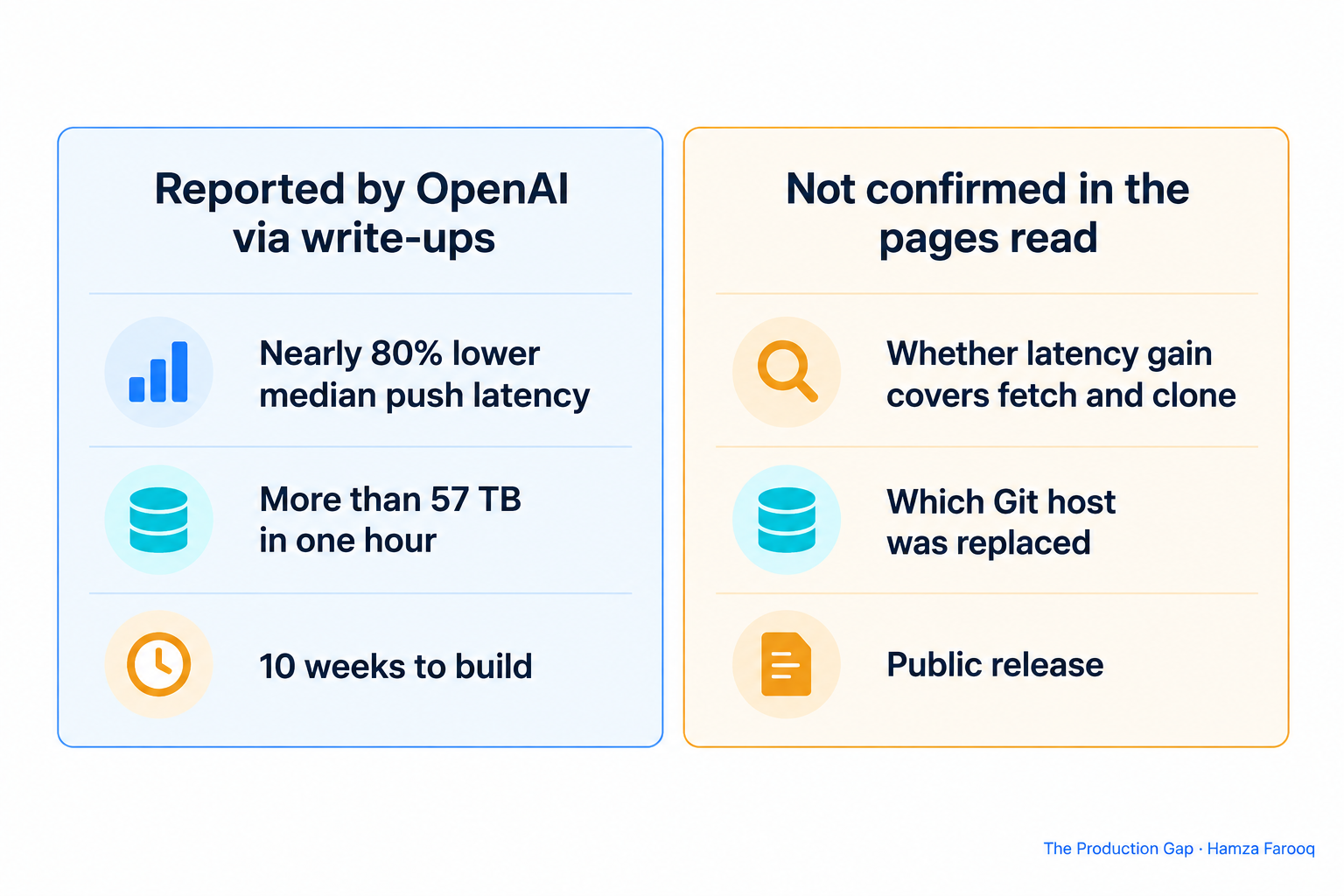
Pando is internal, and the pages I read say OpenAI has published no source code, API or deployment guide. AI Weekly's write-up does not name the Git host Pando replaced, and it does not say whether the latency gain covers fetch and clone or only pushes. The same page paraphrases the authors on the trade-off, warning that reads across several branches may not reflect a single point in time.
What should teams running coding agents check in their own setup?
Start by recording your own median push latency and merge failure rate each week, and note when agent usage rises.
Next, check how many branches your agents create and how often they push to the same one, since OpenAI's design treats those two cases differently. Finally, list the tools that read several branches at once. If any assume a single point-in-time view, start by testing the consistency trade-off.
Frequently Asked Questions
What is OpenAI's Pando?
Pando is an internal Git backend for OpenAI's monorepo. Write-ups say it keeps standard Git clients and workflows while changing how the server handles pushes and serves packfiles.
How much faster is Pando?
OpenAI reports that median push latency fell by nearly 80%. That is a vendor-reported number relayed through secondary coverage, and it is unclear from the pages I read whether the gain covers fetch and clone as well as push.
Can I use Pando in my own team?
Not at the moment. The pages I read say Pando is internal and that OpenAI has published no source code, API or deployment guide.
Does Pando mean Git cannot handle coding agents?
The pages I read do not say that. They describe one company's monorepo under a very large increase in commit volume, and a server-side redesign that keeps standard Git clients. Whether your repository faces the same strain depends on your own volume and tooling.
Conclusion
Treat the coverage of the Pando post as one data point: it reports that OpenAI says Codex commit volume strained its source control, and it responded with a new server that keeps standard Git clients. The numbers are vendor claims, and the system is not available. The practical step is to measure your own push and merge times as agent usage grows, and to check which of your tools assume a single consistent view across branches.
Learn from me

Claude Code in Practice, my Maven cohort. Master Claude Code from fundamentals to advanced orchestration: skills, subagents, hooks, MCP, and production automation. Join the next cohort →
Hire us
Traversaal.ai. We're a team of forward deployed engineers solving the toughest AI problems for Fortune 100 companies: document intelligence, agentic data platforms, and real-time web intelligence, deployed in production. Work with our team to deploy your next agentic ecosystem. Talk to Traversaal.ai →
Join us
Want to solve these problems with us? We're always looking for forward deployed engineers who want to ship production AI. jobs@traversaal.ai
