
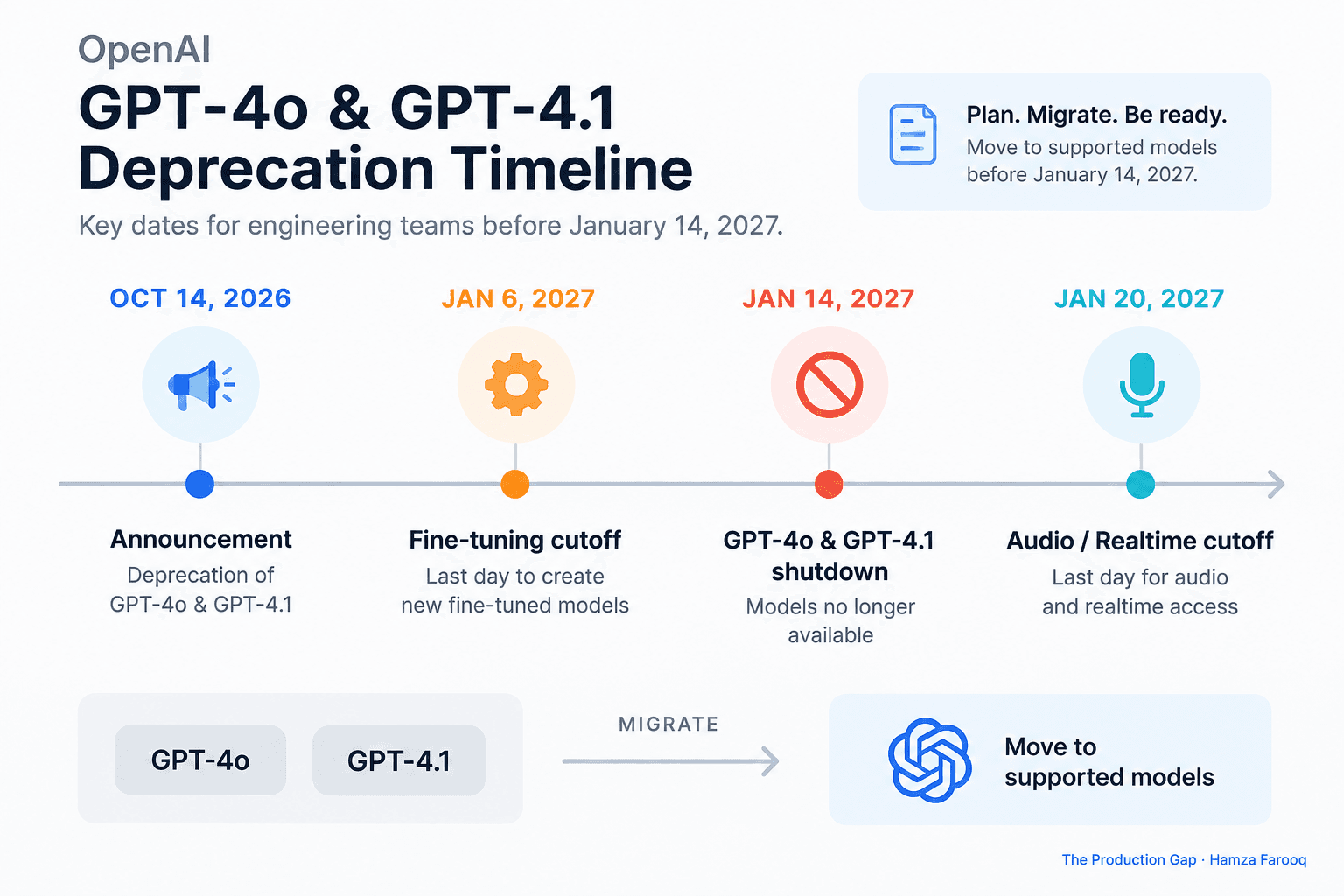
TL;DR: gpt-4o, gpt-4o-mini, gpt-4.1, and gpt-4.1-mini shut down January 14, 2027. Fine-tuning pipelines close eight days earlier, treat January 6 as your hard operational deadline. Inventory dependencies now, submit fine-tune jobs before January 6, and run audio/realtime variants as a separate workstream. Verify all dates on the official OpenAI deprecations page before committing your schedule.
Key Takeaways
- Inventory first: Map every service calling a deprecated model before anything else.
- Confirm your replacement: Evaluate the official successor against production tasks, not general benchmarks.
- Model your cost delta in Week 3: Calculate per-million-token spend before go-live, not after.
- Audio and realtime have a separate cutoff: Run a distinct migration track and verify the exact date on the OpenAI deprecations page.
- Fix your contracts: Add minimum-notice clauses so the next deprecation cycle doesn't catch your team without runway.
What Is the GPT-4o Deprecation Deadline, and Why Is January 6 the Real Cutoff?
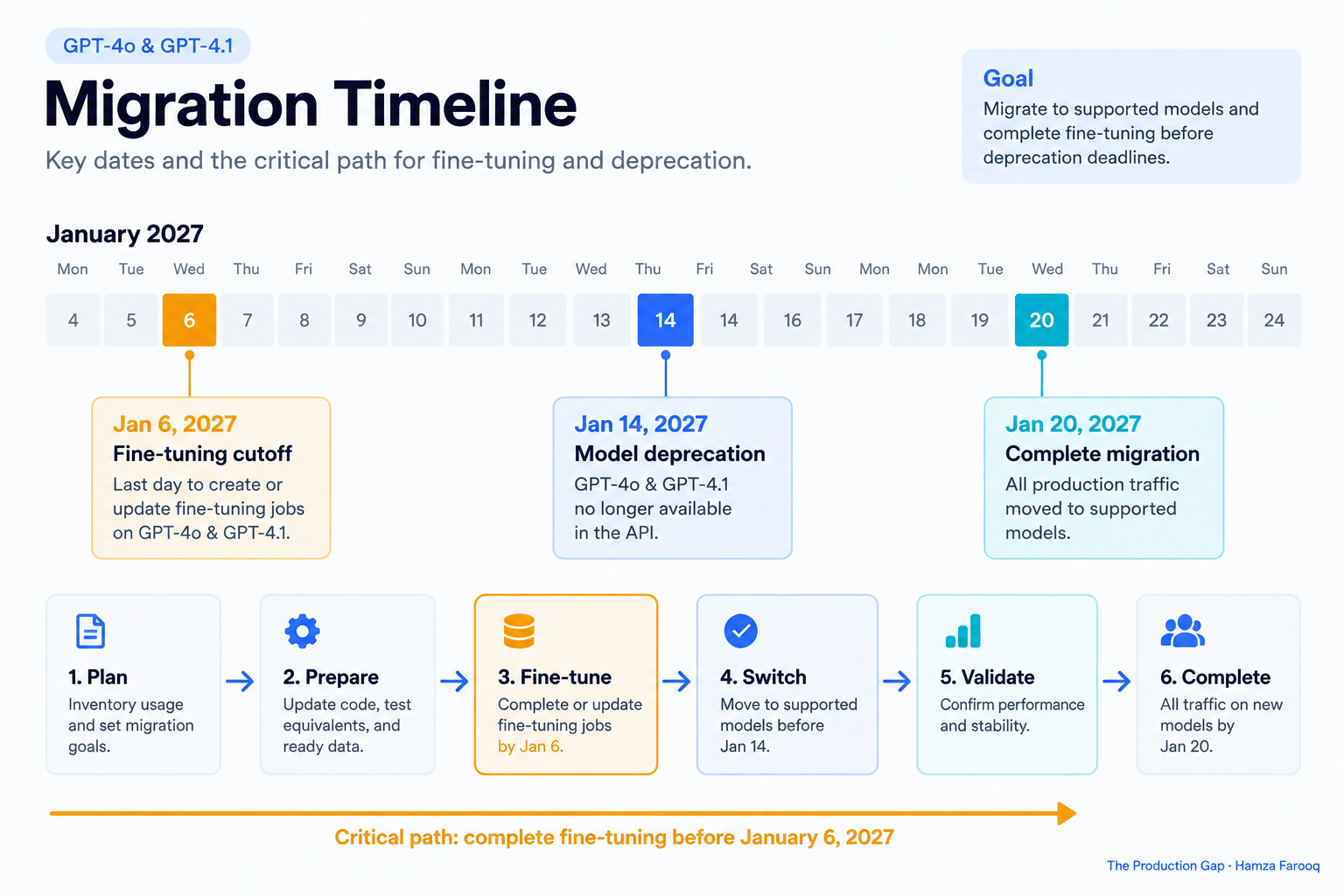
A team that starts retraining on January 10 finds the fine-tuning pipeline already closed. The base model still runs four more days, creating a false sense of safety, but the custom behavior is gone and unrecoverable. Lock your fine-tune plan backward from January 6.
| Date | Event | Verified Source |
|---|---|---|
| January 6, 2027 | Fine-tuning job submissions close (author synthesis: 8 days before base shutdown) | Verify at OpenAI deprecations page |
| January 14, 2027 | gpt-4o, gpt-4o-mini, gpt-4.1, gpt-4.1-mini shut down | Verify at OpenAI deprecations page |
| January 20, 2027 | Legacy audio and realtime model variants retire | Verify at OpenAI deprecations page |
What Is the Week-by-Week Runbook to Migrate Without Outages?
Week 1: Inventory sweep. Search every repo for model ID strings, query 90 days of API telemetry by model, and scan config repos, environment files, and scheduled jobs. Produce a tracker with columns: Service, Owner, Model, Fine-tuned?, Replacement, Status, ETA.
Week 2: Eval harness. Build a test harness using real production prompts, red-team edge cases, and written acceptance thresholds. Provision replacement model sandboxes before touching production.
Week 3: Retrain-or-retire decisions. Decide whether each fine-tuned use case still justifies training compute. Audit labeled data for drift and get finance sign-off on your cost delta this week.
Weeks 4–6: Fine-tune on the replacement model. Submit all jobs before January 6. Run bake-offs against Week 2 thresholds. Treat these weeks as locked.
Weeks 7–8: Canary deployment. Route 5–10 percent of live traffic to the replacement. Monitor latency p95, hallucination rate, escalation rate, and error budget burn. Set automated rollback triggers.
Weeks 9–10: Full cutover. Flip feature flags to 100 percent and run a 48-hour stability soak.
By January 14: Remove all gpt-4o and gpt-4.1 references from code, configs, and documentation.
How Do I Choose Between Drop-In, Retune, and Re-Architect?
- Drop-in (Retain): Swap the model ID. Works for classification, entity extraction, and basic RAG chat where the replacement clears acceptance thresholds immediately.
- Retune: Retrain with refreshed labeled data. Submit all jobs before January 6.
- Retire: Eliminate workloads with no active users or unacceptable regulatory exposure.
4R migration decision matrix
| Criterion | Retain | Retune | Re-architect | Retire |
|---|---|---|---|---|
| Accuracy gap on eval | None | Small, data-fixable | Structural | Irrelevant |
| Latency and SLA impact | None | Acceptable | Requires redesign | N/A |
| Cost delta | Neutral | Justified | Justified by value | Eliminate |
| Regulatory exposure | Low | Low to medium | Needs review | High risk |
| Data drift since last train | None | Moderate | High | N/A |
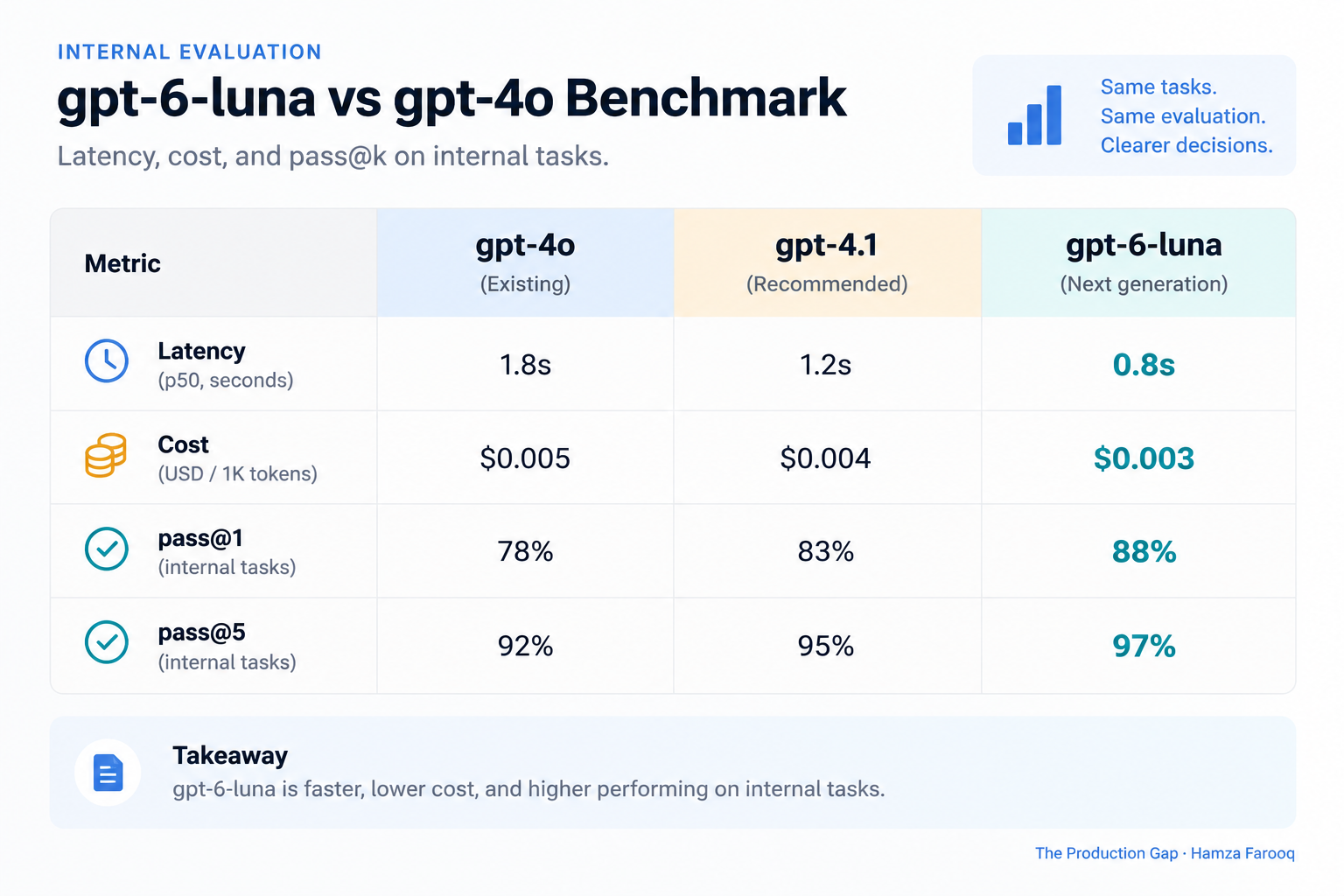
Eval comparison table (populate with your production results)
| Metric | gpt-4o | gpt-4.1 | Replacement model |
|---|---|---|---|
| Avg latency p95 (ms) | fill | fill | fill |
| Exact-match on extraction set (%) | fill | fill | fill |
| Tool-call success rate (%) | fill | fill | fill |
| Hallucination on guarded prompts (%) | fill | fill | fill |
| Cost per 1M input tokens (USD) | fill | fill | see official pricing |
| Cost per 1M output tokens (USD) | fill | fill | see official pricing |
How Do I Budget the Token-Cost Delta and Avoid a Surprise Bill?
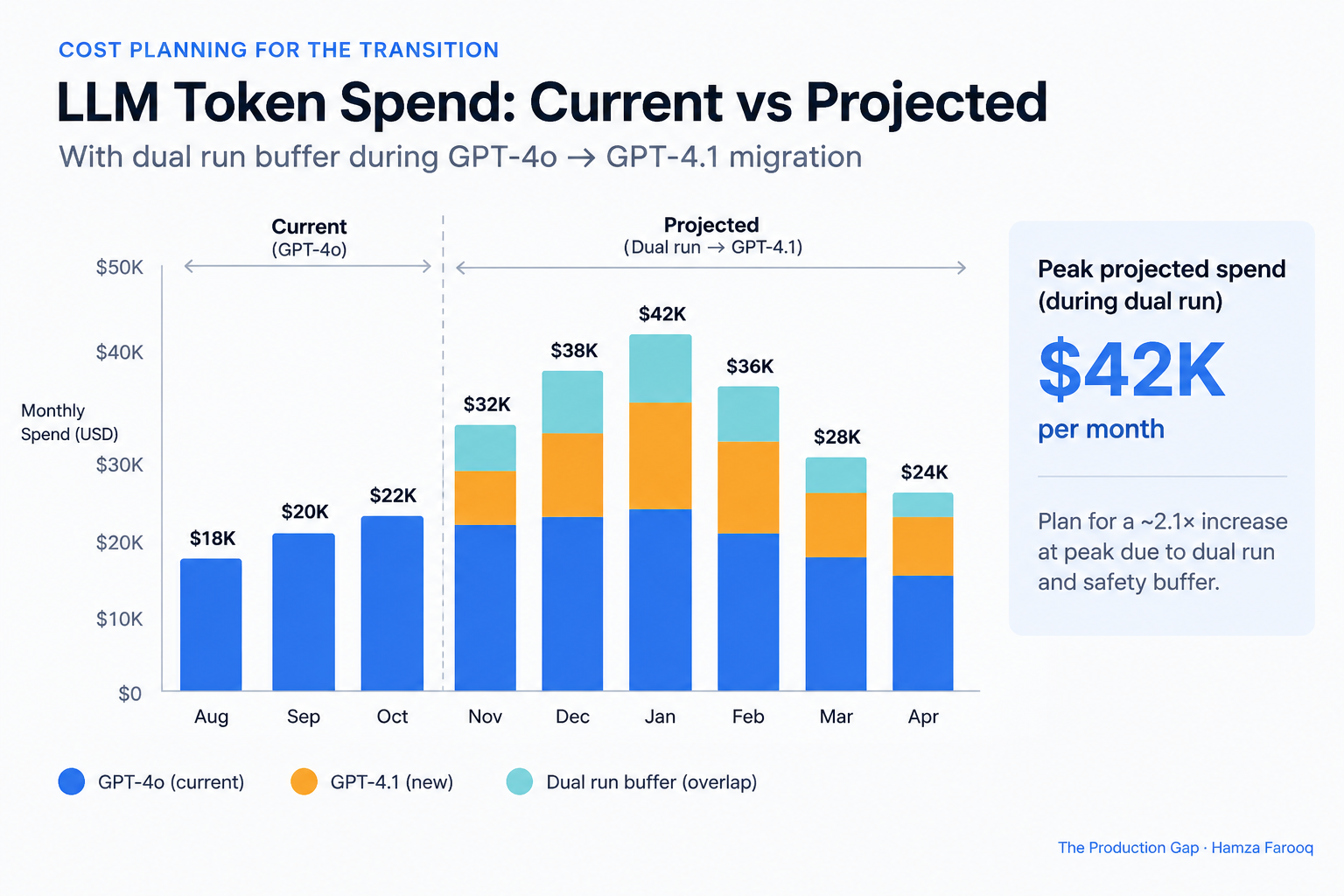
Pull 90 days of telemetry: input tokens, output tokens, p95 tokens per request, and retry rates. Apply current list prices to actual volumes, layer in dual-run overhead for Weeks 7–10, and get finance sign-off in Week 3. Plan for two to three training variants per fine-tuned workload.
What Should Audio and Realtime Teams Do Given Their Separate Cutoff?
Audio and realtime variants retire on a separate date after the base model shutdown, run a parallel migration track with its own SRE runbook and verify the exact date on the official OpenAI deprecations page.
Inventory all voice and streaming dependencies: WebRTC socket connections, partial token streaming handlers, TTS/STS hooks, and latency SLAs. These scatter across mobile SDKs, browser clients, and backend orchestration layers, making them harder to locate than a model ID grep. Evaluate replacements on MOS score, cold-start time, end-to-end roundtrip under jitter, and barge-in accuracy. Assign a dedicated on-call rotation through the audio retirement date.
Frequently Asked Questions
What is the exact shutdown date for gpt-4o and gpt-4.1? January 14, 2027 for gpt-4o, gpt-4o-mini, gpt-4.1, and gpt-4.1-mini; legacy audio and realtime variants retire on a separate subsequent date. Confirm all dates on the official OpenAI deprecations page before finalizing your schedule.
Does OpenAI extend deprecation deadlines after announcing them? Based on the chatgpt-4o-latest retirement, OpenAI followed its posted date with no grace period and redirected developers to alternative models. Treat posted dates as firm and build no extension buffer into your timeline.
What happens to my fine-tuned models after January 14, 2027? Fine-tuned models on deprecated base models stop serving inference at shutdown. Confirm with OpenAI's fine-tuning documentation whether weights are exportable, then retrain on the replacement model and submit that job before January 6.
How do I estimate my cost change on the replacement model? Pull 90 days of telemetry, apply the replacement model's official list prices, and add a 15–25 percent buffer for canary traffic and dual-run weeks. Get that number in front of finance by Week 3.
Conclusion
January 6 is the critical deadline, not January 14. After that date the fine-tuning pipeline closes, and a bare model swap may not preserve the behavior your product depends on.
Run the plan in order: inventory this week, retrain-or-retire decisions by Week 3, fine-tune jobs submitted by end of Week 6, canary in Weeks 7–8, full cutover in Weeks 9–10. Run audio and realtime as a separate workstream. Verify every date against the official OpenAI deprecations page before locking your schedule.
Sample contract clause: minimum deprecation notice "Provider shall give Customer no less than 180 days' written notice before deprecating any generally available model used in production; during this period, legacy endpoints remain available under existing SLAs and pricing, with security and compatibility patches applied."
Continuity option: "If replacement models are not functionally equivalent, Customer may extend legacy access up to 90 additional days at Provider's then-current rates."
Your next three actions: 1. Today: Run the inventory sweep and populate the migration tracker. 2. Tomorrow: Stand up the eval harness and confirm replacement model pricing with your OpenAI account team. 3. This week: Schedule your fine-tune data refresh and book compute capacity for Weeks 4–6.
The only unrecoverable failure is a missed fine-tuning window. Treat January 6 as your launch date.
Learn from me
Forward Deployed Engineering Bootcamp for Full-Stack Developers, my Maven cohort. Build and ship complete AI products end to end, from React and Node.js frontends to deployed models with caching and observability. Join the next cohort →
Hire us
Traversaal.ai. We're a team of forward deployed engineers solving the toughest AI problems for Fortune 100 companies: document intelligence, agentic data platforms, and real-time web intelligence, deployed in production. Work with our team to deploy your next agentic ecosystem. Talk to Traversaal.ai →
Join us
Want to solve these problems with us? We're always looking for forward deployed engineers who want to ship production AI. jobs@traversaal.ai
