
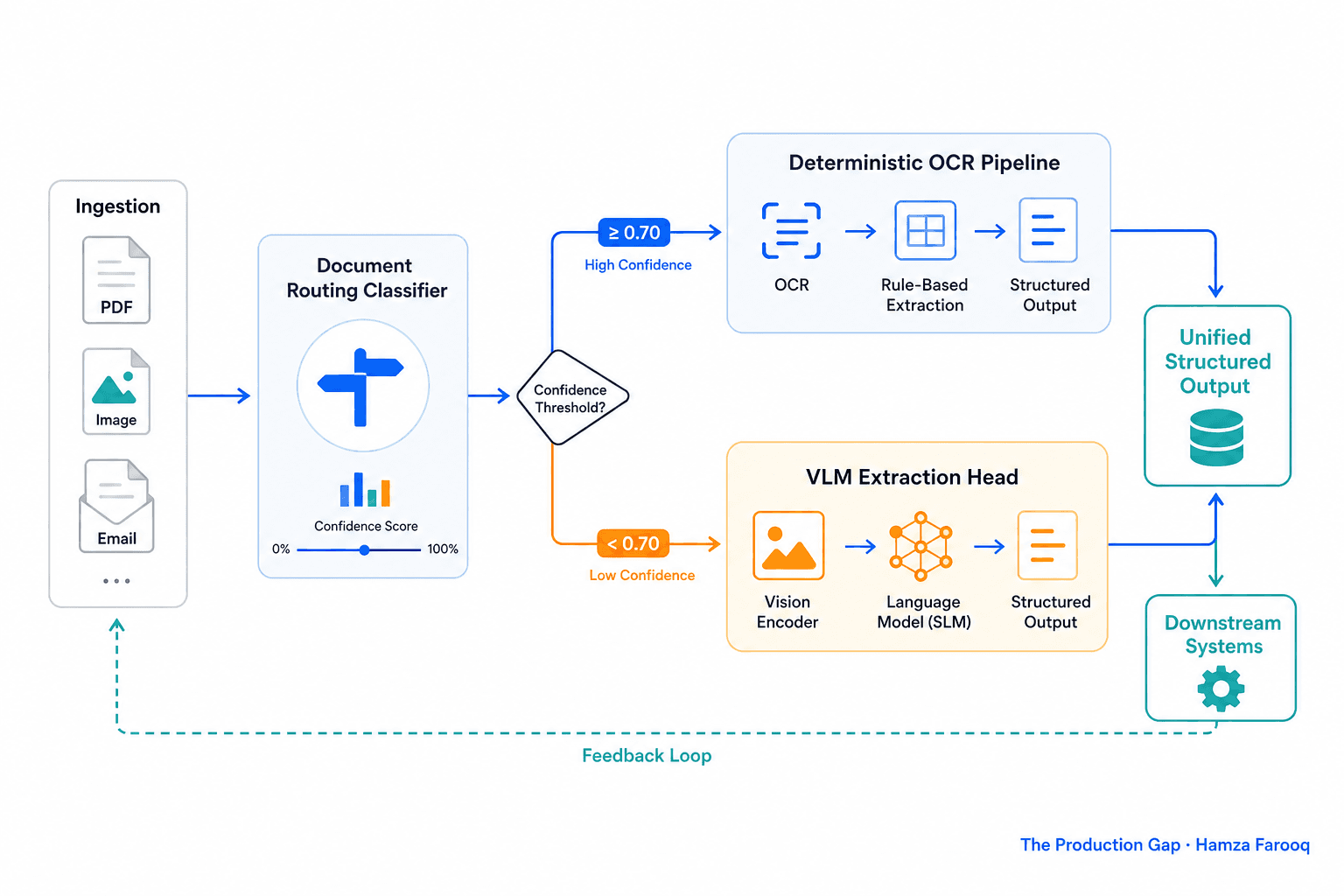
TL;DR: The OCR vs LLM document processing decision comes down to this: rule-based OCR is fast, cheap, and accurate on clean structured documents, but accumulates silent template debt at scale. Hybrid SLM/VLM pipelines solve this by routing each document to the right extraction method based on layout complexity and classifier confidence, delivering consistent accuracy across structured and unstructured document types without replacing OCR entirely.
Key Takeaways
- OCR and LLMs solve different problems. OCR reliably extracts text from clean, structured documents and breaks on variable layouts, handwriting, and context-dependent fields.
- Hybrid pipelines are the production answer. Engineering teams route documents to OCR or a VLM based on scan quality, layout complexity, and classifier confidence scores.
- Rule-based heuristics carry a hidden tax. Template libraries compound quietly into operational debt that rarely appears in vendor pricing comparisons.
- Cost economics depend on workload type. OCR APIs remain cheaper for high-volume structured documents; LLMs add value for unstructured content, summarization, and free text.
- SLMs work as lightweight extraction heads. A compact downstream model resolves ambiguous fields, corrects OCR errors, and normalizes output without frontier-model overhead.
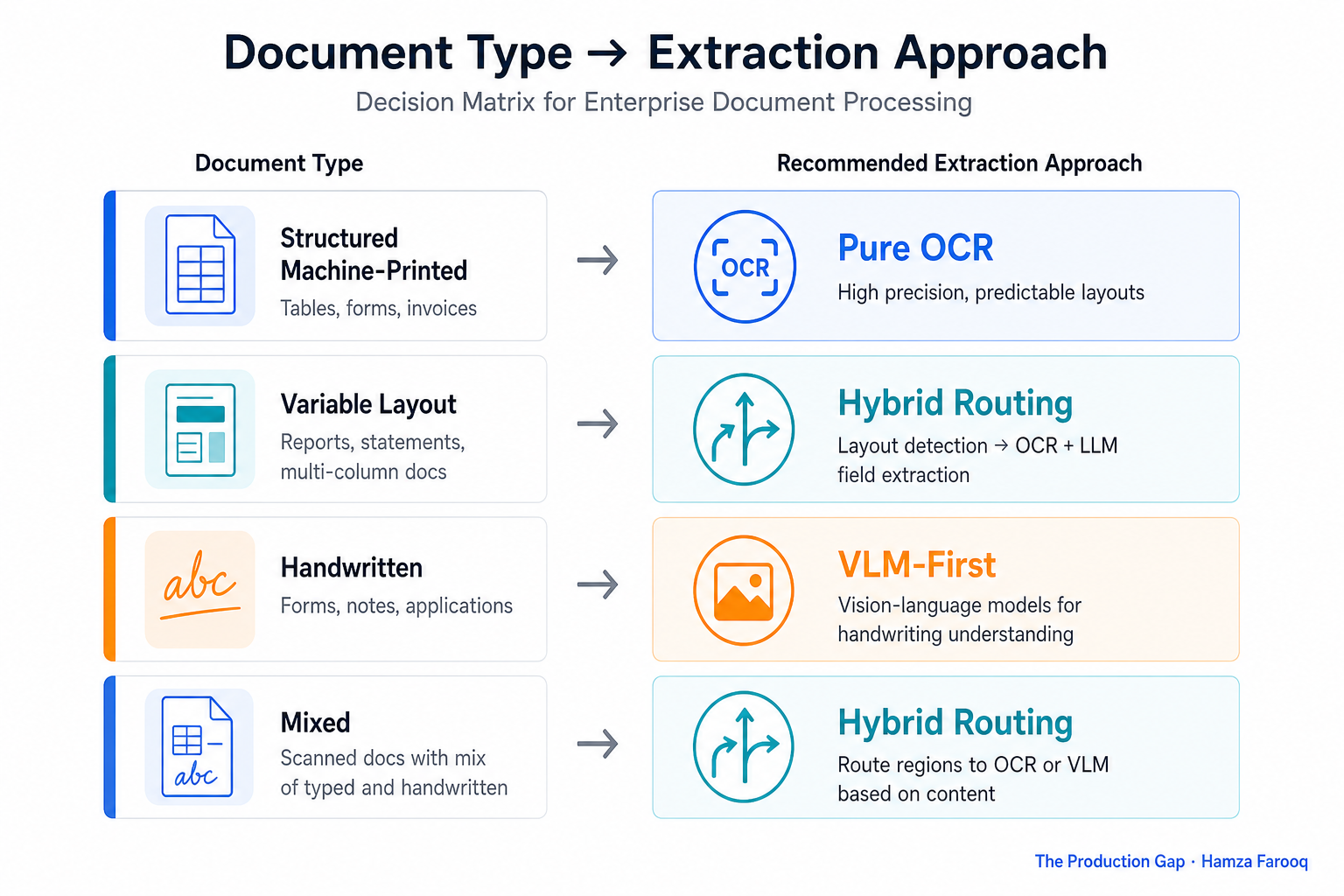
- Document type still drives architecture. Consistent machine-printed forms favor deterministic OCR; messy, variable, or handwritten documents are where VLMs earn their place.
What Is the Difference Between OCR and LLM Document Processing?
OCR extracts text literally from a document image, while LLM-based processing understands context, infers field meaning, and interprets ambiguous or variable layouts. Both approaches are verified to have distinct strengths: OCR delivers deterministic, fast, and consistent results for clean text, whereas LLMs offer flexible, context-aware extraction. Modern production systems combine both technologies to achieve 95%+ accuracy outcomes by applying each method where it performs best, rather than treating the choice as binary.
The practical difference shows up at the failure boundary. OCR fails silently when a vendor changes a form layout or a scanned document arrives skewed. LLMs can misread handwriting or over-correct fields they were not trained to expect. Knowing which failure mode your team can catch and manage is the real starting point for architecture decisions.
Your OCR pipeline probably is not broken. It is just buried under layout templates that nobody owns anymore.
Why Does Rule-Based OCR Heuristic Maintenance Become a Liability at Enterprise Scale?
Rule-based OCR heuristics become a liability at enterprise scale because every distinct vendor layout requires its own template, every regulatory update breaks an existing rule, and every new document type adds a maintenance ticket owned by no one. This compounding dynamic, not character recognition failure on a clean scan, is the core operational problem with legacy OCR at scale.
Deterministic OCR is fast and consistent for clean, machine-printed documents. That is genuinely its strength. The failure mode is not a W-9 processed on a well-calibrated scanner. The failure mode is accumulation: template libraries that grow faster than teams can maintain them, silent drift when a supplier changes their invoice format, and engineering hours absorbed by layout debugging that never show up in per-page API cost comparisons.
How Do Hybrid SLM/VLM Document Pipelines Actually Route Documents?
A hybrid SLM/VLM pipeline routes each document to either a deterministic OCR engine or a VLM based on an upstream classifier that scores document quality, layout complexity, and predicted extraction confidence before any extraction occurs.
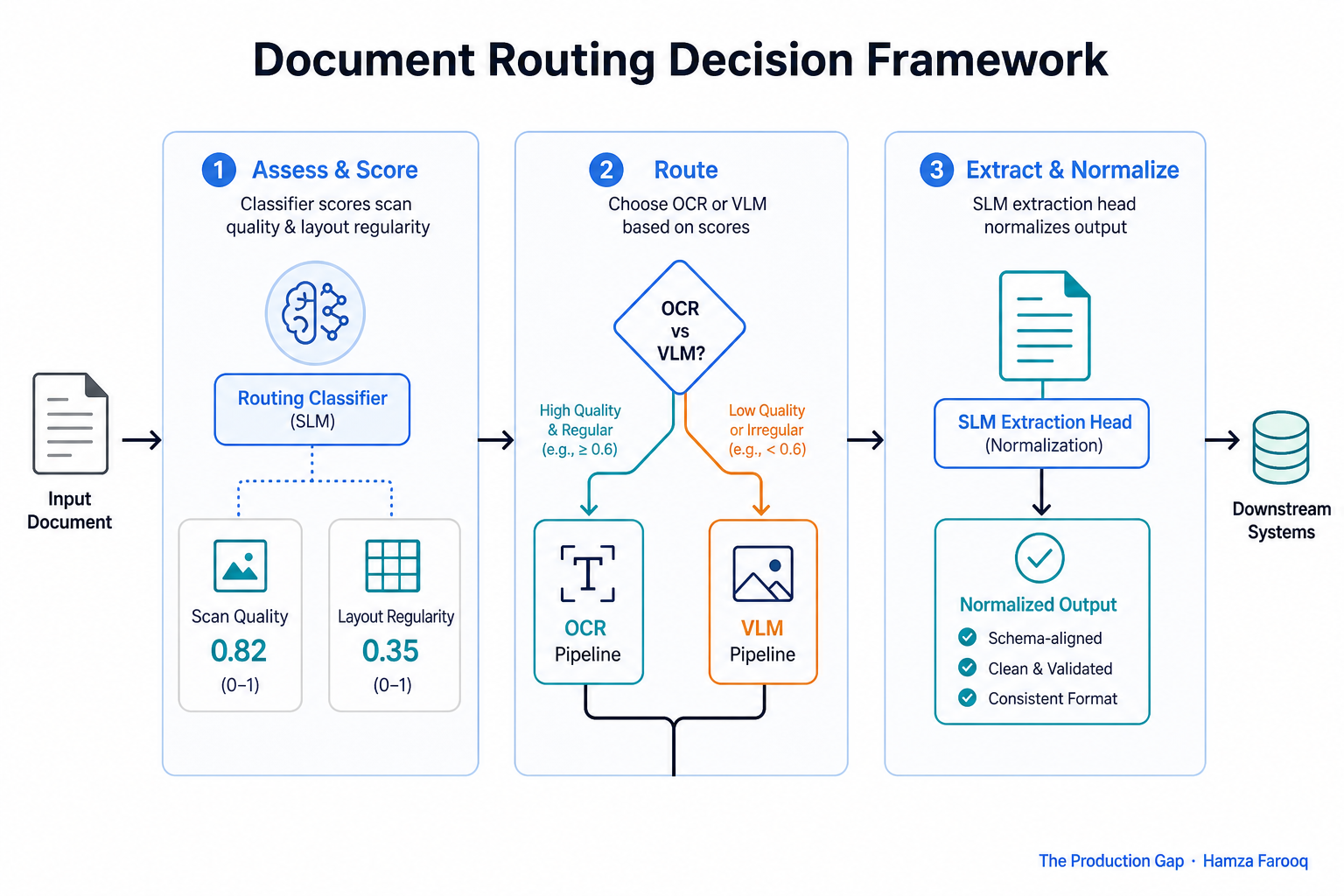
The architecture runs in three stages. First, a lightweight classifier scores incoming documents on scan quality, layout regularity, and document type. Second, clean structured documents route to OCR; messy, variable, handwritten, or novel-layout documents route to a VLM. Third, a small language model extraction head sits downstream of both paths, interpreting extracted text in context, resolving ambiguous fields, and normalizing the output schema.
The Document Routing Decision Framework
- Scan quality score, pixel density, skew, and noise thresholds determine whether the document image is clean enough for deterministic OCR to succeed reliably.
- Layout regularity score, variance from a known template baseline identifies whether the document matches a predictable structure or requires visual inference.
- Document-type confidence, classifier certainty that the document matches a known form type determines which extraction path receives it.
Consider a contract lifecycle system processing NDAs. Machine-generated PDFs score high on all three signals and route to OCR plus an SLM extraction head. Scanned, handwritten-annotated versions route directly to the VLM. The same pipeline produces the same output schema from both paths.
When Does Each Approach Win? A Comparison by Document Type and Cost Profile
OCR APIs remain the cost-efficient default for high-volume, consistent-layout documents. LLMs add the most measurable value for unstructured content, summarization, and free text analysis. Hybrid routing is defensible for mixed-variety workloads where a single extraction strategy would require constant exception handling.
| Dimension | Pure OCR | General-Purpose LLM | Hybrid SLM/VLM Pipeline |
|---|---|---|---|
| Best document type | Structured, machine-printed | Unstructured, free text | Mixed-variety workloads |
| Extraction accuracy | High on clean / Low on variable layouts | High on context / Inconsistent on handwriting | High across document types |
| Failure mode | Silent template drift | Hallucination or over-correction | Explicit confidence signal |
| Maintenance burden | High (growing template library) | Low (prompt tuning) | Medium (routing thresholds) |
| Cost at scale | Low for structured volume | Higher for unstructured value-add | Medium with purpose-built SLMs |
| Latency | Very low | High | Low to medium |
| Handwriting handling | Poor | Variable; can introduce errors | Routed to VLM; best available path |
Which Document Types Still Justify Pure OCR Over a Hybrid Approach?
LLM-based processing is best understood as a complement to OCR, not a wholesale replacement. Four document types that specifically justify keeping pure OCR as the primary path:
- Machine-generated PDF purchase orders from ERP systems with consistent schema and no layout variance.
- Standard federal tax forms such as W-2 and 1099-NEC with fixed, mandated layouts.
- Barcoded logistics labels and GS1-standard shipping documents.
- High-throughput check processing, where MICR line extraction is a solved problem.
The moment layout variance enters the workload, multiple suppliers, hand-annotated fields, or scanned legacy documents, OCR-only starts accumulating template debt. That inflection point is when VLM routing becomes worth a formal evaluation.
Frequently Asked Questions
When does it make sense to keep OCR in a hybrid pipeline rather than replacing it entirely?
Retaining OCR for document segments where layout is consistent, scan quality is high, and throughput volume makes VLM inference costs prohibitive is the recommended default. Pure OCR replacement only makes sense for low-volume, unstructured document types where context-aware extraction is the primary requirement and deterministic speed is not a constraint.
What does the real total cost of ownership for rule-based OCR heuristics include?
True OCR total cost of ownership includes not just per-page API costs but the compounding engineering time required to create, maintain, debug, and update layout-specific templates at scale. The Mindee cost comparison framework separates structured-document economics from unstructured workloads precisely because template maintenance costs dominate at volume and rarely appear in vendor pricing comparisons.
How do hybrid pipelines expose and manage confidence-based failure modes?
Hybrid pipelines expose explicit confidence scores at both the routing and extraction layers, enabling threshold-based fallback logic that sends low-confidence extractions to human review. Silent drift becomes a measurable, auditable signal rather than an invisible accumulation of extraction errors.
Conclusion
The OCR vs LLM document processing debate is often framed as an accuracy contest. It is not. It is a question about which failure mode your team can catch and manage. Silent drift from broken templates is harder to detect and more expensive to fix than an explicit low-confidence signal that routes a document to human review.
OCR remains the right tool for structured, high-volume workloads. For unstructured content, variable layouts, and free text, LLMs add genuine value that rule-based extraction cannot provide. Hybrid pipelines let teams apply each approach where it performs best.
Your next step is practical: audit your OCR template library. If it has no single owner and keeps growing, that is the starting point for a hybrid pipeline evaluation. Begin with your highest-variance document type, instrument confidence scoring at the routing layer, and measure drift before changing the extraction model.
Learn from me

Agent Engineering Bootcamp: Developers Edition, my Maven cohort. Advanced agentic RAG, multi-agent orchestration, memory, evals, and guardrails. Take agents from prototype to production. Join the next cohort →
Hire us
Traversaal.ai. We're a team of forward deployed engineers solving the toughest AI problems for Fortune 100 companies: document intelligence, agentic data platforms, and real-time web intelligence, deployed in production. Work with our team to deploy your next agentic ecosystem. Talk to Traversaal.ai →
Join us
Want to solve these problems with us? We're always looking for forward deployed engineers who want to ship production AI. jobs@traversaal.ai
