
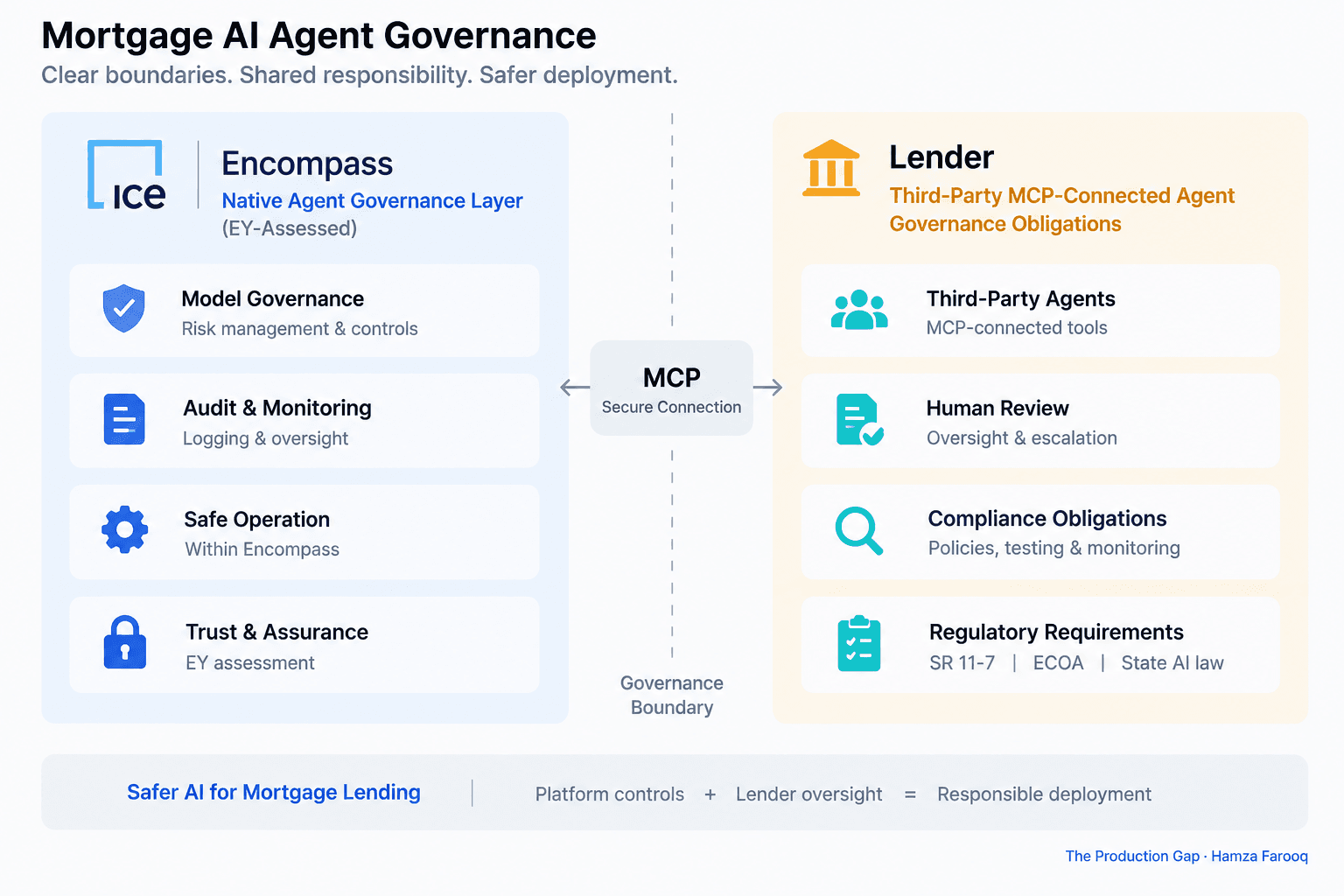
TL;DR: Mortgage AI agent compliance inside Encompass and MSP requires lenders to independently build governance frameworks, audit trails, and human-review checkpoints that go far beyond what ICE's Model Context Protocol provides out of the box. ICE's controls govern tool access and session boundaries, but lenders remain solely responsible for fair lending oversight, explainability documentation, adverse action logging, and supervisory approval workflows before any AI agent touches a live loan file.
Key Takeaways
- The governance boundary is the lender's problem: Connecting an agent to Encompass or MSP via MCP independently triggers every SR 11-7, audit trail, and Fair Lending obligation, none transfer to ICE.
- ICE's governance guidance covers ICE's products only: It sets a floor for ICE-native tooling, not a compliance umbrella for lender-deployed agents. Treating it otherwise is a category error.
- SR 11-7 applies to AI agents: Any agent that flags an exception, routes a document, or recommends a rate lock produces a consequential output subject to model risk governance.
- Human-in-the-loop is not optional: Lenders must define in writing which decisions require human approval and enforce that policy in the workflow, not only in a memo.
- Audit trails must explain every action: Every agent step requires an immutable, timestamped log traceable to a specific input and rationale, producible to regulators on demand.
- Fair Lending exposure travels with automation: ECOA liability follows the lender, not the platform vendor, regardless of who built the agent.
- State AI laws add a jurisdiction-specific layer: Colorado, Illinois, New York, and others have enacted AI-in-lending requirements covering algorithmic transparency, impact assessments, and consumer notification that lenders must evaluate independently.
Introduction: What is the compliance gap lenders face when deploying AI agents via MCP?
The compliance gap is the distance between what the platform vendor governs and what the regulator holds the lender responsible for, and closing it is entirely the lender's burden before go-live.
What does ICE's published governance guidance actually cover, and what does it not cover?
The guidance is real and useful. It is also scoped. A lender treating it as a compliance umbrella for its own MCP-connected agents is making a category error with material regulatory consequences.
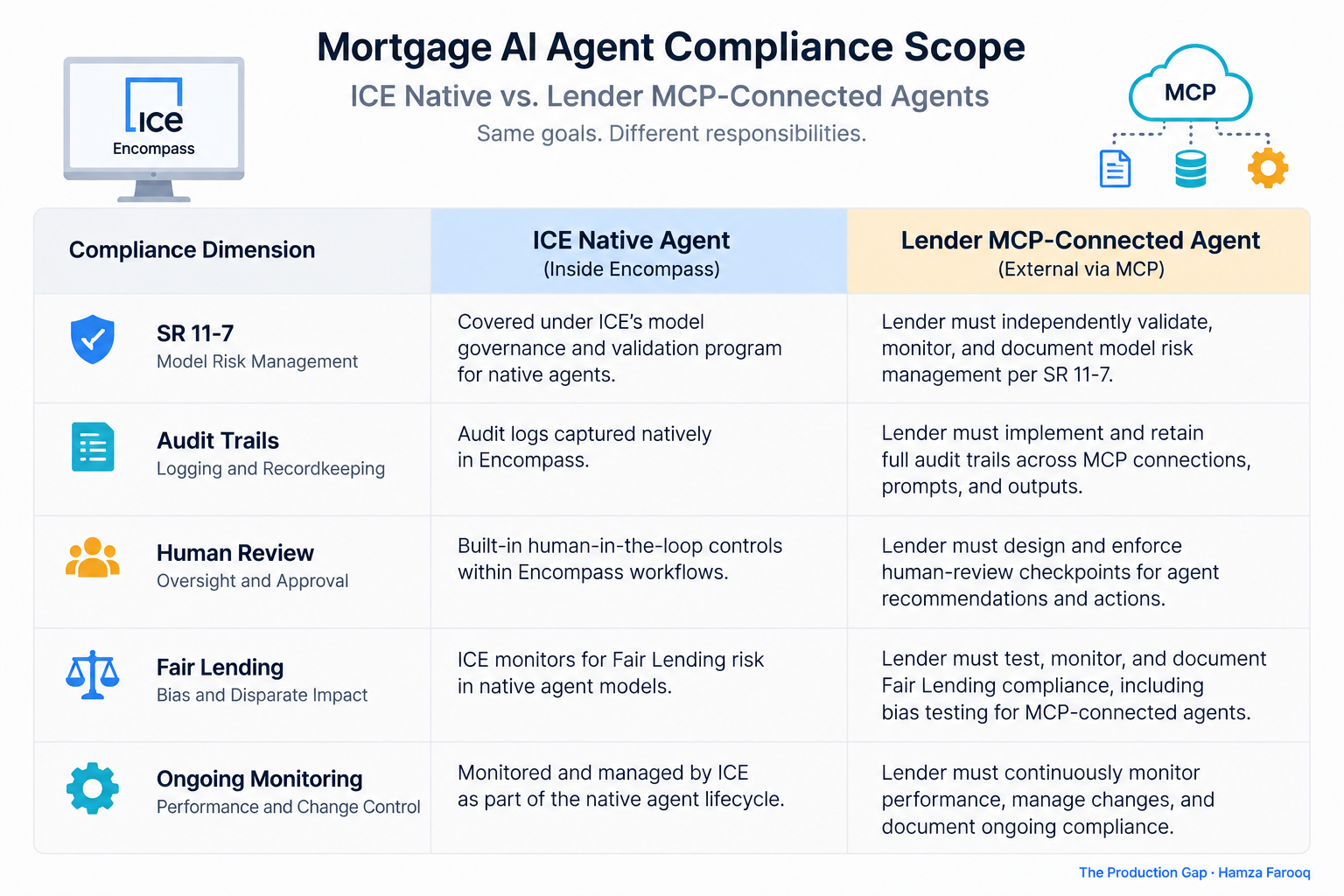
| Governance Element | ICE-Native Tooling (ICE's Scope) | Lender-Connected MCP Agents (Lender's Burden) | Regulatory Anchor |
|---|---|---|---|
| Model validation | ICE's internal process | Lender's own SR 11-7 validation | SR 11-7 (Federal Reserve / OCC) |
| Audit trail ownership | ICE platform logs | Lender must independently capture and retain | CFPB examination expectations |
| Fair Lending testing | ICE scope | Lender's ECOA and disparate impact obligation | ECOA / Regulation B |
| Human-review controls | ICE workflow design | Lender must define and document in writing | SR 11-7; CFPB supervisory guidance |
| State AI law compliance | Not covered | Lender's independent obligation by licensed footprint | Colorado SB 21-169; Illinois AEAA; NY proposed guidance |
How does SR 11-7 model risk management apply to a mortgage AI agent taking live loan actions?
Three obligations demand explicit attention in an agentic context:
Conceptual soundness. Document what data the agent ingests, what logic governs its decisions, and its intended scope before it touches a live file, sufficient for an independent reviewer to assess appropriateness.
Ongoing monitoring. Track decision rates, error rates, and disparate outcome patterns across protected-class proxies continuously. Agent behavior can shift as input data changes, producing systematically different outcomes before any human catches the drift.
Effective challenge. An independent function must be able to reconstruct any agent action from logged data and evaluate whether it was appropriate. If the log cannot support that reconstruction, the control fails.
What human-review controls and audit trail standards must a lender build before go-live?
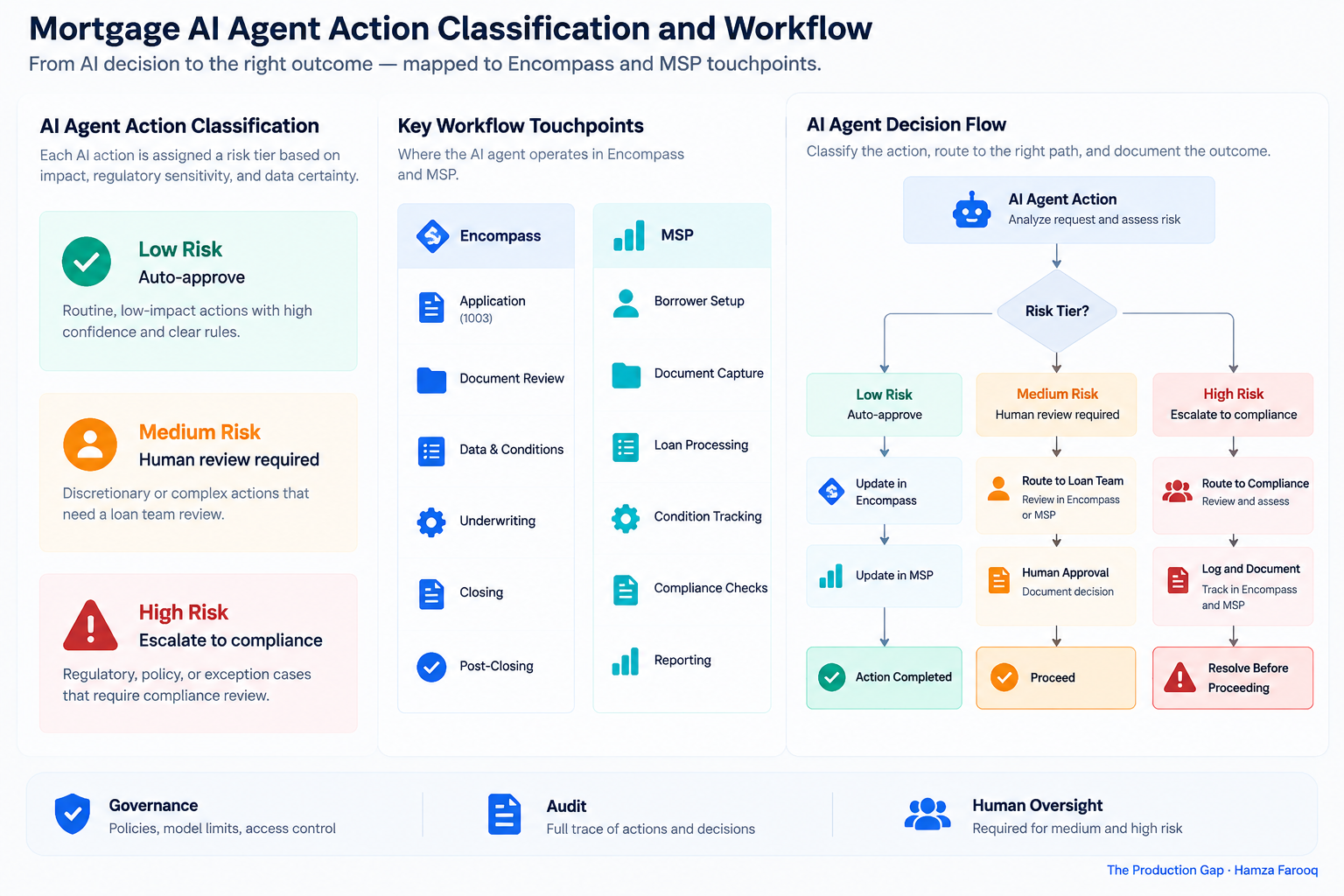
Lenders must produce a written human-review policy defining which agent actions require human approval before becoming final, paired with an immutable audit log capturing every agent action.
ICE's published compliance framing acknowledges the imperative of keeping humans in the loop, but that principle must become auditable lender controls. A policy that lives in a memo but is not enforced in the workflow is not a control, it is a liability.
Decision classification matrix. Tier agent action types by risk and specify human-review requirements for each tier in writing before go-live. Every tier assignment must be documented and compliance-approved.
Escalation triggers. Define exactly which conditions force an action into a human review queue before it writes to the loan record. "Material decisions" alone does not satisfy an examiner, name specific action types, thresholds, and system states.
Reviewer qualification standards. The reviewer must understand what the agent did and why. If the agent's logic is opaque to the reviewer, the review is performative, and regulators will recognize it.
Every agent action must generate a timestamped, immutable log entry capturing: (1) input data evaluated, (2) logic triggered, (3) action taken or recommended, and (4) human review disposition where applicable, retained per examination requirements and producible on demand.
How does Fair Lending and ECOA exposure attach to an AI agent influencing origination or servicing outcomes?
Scale compounds the risk: an agent processing large loan volumes can embed and amplify disparate impact patterns faster than any human workflow detects.
Pre-deployment disparate impact testing. Run the agent's decision logic against synthetic or historical loan populations segmented by ECOA-protected characteristics before the first production action. Document results and any remediation, retain and produce to examiners on demand.
Ongoing monitoring for drift. A single pre-deployment test is insufficient. Monitoring must be continuous and logged to satisfy an examiner asking how the lender detected and responded to outcome pattern changes post-deployment.
What state-level AI lending regulations must lenders evaluate before connecting an agent via MCP?
Lenders must conduct an independent state-by-state legal review mapped to their licensed footprint, several states have enacted obligations that go beyond federal ECOA and vary significantly by jurisdiction.
FAQ
Q1: Does ICE's published governance guidance cover a lender's custom agent connected via MCP? No. ICE's guidance covers ICE's own AI tooling only. Any agent a lender connects via MCP sits outside that scope, and the lender independently inherits all SR 11-7, audit trail, and Fair Lending obligations.
Q2: What is the minimum audit log requirement for an AI agent acting on a loan file? Every action must generate an immutable, timestamped entry capturing input data, logic triggered, action taken or recommended, and human review disposition, retained per examination requirements and producible to regulators on demand.
Q3: How should a lender classify which agent actions require human review before writing to a loan record? Build a written decision classification matrix tiering action types by risk. Actions influencing credit decisions, loan terms, or borrower communication generally require human review before becoming final. The matrix must be enforced in the workflow, not only documented in policy.
Q4: Which states have enacted AI-in-lending requirements a lender must evaluate before MCP deployment? Colorado, Illinois, and New York are among jurisdictions with enacted or proposed requirements covering algorithmic transparency, impact assessments, and consumer notification. Federal ECOA compliance does not satisfy these obligations. Lenders must conduct an independent legal review mapped to their licensed footprint before connecting any agent via MCP.
Conclusion
ICE has opened Encompass and MSP to external agents at scale. The gap that matters is not technical, it is governance, and it sits with the lender. SR 11-7 validation, audit trails, human-review policy, Fair Lending testing, and state AI law inventory all belong to the deploying institution. As ICE's own guidance makes clear, trust is built by the deploying institution, not inherited from the vendor.
Before any agent action writes to a live loan record: map every action type, tier each against a written classification matrix, obtain compliance sign-off on the human-review policy, and complete a state-by-state AI law review mapped to your licensed footprint.
URL Slug: /mortgage-ai-agent-compliance-encompass-msp-governance-audit-human-review
Learn from me
Forward Deployed Engineering Bootcamp for Full-Stack Developers, my Maven cohort. Build and ship complete AI products end to end, from React and Node.js frontends to deployed models with caching and observability. Join the next cohort →
Hire us
Traversaal.ai. We're a team of forward deployed engineers solving the toughest AI problems for Fortune 100 companies: document intelligence, agentic data platforms, and real-time web intelligence, deployed in production. Work with our team to deploy your next agentic ecosystem. Talk to Traversaal.ai →
Join us
Want to solve these problems with us? We're always looking for forward deployed engineers who want to ship production AI. jobs@traversaal.ai
