
TL;DR: Model Context Protocol is a standardized communication layer that lets AI models like Claude connect to external tools, APIs, and data sources through a consistent client-server architecture instead of one-off integrations. It separates the AI host from the servers that expose capabilities, giving teams a secure, auditable way to wire internal systems into Claude Code without rebuilding that plumbing for every new tool.
Your engineering team just connected Claude Code to your production database, and nobody told the security team.
Key Takeaways
- MCP replaces point-to-point chaos: one standard protocol replaces M×N custom integrations.
- Three-layer architecture is the mental model: hosts run clients that talk to servers exposing tools, resources, and prompts.
- Primitives serve different jobs: tools act, resources read, prompts template, conflating them breaks security.
- Security must be designed in from the start: every MCP server is a direct attack surface into production systems.
- Transport choice has real consequences: Standard input/output[ (stdio) for local, HTTP/SSE for shared team infrastructure.
- Enterprise teams are mandating internal MCP servers: this is now a standard engineering platform requirement.
What problem does the Model Context Protocol actually solve?
MCP solves the M×N integration problem: without it, connecting M AI tools to N internal systems requires M×N custom integrations; with it, you write one server per system and every compliant AI tool connects automatically.
At 10 tools × 10 systems, that's 100 integration surfaces to maintain, each with its own auth scheme and error handling. MCP collapses the matrix: one Slack server, and every compliant host connects without modification. It's the same bet the industry made on USB-C.
In July 2026, the MCP community registry lists thousands of open-source servers, and Claude Code, GitHub Copilot, and major agent frameworks all support the protocol natively. Anthropic published MCP as an open specification, which is why it won the standardization race.
How does MCP's architecture actually work, hosts, clients, servers, tools, resources, and prompts?
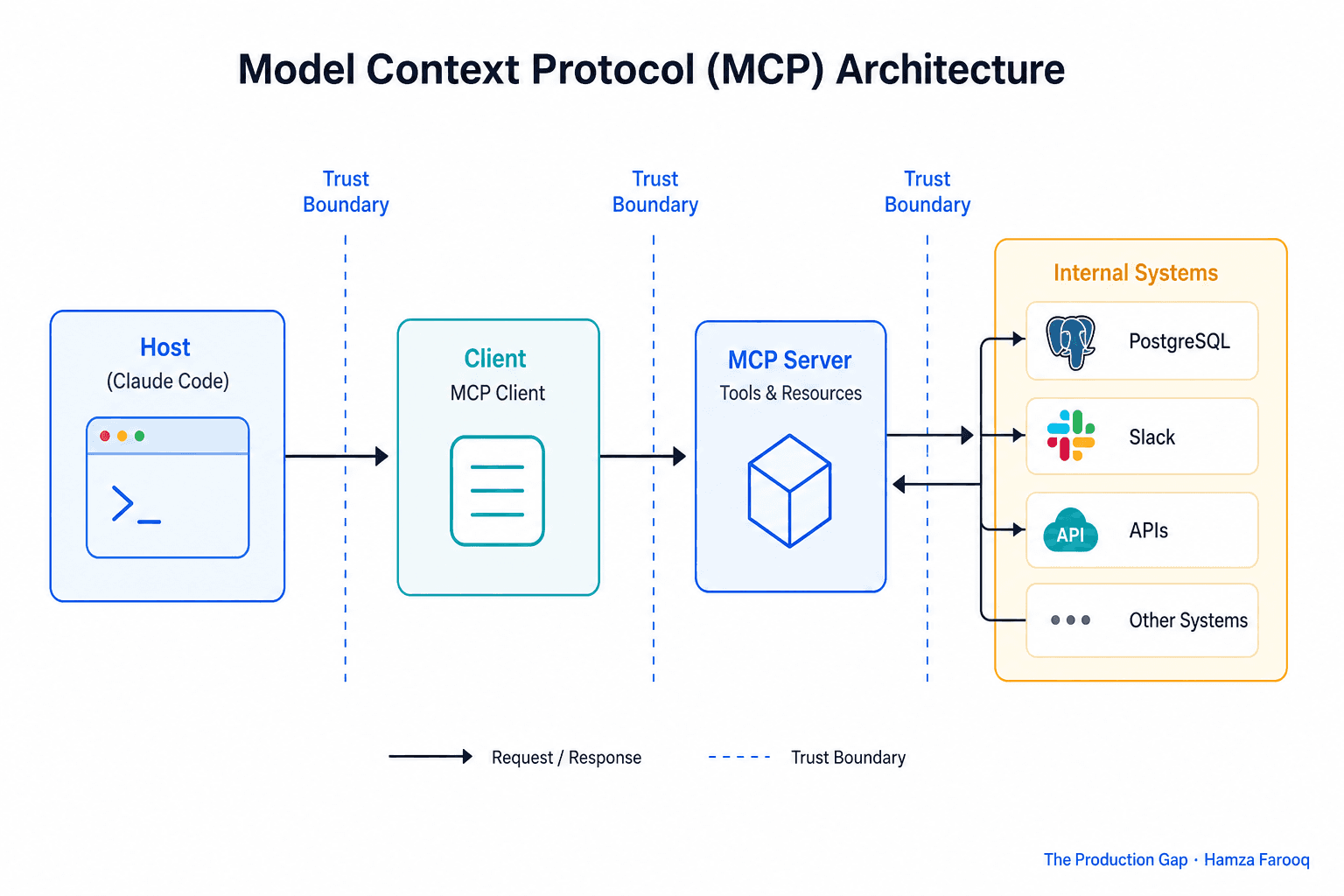
MCP has three layers (host, client, and server) and each server exposes up to three primitives: tools (actions), resources (readable data), and prompts (reusable templates). Conflating any of these produces servers that are hard to use and harder to secure.
The host and client layers
The host is the AI application (Claude Code). It manages the user session and connects only to MCP servers, never directly to your database. The client lives inside the host, managing one server connection at a time: transport, capability negotiation, and message routing.
The server and its three primitives
The MCP server sits between the AI client and your internal system, translating protocol messages into API calls or SQL queries. It exposes three primitives.
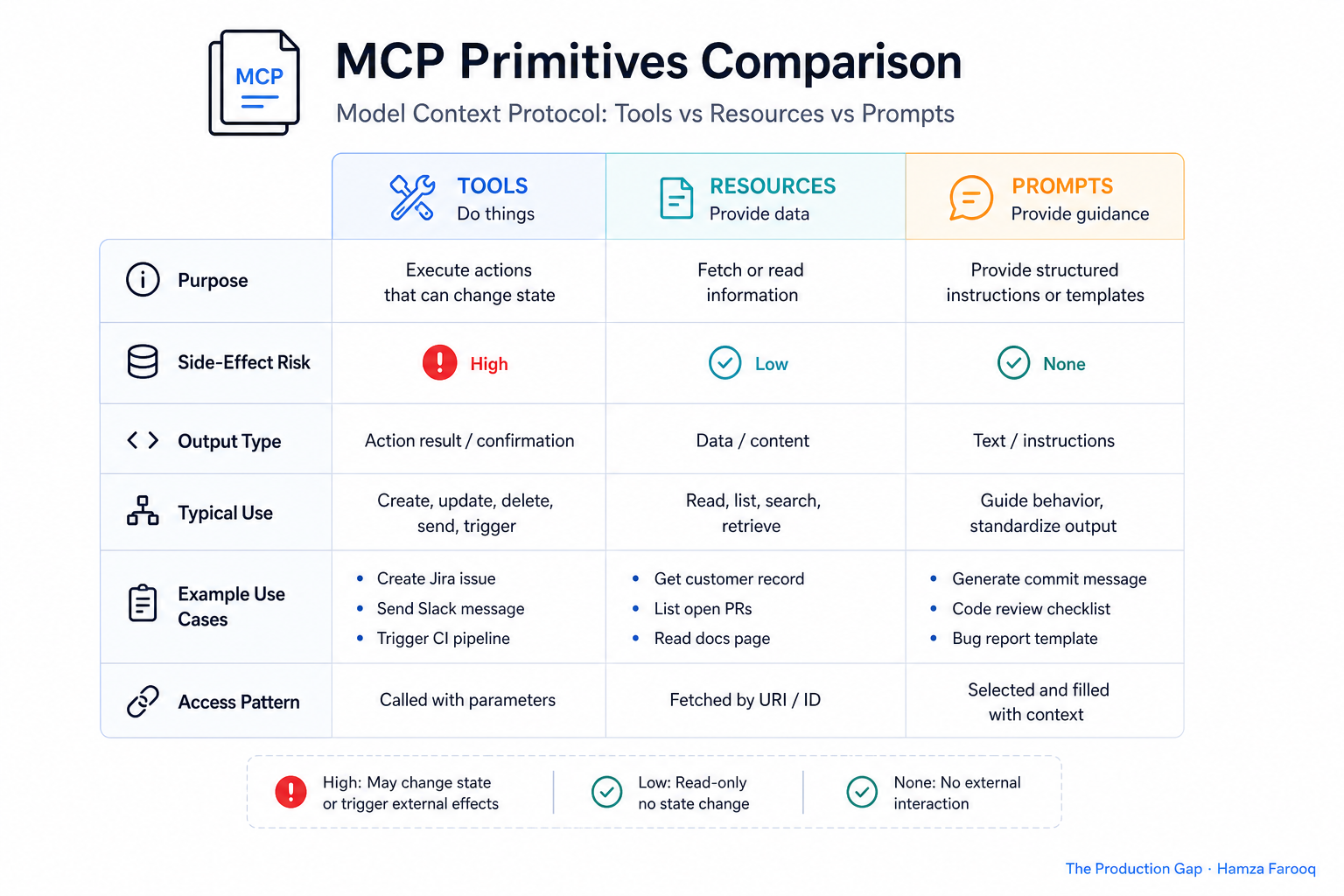
Tools are callable functions the model invokes: run_sql_query, post_slack_message. They cause side effects and carry the most risk. Resources are read-only data endpoints (a database schema, a dashboard payload) with no side effects. Prompts are pre-authored instruction templates that users invoke (not the model), like a "summarize last incident" prompt that queries your alerting system.
| Primitive | Initiated by | Side effects? | Example |
|---|---|---|---|
| Tool | AI model | Yes | run_sql_query, post_slack_message |
| Resource | AI or user | No | Live dashboard JSON, DB schema |
| Prompt | User | No | "Summarize last incident" template |
A miscategorized tool-as-resource is a security boundary mistake, not a naming preference.
How do you connect Claude Code to real internal systems, and which transport should you use?
Connecting Claude Code to an internal system means building or configuring an MCP server that wraps that system's API or database driver, then registering it in Claude Code's config. Transport choice depends on whether the server is local or shared.
Stdio transport runs the MCP server as a local subprocess over stdin/stdout. Zero network configuration, fast to prototype, and the default for most open-source servers. Hard limit: one developer, one machine.
HTTP with SSE runs the server as a persistent HTTP service, which makes auth headers, TLS, and centralized logging possible. It's required for team-wide deployments serving dozens of engineers at once.
A PostgreSQL MCP server exposes a run_query tool against a read-replica using a scoped read-only user, and a get_schema resource returning table definitions. Build with stdio locally, then migrate to HTTP/SSE before the server goes shared, most MCP configuration failures at scale trace back to skipping that step.
What are the real security risks of MCP servers, and how do you manage them in production?
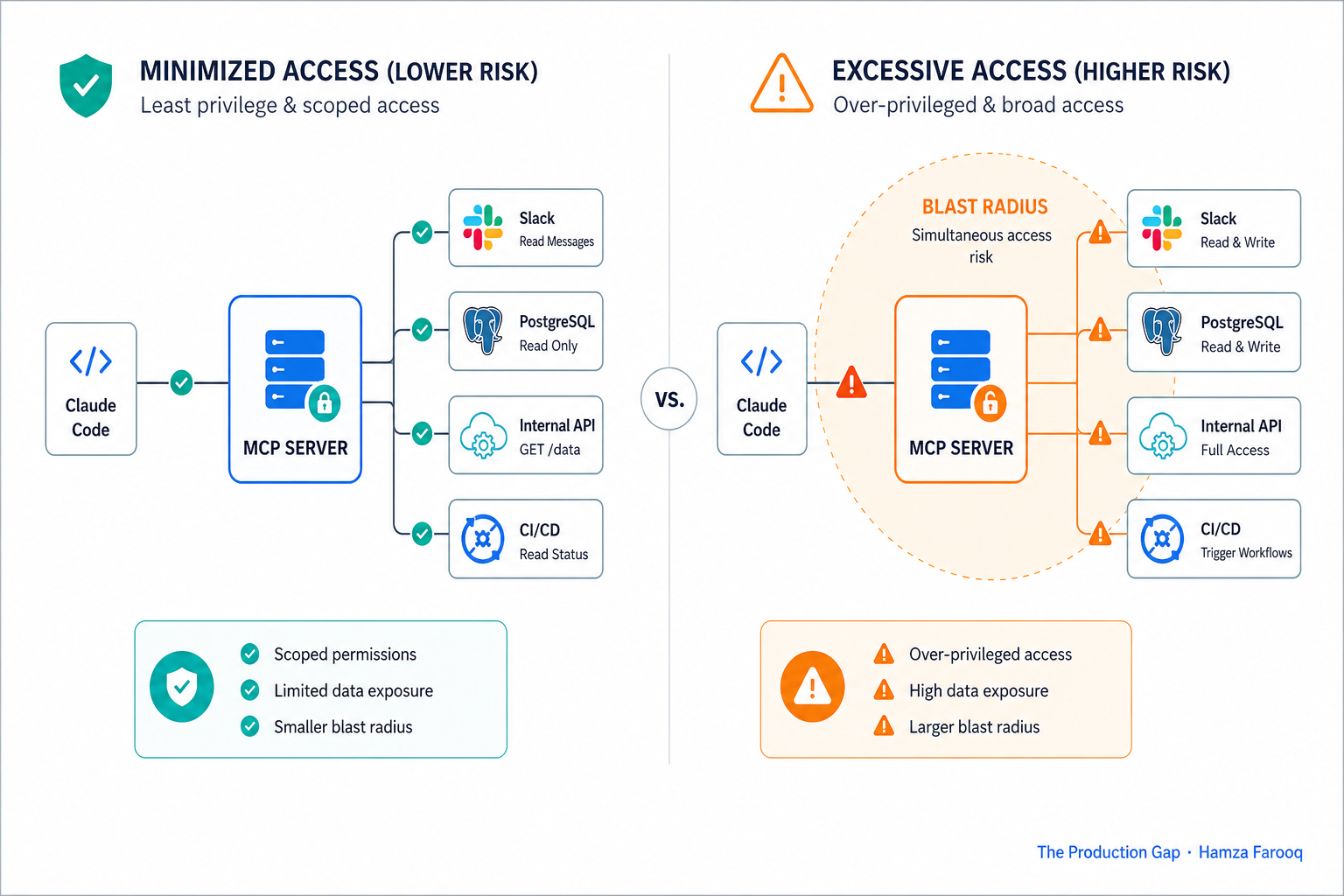
Every MCP server is a privileged intermediary with direct access to your internal systems. A single compromised server can simultaneously pull data from every system it touches, a blast radius that dwarfs a single leaked API key.
The underreported threat surface
An MCP server with broad tool access across Slack, PostgreSQL, and CI/CD is a high-value target most security teams have no threat model for. Security researchers flagged this pattern in 2025, and enterprise teams are still catching up.
Authentication, authorization, and least privilege
MCP servers must enforce their own authentication (the protocol does not do this for you. For HTTP/SSE servers, require OAuth 2.0 or API key validation on every request. Scope each tool to minimum privilege: run_query uses a read-only database user, never the application superuser. Treat each tool's permission scope like an IAM policy) explicitly defined, regularly audited.
Secrets management and audit logging
Credentials must live in a secrets manager (HashiCorp Vault, AWS Secrets Manager), never in .env files or version control. Every tool invocation (what was called, by whom, with what arguments) must go to your Security Information and Event Management (SIEM(. Audit logging is consistently the first control teams drop and the first gap surfaced in post-incident reviews.
The adoption-ahead-of-policy gap
As of July 2026, MCP adoption is outpacing security policy in most organizations. Require a formal security review before any MCP server touches production, the same gate you'd apply to any new production service.
Frequently Asked Questions
What is the difference between MCP tools, resources, and prompts? Tools are model-initiated actions with side effects; resources are read-only data pulled into context; prompts are user-invoked instruction templates. Choose based on who initiates it and whether it causes side effects.
How do you connect Claude Code to a private internal database securely? Run the MCP server against a read-replica with a scoped read-only user, enforce OAuth or API key auth, store credentials in a secrets manager, and log every tool invocation. Never expose the server on the public internet.
How is MCP different from OpenAI function calling or LangChain tool use? Function calling and LangChain tool use are model- or framework-specific, so integrations don't transfer between them. MCP is a transport-level protocol: build one server and every compliant AI host connects without modification.
How do you manage secrets and access control for MCP servers at enterprise scale? Store all credentials in Vault or a cloud secrets manager, assign each server its own service identity with minimum required permissions, require a security review before connecting to production, and log all tool invocations to a SIEM on the same cadence as IAM role audits.
Conclusion
MCP fixes integration sprawl with a clean architecture and well-scoped primitives. The open specification is why it won. Security policy hasn't caught up to deployment pace, and that gap is where incidents happen.
Before any MCP server touches production, four questions need clear answers: Is authentication enforced at the server level? Are credentials in a secrets manager? Is every tool invocation logged? Has the server had a security review?
MCP is production infrastructure with a real blast radius, treat it that way from day one.
Learn from me
Claude Code in Practice, my Maven cohort. Master Claude Code from fundamentals to advanced orchestration: skills, subagents, hooks, MCP, and production automation. Join the next cohort →
Hire us
Traversaal.ai. We're a team of forward deployed engineers solving the toughest AI problems for Fortune 100 companies: document intelligence, agentic data platforms, and real-time web intelligence, deployed in production. Work with our team to deploy your next agentic ecosystem. Talk to Traversaal.ai →
Join us
Want to solve these problems with us? We're always looking for forward deployed engineers who want to ship production AI. jobs@traversaal.ai
