
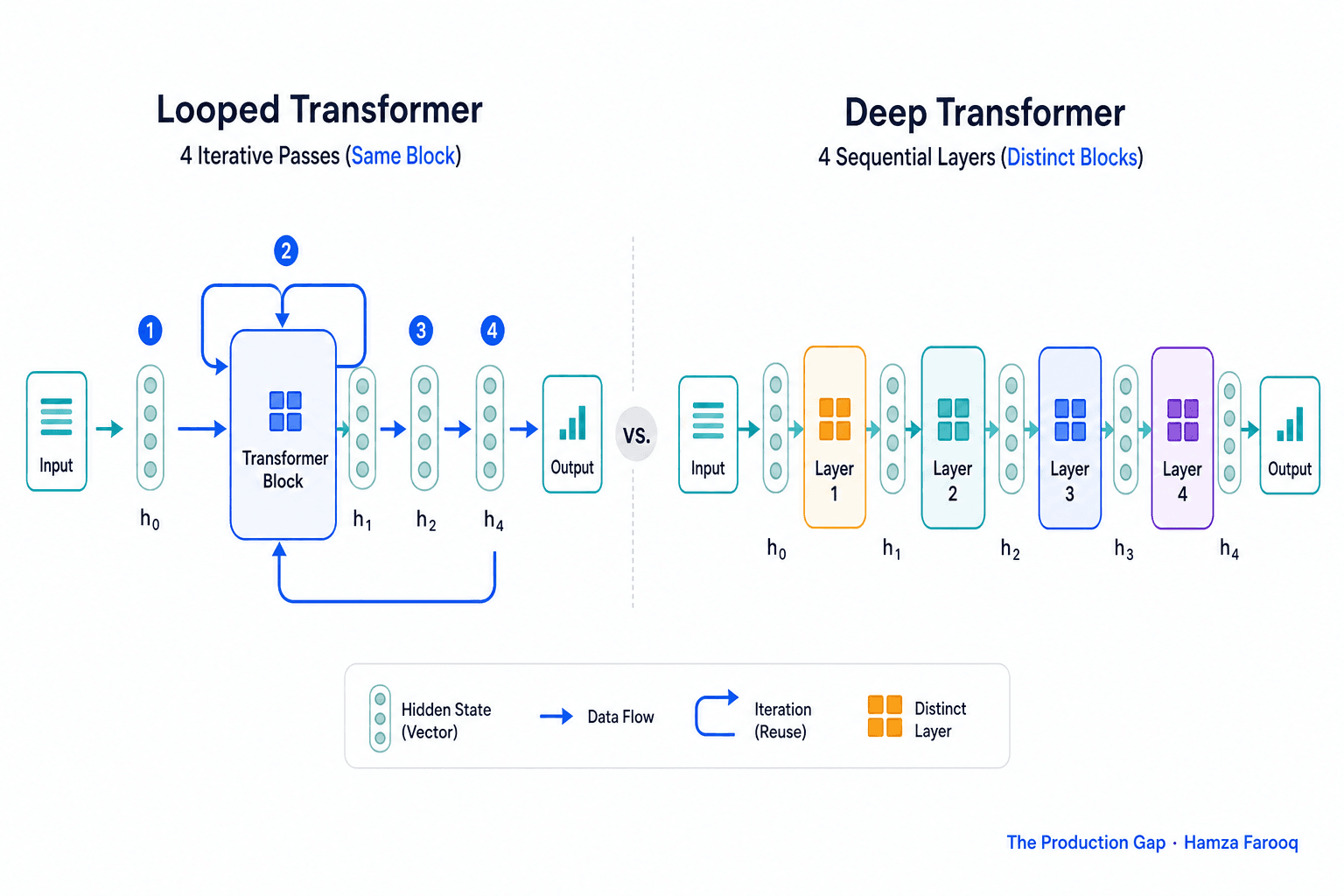
TL;DR: Looped transformer iterative reasoning lets a model refine its internal state across repeated passes through the same weights, producing multi-step reasoning without ever emitting visible chain-of-thought tokens. Developers lose their primary window into model logic, making traditional prompt-level debugging unreliable and conventional output auditing insufficient. Trust now depends on architectural transparency and specialized interpretability tooling rather than inspecting generated text.
Key Takeaways
- Looped transformers reuse one block: The same transformer block runs repeatedly instead of stacking separate layers.
- Reasoning stays hidden inside: All thinking happens in internal memory states; no readable chain-of-thought text appears.
- Fewer parameters, more compute: Looped designs use less memory but require more processing at inference time.
- Standard observability tools go blind: Pipelines built to read CoT tokens produce nothing useful when reasoning never surfaces as text.
- Auditability becomes a compliance risk: Inability to show how a model reached a decision creates legal exposure in regulated industries.
- Probing hidden states is the new debugging: Developers must inspect raw activations rather than readable output.
What is looped transformer iterative reasoning?
Looped transformer iterative reasoning is an architectural pattern in which a single transformer block reuses its weights across multiple passes, refining internal hidden states to produce multi-step reasoning without emitting any intermediate tokens. Most ML engineers have built their observability stacks around one assumption: the model's thinking surfaces as text. Looped transformer iterative reasoning makes that assumption structurally wrong.
When the same transformer block runs iterative passes in latent space and never emits intermediate tokens, your logging pipeline reads silence as signal. MELT and Think-at-Hard (Wang et al., OpenReview 2024) represent active research directions in this space, with efficiency properties that are well-documented in the literature. The compliance implications have received far less attention.
How does a looped transformer actually reason without generating visible tokens?
A looped transformer reasons by passing intermediate representations through the same block repeatedly, refining internal hidden states without ever emitting readable chain-of-thought tokens.
What are the real trade-offs between looped and standard deep architectures?
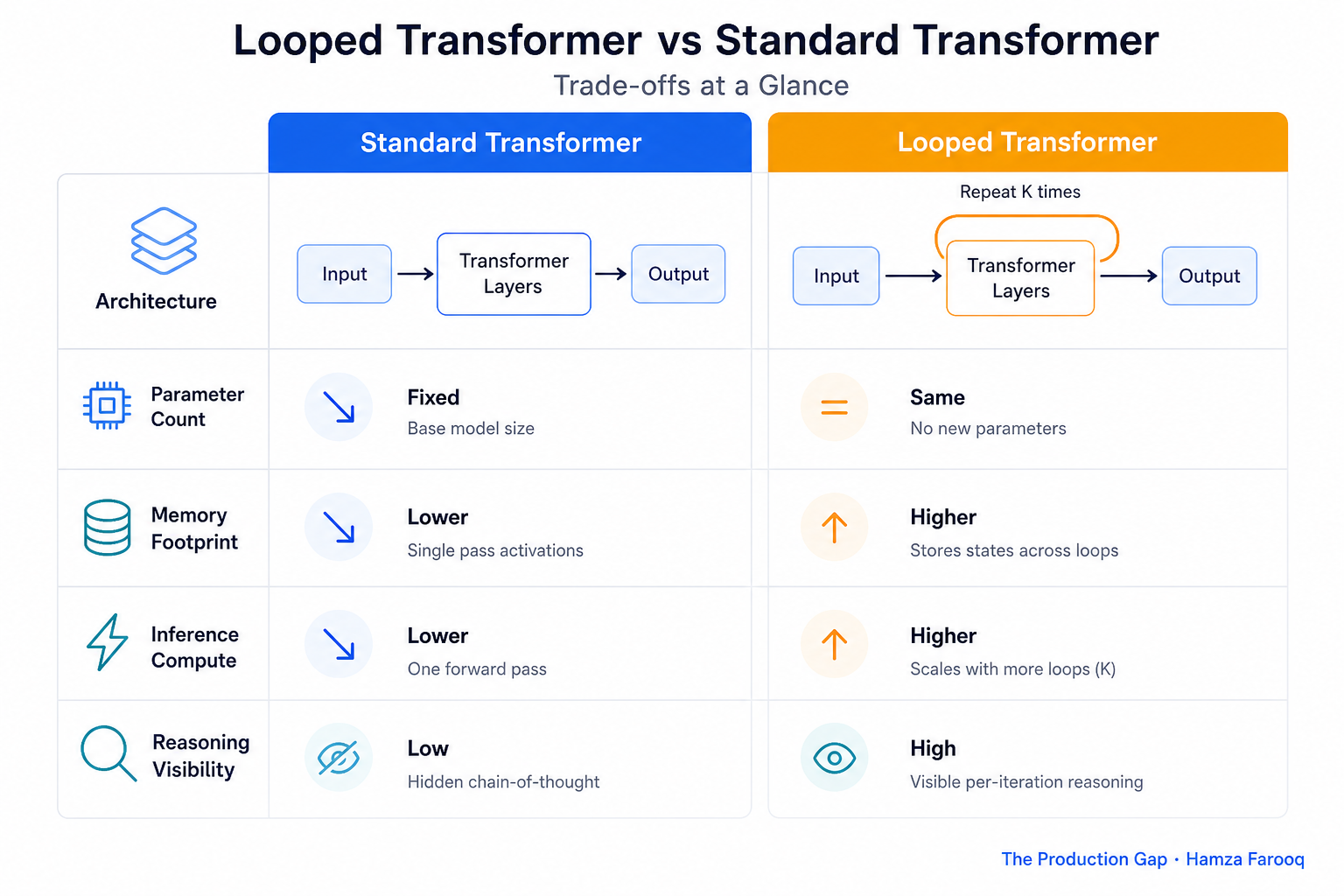
Looped transformers trade parameter count and memory footprint for increased inference-time compute, achieving comparable reasoning depth through iterative block reuse with far fewer parameters.
Looped transformers can emulate iterative learning algorithms with far fewer parameters than standard transformers. The Memory-Efficient Looped Transformer (MELT) specifically decouples reasoning depth from memory consumption . Many reasoning problems can be solved via iterative algorithms, making looped models a practical alternative to deeper architectures.
Table 1: Looped vs. Standard Transformer Trade-offs
| Dimension | Standard Deep Transformer | Looped Transformer |
|---|---|---|
| Parameter count | High (one set per layer) | Low (one shared block) |
| Memory at rest | Large | Small |
| Inference compute | Fixed per token | Variable; scales with loops |
| Reasoning visibility | Token-stream (CoT possible) | Latent only; no token trace |
| Debuggability | High (log CoT tokens) | Low (probe hidden states) |
| Dynamic depth | No | Yes (Think-at-Hard approach) |
The "reasoning visibility" row is the one most teams skip during architecture evaluation. It determines whether your observability stack functions at all.
Two broad design families exist within looped architectures, and they have different implications for developers. Static designs fix the number of iterations as a hyperparameter set at training time, so iteration count is constant and predictable. Dynamic designs, such as Think-at-Hard (Wang et al., OpenReview 2024), use a learned gating mechanism to determine how many latent iterations each input requires, performing multiple latent iterations to refine each token beyond a single forward pass (Wang et al., OpenReview 2024). That variability has direct consequences for latency budgets and audit reproducibility.
Why do standard interpretability and debugging tools fail on looped architectures?
Standard interpretability tools fail on looped transformers because they are designed to inspect token streams and layer-specific activations, structures that looped architectures either eliminate or collapse into a single reused block, leaving no stable layer boundary to probe.
Most production observability pipelines do one of a few things: parse CoT token text, attach attention visualization to specific numbered layers, or log logit distributions at intermediate positions. Looped architectures undermine all of them simultaneously.
For deployments in regulated industries, this raises a question worth examining with legal counsel: whether latent iterative reasoning, absent compensating controls, can satisfy documentation or explainability obligations that a specific regulatory context may impose. Selecting a hidden chain-of-thought architecture is also an auditability decision, and most teams making it have not framed it that way.
What can developers actually do right now to debug and audit looped transformer agents?
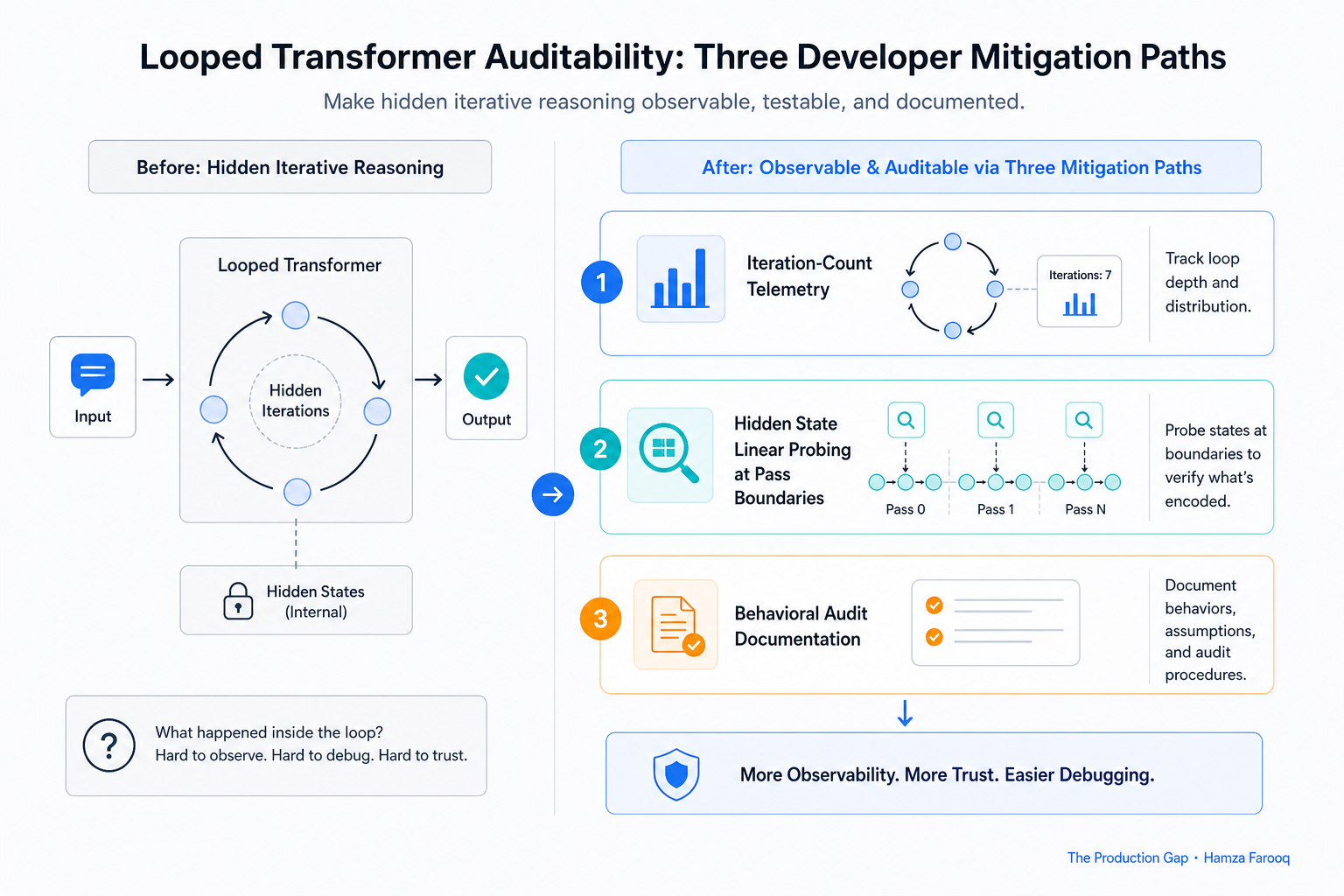
Developers can probe looped transformer reasoning by inspecting raw hidden state activations at each iterative pass using linear probing, representation similarity analysis, and iteration-count monitoring, replacing token-level logging with activation-level telemetry.
1. Iteration-count telemetry. Log iteration counts per inference call. Inputs that consistently push against the maximum loop cap represent harder reasoning problems; flag those clusters for human review.
2. Hidden state probing at pass boundaries. At each loop boundary, extract the full hidden state vector. Train lightweight linear probes on labeled reasoning-step data to classify what the hidden state encodes, such as factual retrieval, arithmetic, or logical inference. This is the closest functional analog to reading chain-of-thought text.
3. Architecture-level audit documentation. For regulated deployments, document explicitly that the model uses latent iterative reasoning, what iteration bounds are enforced, and what behavioral test suites substitute for chain-of-thought inspection. Where mechanistic tracing is unavailable, naming and mitigating the gap is, in the author's experience, a stronger position than leaving it undocumented, though specific regulatory acceptance will depend on the framework and jurisdiction involved.
FAQ
Q1: How does a looped transformer decide how many iterations to run?
Looped transformers determine iteration count via either a fixed hyperparameter set at training time or a learned gating mechanism in dynamic designs like Think-at-Hard (Wang et al., OpenReview 2024). Static designs run a constant number of passes regardless of input difficulty. Dynamic designs, such as Think-at-Hard, apply a learned gate that evaluates whether the current hidden state warrants another pass, allocating more compute to harder inputs automatically (Wang et al., OpenReview 2024).
Q2: Can chain-of-thought prompting still influence a model that reasons in latent space?
A CoT prompt shapes the input representation, but the underlying architecture determines whether any intermediate reasoning tokens are emitted. Developers should not assume CoT prompting provides observability benefits on architectures that do not emit intermediate tokens.
Q3: How does looped transformer reasoning compare to token-visible scratchpad approaches in terms of auditability?
Token-visible scratchpad models produce a log-able token trace at every reasoning step; looped transformers produce no token trace at all. As a practical rule of thumb used in this guide, that gap is categorical rather than a matter of degree, and it should be treated as a binary compliance consideration for regulated deployments rather than a gradual tradeoff.
Q4: Are looped transformer architectures compliant with AI transparency requirements?
That depends entirely on the regulatory framework and jurisdiction in question, and this article makes no legal determination. What is clear is that latent iterative reasoning produces no mechanistic token trace, which creates a documentation challenge worth reviewing with legal counsel before finalizing architecture for high-risk use cases.
Conclusion
The efficiency case for looped transformer iterative reasoning is real: fewer parameters, decoupled reasoning depth, and test-time compute scaling (arXiv:2502.17416). When reasoning moves entirely into latent space, every observability tool built on token inspection becomes ineffective, not merely degraded, but inapplicable by design.
The gap most teams have not closed is definitional. Classifying "this model uses latent iterative reasoning" as an architecturally significant fact, the kind that belongs in a model card, a system design review, and a legal risk assessment, is what makes the mitigations tractable. Those mitigations include iteration telemetry, hidden state probing, behavioral audit suites, and documented regulatory rationale.
Start here: audit every reasoning model in your production stack and flag explicitly whether its chain-of-thought is token-visible or latent. That list is the foundation of everything else.
Learn from me

Agent Engineering Bootcamp: Developers Edition, my Maven cohort. Advanced agentic RAG, multi-agent orchestration, memory, evals, and guardrails. Take agents from prototype to production. Join the next cohort →
Hire us
Traversaal.ai. We're a team of forward deployed engineers solving the toughest AI problems for Fortune 100 companies: document intelligence, agentic data platforms, and real-time web intelligence, deployed in production. Work with our team to deploy your next agentic ecosystem. Talk to Traversaal.ai →
Join us
Want to solve these problems with us? We're always looking for forward deployed engineers who want to ship production AI. jobs@traversaal.ai
