
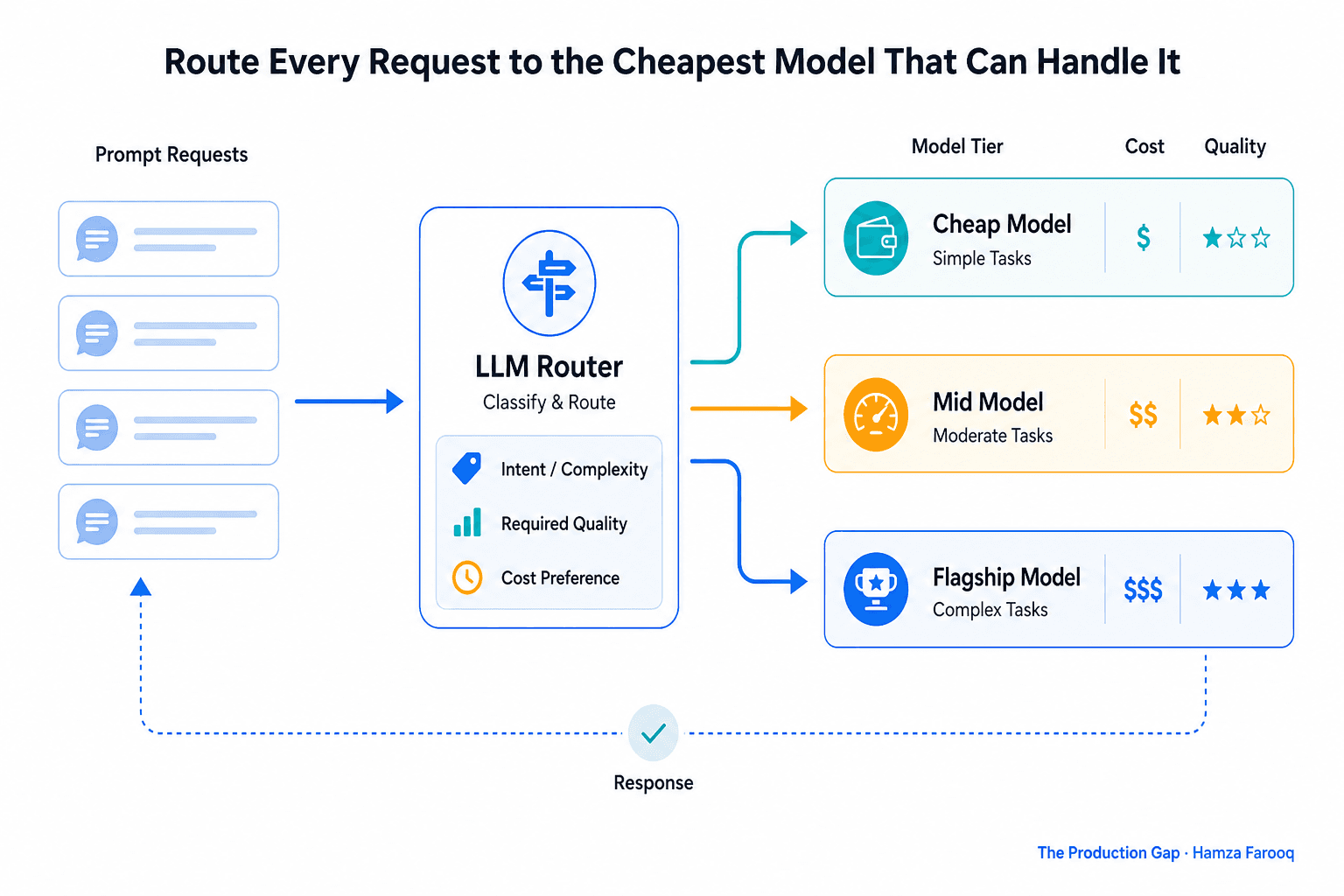
TL;DR: LLM router cost optimization works by classifying each incoming request and routing it to the least expensive model capable of handling it well, reserving powerful models only for genuinely complex queries. Teams commonly report 40–70% cost reductions, but the real tradeoffs (added latency, continuous routing-logic maintenance, and the eval burden of validating quality at every tier) rarely appear in vendor pitches.
Key takeaways
- Routing works by classifying difficulty first: The router scores complexity and picks the cheapest capable model before any inference call.
- Most requests don't need your best model: In real traffic, a large share of prompts are simple enough for smaller models.
- Confidence thresholds control quality risk: Below-threshold scores escalate to a stronger model rather than risk a wrong classification.
- Routing adds latency you have to budget for: Classification overhead only pays off if cheaper models' lower cost offsets it.
- Routing logic needs ongoing maintenance: Model releases and shifting traffic distributions cause routing rules to drift.
- Real savings depend on your traffic mix: The fraction of genuinely simple requests in your product determines the ceiling.
Introduction
Per-token prices keep falling, yet AI teams pay more than ever because volume has exploded. Most production systems still send every request to the same flagship model regardless of what the request actually needs. LLM router cost optimization fixes this: classify each prompt by difficulty, send it to the cheapest capable model. Anyscale achieved up to 70% cost reduction on MT Bench with no measurable quality loss. This article explains exactly how that works, and what it costs to build and maintain.
How does an LLM router classify prompt difficulty and select a model?
The router pulls signals (token length, syntactic complexity, multi-step reasoning requirements, domain specificity) and feeds them into a fine-tuned classifier that produces a difficulty score mapped to a tier:
| Tier | Example models | Best for |
|---|---|---|
| Cheap | Llama 3.1 8B, Gemini Flash 2.0 | FAQ answers, classification, short summaries |
| Mid-tier | GPT-4o Mini, Claude Haiku | Moderate reasoning, code snippets, structured extraction |
| Flagship | GPT-4o, Claude Opus | Complex reasoning, long-form generation, ambiguous tasks |
Morphllm's router benchmarks show classification completes in approximately 430ms (real overhead you have to budget for. A customer support chatbot shows the split clearly: "What are your return policy hours?" routes to cheap-tier; "Help me dispute this charge under EU consumer law" goes straight to flagship. Difficulty classification is a scoring problem, not a rules problem) treating it as rules breaks at scale.
How much can LLM routing actually save, and what does the data show?
Verified numbers: Anyscale achieved up to 70% cost reduction at equivalent quality. AI Router reports up to 60% savings compared to routing everything through GPT-4o. DigitalApplied's guide documents 40–85% in real deployments.
The honest math: if a large share of your prompts are simple, routing them to cheap-tier captures most of the available savings. If your product is a code review tool where most requests require multi-step reasoning, the proportion of traffic eligible for cheaper models shrinks and savings shrink with it.
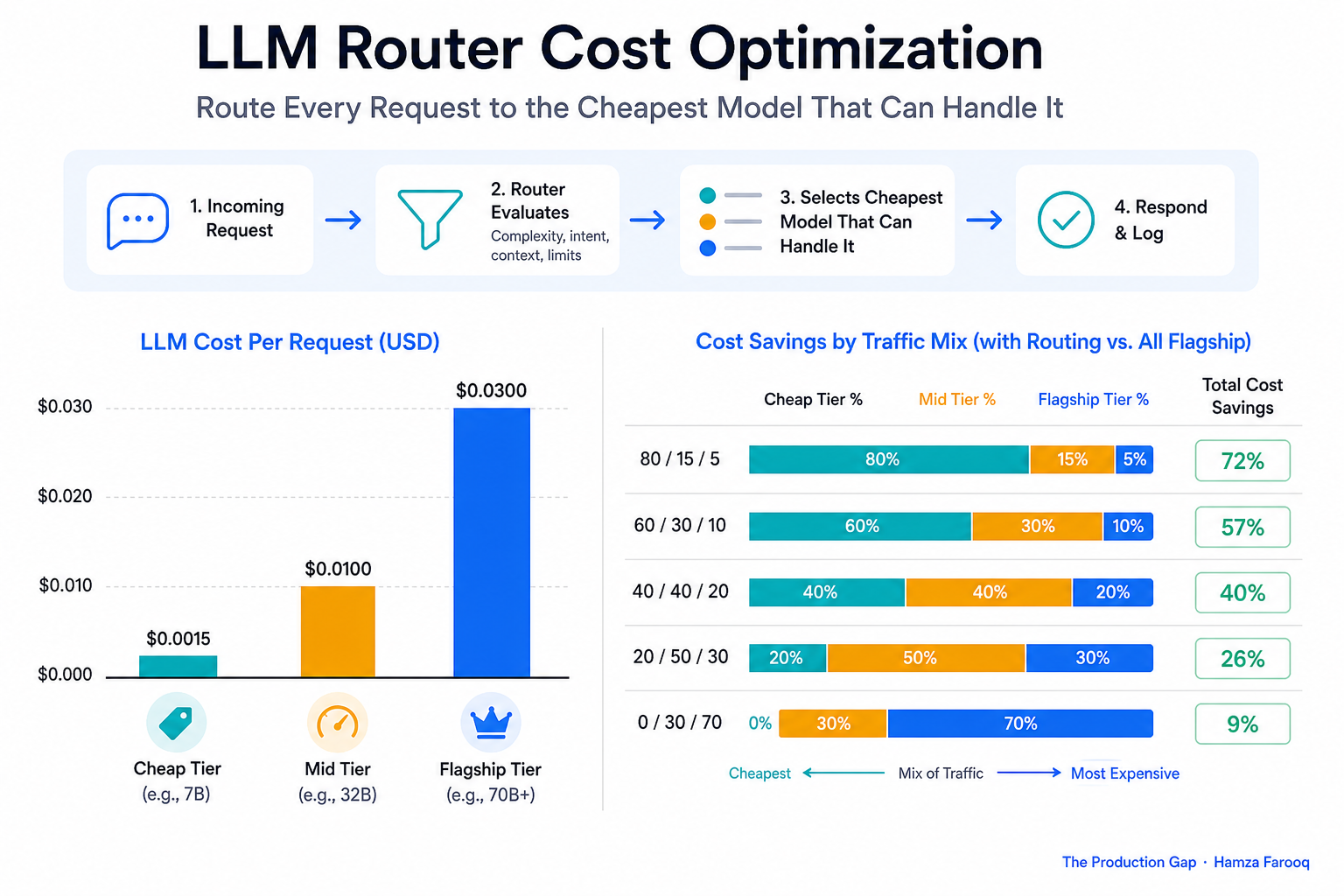
Audit your traffic before projecting savings. Categorize 500 real production prompts by hand, that exercise tells you more than any vendor benchmark.
What happens when the router gets it wrong, how do confidence thresholds and fallbacks work?
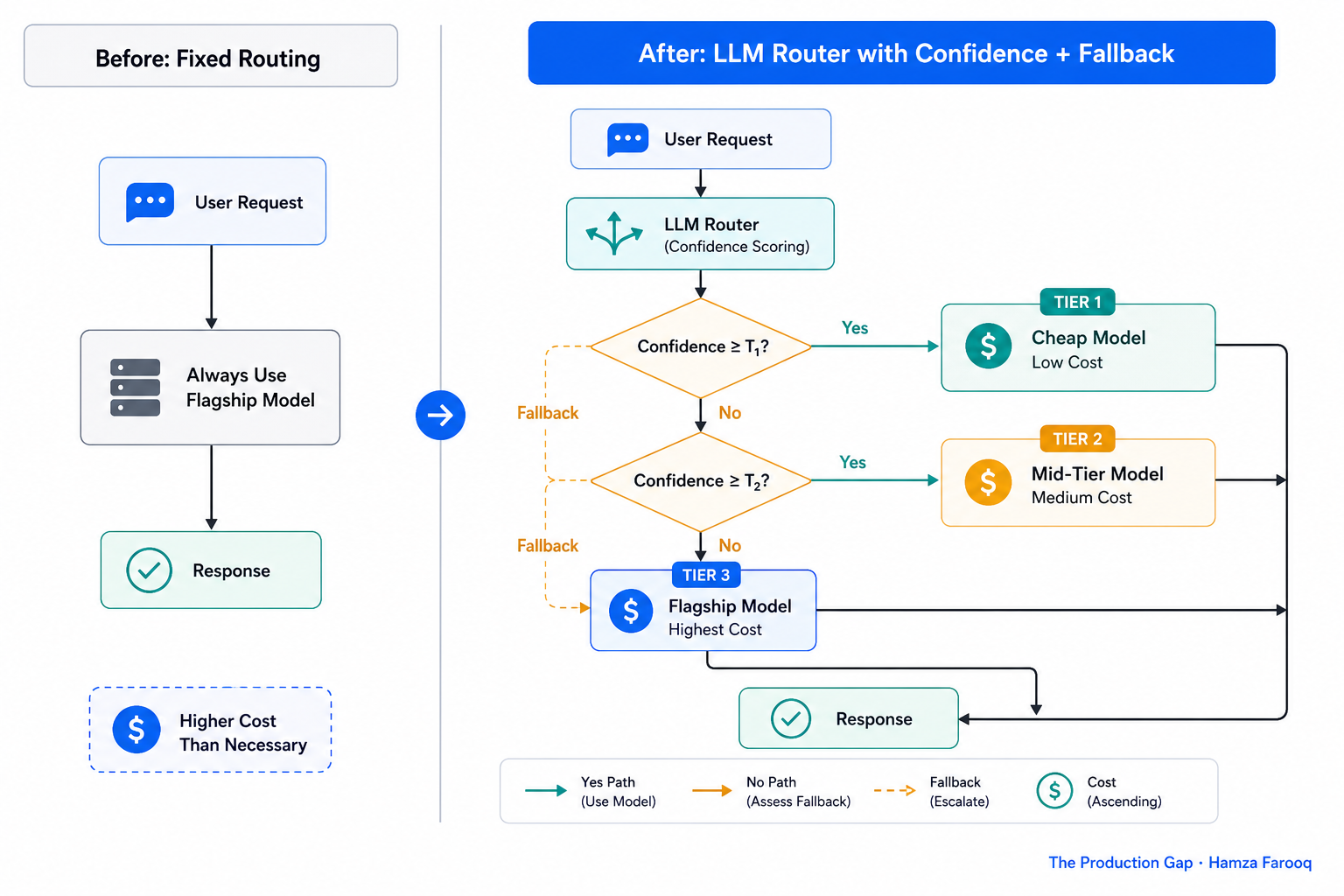
When a router's confidence score falls below a set threshold, fallback logic automatically escalates the request to the next model tier rather than risk degrading output quality.
A routing confidence threshold is the minimum certainty the classifier must reach before committing to a cheaper model. If the router scores a prompt at 0.72 for cheap-tier but your threshold is 0.85, it escalates to mid-tier, and again to flagship if mid-tier also fails to clear the threshold. Lower thresholds maximize savings but increase misrouting risk; higher thresholds protect quality but push more traffic to expensive models.
This tradeoff has real product consequences: a misrouted complex request doesn't just produce a bad response, it erodes user trust in ways that are hard to measure after the fact. Threshold calibration is a product and business decision, not a pure accuracy metric. Set it by calculating the actual business cost of a misrouted response in your specific context.
Why does routing logic drift, and how do you maintain it without letting it silently break?
LLM routing logic drifts when the model landscape changes (new models launch, existing models update, or traffic mix shifts) and a router trained on last quarter's conditions silently stops making optimal decisions.
Drift has two failure modes: routing hard tasks to newly cheap but underqualified models, which causes silent quality degradation, or missing newly capable cheap models that could absorb expensive-tier work, which causes savings to plateau. Neither failure mode announces itself, costs rise or quality falls before anyone connects the symptom to the router.
Maintenance cadence:
- Monthly: Re-evaluate tier assignments against current model pricing.
- Quarterly: Run evals on your actual production prompt sample, not public benchmarks.
- On new model release: Stress-test on your hard-tier prompt set before routing live traffic.
- On major feature ship: Re-audit traffic mix whenever product changes could shift prompt complexity.
The routing layer needs a dedicated eval pipeline and a named owner, or it becomes a slow source of quality and cost regression that nobody notices until it is expensive to fix.
FAQ
Q: How does an LLM router decide which model to send a request to? It scores the prompt on complexity signals (length, reasoning requirements, task type, domain specificity) using a lightweight classifier, then maps that score to the cheapest capable model tier. The classification step takes around 430ms and runs before any inference call.
Q: What is the latency cost of adding an LLM routing layer to my inference pipeline? Classification overhead runs around 430ms before inference. For async or batch jobs this is negligible. For real-time chat, verify the cheaper model's faster inference offsets the overhead and that the total round-trip still meets your SLA.
Q: How much can LLM routing realistically save compared to always using GPT-4o or Claude Opus? Verified production data shows 40–85% reductions, with Anyscale at up to 70% and AI Router at up to 60%. Teams with high volumes of simple prompts see the high end; complex-reasoning products see less. Audit 500 real prompts before projecting a number.
Q: How do I evaluate and maintain routing logic as new models are released? Run monthly pricing audits, quarterly evals on your actual production sample, and stress-tests on new models before routing live traffic. Assign a named owner, routing logic maintained by nobody drifts fast.
Conclusion
LLM router cost optimization is proven in production. Route each request to the cheapest capable model, set confidence thresholds that reflect what a misrouted response actually costs your business, and build fallback logic that escalates rather than gambles.
Routing is not a one-time build. Drift doesn't announce itself, it silently raises costs by missing cheaper capable models, or quietly degrades quality by misrouting hard tasks. Treat the routing layer like any production ML system: dedicated eval pipeline, clear ownership, scheduled review cadence.
Start by auditing 500 real production prompts. That single exercise tells you whether the savings math works for your traffic mix.
Learn from me

Forward Deployed Engineering Bootcamp for Full-Stack Developers, my Maven cohort. Build and ship complete AI products end to end, from React and Node.js frontends to deployed models with caching and observability. Join the next cohort →
Hire us
Traversaal.ai. We're a team of forward deployed engineers solving the toughest AI problems for Fortune 100 companies: document intelligence, agentic data platforms, and real-time web intelligence, deployed in production. Work with our team to deploy your next agentic ecosystem. Talk to Traversaal.ai →
Join us
Want to solve these problems with us? We're always looking for forward deployed engineers who want to ship production AI. jobs@traversaal.ai
