
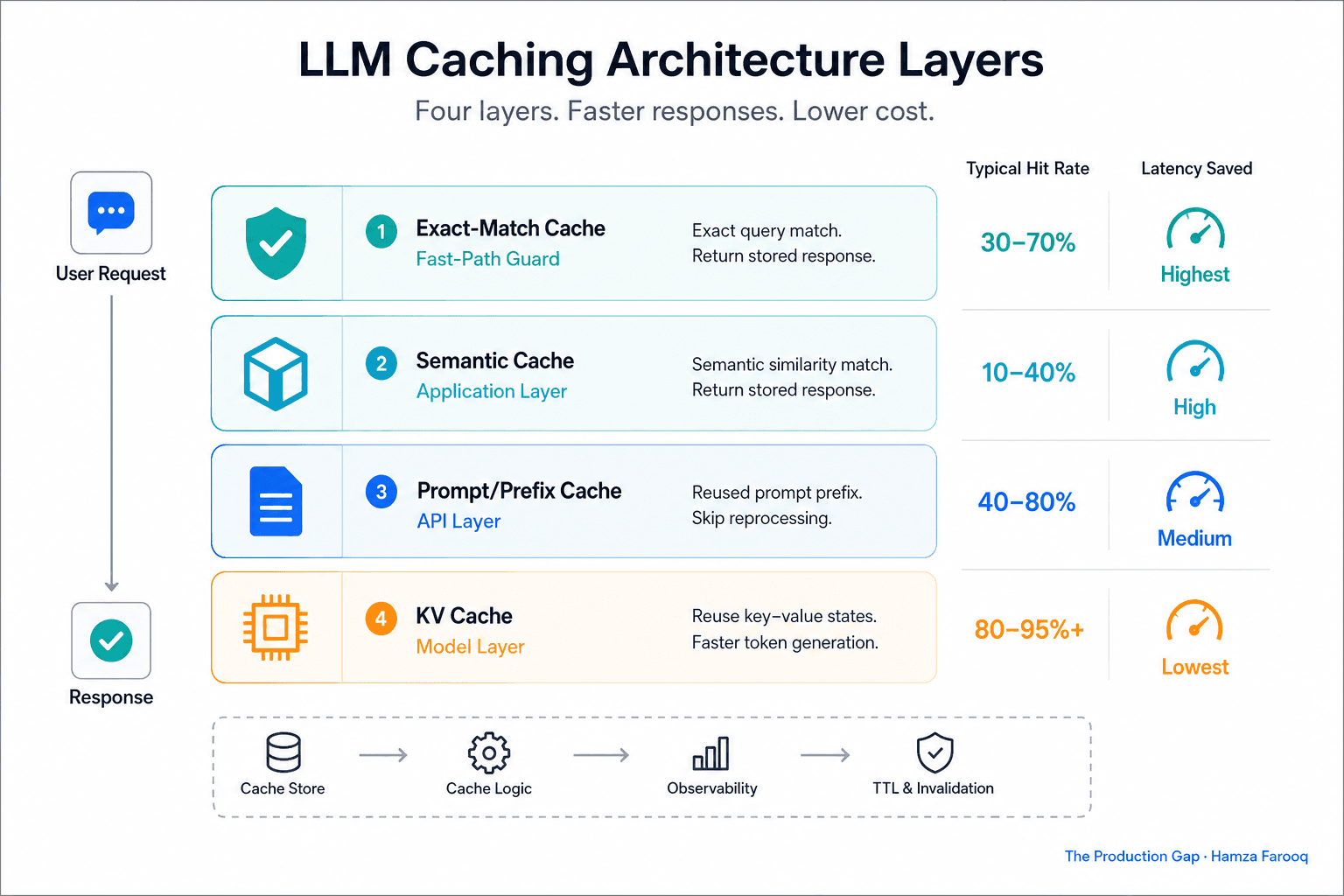
TL;DR: LLM caching reduces inference costs by storing and reusing processed prompt representations or full model responses across four composable layers: exact-match, semantic, prompt/prefix, and KV cache. Each layer targets a different cost-latency tradeoff and requires its own invalidation approach.
Key Takeaways
- Exact-match has a narrow sweet spot: Useful for templated or high-volume repeated prompts, not open-ended conversation.
- Semantic caching trades precision for hit rate: Threshold tuning determines whether you get more hits or subtly wrong answers.
- KV cache works at the model layer, not your app: Prompt structure determines how much redundant computation you avoid.
- Cache invalidation is the sharpest production risk: Each layer needs its own TTL or event-driven refresh.
- Layered caches require per-layer measurement: Track hit rate and quality per layer separately to avoid obscuring savings.
What are the four LLM caching strategies and what does each one actually do?
The four LLM caching strategies (exact-match, semantic, prompt/prefix, and KV) each operate at a different stack layer, are owned by a different team, and fail in a different way.
Exact-match caching hashes the prompt string and returns a stored response on a byte-for-byte match. Zero ambiguity, zero quality risk. Hit rate is low for conversational apps but high for templated pipelines and nightly report generation. Storage is a standard key-value store like Redis.
Semantic caching embeds the prompt and runs a vector similarity search, returning a cached response when cosine similarity exceeds a configured threshold. Hit rate is higher than exact-match, but quality depends entirely on threshold tuning. Storage requires a vector database such as Pinecone, pgvector, or Redis vector.
Prompt/prefix caching is provider-native. Stable token sequences at the prompt head are cached server-side with no application code required, but prompt structure determines your savings.
KV cache is internal to the inference engine. It stores attention key-value computations so the model does not reprocess already-seen tokens. Engineers do not build this; they influence it through prompt structure.
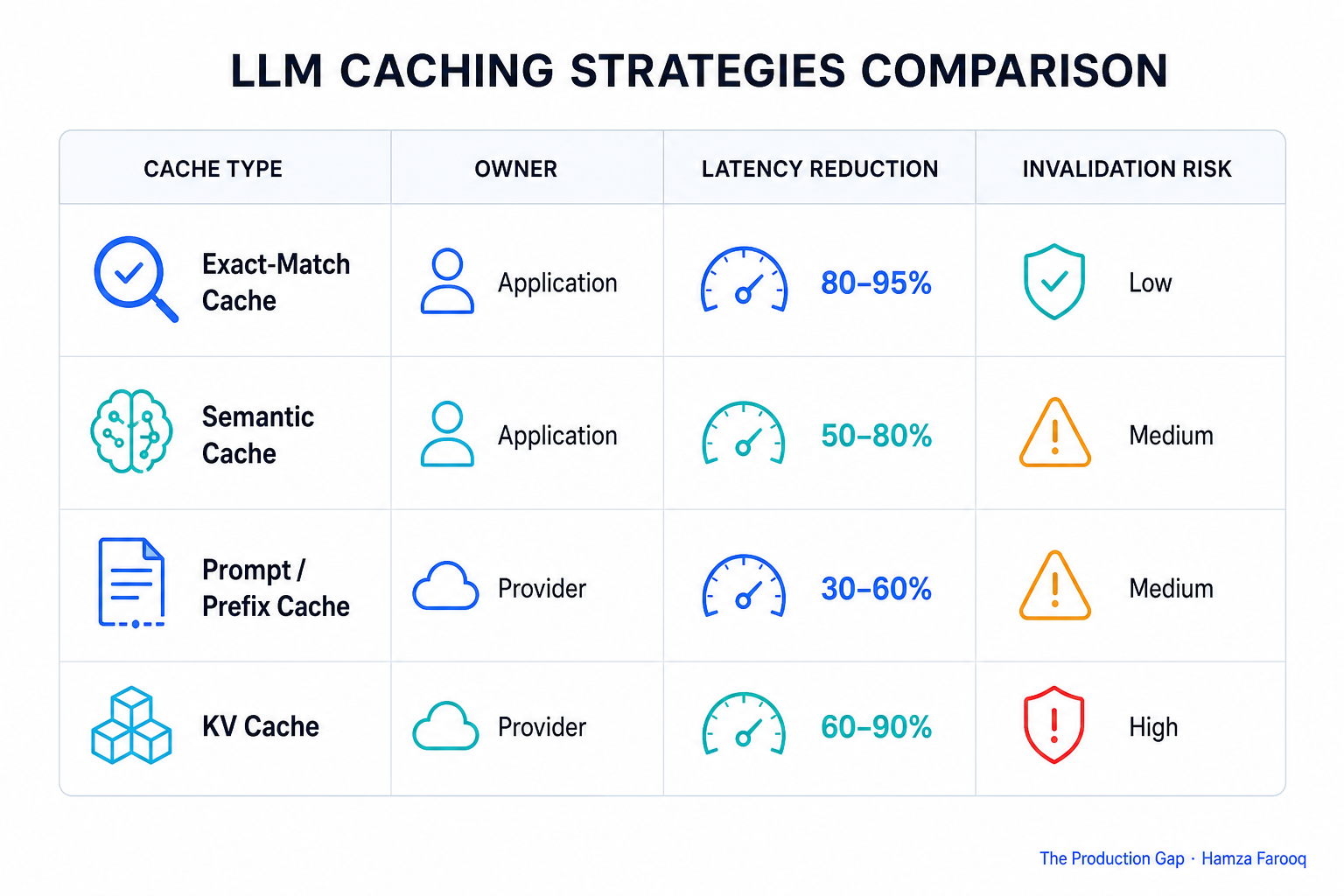
Table 1: LLM Caching Layer Comparison
| Cache Type | Owned By | Primary Benefit | Primary Invalidation Risk |
|---|---|---|---|
| Exact-match | Your app | Instant return on repeated prompts | Stale response on content update |
| Semantic | Your app | Higher hit rate than exact-match | Wrong answer served to similar-but-different query |
| Prompt/Prefix | API provider | Token cost reduction on stable prefixes | Prompt restructuring busts cache silently |
| KV cache | Inference engine | Avoids reprocessing seen tokens | Long context eviction under memory pressure |
How should you set the similarity threshold for semantic caching without degrading response quality?
Threshold selection should be driven by the cost of serving a wrong answer in your specific domain, because embeddings compress semantic nuance, and a high similarity score can still represent meaningfully different queries.
Group use cases by consequence: summarization and creative writing can tolerate lower thresholds; legal, medical, or financial queries warrant thresholds near exact-match territory, or no semantic caching at all. A user asking "What is the capital gains tax rate for assets held over one year?" must not receive a cached answer to "What is the capital gains tax rate?", the answers differ materially if the cached response predates a law change. Add a lightweight re-rank or verification step before serving cached hits in moderate-stakes domains. Test your threshold against real query pairs from your domain before shipping, not synthetic benchmarks.
Pick your threshold based on the cost of a wrong answer, not on what maximizes hit rate.
How do you structure prompts to maximize prefix and KV cache savings at the API layer?
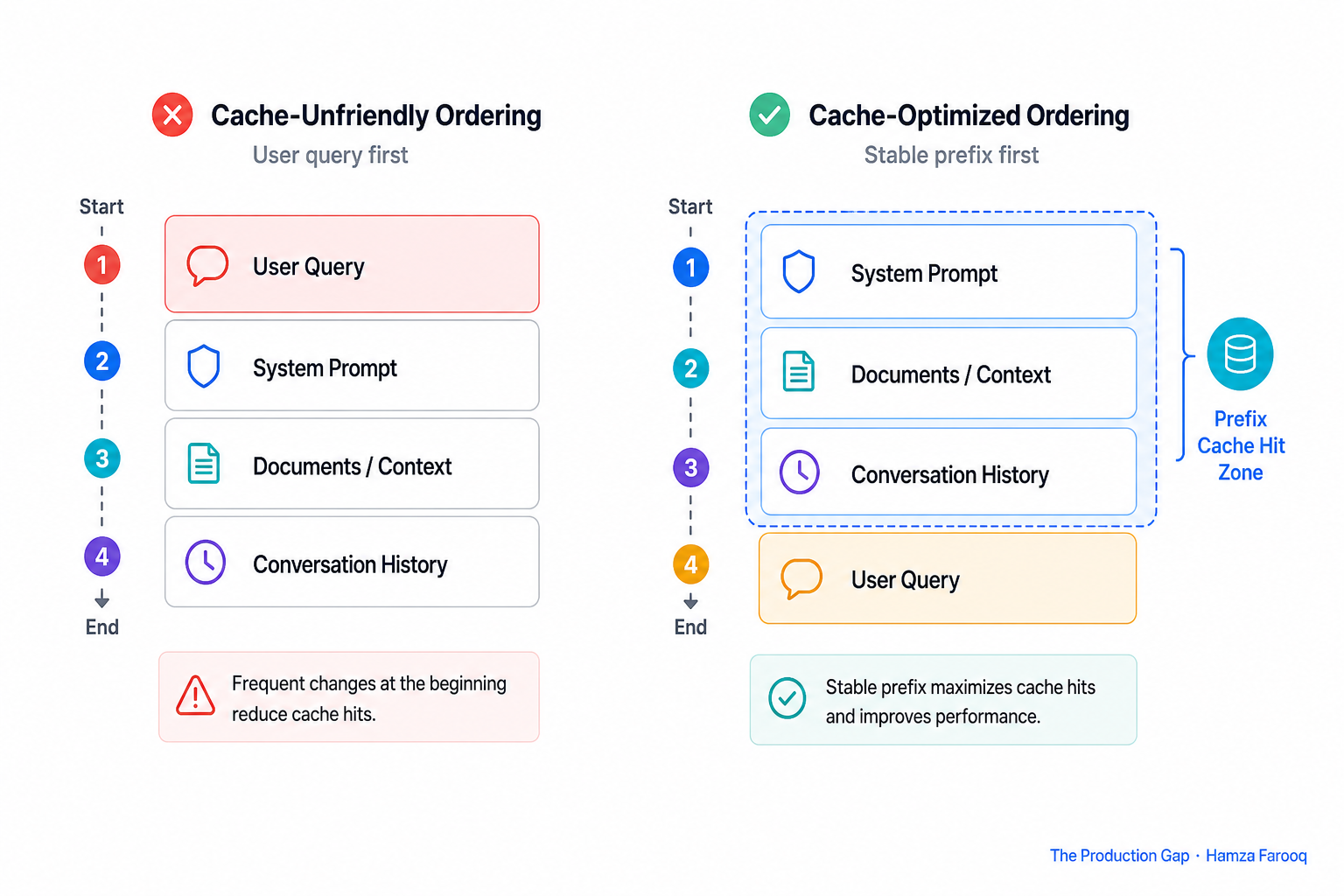
Put stable content first and dynamic content last, because providers cache from the beginning of the prompt forward, and any dynamic content inserted before your system prompt guarantees a cache miss on every request.
When a provider caches a prefix, the KV attention pairs for those tokens are preserved and reused, compounding savings into both token cost reduction and time-to-first-token improvement. For RAG pipelines, place retrieved chunks after the system prompt and before conversation history. If documents change per request but your system prompt is stable, you still capture system-prompt prefix savings, often the largest share of input tokens in instruction-heavy pipelines.
This single reordering change is often worth more than building a semantic cache from scratch.
How do you compose all four LLM caching layers in production?
The correct layering hierarchy runs exact-match first, semantic second, provider prefix third, and KV last, because stale-response risk and quality failure modes differ per layer and a single global TTL cannot cover all of them.
Layer sequence:
- Exact-match as first guard: O(1) lookup, zero quality risk, handles highest-volume repeated queries instantly.
- Semantic cache on exact-match miss; apply domain-appropriate threshold logic here.
- Prompt/prefix cache at the API boundary, fires automatically if prompts are structured correctly.
- KV cache at the model, always active; influenced through prompt structure, not direct control.
Invalidation contracts per layer:
- Exact-match: TTL-based for stable content; event-driven purge on content update.
- Prefix cache: Provider-managed; monitor for silent cache busting when prompt templates change.
- KV cache: Inference-engine-managed; monitor for eviction under high-concurrency load.
Track four metrics per layer separately: cache hit rate, response quality on hits versus live responses, latency reduction, and stale-response rate. Watch for double-counting: if your semantic cache and provider prefix cache both fire on the same request, token-count savings will overcount. Log which layer served each response at the request level.
Define each layer's invalidation contract before deployment. Stale-response risk is specific per cache type and cannot be solved with one global TTL.
Frequently Asked Questions
What is the difference between semantic caching and exact-match caching for LLM applications? Exact-match returns a stored response only on byte-for-byte prompt identity, precise but low hit-rate. Semantic caching matches by meaning, giving higher hit rates but risking a wrong answer to a similar-but-different question.
When does provider-level prompt caching make application-level semantic caching redundant? It rarely does. Prompt caching reduces token cost at the API boundary; semantic caching skips the model call entirely at the application layer. Both can fire on the same request without replacing each other.
How do I measure actual cost savings from each caching layer without double-counting? Log which layer served each response (exact-match hit, semantic hit, provider cache hit, or full model call) and compute savings per layer against the full-model baseline independently.
What similarity threshold should I use for semantic caching in production? Set it based on what a wrong cached answer costs in your domain. High-stakes domains warrant tight thresholds or no semantic caching; lower-stakes workflows can accept permissive settings. Validate against real query pairs before shipping.
Conclusion
The four caching layers form a hierarchy, not a menu. Exact-match guards the fast path. Semantic cache extends coverage with a domain-tuned threshold. Prefix caching works automatically when prompts put stable content first. KV cache runs at the model layer regardless, rewarding the same structural discipline.
Engineers chasing hit rate with an untested cosine threshold are trading accuracy for latency, in high-stakes domains, a wrong cached answer is a product liability, not a performance tradeoff. Running all four layers without per-layer observability means you cannot attribute savings, detect stale responses, or tell which layer is earning its keep.
Audit your pipeline against the four-layer stack, document the invalidation contract for each deployed layer, and add per-layer hit-rate and quality logging before your next production deployment.
Learn from me
Forward Deployed Engineering Bootcamp for Full-Stack Developers, my Maven cohort. Build and ship complete AI products end to end, from React and Node.js frontends to deployed models with caching and observability. Join the next cohort →
Hire us
Traversaal.ai. We're a team of forward deployed engineers solving the toughest AI problems for Fortune 100 companies: document intelligence, agentic data platforms, and real-time web intelligence, deployed in production. Work with our team to deploy your next agentic ecosystem. Talk to Traversaal.ai →
Join us
Want to solve these problems with us? We're always looking for forward deployed engineers who want to ship production AI. jobs@traversaal.ai
