
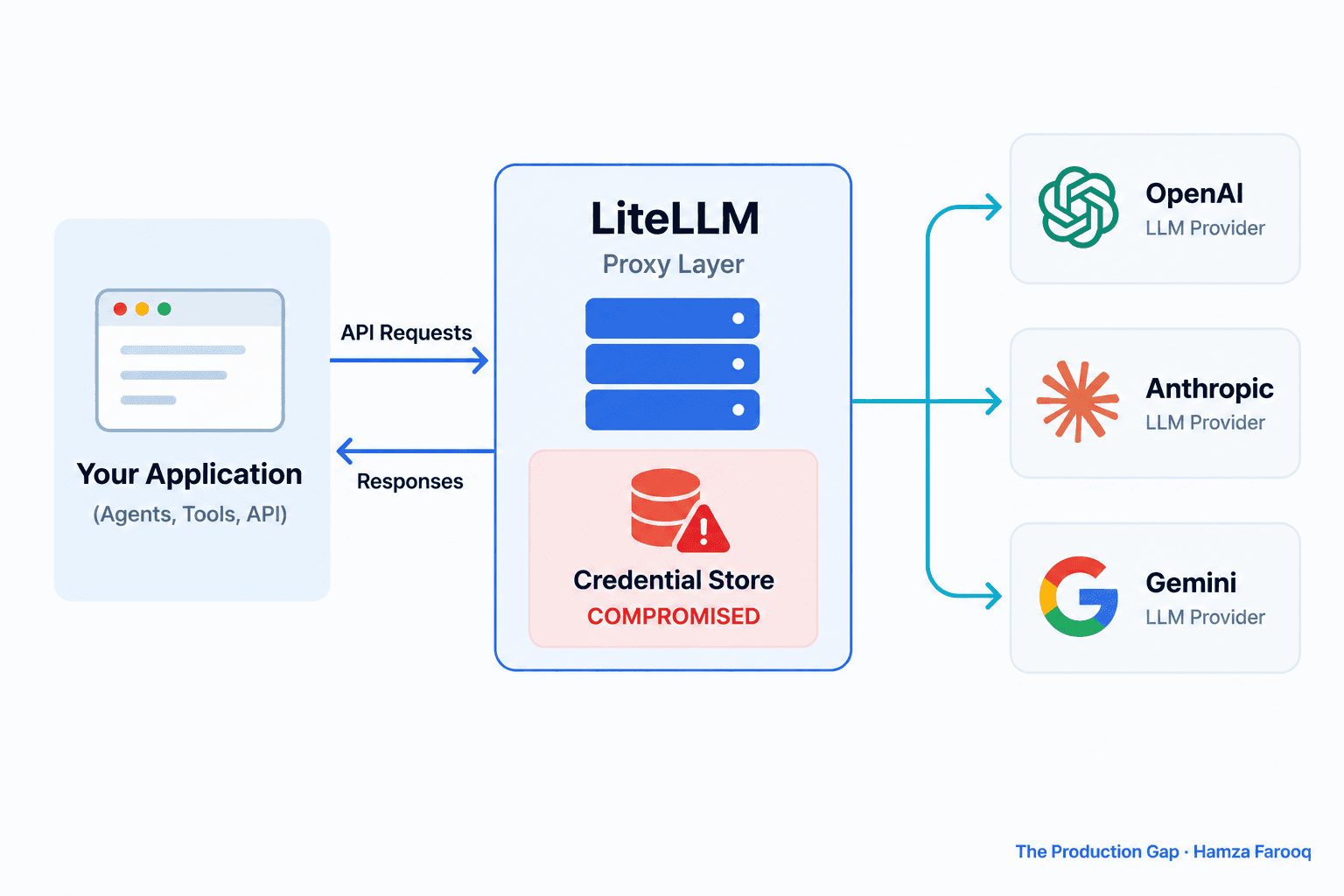
TL;DR: The LiteLLM supply chain attack confirmed that AI gateways are the single highest-value target in any agent stack because they aggregate credentials, route every model call, and sit between your application and every downstream LLM provider simultaneously. Compromising one gateway means owning all of them. Teams must treat their gateway as critical infrastructure, applying zero-trust controls, secrets isolation, and continuous dependency auditing rather than routine software hygiene.
Key Takeaways
- AI gateways are the highest-value target: A single compromise hands attackers the keys to your entire AI operation.
.pthfiles are a silent attack vector: They execute automatically at interpreter startup, before your application loads.- CI/CD pipelines are the real weak link: Stolen GitHub CLI tokens and a lookalike repository bypassed code review entirely.
- Blast radius goes far beyond LLM keys: Cloud credentials, proxy databases, and downstream service tokens are all exposed.
- TeamPCP is a repeat offender: The group follows a deliberate strategy of targeting developer and security tooling with elevated access.
- Architecture must assume gateway compromise: Isolate credentials, enforce least-privilege scoping, and rotate secrets now.
Introduction
Most post-mortems focus on the payload. The deeper problem is architectural: LiteLLM's credential concentration is what made this breach catastrophic, not just embarrassing. This article covers both the attack mechanics and the architectural implication the industry keeps avoiding.
How did attackers compromise LiteLLM without touching application code?
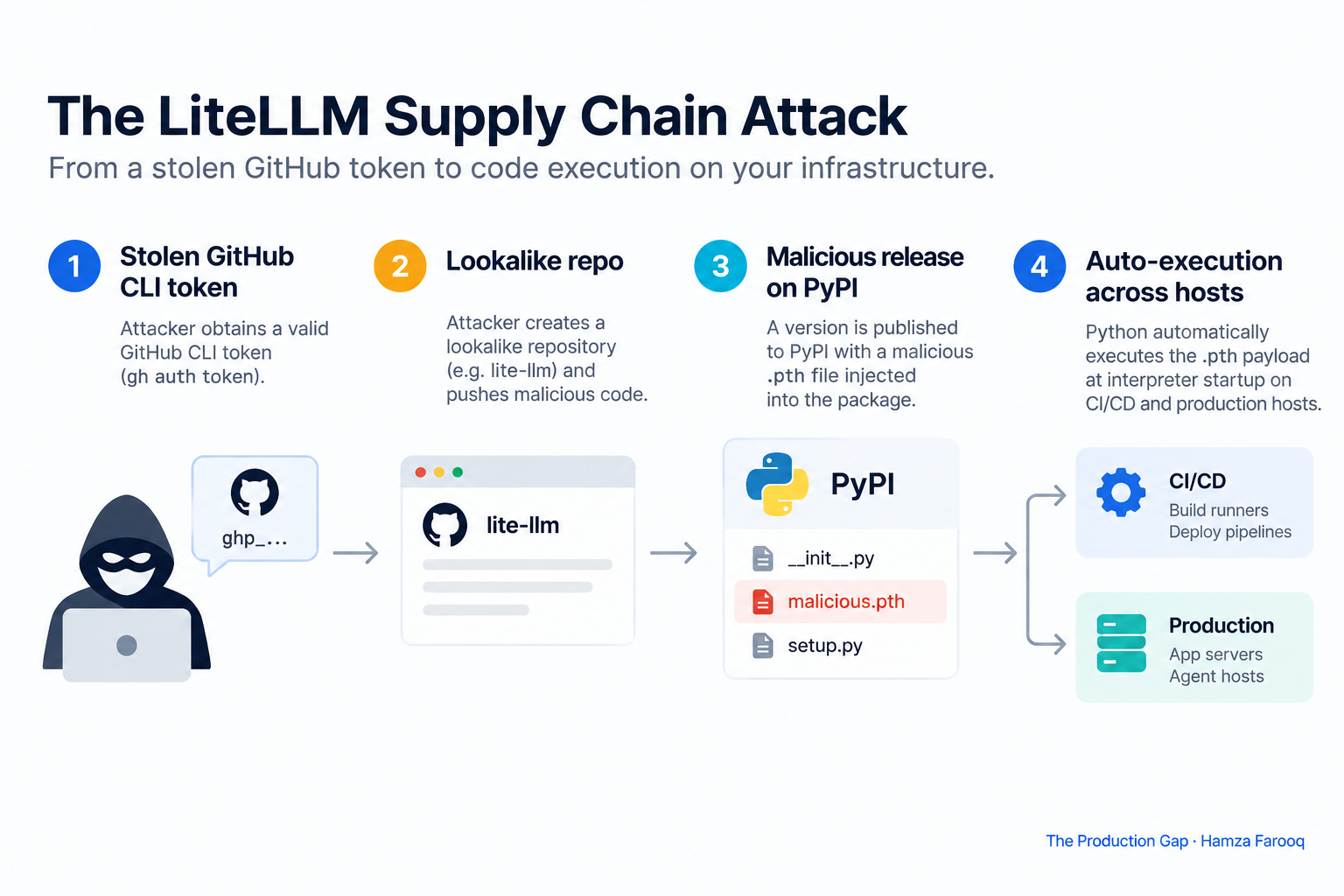
Attackers stole GitHub CLI tokens, injected a malicious .pth file through a lookalike repository, and exploited Python's automatic execution of .pth files at startup, so the payload ran before any application code loaded.
The entry point was the release pipeline, not the source code. No code review would have caught it because application source was never modified, which is consistent with how TeamPCP has operated before. A .pth file sitting in site-packages/ gets processed automatically when the Python interpreter starts, with no import statement and no application trigger required.
Two malicious patch versions landed on PyPI. Any CI/CD pipeline pulling the latest patch version picked them up automatically, with no human in the loop. The attack required no application vulnerability, only your pipeline's implicit trust in PyPI.
What credentials are at risk when an AI gateway is compromised?
A compromised AI gateway exposes every LLM provider API key, cloud credentials, proxy database secrets, and downstream service tokens at once, making it a single point of catastrophic failure for an entire AI operation.
Table 1: Credential exposure comparison, standard PyPI breach vs. LiteLLM-style AI gateway breach
| Credential type | Standard PyPI breach | AI gateway (LiteLLM) breach |
|---|---|---|
| LLM provider API keys | Low (rarely colocated) | Critical, all providers in one store |
| Cloud IAM / service account | Possible | High, gateway often runs with cloud-native auth |
| Proxy database secrets | Unlikely | High, LiteLLM stores usage logs and config |
| SSH keys | Possible | High, at risk given gateway host access |
| Downstream agent service tokens | Low | Critical, agentic pipelines chain credentials |
Organizations adopted the gateway pattern to reduce credential sprawl, with fewer places storing secrets and fewer things to audit. That reasoning is sound, but credential concentration also creates a more valuable target. A breach across ten scattered services is painful and recoverable, whereas a gateway breach exposes the full scope of an AI operation in one event.
What does TeamPCP's targeting pattern reveal about threat actor strategy against AI infrastructure?
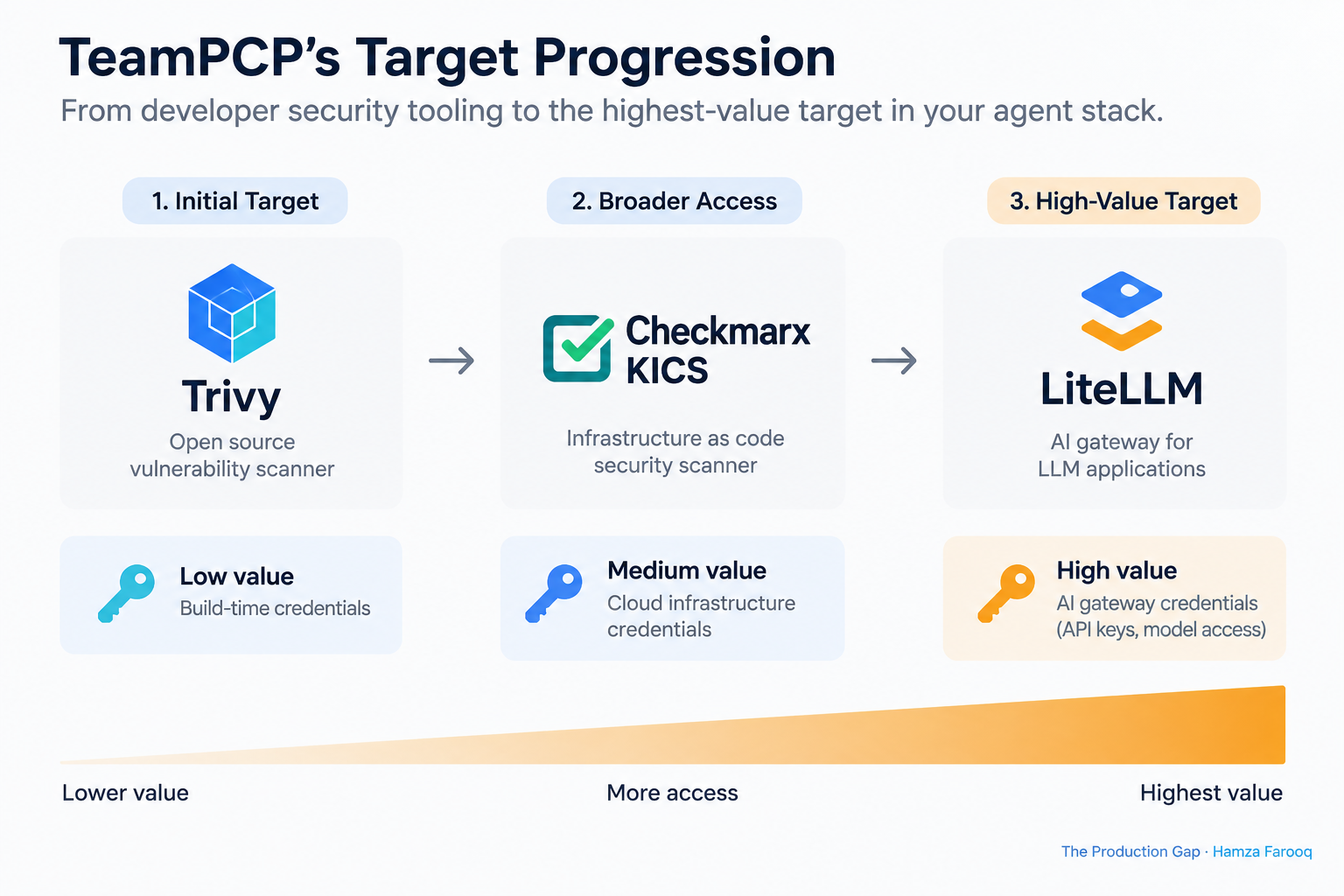
TeamPCP deliberately targets developer security and infrastructure tooling because tools used by developers with elevated access yield higher-value credentials per breach than end-user applications do.
The targets share a common profile: Trivy (container scanning), Checkmarx KICS (IaC security), and LiteLLM (AI gateway) all run with privileged access and are implicitly trusted by the teams using them. AI tooling represents a logical extension of this pattern. A production agentic architecture touches more operational secrets than most security scanning tools ever see.
Framing this solely as a "poisoned PyPI package" incident understates what the evidence shows. A sophisticated actor has compromised multiple high-trust developer tools through the same CI/CD injection technique, each time harvesting credentials from privileged environments. Your gateway fits that targeting profile.
How should teams architect AI gateway deployments to reduce credential concentration risk?
Rotate all exposed credentials immediately, scope provider API keys to minimum permissions, isolate the gateway with vault-backed secrets injection, and treat the gateway as an assumed-breach surface.
Immediate response for teams who ran the affected versions: Rotate in this order, cloud IAM credentials first, then LLM provider API keys, then database connection strings, then SSH keys. Scan site-packages/ for unexpected .pth files on any affected host. Then audit your CI/CD package pinning, since unpinned patch-version pulls were the direct attack surface here.
Architectural hardening, a practical framework for AI gateway deployments:
- Secrets isolation: Inject credentials at runtime via a secrets manager (HashiCorp Vault, AWS Secrets Manager). Never store them in environment files or config at rest.
- Least-privilege key scoping: Provision separate, rate-limited API keys per provider per use case. A breach then yields scoped keys, not master keys.
- Network segmentation: Run the gateway in an isolated segment with outbound connections restricted to explicitly allowlisted provider endpoints.
- Supply chain pinning: Pin exact package hashes in
requirements.txtand verify against a private mirror before deployment.
Rotating keys after a breach without changing the underlying architecture only buys time. The next campaign targeting AI infrastructure will encounter the same structural exposure if the credential concentration pattern remains.
Frequently asked questions
What are the indicators of compromise to look for after exposure? Scan site-packages/ on every affected host for unexpected .pth files, which are the delivery mechanism confirmed in this incident. Audit outbound network connections from the gateway host and review access logs for all credential stores the gateway touched during the window those versions were running.
What is a .pth file and why is it dangerous in a supply chain attack? A .pth file placed in site-packages/ executes automatically at Python interpreter startup with no application code modification required. The payload runs inside every Python process before your application starts, making it invisible to code review and most static analysis tools.
How does the LiteLLM attack compare to previous TeamPCP operations? All three known TeamPCP targets, Trivy, Checkmarx KICS, and LiteLLM, share the same approach: compromise a high-trust developer tool through CI/CD injection using stolen tokens, then harvest credentials from privileged environments. LiteLLM represents an escalation in potential credential yield because AI gateways aggregate secrets across more providers than security scanning tools typically access.
Conclusion
The LiteLLM attack is large-scale evidence that AI gateways have become primary targets, and that the architectural choices teams made to solve credential sprawl have created the highest-value credential aggregation point in the modern stack. TeamPCP identified that exposure before most defenders did.
Start this week: Audit your site-packages/ directory, review how your gateway handles secret injection, and pin your package versions with hash verification. Credentials stored in plain-text config files represent exactly the kind of exposure that campaigns targeting AI infrastructure are designed to find.
Learn from me
Forward Deployed Engineering Bootcamp for Full-Stack Developers, my Maven cohort. Build and ship complete AI products end to end, from React and Node.js frontends to deployed models with caching and observability. Join the next cohort →
Hire us
Traversaal.ai. We're a team of forward deployed engineers solving the toughest AI problems for Fortune 100 companies: document intelligence, agentic data platforms, and real-time web intelligence, deployed in production. Work with our team to deploy your next agentic ecosystem. Talk to Traversaal.ai →
Join us
Want to solve these problems with us? We're always looking for forward deployed engineers who want to ship production AI. jobs@traversaal.ai
