
TL;DR: Becoming a forward deployed engineer requires combining strong software engineering fundamentals with customer-facing consulting skills, then targeting companies that embed engineers directly inside client environments. Most successful candidates transition from software engineering, solutions engineering, or technical consulting backgrounds by building a portfolio that demonstrates both technical depth and business impact. The hiring process rewards engineers who can solve ambiguous, high-stakes problems autonomously.
Key Takeaways
- FDEs ship, not just demo: a forward deployed engineer writes and deploys real software inside a customer's environment.
- Your background probably maps closer than you think: software, data engineering, and technical consulting are the strongest bridges in.
- FDE interviews test real scenarios: expect scoping exercises, take-home deployments, and customer role-play, not whiteboard puzzles.
- Your portfolio must show end-to-end ownership: requirements, build, and handoff, not just a GitHub repo.
- A structured learning path closes the gap: targeted courses and FDE-specific job boards get you from curious to hireable faster than a generalist search.
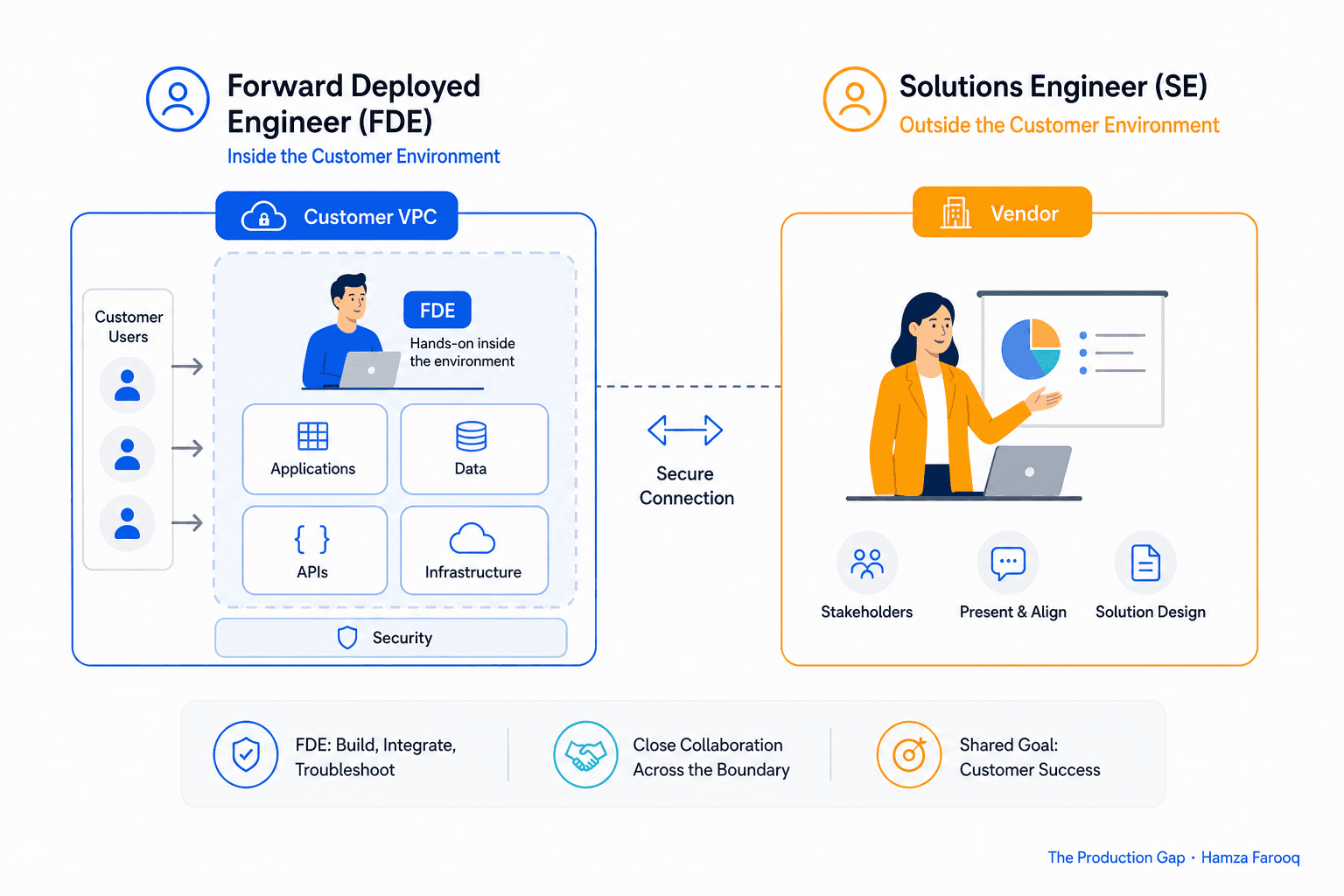
What does a forward deployed engineer actually do, and how is it different from a solutions engineer?
"A forward deployed engineer writes and ships production software inside a customer's own environment (their cloud, their servers, their data) whereas a solutions engineer builds demos and advises from the outside."
Consider a typical week: Monday, an FDE logs into a logistics company's AWS environment. By Thursday, they have shipped an LLM-powered exception handler into the customer's VPC. Friday, they walk the ops lead through it, no handoff ticket, no waiting on another team.
FDE Role Comparison Matrix, 2026
| Dimension | Forward Deployed Engineer | Solutions Engineer | Sales Engineer |
|---|---|---|---|
| Primary output | Shipped, deployed software | Technical specs and demos | Pre-sales demos and RFPs |
| Works inside customer environment? | Yes, VPC, on-prem, data | Rarely | No |
| Coding depth | Production-grade | Prototype or script level | Minimal |
| Commercial tie | Delivery and expansion | Pre-sale to close | Pre-sale only |
| Cycle time | Days to weeks | Weeks to months | Deal-dependent |
The concept worth getting clear on early is operational trust: the earned right to touch production inside someone else's environment. It is a craft skill, not a clearance checkbox, and it is what most career guides miss entirely.
The forward deployed engineer title began as a distinct go-to-market approach at a small number of enterprise software companies and has since become a recognizable hiring pattern at AI-native companies more broadly. Understanding that origin helps explain why the role blends engineering depth with commercial accountability in a way that neither pure software engineering nor solutions engineering does.
What technical skills do forward deployed engineers need in 2026?
"Forward deployed engineers need full-stack or backend development fluency, data integration experience, working knowledge of LLM and agent systems, and the ability to operate inside a client's security and compliance environment."
FDE skills stack in four layers, as identified through this guide's analysis of job postings and hiring discussions. Missing one layer tends to surface as a ceiling in final interview rounds, not in early screens.
Layer 1, Core engineering: Python, TypeScript, REST APIs, and SQL at production grade. If you cannot debug a broken FastAPI endpoint in an unfamiliar repo under time pressure, the role will be a struggle from day one.
Layer 3, Agentic and LLM systems: Prompt engineering, RAG pipelines, and agent orchestration via LangChain or LangGraph. A representative FDE engagement at an AI-native company might look like this: build an agent with LangGraph, connect it to a client's document store, deploy it inside their Azure environment, all within a five-day window.
How do FDE interviews work in 2026, and what should you prepare for?
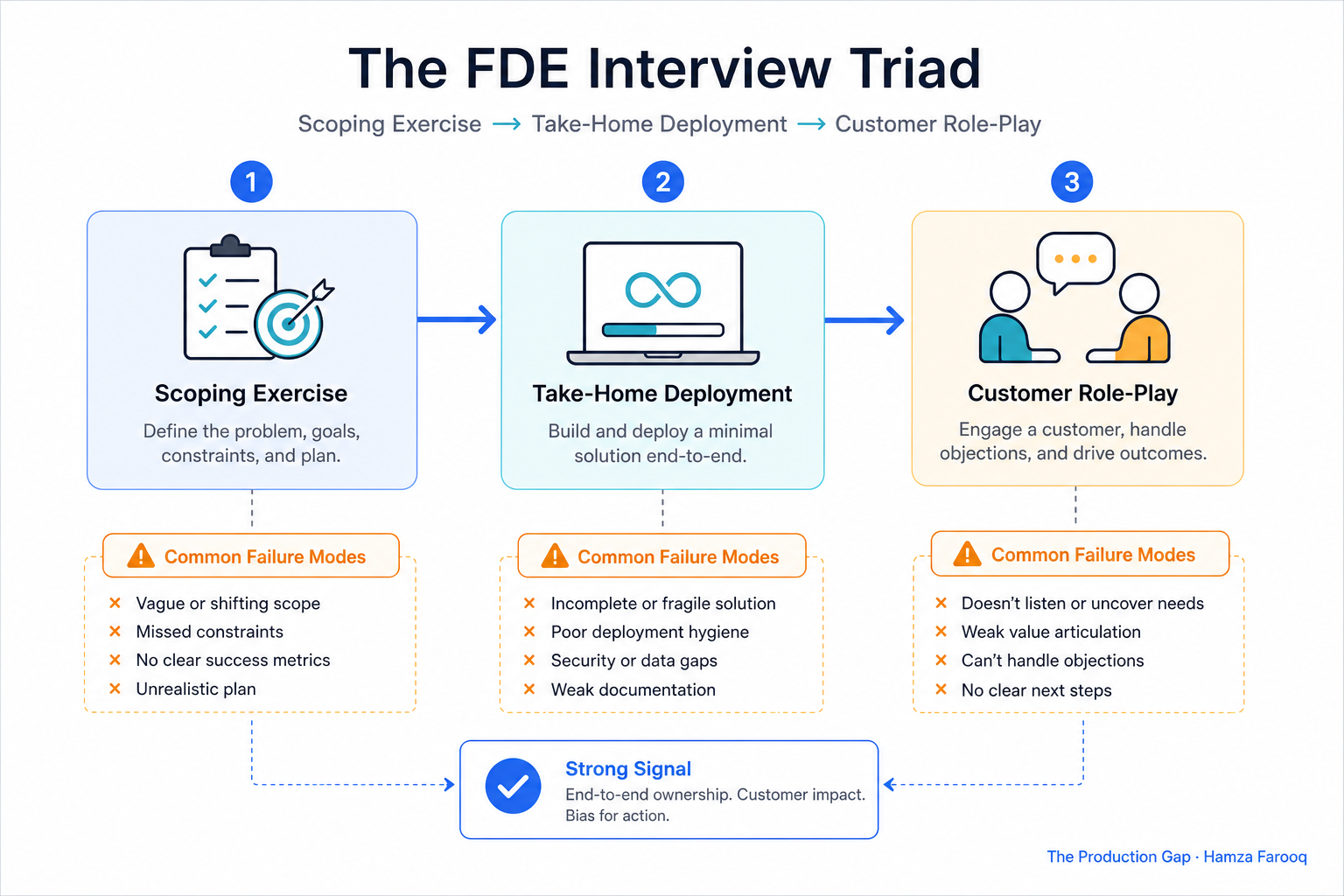
"FDE interviews replace algorithmic puzzles with scoping exercises, take-home deployments inside a constrained environment, and customer role-play scenarios that test how you handle ambiguity and deliver under deadline."
Round 1, Scoping exercise: A vague brief, 30 minutes, define scope and present a build plan. Interviewers check whether you drive to clarity without a spec, because customers rarely hand you one.
Round 2, Take-home deployment: A starter repo, a simulated customer environment, and a task. The bar is not perfect code; it is whether the solution works in the environment provided. The most common failure is candidates who build locally and submit something that never ran in the target environment.
Round 3, Customer role-play: An interviewer plays a skeptical enterprise stakeholder. You explain your approach, handle objections, and navigate a change-management concern without losing the technical thread. No amount of algorithmic practice builds this skill.
How to prepare: Build one end-to-end project inside an AWS Free Tier or GCP sandbox and practice explaining it to a non-engineer. Record yourself. That narration ability is exactly what the role-play round tests.
How do you build a portfolio and learning path to get hired as a forward deployed engineer in 2026?
"Build two or three end-to-end projects where you owned requirements, shipped working software into a real or simulated environment, and documented the handoff, then follow a structured path covering agentic AI systems and enterprise deployment constraints."
Three questions serve as a practical portfolio test, synthesized from the patterns in this guide. For each project: Did you talk to a real or simulated user to define scope? Did you deploy into an environment you did not control? Did you document how a non-engineer would use and maintain it? One project that passes all three beats ten unshipped GitHub repos.
Your background shapes the shortest path in:
- Software engineer to FDE: The gap is customer communication and deployment-environment constraints. Add one client-facing project with a documented AWS or GCP handoff.
- Data engineer to FDE: The gap is the LLM and agent layer plus direct stakeholder communication. Build a RAG pipeline and write it up for a non-technical audience.
- Solutions engineer to FDE: The gap is production coding depth. A shipped, deployed application carries more weight than a notebook proof-of-concept.
For structured learning, look for courses that specifically target the operational trust and agentic systems layers, the two gaps most common among candidates coming from software or data backgrounds. Programs that include simulated customer environments and constrained deployments are more useful preparation than general LLM tutorials. Traversaal's free FDE courses are one place to start: recorded sessions on building and shipping AI agents with Claude Code.
One practical note on job searching: most FDE postings do not use that exact title. Also search "Implementation Engineer," "Technical Implementation Manager," "Embedded Engineer," and "Customer Engineer." Traversaal's FDE job board collects forward deployed roles in one place, with filters for region and posted pay.
Frequently Asked Questions
What is the difference between a forward deployed engineer and a solutions engineer?
A forward deployed engineer ships production software directly inside a customer's environment. Their VPC, their data, their servers. A solutions engineer builds demos and technical specs during pre-sales and rarely touches production systems. The distinction is not seniority; it is where the code lands and who owns it after deployment.
What technical skills do you need to become a forward deployed engineer?
Core skills are full-stack or backend development, data integration, LLM and agent systems, and operational trust, meaning the ability to deploy within a client's security and compliance constraints including SSO and SAML, air-gapped networks, and change-management workflows. That fourth layer is what most candidates underestimate and what most hiring managers are testing in final rounds.
How do FDE job interviews work and what should I prepare for?
Expect three formats: a scoping exercise, a take-home deployment in a constrained environment, and a customer role-play. Prepare by building one deployable end-to-end project you can explain clearly to a non-engineer. The ability to narrate your technical decisions to a non-technical audience is the skill the role-play round is directly measuring.
Which companies hire forward deployed engineers and where can I find job listings?
AI-native startups and enterprise software vendors are the primary hirers. Traversaal's FDE job board tracks 1,249 roles from 707 companies (as of 19 October 2026); about 60% are in the US, 19% in Europe and 6% in India, and the biggest hirers on the board are Google, Databricks and Salesforce. Search for "Implementation Engineer," "Customer Engineer," and "Embedded Engineer" alongside the FDE title to surface more relevant postings.
Conclusion
The engineer from the opening failed because they built for their own environment, not the customer's. They missed the operational trust layer.
The path is specific: understand what FDEs actually do, build the four-layer skill stack with real attention on operational trust, prepare for the three interview formats, and assemble a portfolio that passes the three-question test. Specific gaps close faster when you can name them.
Next move: start one deployed end-to-end project this week inside an environment you do not control. That single constraint, deploying somewhere unfamiliar, is the clearest distance between where most candidates are now and a first FDE offer. To build the skills alongside it, start Traversaal's free FDE courses, and when you are ready, browse open roles on the FDE job board.
Learn from me
Forward Deployed Engineering Bootcamp for Full-Stack Developers, my Maven cohort. Build and ship complete AI products end to end, from React and Node.js frontends to deployed models with caching and observability. Join the next cohort →
Hire us
Traversaal.ai. We're a team of forward deployed engineers solving the toughest AI problems for Fortune 100 companies: document intelligence, agentic data platforms, and real-time web intelligence, deployed in production. Work with our team to deploy your next agentic ecosystem. Talk to Traversaal.ai →
Join us
Want to solve these problems with us? We're always looking for forward deployed engineers who want to ship production AI. jobs@traversaal.ai
