
TL;DR: Google Public Sector Summit 2026 revealed that most federal and state agencies are stuck in a pilot loop, deploying AI agents in narrow proofs of concept but failing to scale them agency-wide due to data governance gaps, workforce readiness deficits, and procurement friction. Named deployments show that agencies breaking through this gap share one trait: they treated AI infrastructure as mission-critical from day one, not as an experiment.
Nearly every federal agency can show you an AI agent. Far fewer can show you one that runs across the whole organization, and the reason has almost nothing to do with the technology.
Key Takeaways
- The pilot-to-scale gap is the real story: Agencies keep launching AI agents in sandboxes; far fewer run them organization-wide.
- Survey numbers need a skepticism filter: Adoption figures cited at the summit came from a vendor-sponsored poll, directional in nature, not auditable government benchmarks.
- Google's connector architecture targets the integration wall: The approach lets AI query existing agency systems without forcing a data migration first, according to Google's own descriptions.
- DoD deployments show the scale ceiling and the challenge: The Department of Defense's AI agent deployments across millions of personnel illustrate what full organizational scale can look like; civilian agencies face different authorization hurdles to reach that point.
- Named deployments beat abstract promises: Concrete, operational reference architectures give procurement teams something to evaluate.
- FY2027 budgets make "pilot" a political liability: Agency leaders who can only show a sandbox are exposed heading into the next appropriations fight.
Why do so many agencies have AI agents but so few run them agency-wide?
The gap is a governance and procurement problem that no model upgrade alone can fix.
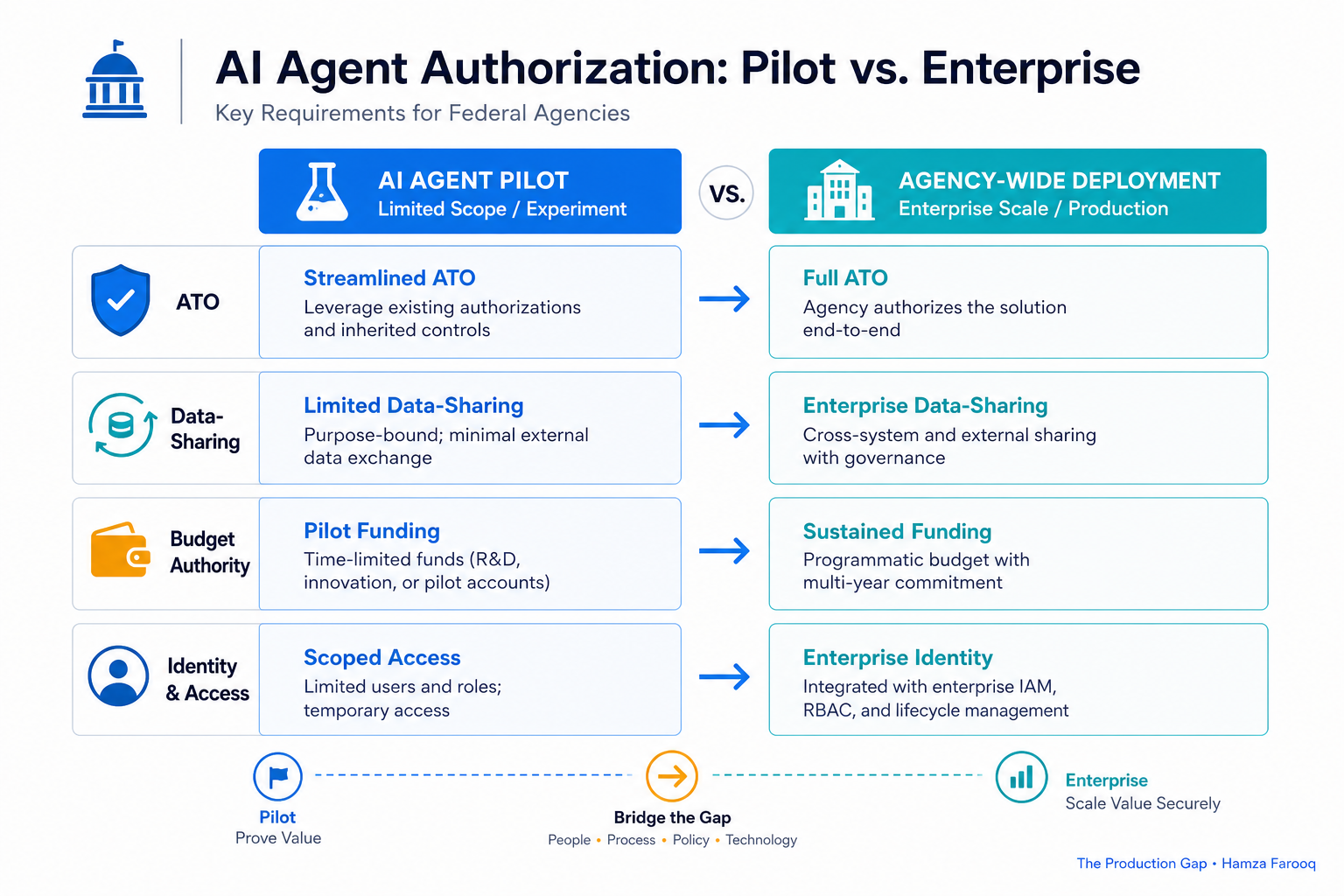
A pilot agent fits inside existing discretionary budgets and sandbox authorities without triggering a new Authority to Operate (ATO), cross-bureau data-sharing agreements, or new appropriations language. That is why pilots keep multiplying. The moment an agent needs to query payroll data inside a legacy ERP or process transactions across every regional office, the governance machinery activates.
In the author's synthesis of how these deployments stall, three blockers tend to be sequential rather than parallel. ATO re-adjudication can require a full new authorization review when a new system boundary is touched. Cross-bureau data-sharing agreements require legal authority that can take considerable time to finalize. And agency-wide deployment frequently crosses from discretionary spending into territory requiring explicit congressional authorization.
| Scaling Dimension | Pilot Stage | Agency-Wide Stage |
|---|---|---|
| Budget authority | Discretionary / sandbox | Often requires new appropriations language |
| ATO status | Sandbox or inherited | Full re-adjudication often required |
| Data access | Single system or bureau | Cross-bureau data-sharing agreements |
| Identity layer | Local or app-level | Enterprise identity / zero-trust alignment |
| Timeline | Weeks to months | Commonly extends beyond one year |
The Adoption Gap Framework (author synthesis, Google Public Sector Summit 2026, October 2026): why the jump from pilot to production is institutional, not technical.
What does Gemini for government services' private preview actually offer that existing FedRAMP tools do not?
According to Google's own descriptions, Gemini for government services is built around a connector model that lets AI query existing agency systems without requiring data migration.
The caveat worth stating plainly: "private preview" is not "procurement-ready." General availability has not been confirmed, and the FedRAMP authorization package was not publicly reviewable at the time of the summit. Writing Gemini for government services into a FY2027 budget request before reaching that threshold carries real timeline risk.
What do publicly cited DoD deployments reveal about realistic paths to scale?
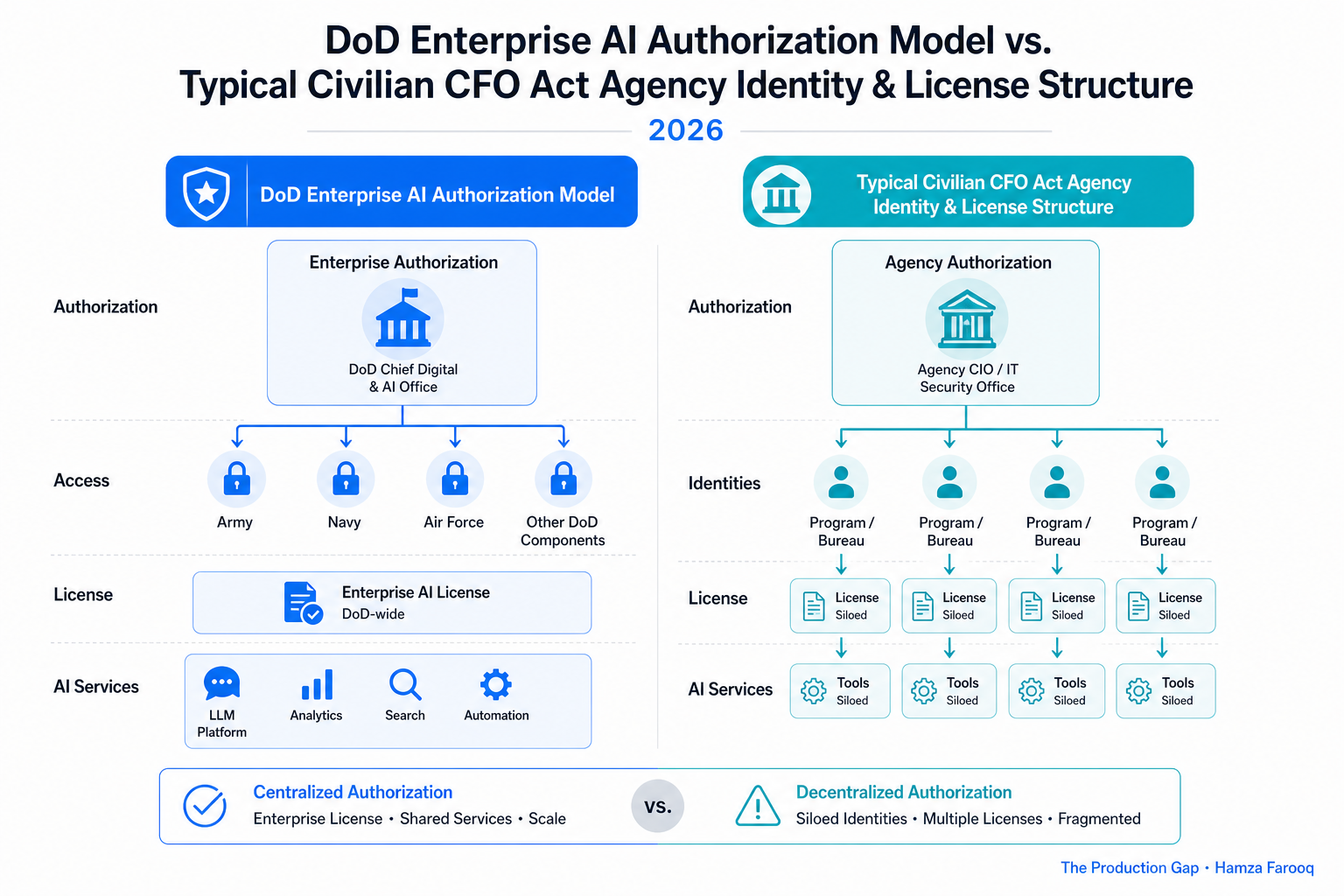
The Department of Defense's AI agent deployments represent the only publicly cited examples of true organization-wide federal AI agent scale, and they required infrastructure most civilian agencies don't currently have.
What should agency CIOs actually do before writing agentic AI into their FY2027 budget request?
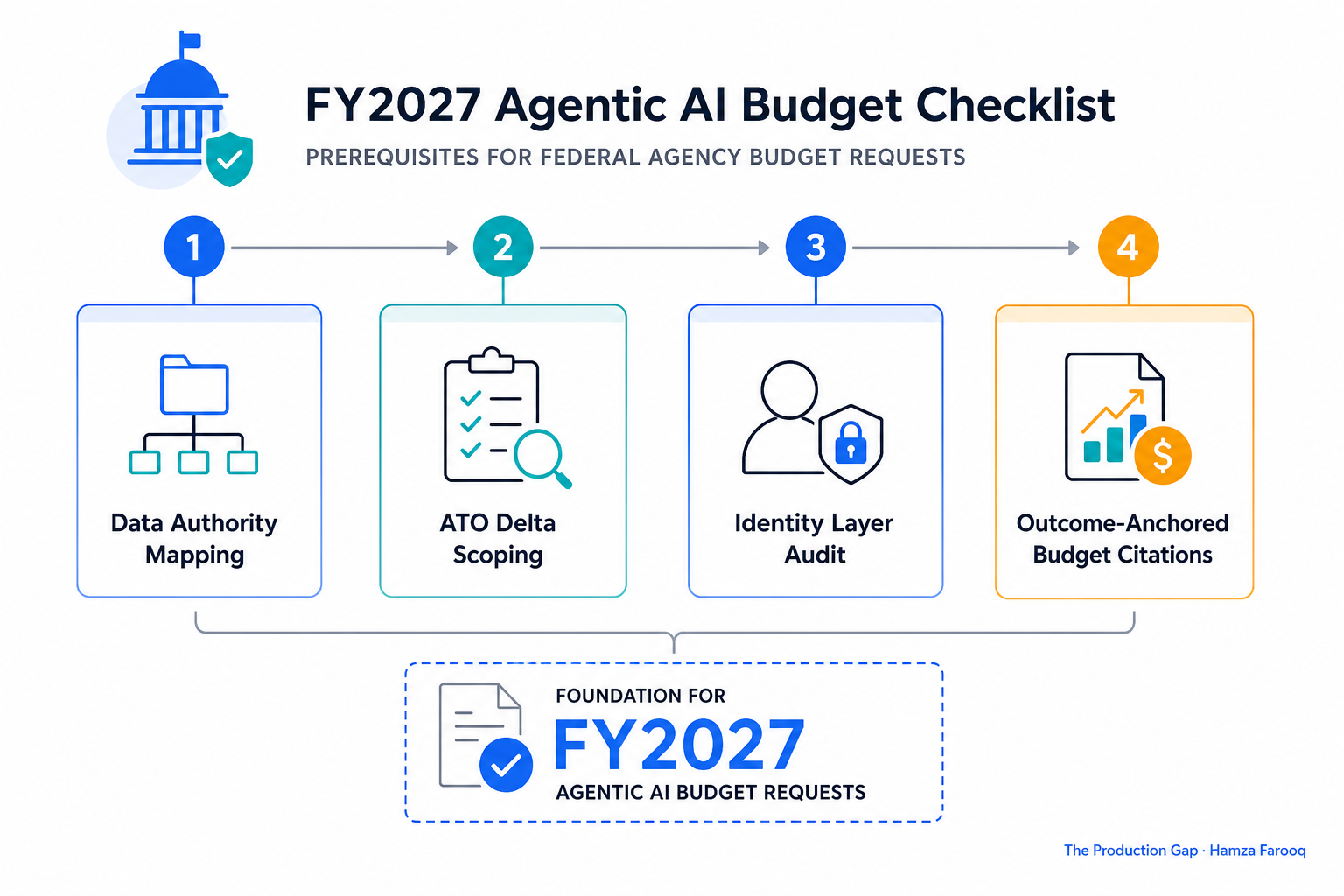
Four prerequisite steps, drawn from the framework used in this guide, should be completed before any agentic AI appears in a budget submission.
Scope the ATO delta next. Work with your ISSO to define what a connector-model surface area adds to your existing authorization boundary, and request any available FedRAMP package materials early. Reviewing them costs nothing; discovering a gap after submission costs you the cycle.
Audit your identity layer. Multiple identity systems across bureaus create friction that must be resolved before agents can scale to enterprise level. Treat this as a prerequisite, not a parallel workstream.
Anchor budget arguments to auditable outcomes. Vendor-commissioned survey figures presented at the summit frame the problem usefully in internal discussions, but they will not survive a program examiner's scrutiny. Named program outcomes from official agency or IG documentation are what a credible budget justification requires.
Frequently Asked Questions
What was announced at the Google Public Sector Summit 2026? Google hosted more than 2,000 federal and state technology leaders on October 20 at the Ronald Reagan Building in Washington, D.C. Announced capabilities included the private preview of Gemini for government services and discussion of operational AI agent deployments referencing agency and DoD-scale examples.
Should I cite the vendor-commissioned survey figures in a budget justification? No, not without explicitly flagging them as vendor-commissioned survey data. Use them internally to frame the problem, and anchor budget justifications to named program outcomes and IG- or GAO-sourced data wherever available.
How did DoD reach organization-wide AI agent scale, and can civilian agencies replicate it? Publicly cited DoD deployments relied on pre-existing enterprise license authority and unified identity infrastructure across millions of personnel. Most civilian agencies lack both, making direct replication impossible without a multi-year, multi-appropriation infrastructure build.
What is the first concrete step an agency should take before scaling an AI agent beyond a pilot? Map your data authorities. Know which bureau owns each dataset, what legal authority permits cross-system access, and whether existing data-sharing agreements cover AI-mediated queries. Without that map, most scaling attempts hit the same wall.
Conclusion
The adoption gap visible at the Google Public Sector Summit 2026 reflects a governance infrastructure that is still being built, not a technology that has failed to arrive. Google's connector architecture, as described, shrinks the authorization surface area that has historically made scaling difficult, but whether that pays off depends on general availability timing, the FedRAMP authorization timeline, and whether civilian agencies can build the identity and license infrastructure that enabled DoD-scale deployments.
Start your data authority map this week. Document which datasets your proposed agents would touch, who legally owns them, and what authorization steps stand between your pilot and agency-wide deployment. That document, not a vendor survey, is what a credible budget request requires.
Learn from me

Agentic AI for Product Managers, my Maven cohort. Learn how to design, evaluate, and ship reliable AI systems: the technical fluency PMs need to lead agentic products, no engineering background required. Join the next cohort →
Hire us
Traversaal.ai. We're a team of forward deployed engineers solving the toughest AI problems for Fortune 100 companies: document intelligence, agentic data platforms, and real-time web intelligence, deployed in production. Work with our team to deploy your next agentic ecosystem. Talk to Traversaal.ai →
Join us
Want to solve these problems with us? We're always looking for forward deployed engineers who want to ship production AI. jobs@traversaal.ai
