
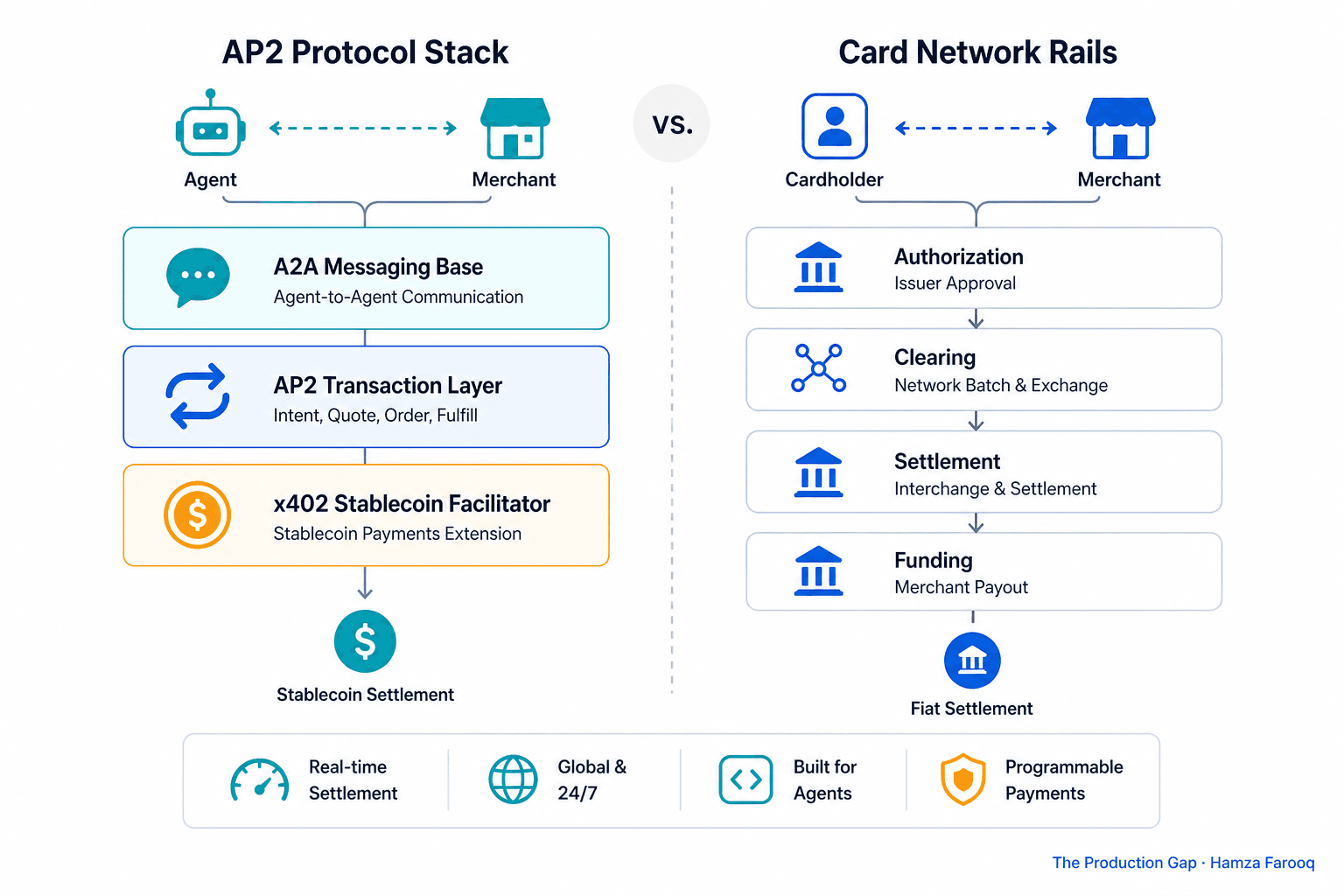
TL;DR: Google AP2 settles stablecoin payments on-chain in near real-time through Coinbase's x402 facilitator, with no interchange fee floor, making sub-dollar agent-to-agent transactions economical for the first time. Card networks settle on T+1/T+2 cycles with interchange fees and built-in chargeback infrastructure. AP2 wins on speed and micropayment economics; card rails win on compliance coverage and redundancy. The real integration challenge is not settlement speed but agent identity resolution and on-chain reconciliation, which your team must build entirely from scratch.
Key Takeaways
- AP2 settles near real-time on-chain versus T+1/T+2 card cycles, closing the book intraday rather than against multi-day pending batches.
- x402 is the only stablecoin facilitator today, with no automatic fallback if it goes down or encounters a regulatory action against Coinbase.
- Payment initiation runs agent-to-agent with scoped authorization, meaning no human approves each transaction and your team owns scope policy entirely.
- AML, KYC, and wallet-monitoring obligations that card processors normally absorb by contract become an explicit internal build under AP2.
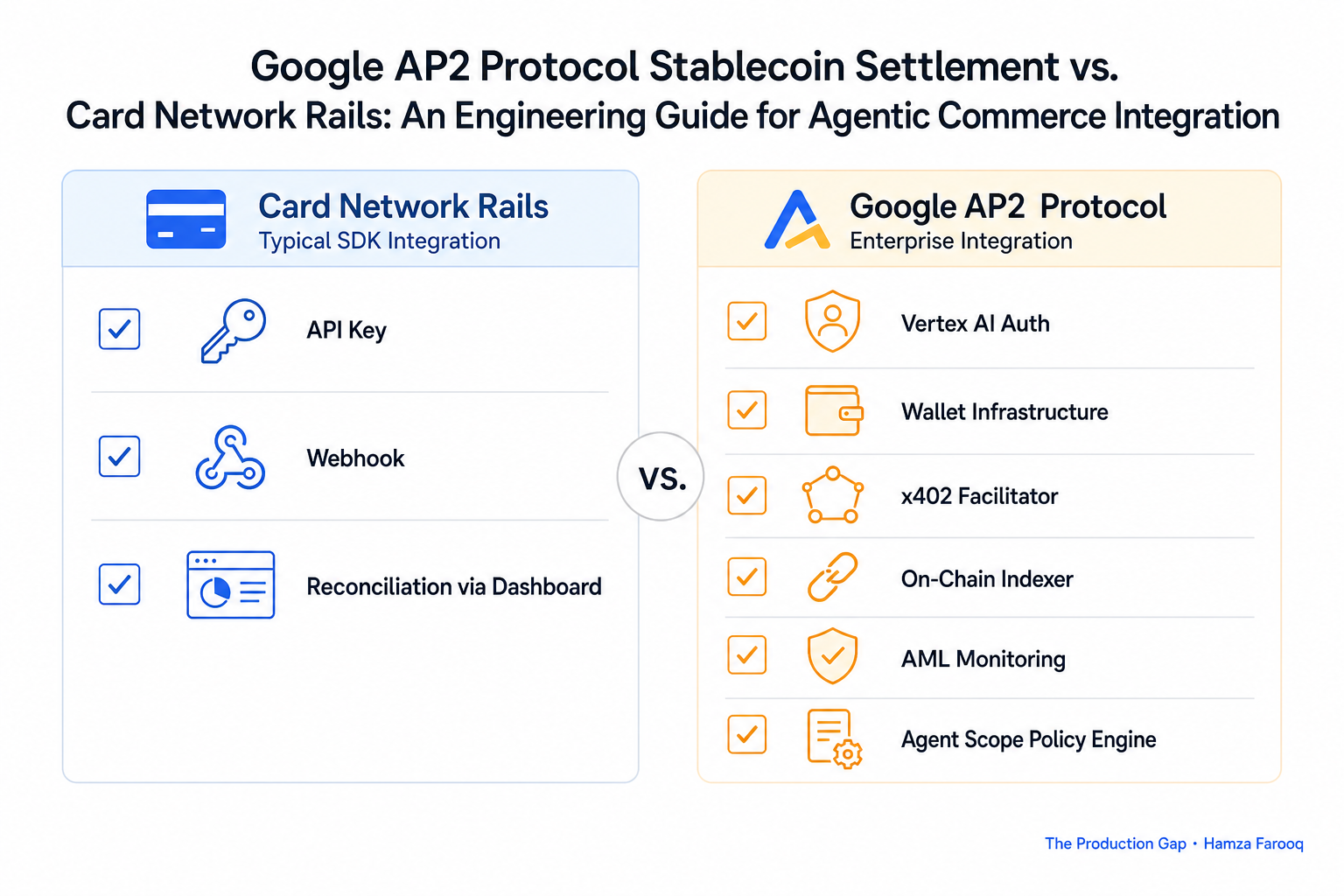
- Integration requires Vertex AI credentials, on-chain wallet infrastructure, and custom reconciliation, not a library swap on top of an existing card-processor integration.
- No interchange floor means sub-dollar agent-to-agent payments are economical, a structural capability card networks cannot replicate.
How does Google AP2 protocol settle stablecoin payments without card networks?
AP2 is not a payments network; it is a transaction layer built on A2A, Google's Agent2Agent messaging protocol, which means payment capability is inseparable from agent identity and capability negotiation.
Layer 1: A2A as the foundation
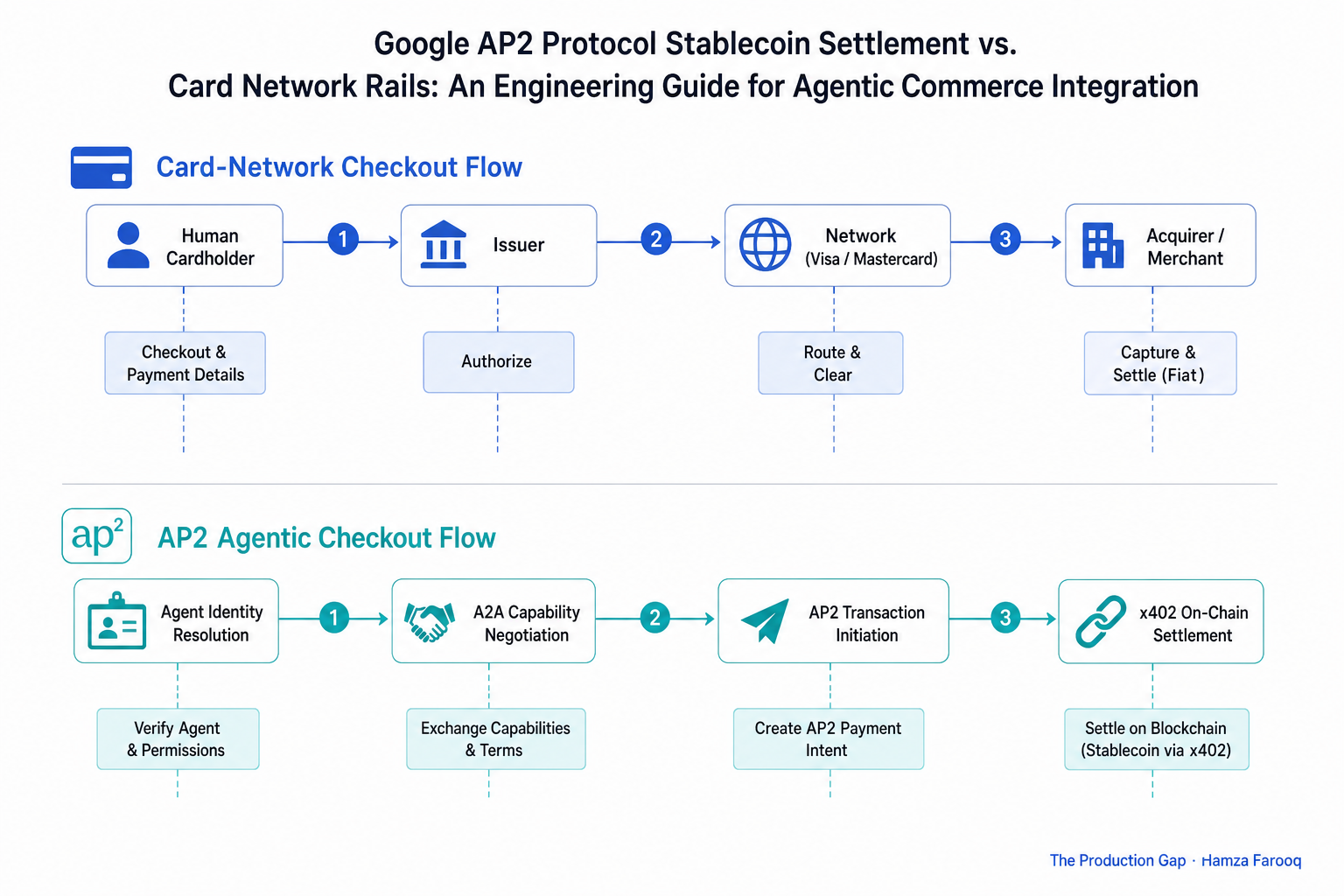
A2A handles agent discovery and messaging; AP2 converts that messaging capability into transactional capability. As AP2 Lab puts it: "A2A allowed agents to talk to each other; AP2 allows them to transact." Before any payment fires, the paying agent must discover the receiver, negotiate capability, and establish cryptographic trust. None of that exists in card flows, where the issuing bank owns identity verification entirely.
Layer 2: AP2 transaction layer
AP2 defines payment initiation, authorization scope, and settlement instruction format. Authentication runs via Google API Key or Vertex AI credentials set as environment variables, which makes Vertex AI a first-class infrastructure dependency and a credential management surface most payments teams have never operated in a production context.
Layer 3: x402 as stablecoin transport
x402 is Coinbase's extension and currently the only stablecoin facilitator in the AP2 ecosystem. That means it inherits Coinbase's uptime and regulatory posture, not the decades of SLA enforcement baked into Visa or Mastercard.
The integration bottleneck is not settlement speed. Card networks assume a human with a card; AP2 assumes a machine with a cryptographic identity, and building that identity layer is entirely your team's job.
How does Google AP2 stablecoin settlement compare directly to Visa/Mastercard card-network clearing?
Table 1: AP2 + x402 vs. Visa/Mastercard Settlement Comparison, 2025
| Dimension | AP2 + x402 (stablecoin) | Visa/Mastercard (card network) |
|---|---|---|
| Settlement finality | Near real-time (on-chain) | T+1 to T+2 |
| Per-transaction fee | Gas fee (varies by chain and volume) | Interchange percentage plus fixed fee |
| Micropayment viability | Yes (sub-$1 practical) | No (fee structure too high) |
| Chargeback mechanism | None native | Built-in |
| Redundant facilitators | x402 only (single point of failure) | Visa plus Mastercard plus processors |
| Human cardholder required | No | Yes |
Settlement speed is a genuine AP2 advantage. Single-facilitator dependency on x402 is a real production risk that card networks, with their multiple competing processors, do not carry.
What compliance and integration obligations does AP2 add that card rails normally absorb?
Compliance surface delta
Under card-network contracts, the issuing bank and processor handle KYC on the cardholder. Accepting stablecoin via x402 means taking on wallet screening, transaction monitoring, and potentially money transmitter obligations that your legal team will need to assess against applicable virtual currency regulations in your jurisdictions. The compliance coverage that card processors provide by default becomes an explicit internal build.
Fraud and reconciliation architecture
Card networks have mature chargeback infrastructure; AP2 and x402 have none natively, so enterprises must build dispute resolution from scratch. Reconciliation means indexing wallet transactions, matching on-chain event logs to internal order IDs, and handling chain reorganization edge cases. As a practical rule of thumb used in this guide, the AP2 stack requires at minimum five parallel systems your team must build or operate: Vertex AI credentials, wallet infrastructure, an on-chain event indexer, AML monitoring, and an agent scope policy engine. These are not adaptations of existing card-processor integrations; they are net-new builds.
Agent authorization scope
AP2 supports scoped authorization, where agents carry credentials limiting what they can spend and on what. Enterprises must define scope policies, audit autonomous payments against those scopes, and rotate credentials on a defined schedule. Unauthorized spending prevention depends entirely on how rigorously your team defines and enforces scope. There is no network-level floor comparable to a card authorization hold.
FAQ
Q1: Is AP2 production-ready for enterprise stablecoin payments today? AP2 is live and open-sourced, and x402 is operational, but it is early-production for greenfield agentic workflows rather than a drop-in card-rail replacement. Single-facilitator status, no native chargeback infrastructure, and early-stage agent identity standards make it unsuitable for high-volume enterprise checkout where compliance coverage and redundancy are non-negotiable today.
Q2: Can AP2 support both stablecoin and traditional fiat payment methods in the same agentic checkout flow? Yes. AP2 is designed as a universal protocol supporting both. A hybrid flow requires parallel settlement and reconciliation stacks, which multiplies integration surface rather than simplifying it, so evaluate whether the added complexity is justified before committing.
Q3: How does AP2 handle agent identity verification to prevent unauthorized autonomous spending? Agents authenticate via scoped credentials, with Google API Key and Vertex AI authentication supported in the GitHub implementation. Unauthorized spending prevention depends entirely on how rigorously the enterprise defines authorization scopes. There is no network-level floor comparable to a card authorization hold, so scope policy design is a critical internal engineering decision.
Q4: What is the real engineering risk of depending on x402 as the only stablecoin facilitator? Single-facilitator dependency means any x402 outage or regulatory action against Coinbase creates total payment rail failure with no automatic fallback. Design a circuit-breaker to card rails before that failure happens, not after, and treat x402 redundancy as a launch-blocking architecture requirement rather than a future optimization.
Conclusion
AP2 is the right rail for machine-to-machine, high-frequency, low-value workflows where your team can own compliance and reconciliation. Near-real-time settlement, no interchange fee floor, and autonomous payment initiation are capabilities card networks structurally cannot replicate.
Card rails are the right choice for human-supervised, high-value transactions where chargeback protection and regulatory clarity matter more than settlement speed. They absorb compliance obligations your team would otherwise build from scratch.
The settlement comparison is straightforward. Agent identity resolution and on-chain reconciliation are where this integration will actually succeed or stall. Pick the architecture that matches your compliance capacity, not just your latency requirements.
Next step: Clone the AP2 GitHub repository, run the Vertex AI authentication flow against a test wallet, and map your existing compliance checklist against what x402 does not cover. That gap is your build list.
Learn from me
Forward Deployed Engineering Bootcamp for Full-Stack Developers, my Maven cohort. Build and ship complete AI products end to end, from React and Node.js frontends to deployed models with caching and observability. Join the next cohort →
Hire us
Traversaal.ai. We're a team of forward deployed engineers solving the toughest AI problems for Fortune 100 companies: document intelligence, agentic data platforms, and real-time web intelligence, deployed in production. Work with our team to deploy your next agentic ecosystem. Talk to Traversaal.ai →
Join us
Want to solve these problems with us? We're always looking for forward deployed engineers who want to ship production AI. jobs@traversaal.ai
