
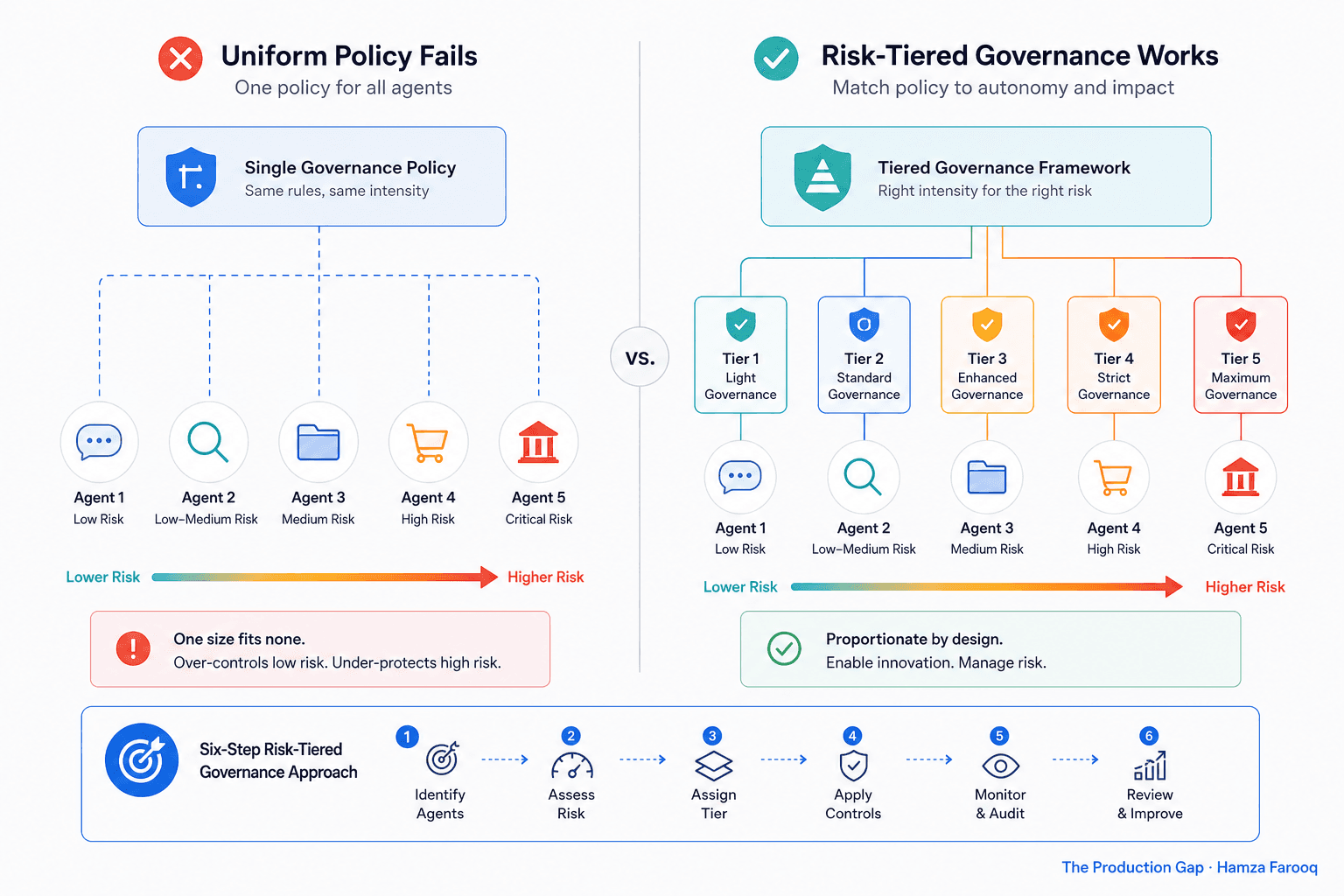
TL;DR: The Gartner AI agent governance framework rejects one-size-fits-all policies because agents vary too widely in autonomy and risk for uniform rules to work safely. Instead, Gartner prescribes a six-step, risk-tiered approach that classifies agents by impact level, then applies proportional controls, so organizations can govern agent sprawl without blocking legitimate innovation.
Key takeaways
- Uniform governance guarantees failure: The same rules cannot cover both a FAQ chatbot and an agent executing financial transactions.
- Agent sprawl is a board-level crisis: Uncontrolled proliferation with no central inventory has moved from theoretical risk to active enterprise failure.
- Gartner's six-step framework: A graduated approach matching oversight intensity to each agent's autonomy and business impact.
- Risk tiering is the foundation: Classify every agent before any governance policy can function.
- You need an agent inventory first: Boards are asking how many agents are running, who owns them, and what they can do, and most organizations cannot answer.
- Accountability must be named: Every agent needs a designated human owner, or governance exists on paper and fails in practice.
Introduction
Enterprise AI agents are running in production across sales, operations, customer service, and engineering, not as pilots, but as live decision-making systems. Gartner formalized the crisis with two releases: the April 28, 2026 release identifying six steps to manage AI agent sprawl and the May 26, 2026 release declaring that uniform governance will lead to enterprise AI agent failure. This article explains why uniform governance fails and walks through Gartner's verified six-step framework, with the PM accountability angle that most coverage skips entirely.
Key terms defined
Agent sprawl: The uncontrolled proliferation of autonomous AI agents across business units, deployed faster than any governance structure can track, classify, or oversee them.
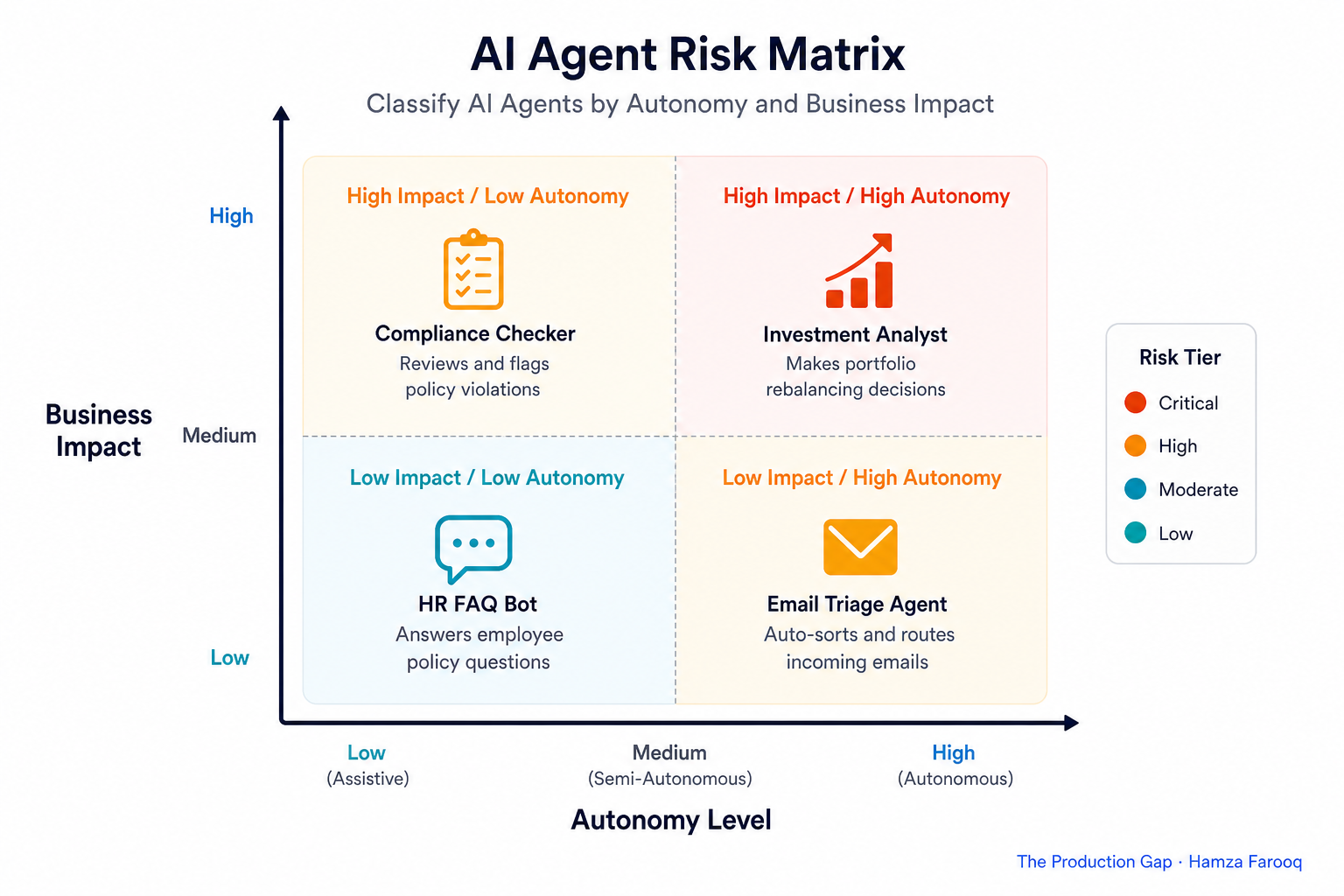
Risk tier: A classification assigned to each AI agent based on its autonomy level and business impact, used to determine the appropriate intensity of governance controls.
Agent inventory: A living registry that captures each deployed agent's identity, named owner, capability scope, and risk tier. It is the foundational prerequisite for every other governance step.
Human accountability owner: The named individual personally responsible for a specific agent's behavior, audit trail, and compliance with its assigned governance tier. Governance without a named owner is unenforceable in practice.
Why does applying the same governance policy to every AI agent guarantee failure?
Uniform governance fails because agents vary so dramatically in autonomy and business impact that a single policy simultaneously over-restricts low-risk agents and dangerously under-protects high-risk ones.
Gartner stated plainly in May 2026 that uniform governance will lead to enterprise AI agent failure. The contrast is concrete: a FAQ chatbot's worst-case error is limited in scope, while an agent autonomously approving vendor invoices can produce serious financial damage from a single wrong action. Both are "AI agents," and a policy calibrated for one is badly wrong for the other.
Failure runs both directions. Heavy governance on low-autonomy agents kills adoption; light governance on high-autonomy agents creates unchecked liability. Both mistakes share the same root cause: ignoring that autonomy level and business impact are the two variables that determine how much oversight an agent actually requires.
What is AI agent sprawl and why has it become a board-level crisis in 2026?
AI agent sprawl is the uncontrolled proliferation of autonomous agents across business units, deployed faster than any governance structure can track, classify, or oversee them.
Sprawl is not simply "many agents." It is agents deployed without a central inventory, without named owners, and often without legal or risk functions knowing they exist. Unlike earlier shadow IT problems that centered on data storage, ungoverned agents act on data in real time, creating compounding governance gaps as they operate. As Refonte Learning's 2026 analysis frames it, governance frameworks finally caught up to sprawl in 2026, which means the ungoverned period has already created structural accountability gaps that organizations must now remediate.
What are Gartner's six steps to manage AI agent sprawl, and how does each one work?
Gartner's six-step framework prescribes a graduated sequence: inventory all agents, classify by risk tier, assign human owners, define tier-appropriate policies, implement proportional monitoring, and establish board-level reporting.
Each step is a dependency. Skipping any one makes every downstream step structurally impossible.
Step 1, Build the agent inventory. Catalog every deployed agent: name, owner, capability, data access, autonomy level. You cannot govern what you cannot see.
Step 2, Classify agents by autonomy and business impact. Assign each agent a risk tier using the two-axis framework described in this guide. Classification drives every subsequent decision.
Step 3, Assign named human accountability. Every agent needs a designated owner personally responsible for its behavior and audit trail. Governance without a named owner attached is unenforceable in practice.
Step 4, Define tier-appropriate policies. Lower-risk agents require lighter oversight; higher-risk agents require more intensive controls, legal sign-off, and escalation protocols. Blanket policies fail because they ignore the variation that makes differentiated frameworks necessary.
Step 5, Implement proportional monitoring. Continuous logging for high-autonomy agents; lighter audit trails for low-autonomy ones. Undifferentiated monitoring buries real signals in noise.
Step 6, Establish board-level reporting. A governance dashboard that answers three questions: How many agents are running? Who owns each one? What is the current risk exposure?
Table 1: Gartner Risk-Tier Governance Matrix, author synthesis from Gartner April and May 2026 releases
| Governance element | Lower-risk agents | Medium-risk agents | Higher-risk agents |
|---|---|---|---|
| Review frequency | Less frequent | More frequent | Continuous |
| Human approval required | Minimal | Spot-check | Pre-action sign-off |
| Monitoring intensity | Lightweight audit log | Structured logging | Real-time alerting |
| Legal/risk sign-off | Not required | Recommended | Mandatory |
| Board visibility | Aggregate count | Named in inventory | Individual risk report |
How should a product manager use this framework before the board asks?
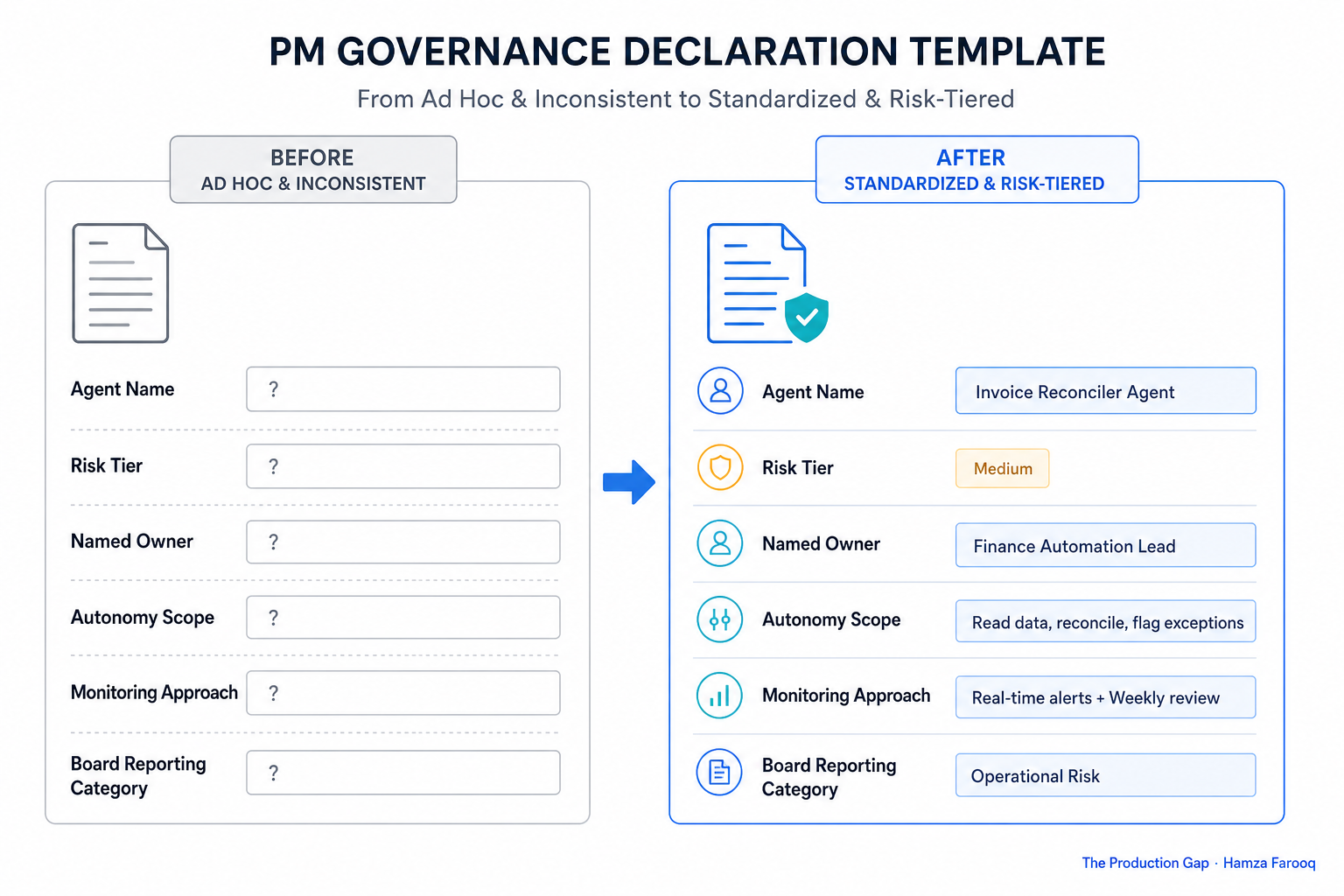
The practical artifact, used here as a practical rule of thumb rather than an externally prescribed standard, is a PM governance declaration: a one-page document capturing each agent's risk tier, named owner, monitoring approach, and board-reporting category. It travels with the feature brief and serves as both the board answer and the accountability record.
Frequently asked questions
What are the six steps Gartner recommends for managing AI agent sprawl? The six steps are: build an agent inventory, classify by risk tier, assign named human owners, define tier-appropriate policies, implement proportional monitoring, and establish board-level reporting. It is a strict sequence; skipping the inventory step makes every downstream step impossible.
Why does applying the same governance policy to all AI agents cause failure? Uniform governance fails because agents vary enormously in autonomy and business impact. A policy calibrated for a low-autonomy bot dangerously under-governs an agent executing autonomous financial transactions.
How should enterprises classify AI agents by risk and autonomy level? Enterprises classify AI agents by plotting each agent on two axes, autonomy level and business impact, where the intersection determines the risk tier and the appropriate governance intensity, from lower-risk (low autonomy, low impact) to higher-risk (high autonomy, high impact).
What should a product manager have ready when the board asks about AI agent governance? A live agent inventory listing every deployed agent, its risk tier, named owner, and board-reporting category, assembled proactively at deployment, not reactively after the question arrives.
Conclusion
Gartner's 2026 releases make one claim: agent governance is a current crisis, and uniform policies are an active failure mode, not a safe default. The accountability gap exists because PMs deploy agents faster than governance structures recognize what has been deployed. The fix is structured deployment: audit every agentic workflow, assign a risk tier, name an owner, write the governance declaration. The six-step framework is a sequence; attempting Step 4 without completing Step 1 produces process without substance.
The board question is coming. The only variable is whether your answer is already written.
Learn from me

Agentic AI for Product Managers, my Maven cohort. Learn how to design, evaluate, and ship reliable AI systems: the technical fluency PMs need to lead agentic products, no engineering background required. Join the next cohort →
Hire us
Traversaal.ai. We're a team of forward deployed engineers solving the toughest AI problems for Fortune 100 companies: document intelligence, agentic data platforms, and real-time web intelligence, deployed in production. Work with our team to deploy your next agentic ecosystem. Talk to Traversaal.ai →
Join us
Want to solve these problems with us? We're always looking for forward deployed engineers who want to ship production AI. jobs@traversaal.ai
