
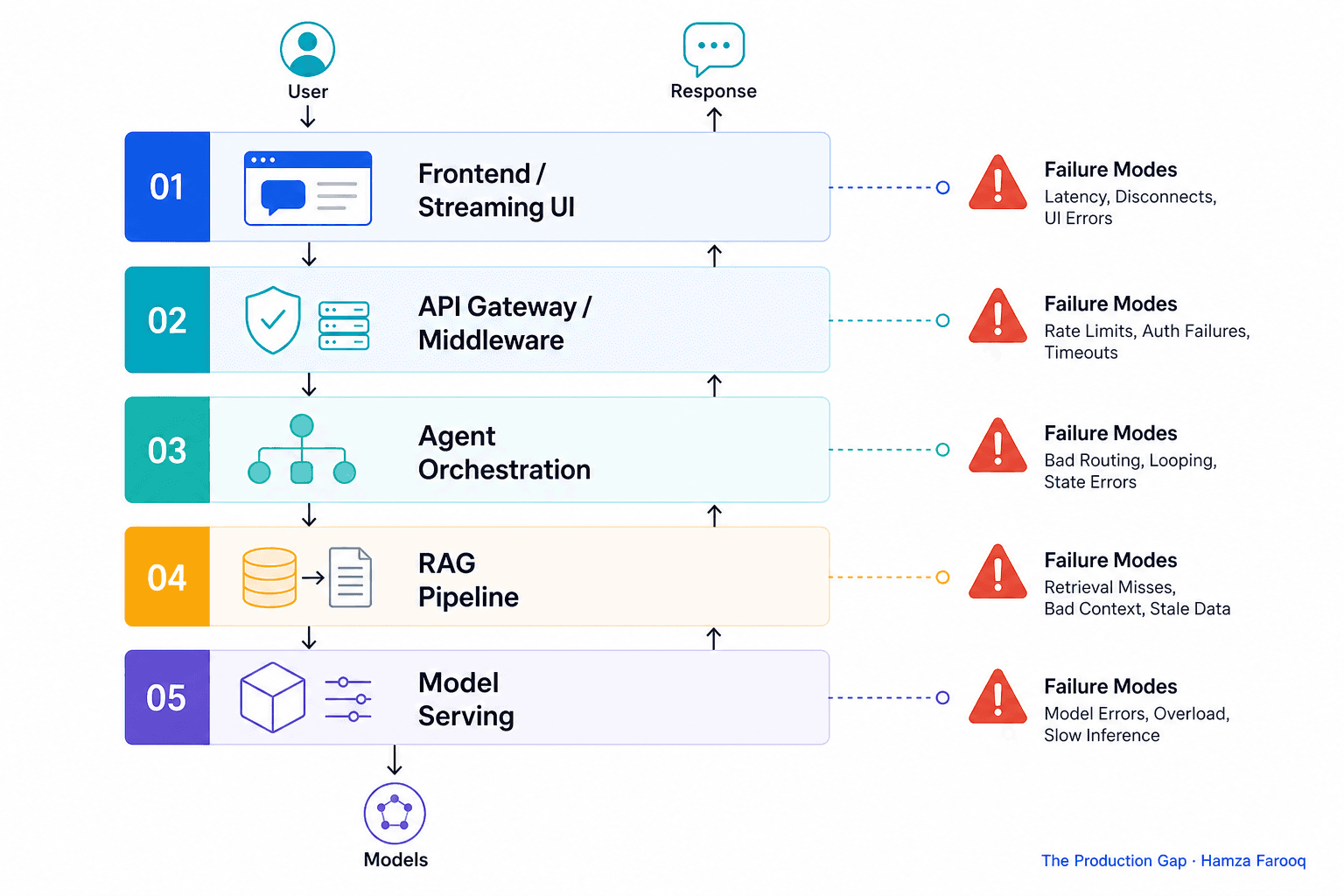
TL;DR: Production AI product architecture consists of five distinct layers: frontend and streaming UI, API gateway and middleware, agent orchestration, RAG pipeline, and model serving. Each layer owns specific responsibilities and fails in distinct ways. The developers shipping reliable AI products are not the ones who picked the best model, they are the ones who defined the clearest contracts between layers from the start.
Key Takeaways
- Each layer owns distinct failure modes that no other layer can detect.
- RAG design is an engineering problem: chunking and reranking determine whether retrieval helps or quietly poisons context.
- Agent orchestration needs explicit loop termination and memory boundaries or failures accumulate silently.
- Self-hosting open-weight models is within small-team reach but shifts hardware, batching, and uptime ownership entirely onto your team.
- Observability must reach the reasoning layer: token counts tell you something broke; traces tell you why.
- Caching LLM responses requires semantic similarity matching, not exact-match keys.
- The bottleneck in production AI is almost never the model, it is the absence of explicit contracts between layers.
Introduction
The real problem is not the model. Developers burn weeks swapping LLMs when the actual break is a missing inter-layer contract: no typed schema for agent state, no semantic caching, observability that captures tokens but not reasoning. AI architecture is a data-flow contract problem, not a model selection problem.
What does each layer of a production AI product actually own, and how does each one fail?
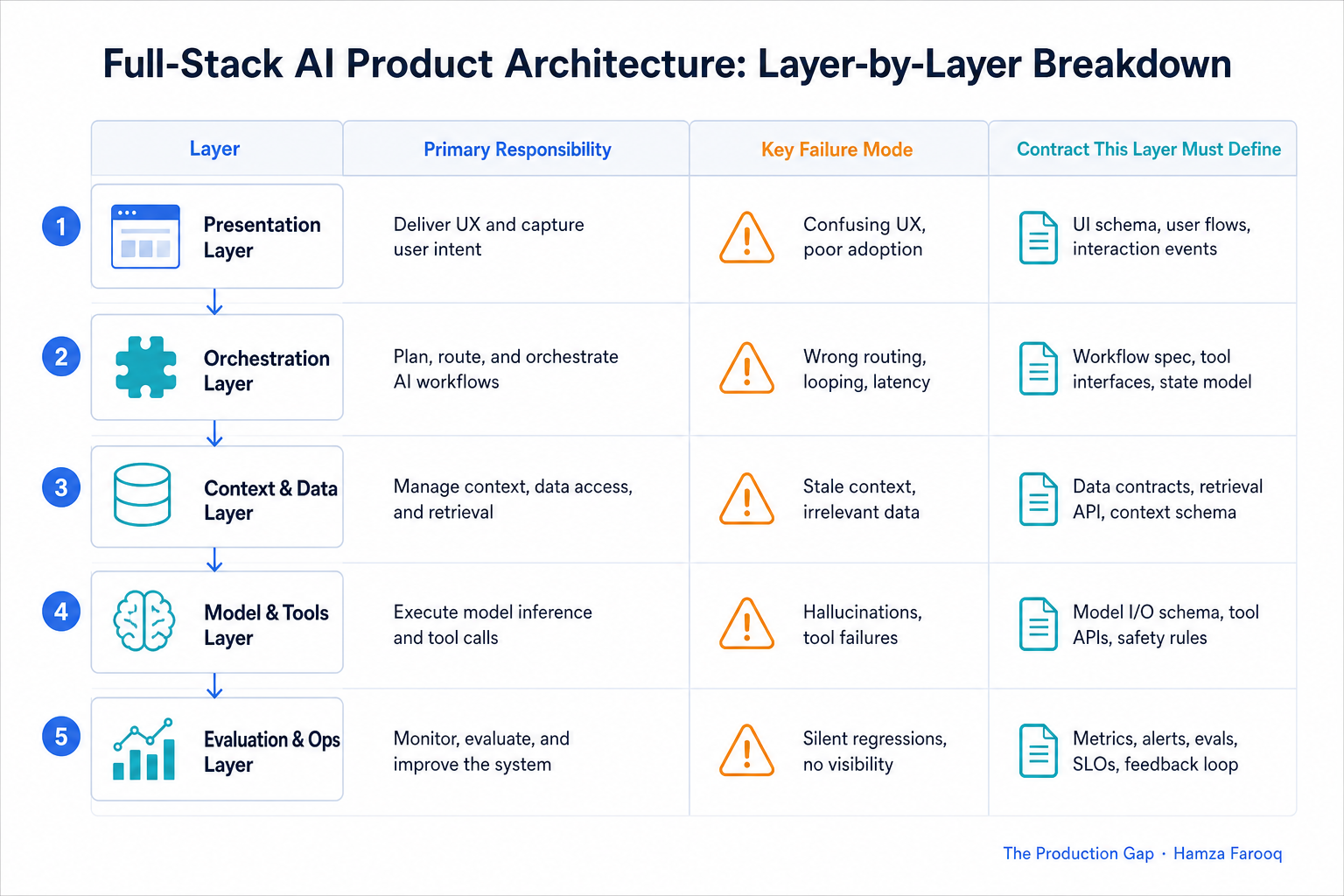
Each layer must declare what it accepts, what it returns, and what it refuses. Without that declaration, every downstream layer invents its own assumptions, the same problem REST APIs solve with OpenAPI specs.
Frontend and streaming UI owns SSE or WebSocket streaming, optimistic rendering, and graceful degradation. Failure mode: the UI assumes a complete response and renders partial JSON as broken output.
API gateway and middleware owns request validation, rate limiting, token budget enforcement, prompt assembly, and semantic cache lookup. Failure mode: no schema for agent state means every downstream layer invents its own format.
Agent orchestration owns tool-use sequencing, loop termination, memory scope, and state transitions. Failure mode: infinite loops or silent context accumulation that inflates cost without surfacing a catchable error. Explicit loop exit conditions are not optional.
RAG pipeline owns chunking, embedding, vector search, and reranking. Failure mode: retrieved context that scores well on cosine similarity but is semantically stale, after which the model confidently answers the wrong question.
Model serving owns the inference runtime, batching, hardware provisioning, and latency SLAs. Failure mode: unbounded queue depth under load that degrades silently rather than returning a catchable error.
Every debugging session should start with "which layer broke its contract?" not "is the model wrong?"
| Layer | Primary responsibility | Key failure mode | Contract it must define |
|---|---|---|---|
| Frontend / Streaming UI | SSE streaming, optimistic rendering, degradation | Renders partial JSON as broken output | What it does when the stream is incomplete |
| API Gateway / Middleware | Validation, rate limiting, prompt assembly, semantic cache | No schema for agent state; each layer invents its own format | Typed schema for every request and response |
| Agent Orchestration | Tool sequencing, loop termination, memory scope | Infinite loops or silent context accumulation | Explicit loop exit conditions and memory boundaries |
| RAG Pipeline | Chunking, embedding, vector search, reranking | Semantically stale retrieval; model answers the wrong question | Chunk structure, reranking threshold, what gets passed to the model |
| Model Serving | Inference runtime, batching, hardware, latency SLAs | Silent degradation under queue depth spikes | Latency SLA and error behavior under load |
How do you design the RAG pipeline and caching strategy that most guides skip?
RAG fails most often not at vector search but at chunking and reranking, and caching LLM responses requires semantic similarity matching, not exact-match keys.
RAG as an engineering problem
Enterprise data is evolving from static documentation into a governed metadata control plane architected for AI-ready retrieval. Documents your RAG pipeline retrieves now need governance metadata attached, not just embeddings.
The reranking gap
Vector retrieval returns candidates by geometric proximity, not semantic usefulness. A cross-encoder reranker re-scores top-k results against the actual query after initial vector search. Skipping this step means feeding the model the most statistically common documents rather than the most contextually relevant ones. The reranker is where RAG moves from prototype toward production reliability.
Semantic caching
Embed the incoming query and check cosine similarity against a cache index before routing to the model. Threshold tuning requires care: too low and you serve stale responses; too high and you miss obvious paraphrases.
| Caching approach | Works for | Fails when | Implementation cost |
|---|---|---|---|
| Exact-match (Redis) | Static prompts, deterministic queries | Any natural language variation | Low |
| Semantic cache (embedding similarity) | Conversational queries, paraphrase-heavy traffic | Similarity threshold is miscalibrated | Medium |
| Response memoization by intent bucket | High-volume FAQs, known query clusters | Query space is too broad | Medium-High |
When should you self-host a model, and what does that decision actually change in your architecture?
Self-host when data residency, latency, or cost demand it, but understand that self-hosting shifts hardware provisioning, batching, and inference runtime ownership entirely onto your team.
Three forcing functions: data residency requirements that prohibit external API calls, tail latency predictability that dedicated hardware provides and managed APIs cannot guarantee, and per-token cost that exceeds amortized GPU cost at volume. As of mid-2025, Articul8 AI has deployed specialized Llama 4 models with a security-first AWS architecture for industrial equipment failure detection, demonstrating that self-hosted LLM architecture is not enterprise-only.
Your API gateway proxies to an internal inference endpoint. You own batching configuration and observability directly, no managed dashboard abstracts that responsibility. Scalable, cost-predictable storage is a foundational dependency teams consistently underestimate when planning self-hosted inference.
| Runtime | Best for | Key feature | Managed option |
|---|---|---|---|
| vLLM | High-throughput production | Continuous batching | Anyscale, Modal |
| Ollama | Local dev, small team inference | Zero-config, Mac/Linux native | Self-managed only |
| TGI | HuggingFace ecosystem | Tensor parallelism, quantization | HF Inference Endpoints |
How do you build observability that captures reasoning traces, not just token counts?
Token counts and latency tell you something broke; reasoning traces tell you why, and why is the only information that lets you fix the actual problem.
Infrastructure level: Latency per layer, token usage, and cost per request. OpenTelemetry or a managed APM handles this. It is the starting point, not the finish line.
Retrieval level: Which chunks were retrieved, their similarity scores, whether the reranker changed ranking order, and what the model actually received in context. Most teams have zero coverage here, it is where to focus first.
Reasoning level: For agent orchestration, what tool was called, what intermediate state was passed, and whether the loop terminated as expected. Wrap every tool call in a named span capturing inputs, outputs, and an intermediate reasoning field. Structured context files that document behavioral contracts for your agents give you a versioned record of expected behavior, making post-hoc debugging interpretable rather than speculative.
Frequently Asked Questions
What are the most common mistakes full-stack developers make when adding RAG to an existing product architecture? Fixed-size chunking without semantic boundaries, skipping reranking, and treating the vector store as a black box with no retrieval observability. These are engineering problems with engineering solutions, none require a better model.
How do you implement observability for agent reasoning traces rather than just token counts? Wrap every tool call in a named span capturing inputs, outputs, and an intermediate reasoning field. Token counts tell you cost; reasoning traces tell you causality.
How do you design a caching strategy for LLM responses that accounts for semantic similarity? Embed the incoming query and run cosine similarity against a cache index before routing to the model. The key engineering work is threshold tuning, too low serves stale responses; too high misses obvious paraphrases.
When should a full-stack team self-host a model rather than use a managed API? Self-host when data residency prohibits external calls, tail latency predictability matters to your SLA, or per-token cost exceeds amortized GPU cost at your traffic volume. A managed API is the right starting point; self-hosting is a deliberate operational upgrade, not a day-one requirement.
Conclusion
The bottleneck in production AI is almost never the model, it is the absence of explicit contracts between layers. Three next steps:
- Audit your stack layer by layer. Write down what contract each layer defines, accepts, and returns. Where there is no answer, that is your first fix.
- Add retrieval-level observability before touching the model. Log what your RAG pipeline actually retrieved and passed to context. Most teams have never looked at this data.
- Evaluate one self-hosting runtime today (Ollama for local development or vLLM for production) even if you are on a managed API. Understanding the operational difference informs better architecture decisions regardless of which path you choose.
The developers who ship reliable AI products designed the clearest contracts. Start with the audit.
Learn from me
Forward Deployed Engineering Bootcamp for Full-Stack Developers, my Maven cohort. Build and ship complete AI products end to end, from React and Node.js frontends to deployed models with caching and observability. Join the next cohort →
Hire us
Traversaal.ai. We're a team of forward deployed engineers solving the toughest AI problems for Fortune 100 companies: document intelligence, agentic data platforms, and real-time web intelligence, deployed in production. Work with our team to deploy your next agentic ecosystem. Talk to Traversaal.ai →
Join us
Want to solve these problems with us? We're always looking for forward deployed engineers who want to ship production AI. jobs@traversaal.ai
