
Most engineers who land an FDE role expect to spend their days fine-tuning models, then discover on week two that the actual job is keeping a Fortune 500 account from churning.
TL;DR: In 2026, forward deployed engineer jobs have gone mainstream, nearly 4,000 postings on Indeed, 1,000-plus on LinkedIn. The verified median base is $188K, a $25K premium over comparable titles, but tier and seniority matter far more than the headline number. The title now covers two fundamentally different jobs, and engineers who can't tell them apart before interviewing will waste months in the wrong role.
Key Takeaways
- FDE hiring has gone mainstream: nearly 4,000 postings on Indeed, no longer a niche AI-lab title.
- Consulting firms and enterprise software vendors now account for significant volume alongside AI labs.
- FDEs earn a real premium: $188K median base versus $163K for comparable titles, a verified $25K gap.
- FDE and ML engineer are not the same job: FDEs deploy solutions inside customer environments, not build models.
- Many postings blur the line between sales engineering and deep technical work.
- FDE can accelerate a move into technical leadership or pull you away from pure engineering in ways that are hard to reverse.
Who is hiring forward deployed engineers in 2026?
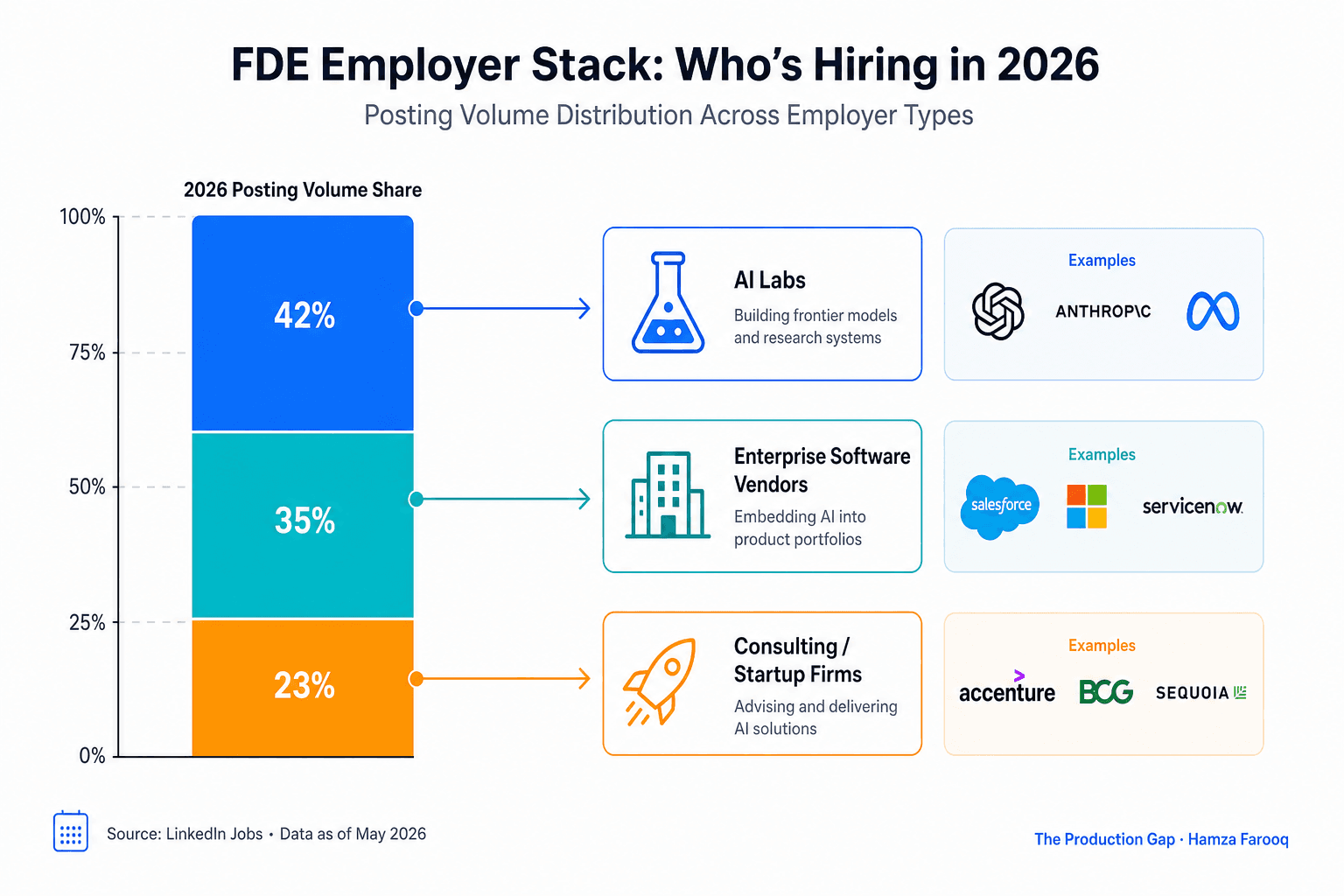
Tier 1, AI Labs define FDE work at its most technical. OpenAI lists 43 dedicated FDE roles out of 738 total openings, requiring working ML fluency: model integration, prompt systems, LLM deployment. If you want model-layer work, Tier 1 is your target.
Tier 2, Enterprise Software Vendors are where much of the volume has shifted. Snowflake's Senior FDE posting centers "modernization of data and application ecosystems", not model tuning. Skill emphasis runs toward platform integration, data pipelines, and onboarding velocity. Adobe is also actively hiring FDEs in this tier.
Tier 3, Consulting Firms and Startups are a fast-growing segment. The work is integration engineering and solutions architecture; ML depth is a bonus, not a requirement. Gecko Robotics is among the active hirers here.
Table 1: The FDE employer stack, mid-2026 hiring landscape
| Employer Tier | Example Companies | Primary FDE Skill Demand | ML Depth Required? | Day-to-Day Skew |
|---|---|---|---|---|
| AI Labs | OpenAI | LLM integration, model deployment, prompt systems | Yes, working fluency | Model-layer work, customer architecture |
| Enterprise Software | Snowflake, Adobe | Platform integration, Spark/data pipelines, onboarding | No, preferred not required | Data modernization, deployment acceleration |
| Consulting / Startups | Gecko Robotics | Systems integration, solutions architecture, coding | No | Account cadence, integration builds, sales cycle support |
Sources: Traversaal.ai FDE Job Board, Indeed, LinkedIn, OpenAI Careers, Snowflake Careers, Adobe Careers, Plank FDE Job Market
What does a forward deployed engineer actually earn in 2026?
FDEs earn a verified median base of $188K ($25K above the $163K median for comparable titles) but that premium is not spread evenly. It is most likely concentrated at AI labs and top-tier enterprise vendors, not consulting-tier employers. Entry-level FDE pay runs $51,500 to $165,000, entirely driven by tier. Adjust expectations before entering any salary negotiation.
Table 2: FDE compensation orientation by seniority and employer tier (mid-2026)
Mid-level and senior columns are directional estimates based on tier positioning relative to the verified $188K median. Verify current figures through employer-specific research.
| Level | AI Lab (e.g., OpenAI) | Enterprise Software (e.g., Snowflake) | Consulting / Startup |
|---|---|---|---|
| Entry-Level | Upper end of $51K–$165K range | Mid-range of $51K–$165K range | $51K–$100K base |
| Mid-Level (3–5 yrs) | Above $188K median | Around $188K median | Below $188K median |
| Senior (6–8 yrs) | Well above $188K median | Around or above $188K median | At or below $188K median |
What do FDE job postings actually require, and how is that different from an ML engineer role?
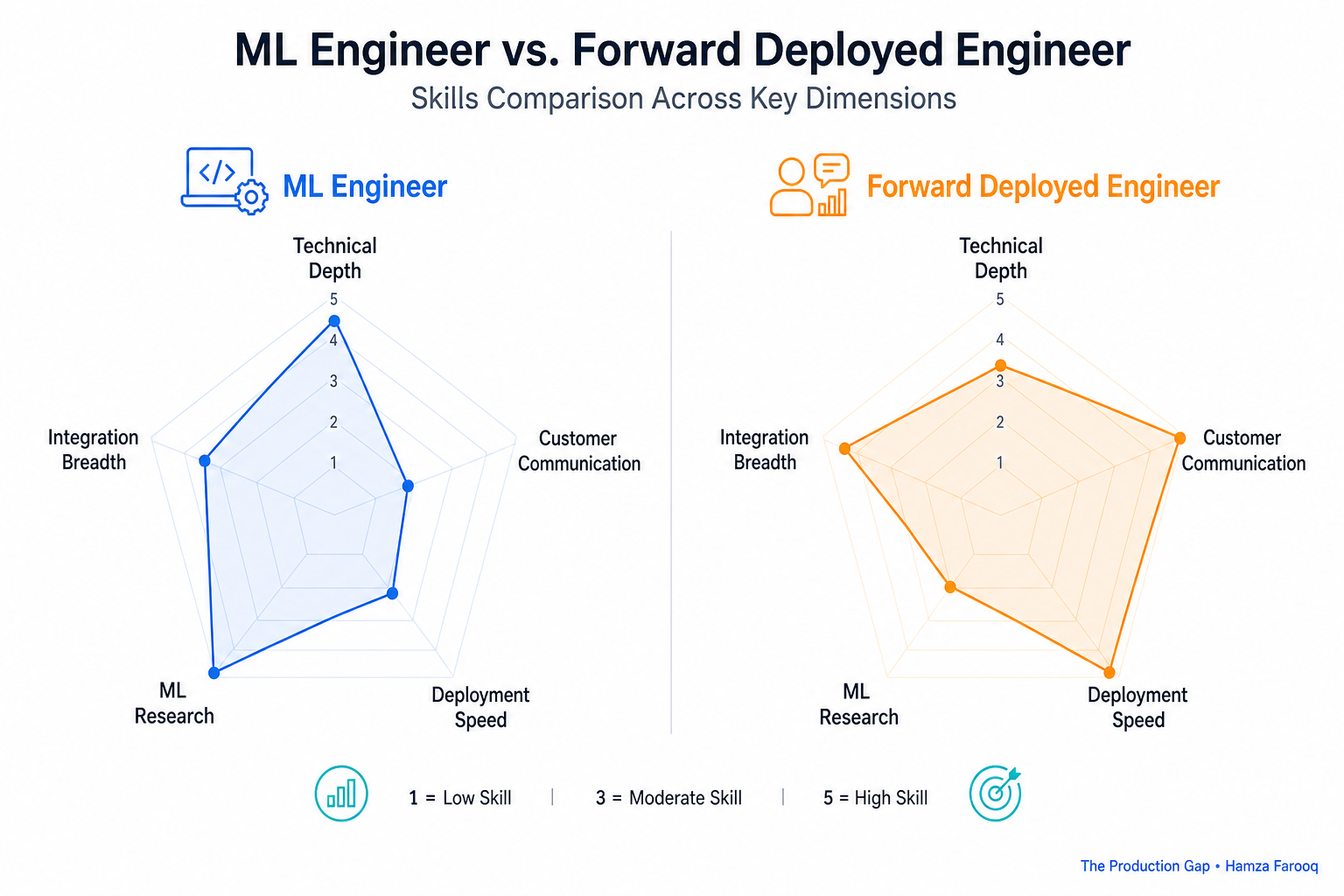
FDE postings most commonly require integration engineering, customer-facing communication, and the ability to compress time-to-value, not the model-building depth an ML engineer role demands.
The FDE title is now a catch-all hiding a real skills split. AI-lab roles require ML fluency. The enterprise and consulting wave recruits customer-embedded engineers who can code and consult. Snowflake's Senior FDE description explicitly centers "modernization of data and application ecosystems", not model research. The role formally sits at the intersection of engineering, consulting, sales, and customer-facing responsibilities, accurate for Tiers 2 and 3, less so for Tier 1.
ML engineers are built for depth and controlled environments. FDEs are built for breadth and ambiguity, deploying in customer environments they don't control, on compressed timelines, with a sales rep in the room. If a posting emphasizes "time-to-value," "customer onboarding," or "account health," the role sits closer to technical consulting than ML engineering, regardless of the title.
Table 3: ML engineer vs. forward deployed engineer, skills and role comparison (mid-2026)
| Dimension | ML Engineer | Forward Deployed Engineer |
|---|---|---|
| Core Technical Skills | Model architecture, training pipelines, evaluation frameworks | Systems integration, API deployment, data pipelines, platform APIs |
| Soft Skills | Deep focus, written async communication | Client communication, stakeholder management, live problem-solving |
| Work Environment | Controlled, internal, long iteration cycles | Customer environments, variable stacks, compressed timelines |
| Primary Success Metric | Model accuracy and benchmark performance | Customer time-to-value, deployment velocity, retention |
| Career Risk | Specialization can narrow options over time | Customer-facing cadence can pull away from core engineering |
How do you evaluate an FDE offer, and what are the red flags in job descriptions?
The most reliable evaluation move: ask in the final round what percentage of FDE time goes to sales-cycle activities versus technical build work, and get that answer in writing.
Four red flags to screen for:
- "Partner with the sales team" in responsibilities signals pre-sales support, demos, RFPs, POC management. That is solutions engineering carrying an FDE title.
- Vague technical requirements like "familiarity with ML models" paired with heavy stakeholder-management language signals solutions engineering rebranded. Real FDE technical sections name specific stacks.
- No IC growth path or technical mentorship program means the role tops out at senior with no internal ladder.
- "Travel up to 50%" without corresponding technical depth signals field consulting, not engineering.
Three questions to bring into your final round: - What does a typical week look like once an account is live, and what is the split between building and meetings? - How is FDE performance measured: deployment metrics, revenue retention, or both? - Has anyone on the FDE team successfully transferred to a pure IC engineering role internally?
Frequently Asked Questions
What is the difference between a forward deployed engineer and a solutions engineer? A solutions engineer works pre-sale: demos, POCs, RFPs. An FDE is embedded post-sale to actually build and deploy. Tier-2 and Tier-3 FDE roles frequently blend both when the POC phase runs deep into the sales cycle.
Do you need an ML background to get a forward deployed engineer job in 2026? Only at AI labs like OpenAI. At enterprise vendors and consulting firms (the majority of FDE postings) integration engineering, cloud platform fluency, and customer communication are weighted far more heavily than ML depth.
What is the average forward deployed engineer salary in 2026? The verified median base is $188K as of mid-2026 (Plank); entry-level roles start at $51,500 (ZipRecruiter). Use the median as a negotiation anchor calibrated to employer tier, not a guarantee.
Does the FDE role lead back to pure engineering or toward technical leadership? Both paths are possible, but engineers who stay in FDE for several years typically find the path back to pure IC work narrowing while paths toward solutions leadership and technical program management widen. Deliberate planning early beats course-correcting later.
Conclusion
The mid-2026 FDE market is real, large, and well-compensated, but the title carries more variation than it signals. An OpenAI FDE and a Gecko Robotics FDE are doing materially different work under an identical title. The engineers who succeed here walk into messy customer environments, find the shortest path to a working deployment, and finish before the account churns.
Before your next FDE interview: identify the employer's tier using Table 1, calibrate compensation against Table 2, and bring the three evaluation questions into your final round.
Looking for Forward Deployed Engineer (FDE) roles? Follow our FDE Jobs Dashboard for the latest opportunities.
Learn from me
Forward Deployed Engineering Bootcamp for Full-Stack Developers, my Maven cohort. Build and ship complete AI products end to end, from React and Node.js frontends to deployed models with caching and observability. Join the next cohort →
Hire us
Traversaal.ai. We're a team of forward deployed engineers solving the toughest AI problems for Fortune 100 companies: document intelligence, agentic data platforms, and real-time web intelligence, deployed in production. Work with our team to deploy your next agentic ecosystem. Talk to Traversaal.ai →
Join us
Want to solve these problems with us? We're always looking for forward deployed engineers who want to ship production AI. jobs@traversaal.ai
