
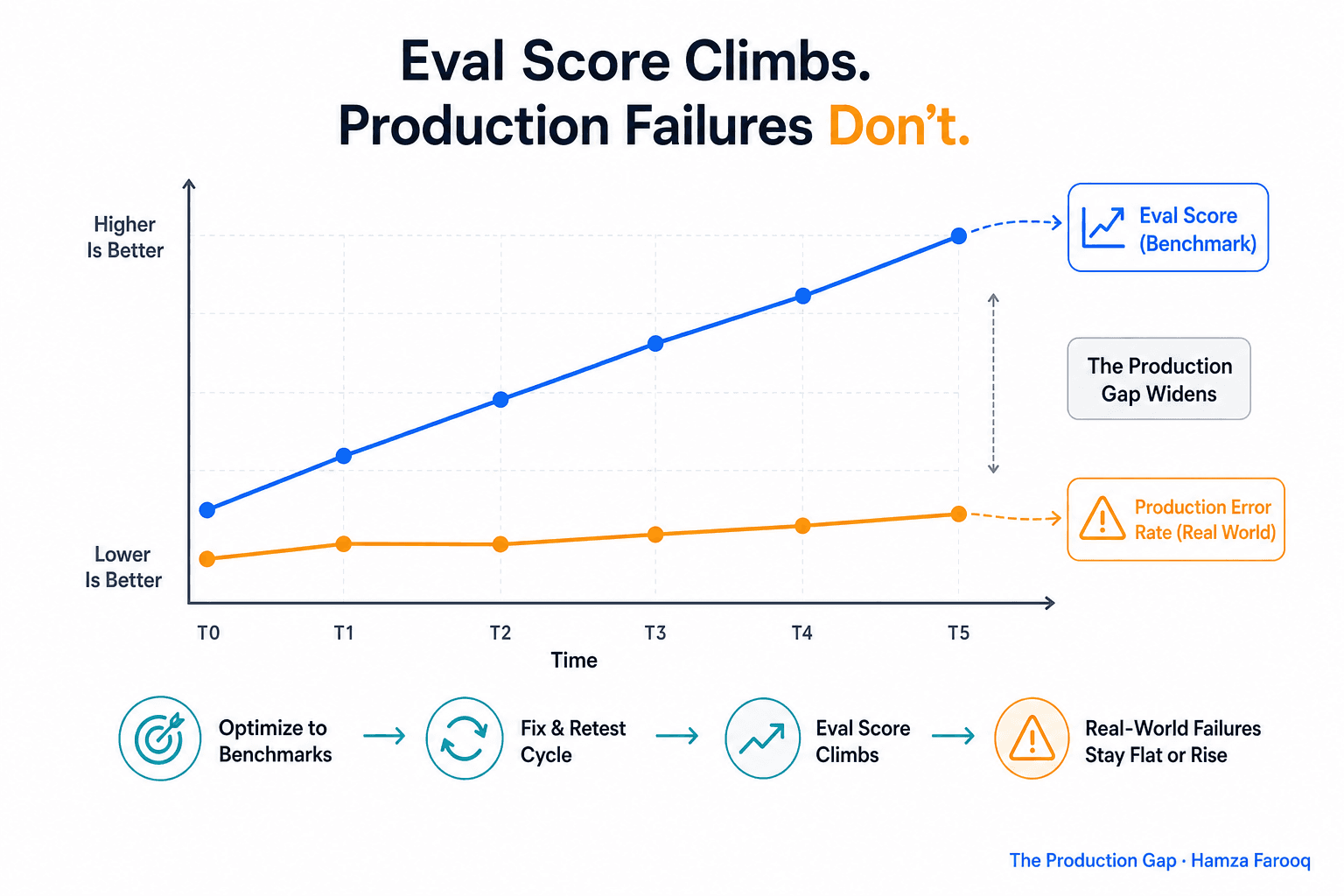
TL;DR: Eval overfitting in agents happens when engineers repeatedly patch failures on specific test cases until benchmark scores rise, producing a system that aces its eval suite but breaks on real-world tasks it has never seen. This is Goodhart's Law applied to agent development: the metric becomes the target and stops measuring what matters. Separate your fix-and-retest loop from a held-out eval set to preserve honest signal.
Key takeaways
- Goodhart's Law kills agent evals: when your benchmark score becomes the goal, it stops measuring what actually matters.
- The fix-and-retest trap inflates scores: patching individual failing cases teaches the agent nothing it hasn't already seen.
- Trajectory evals catch what output evals miss: correct answers via brittle paths still break in production.
- Holdout sets are non-negotiable: folding every failing case back into your suite turns it into a memory bank.
- Notebook evals are not production: real inputs and edge cases were never part of the eval distribution.
- Your LLM judge can overfit too: tune against it long enough and the agent learns to satisfy the judge, not the task.
Introduction
Passing a curated eval suite does not guarantee real-world task alignment. Practitioners openly ask how to evaluate agents once they leave the notebook , because the dominant failure mode has a name: eval overfitting. This article gives engineers a concrete mental model for diagnosing it and breaking the fix-and-retest loop before it hollows out both the suite and the team's diagnostic instincts.
What is the fix-and-retest trap, and why does it inflate eval scores without improving your agent?
The fix-and-retest trap is the cycle where engineers patch each failing eval case individually, retest, and ship, producing rising scores that reflect case memorization, not generalized capability.
The loop goes like this: agent fails a case, engineer tweaks the prompt or adds a routing rule, retest passes, merge, repeat. Eval scores climb while production reliability stays flat. This is Goodhart's Law applied directly: when a measure becomes a target, it ceases to be a good measure. Anthropic's engineering guidance explicitly acknowledges that agent evaluation is a distinct and non-obvious problem space.
The deeper consequence is not score inflation. Each targeted patch trains engineers to satisfy the eval rather than understand the failure mode, and diagnostic instinct quietly atrophies. That is a team cognition and incentive problem dressed as an engineering one.
Why does trajectory evaluation reduce overfitting compared to output-only evals?
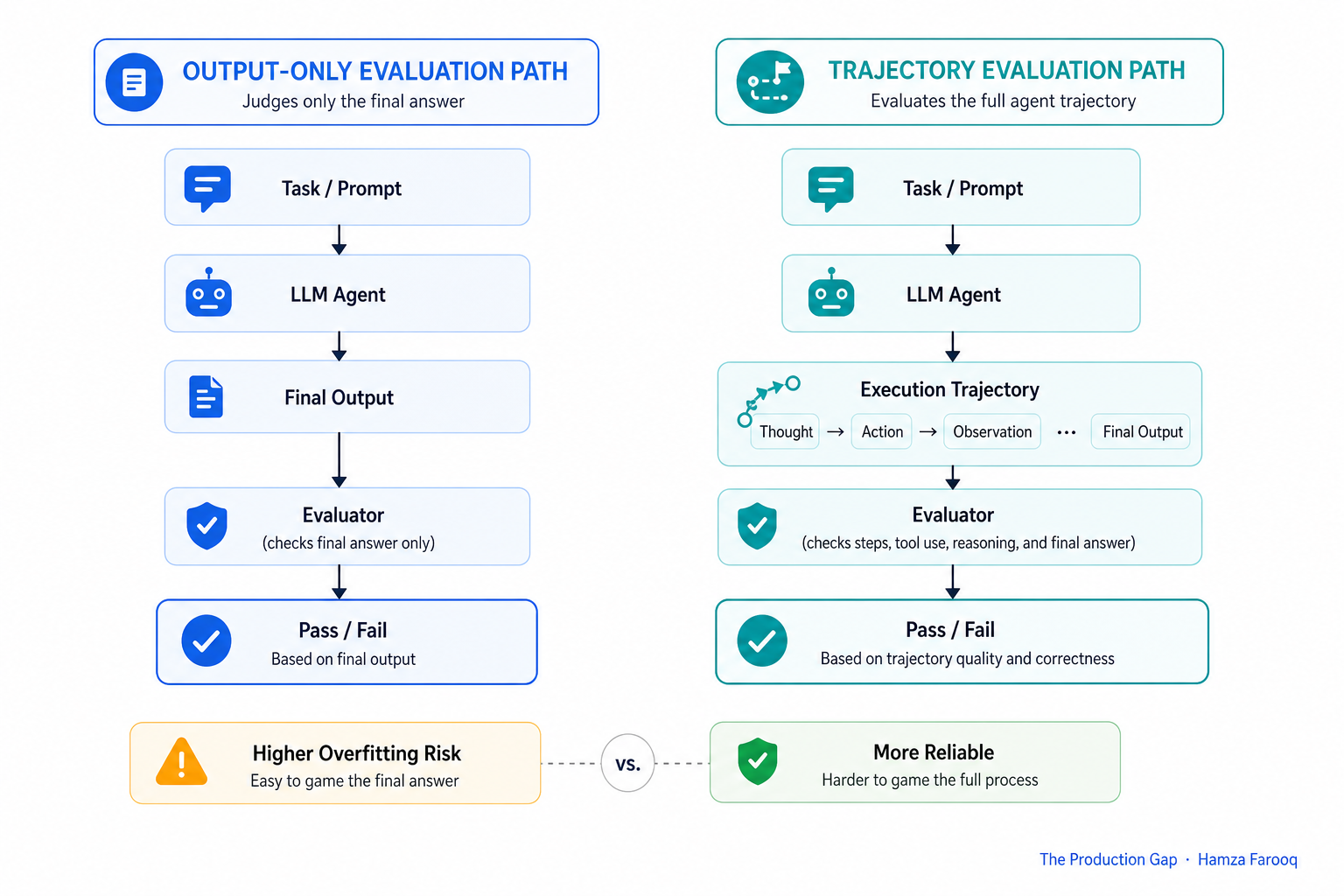
Trajectory-based evaluation reduces overfitting because it checks whether the agent reached the right answer via a sound reasoning path, not just whether the final output matches the expected string.
Output evals ask one question: did the agent produce the right answer? Trajectory evals ask several: did the agent call the right tools, in the right order, with appropriate intermediate reasoning? An agent can produce a correct final output through a coincidental or brittle path that breaks the moment inputs shift.
| Eval dimension | What it checks | What it misses | Overfitting risk |
|---|---|---|---|
| Output-only | Final answer correctness | Reasoning path, tool selection | High, easy to patch single outputs |
| Trajectory | Tool calls, step order, intermediate states | Subjective task alignment | Medium, harder to game |
| LLM-as-Judge | Holistic quality, alignment, tone | Judge's own biases, prompt sensitivity | Medium-high, judge can be gamed |
| Production telemetry | Real user outcomes, failure patterns | Latency in feedback loop | Low, ground truth, but slow |
The LLM-as-judge risk deserves close attention. Tune your agent against an automated evaluator long enough and it starts optimizing for satisfying the judge, not completing the task. Static judge calibration decays because agents never give identical outputs twice.
How should you structurally design an eval suite that resists the fix-and-retest trap?
An eval suite that resists overfitting uses a permanent holdout set that never receives patches, maps coverage to failure modes rather than case counts, and treats production telemetry as the ground-truth validation layer.
Holdout sets are non-negotiable. If every failing case gets folded back into the active suite after a fix, the suite stops testing generalization and starts testing recall. Keeping a locked holdout (cases no patches ever touch) means your score there reflects genuine capability, not accumulated fixes.
Distribution coverage matters more than case count. Cases clustering around the same input archetypes give less signal than a smaller set spanning distinct failure modes. Map eval cases to a failure mode taxonomy; gaps in that taxonomy are production incidents waiting to happen. Eval suites built in notebook conditions are systematically missing production failures.
Eval-driven development is sound , but only if production signals feed back into suite updates. When a novel failure appears in production, add coverage to the holdout set rather than a targeted patch to the active suite.
How do you know if your team has already fallen into the eval overfitting trap?
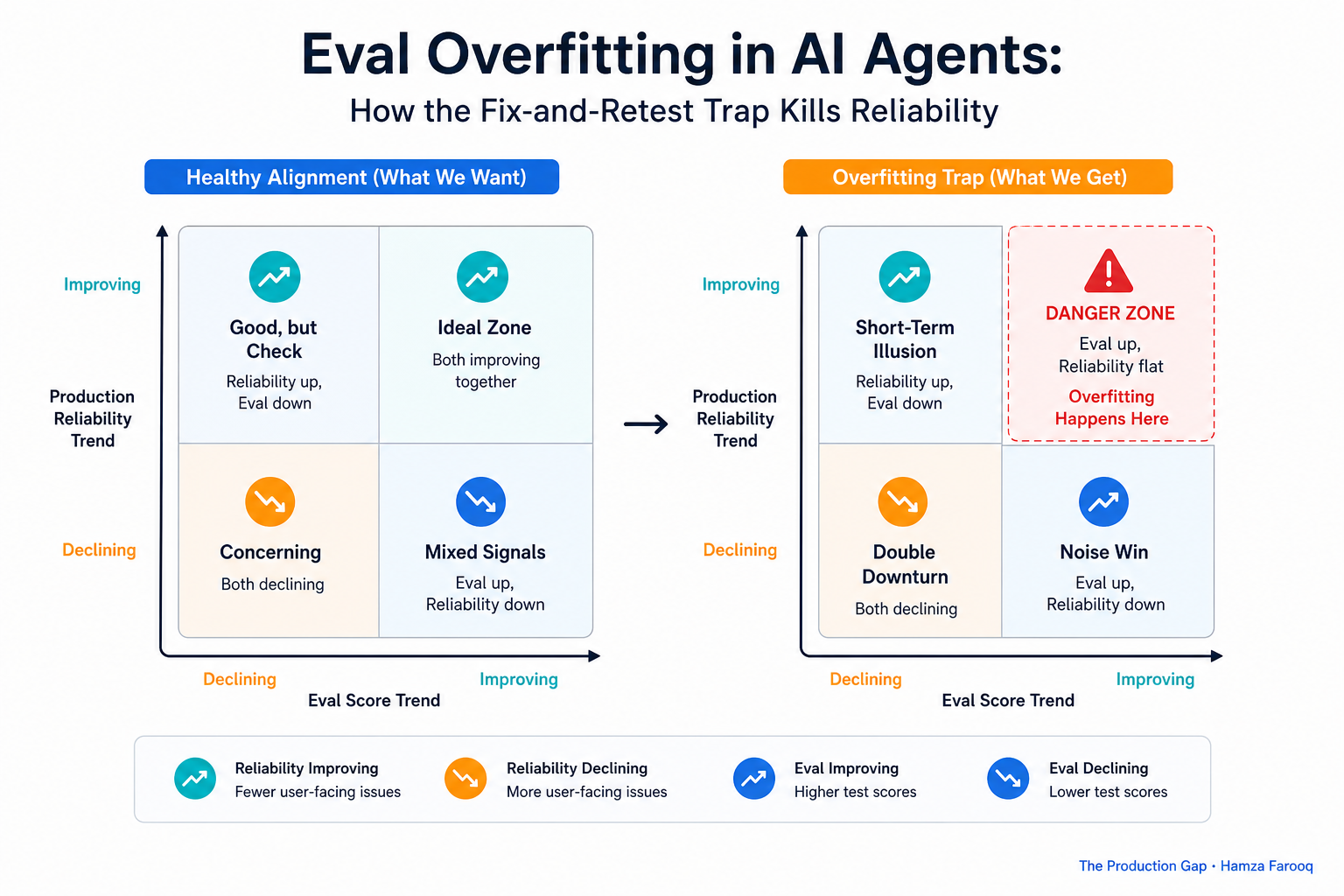
Your team has likely fallen into the trap if eval scores improve sprint-over-sprint while production failures remain patterned and predictable, that divergence is the diagnostic signal.
Four concrete signals to check today:
- Eval score and production reliability diverge. Scores climb; production errors are the same types, just different instances.
- Every sprint closes with "fixed failing evals." If retros list eval patches as wins, you're measuring patch throughput, not agent improvement.
- Engineers can predict which cases will fail next. If failures are anticipated by pattern, the suite is no longer generating new information.
- Holdout performance is unknown or materially worse than active suite performance. If the delta is never tracked, the active suite score is meaningless.
When green evals are the sprint metric, every engineer is implicitly rewarded for satisfying the eval, not diagnosing the agent. The team gets progressively better at passing evals and progressively worse at building reliable agents.
Frequently asked questions
How do I know if my eval suite is overfit rather than measuring real capability? Your suite is overfit if holdout scores are significantly worse than active suite scores, or if production failures repeat patterns the suite has already "fixed." The holdout score is the only number that distinguishes generalization from memorization.
What is the difference between fixing an agent and fixing an eval score? Fixing an agent means resolving the root cause of a failure class so it generalizes to unseen variations. Fixing an eval score means patching the specific failing case, the number improves, the agent doesn't.
How should I structure eval suites to avoid the Goodhart's Law trap? Use a locked holdout set that receives no patches, map cases to a failure mode taxonomy rather than maximizing count, and treat production telemetry as the authoritative validation layer.
How do trajectory-level evals reduce overfitting compared to output evals? Trajectory evals require correct tool selection and intermediate reasoning (not just a matching final output) making it substantially harder to pass via coincidental paths that break under real conditions.
Conclusion
Eval-driven development is not the problem. The fix-and-retest loop that hijacks it is. Rising scores generate organizational confidence, but if they reflect patch accumulation rather than genuine capability, that confidence is not grounded in reliability.
Two concrete next steps:
- Run your current suite against your holdout set today. If you don't have one, create it before the next sprint.
- Map your last five production failures to your failure mode taxonomy. If they don't appear, your suite has distribution gaps, not a patching backlog.
Your eval suite should surface uncomfortable gaps. If it no longer does, it has stopped measuring anything real.
Learn from me

Agent Engineering Bootcamp: Developers Edition, my Maven cohort. Advanced agentic RAG, multi-agent orchestration, memory, evals, and guardrails. Take agents from prototype to production. Join the next cohort →
Hire us
Traversaal.ai. We're a team of forward deployed engineers solving the toughest AI problems for Fortune 100 companies: document intelligence, agentic data platforms, and real-time web intelligence, deployed in production. Work with our team to deploy your next agentic ecosystem. Talk to Traversaal.ai →
Join us
Want to solve these problems with us? We're always looking for forward deployed engineers who want to ship production AI. jobs@traversaal.ai
