
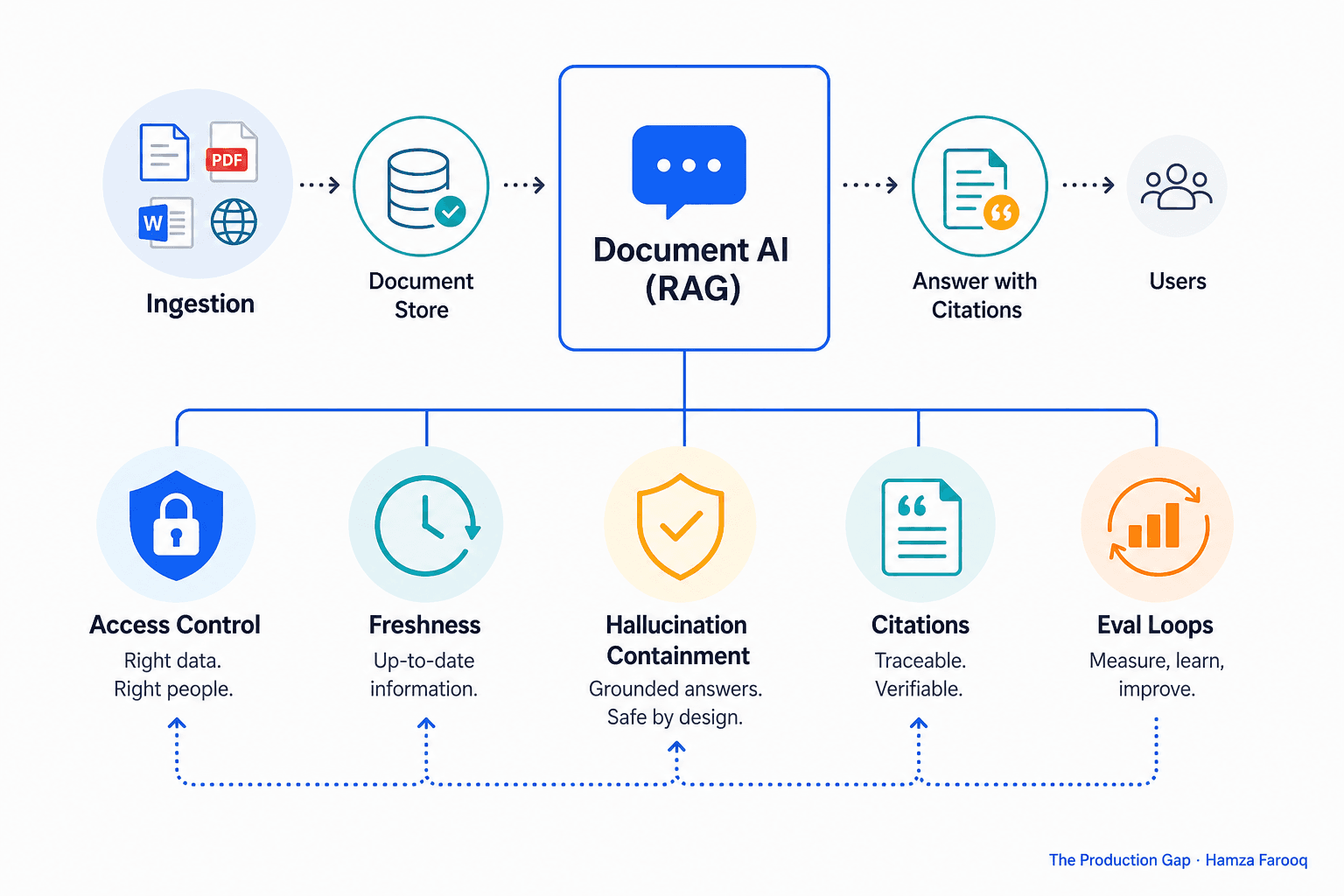
TL;DR: Enterprise document AI done right requires five non-negotiable pillars: source citations, role-based access control, document freshness mechanisms, continuous evaluation loops, and hallucination containment. Without all five, what looks like a capable system in a demo will fail silently in production, leaking restricted content, returning stale answers, or fabricating facts with confident precision.
Key takeaways
- Source citations are non-negotiable: every answer must link to a specific page, clause, or passage so users can verify it themselves.
- Access control must follow the retrieval layer. Permissions enforced only at the UI allow answers drawn from documents users were never authorized to read.
- Index staleness is a silent liability. An answer grounded in a superseded policy is wrong even if retrieval mechanics worked perfectly.
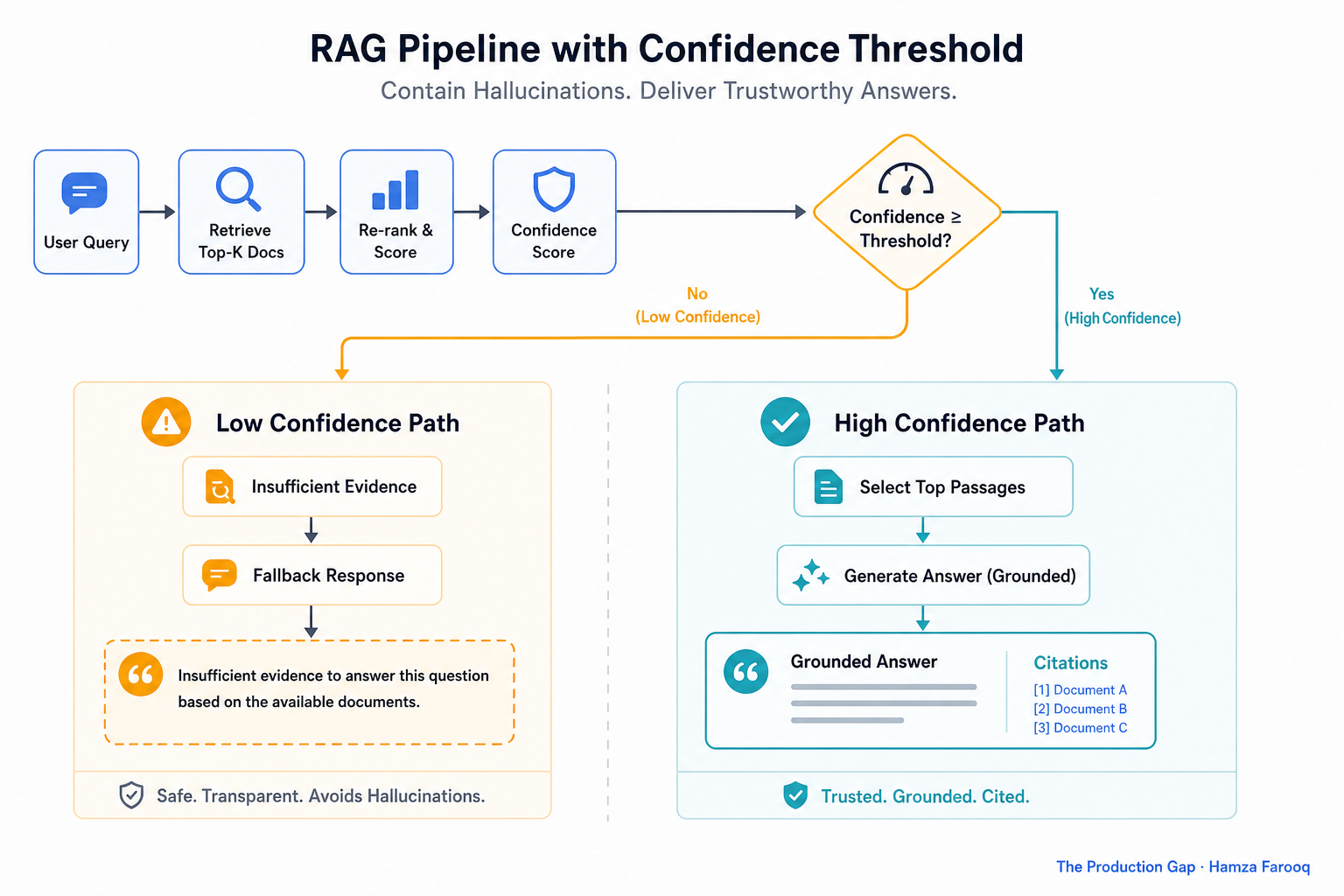
- Hallucination containment requires active architecture. Production systems need explicit grounding checks, confidence thresholds, and fallback behavior built into the pipeline.
- Evaluation loops separate pilots from production. Without ongoing measurement, accuracy problems accumulate quietly until they become a compliance incident.
- Ingestion quality determines everything downstream. Broken OCR or inconsistent chunking corrupts retrieval and generation regardless of how well the rest of the system is built.
Why does document ingestion quality matter for enterprise AI accuracy?
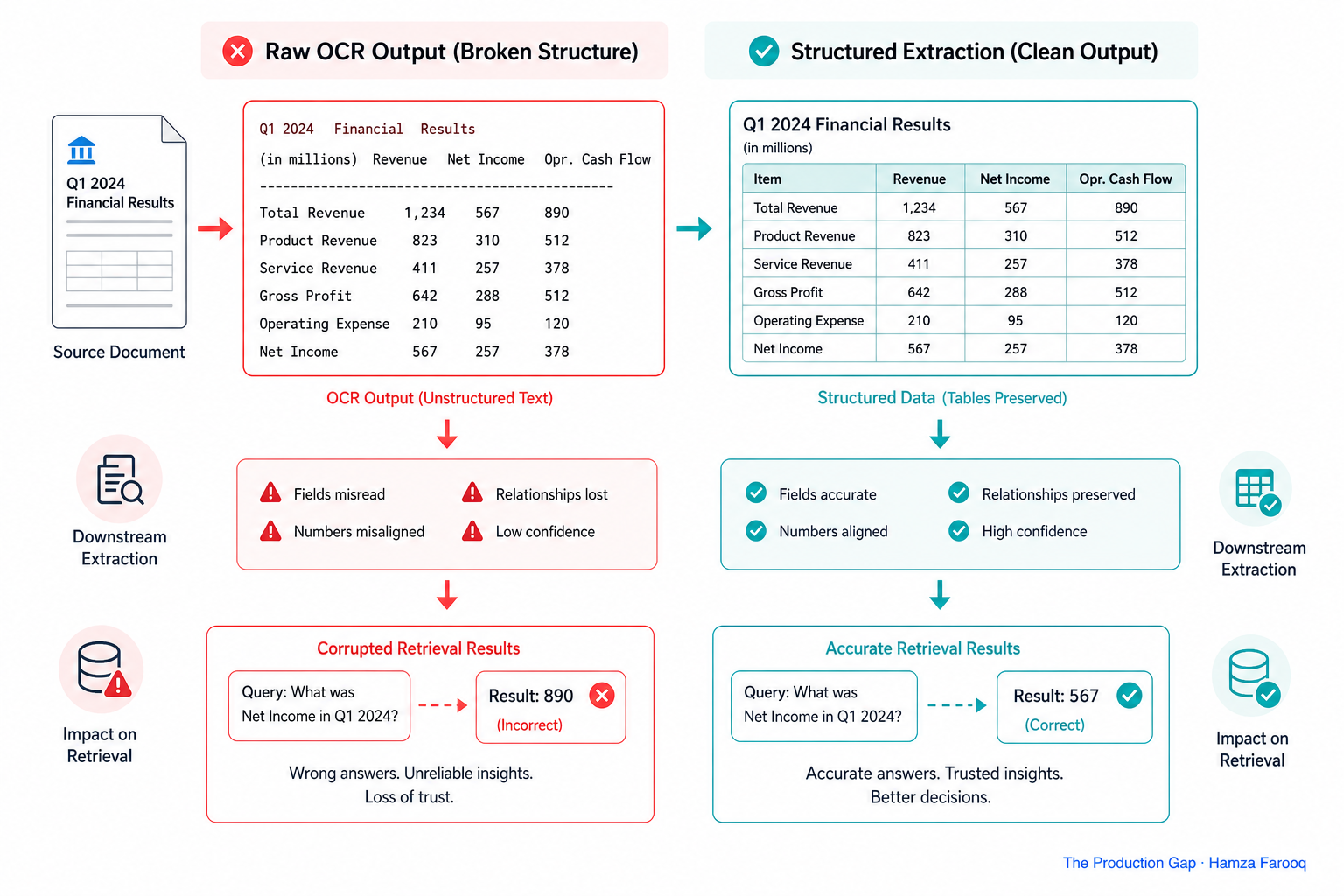
Ingestion is the highest-leverage point in the system. Corrupt text at intake and every downstream step inherits that corruption.
- OCR character errors in scanned contracts destroy clause-level retrieval. A misread character in a liability cap turns a retrievable clause into a gap in the index.
- Table cell boundary misalignment turns financial schedules into narrative gibberish the model then synthesizes into nonsense.
- Naive fixed-length chunking splits a legal definition across two chunks so neither retrieves cleanly.
Each has a discrete remedy: layout-aware OCR, structured table extraction, and semantic chunking with overlap. Google Cloud's Enterprise Document OCR addresses layout-sensitive failures directly. Snowflake's engineering work confirms ingestion is an active engineering problem, not a commodity. Build it wrong and no downstream improvement recovers it.
What does a production-grade source citation and access control architecture actually look like?
Production systems require citation and access control enforced at the retrieval layer, not the application surface, so every answer is both verifiable and permission-bounded.
Citation architecture requires every retrieved chunk to carry metadata: document ID, page number, section heading, and version timestamp. That metadata travels through the generation pipeline and surfaces in the final answer. A citation that cannot be traced back to a specific passage gives users no way to verify what they are reading.
Access control means permission filtering executes at query time against the vector index, before results are returned. A user without access to executive compensation documents must receive a retrieval result set that never included those chunks, not one that included them but suppressed the answer. The distinction is legally material in regulated industries.
Table 1: Permission Architecture Patterns by Production Safety
| Architecture pattern | Where permissions enforced | Citation traceability | Production-safe? |
|---|---|---|---|
| Chatbot over PDFs (no ACL) | None | None | No |
| UI-layer permission filter | Application surface | Answer string only | No |
| Retrieval-layer permission filter | Vector query execution | Chunk metadata + answer | Yes |
If permissions live above the retrieval call and citations live below the generation call, the result is a demo rather than a system.
How do you contain hallucinations and keep document answers fresh in production?
Hallucination containment and document freshness are active pipeline properties, not defaults. An LLM will generate plausible answers from stale or missing context without signaling it has done so.
Three containment mechanisms belong in every production pipeline, as a practical rule of thumb:
- Retrieval confidence thresholds that trigger a "no sufficient evidence found" fallback rather than a low-confidence answer.
- Grounding verification that checks whether every factual claim maps to a span in the retrieved chunks.
- Answer-refusal policies for ambiguous or contradictory context, because acknowledging uncertainty is preferable to fabricating regulatory guidance.
On freshness: every indexed chunk must carry a version timestamp and staleness TTL. Version eviction must happen before new chunks are indexed, not after. An answer drawn from a superseded policy is factually wrong even if retrieval mechanics worked correctly.
What evaluation loop does a production document AI system actually need?
A production system requires a continuous evaluation loop tied to real user queries and ground-truth answers. Without it, accuracy degradation accumulates quietly until it surfaces as a compliance incident.
Three evaluation layers every production system needs, as author synthesis from the framework used in this guide:
- Offline ground-truth eval: a curated question-answer-citation dataset from the actual corpus, run against every pipeline change. It measures retrieval recall, answer faithfulness, and citation accuracy.
- Online user feedback loop: thumbs-down signals and session abandonment rates tied to specific query types, surfacing failures without manual review.
- Periodic adversarial auditing: scheduled red-team testing of edge cases, ambiguous queries, and permission and freshness boundaries.
FAQ
Q: What is the difference between a chatbot over PDFs and a production-grade enterprise document AI system? A chatbot over PDFs lacks permission-aware retrieval, citation traceability, freshness pipelines, hallucination containment, and evaluation loops. Those missing properties make it unsuitable for regulated or high-stakes enterprise use. As IBM defines it, document AI uses OCR, machine learning, and NLP to analyze and extract information in a way that mimics human review. Doing that reliably at enterprise scale requires the full trust architecture, not just the language model.
Q: How do you enforce user-level access permissions so employees only see answers from documents they are authorized to view? Permission filtering must execute at the retrieval layer, at query time against the vector index, not at the application surface. Restricted chunks must be excluded from the candidate set entirely before generation begins. Any architecture that filters later than this point cannot guarantee that restricted content did not inform the answer.
Q: How should enterprises handle document freshness to ensure answers reflect current policy, contracts, or regulations? Every indexed chunk must carry a version timestamp and staleness TTL. Version eviction must happen before new chunks are indexed, not after. An answer drawn from a superseded policy is factually wrong even if retrieval mechanics worked correctly.
Q: What evaluation metrics should teams implement to continuously validate production accuracy? In my experience, three layers are necessary: an offline ground-truth dataset measuring retrieval recall, faithfulness, and citation accuracy; an online feedback loop capturing thumbs-down signals and abandonment by query type; and periodic adversarial audits testing permission, freshness, and ambiguity edge cases.
Conclusion
As of 2026, the pattern that most reliably undermines enterprise document AI is trust architecture failure, not model failure. Ingestion quality, source citation, permission-aware retrieval, hallucination containment, freshness, and continuous evaluation are not features to add after launch. They are the design decisions that determine whether a system is trustworthy from the first query. Google Cloud Document AI, Mistral AI, and Snowflake have lowered the barrier to capable ingestion at scale. The remaining gap is the trust architecture layer between ingestion and the user, and closing it requires deliberate engineering choices made before launch, not retrofitted afterward.
Build the trust architecture first. The model quality will follow.
Learn from me
Agent Engineering Bootcamp: Developers Edition, my Maven cohort. Advanced agentic RAG, multi-agent orchestration, memory, evals, and guardrails. Take agents from prototype to production. Join the next cohort →
Hire us
Traversaal.ai. We're a team of forward deployed engineers solving the toughest AI problems for Fortune 100 companies: document intelligence, agentic data platforms, and real-time web intelligence, deployed in production. Work with our team to deploy your next agentic ecosystem. Talk to Traversaal.ai →
Join us
Want to solve these problems with us? We're always looking for forward deployed engineers who want to ship production AI. jobs@traversaal.ai
