
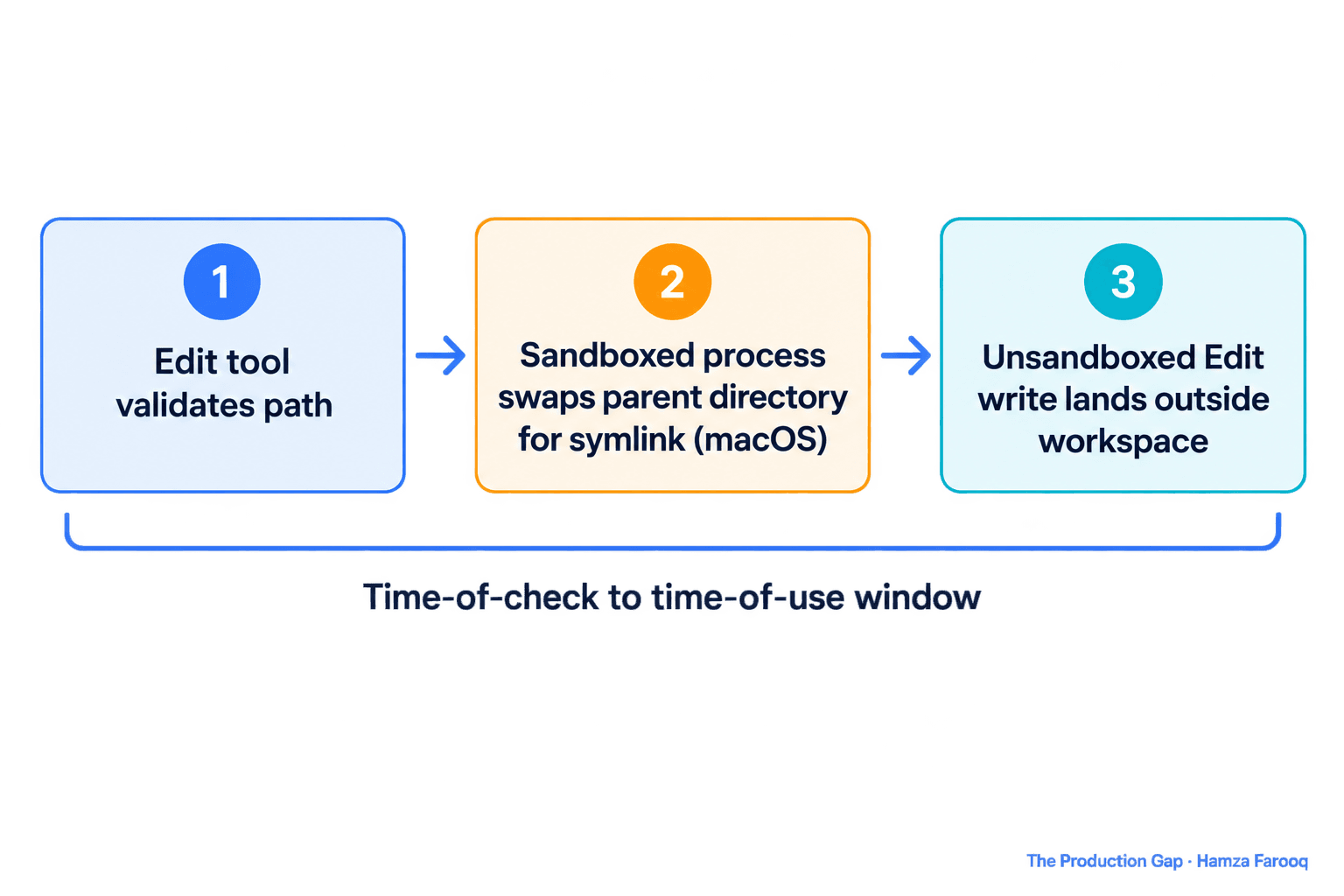
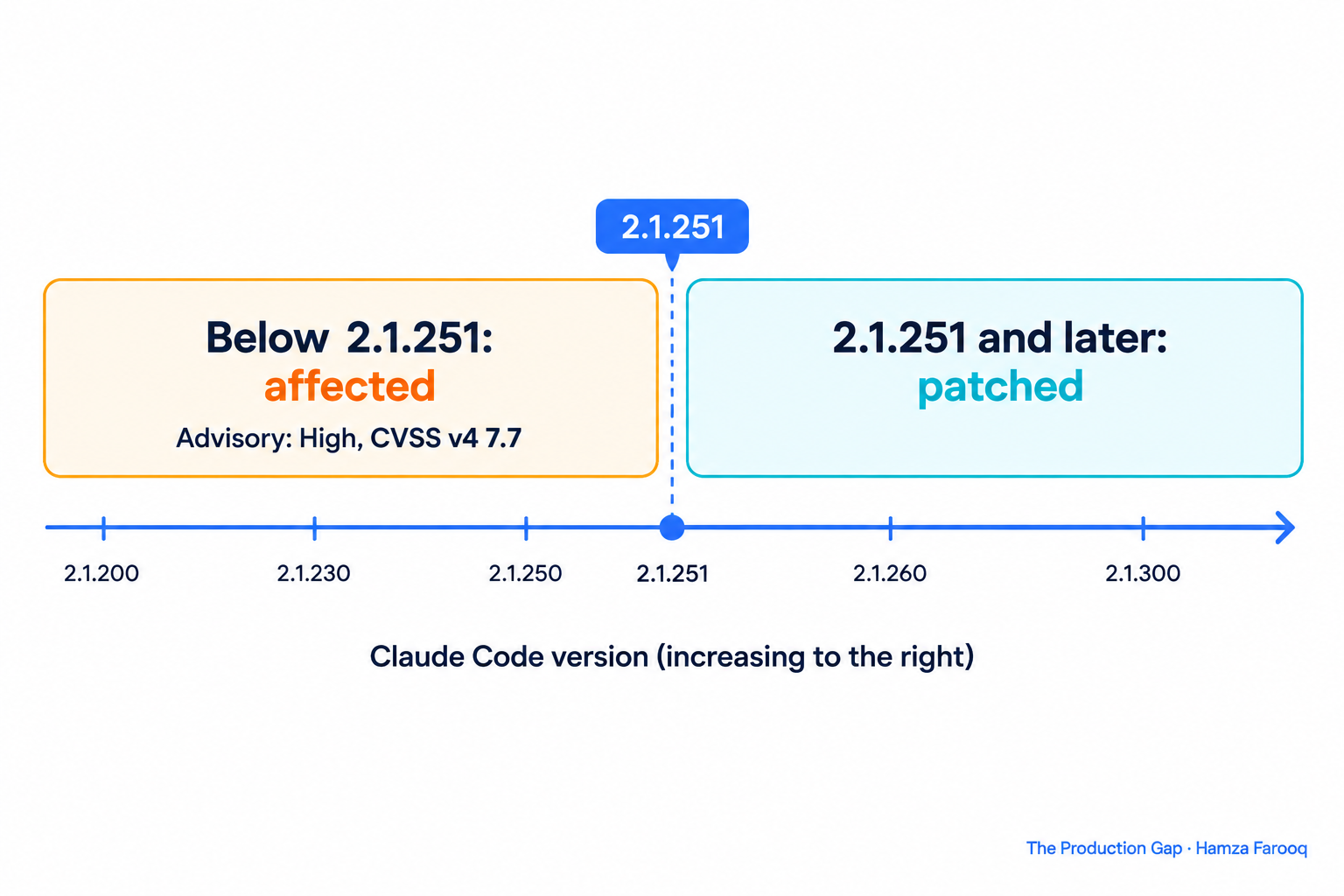
CVE-2026-88968 is a time-of-check to time-of-use race in Claude Code's Edit tool. The GitHub security advisory rates it High with a CVSS v4 score of 7.7, lists versions below 2.1.251 as affected and names 2.1.251 as the patched version. On macOS, code inside the Bash sandbox could redirect an Edit write to a file outside the workspace.
TL;DR: CVE-2026-88968 affects Claude Code versions below 2.1.251 and is fixed in 2.1.251, per the GitHub advisory. It is rated High (CVSS v4 7.7). The advisory describes a macOS race in which sandboxed code swaps a workspace parent directory for a symlink, so the unsandboxed Edit tool writes outside the workspace. Exploitation needs attacker-controlled code inside the sandbox. Check the installed version on every machine.
Key Takeaways
- Fix version: The advisory lists versions below 2.1.251 as affected and 2.1.251 as patched.
- Severity: GitHub rates it High at CVSS v4 7.7; other trackers publish different scores for the same CVE.
- Platform: The advisory describes the attack path on macOS.
- Precondition: The advisory says exploitation required attacker-controlled code inside the sandbox, such as a malicious repository or dependency script.
- Fleet action: My suggestion: inventory installed versions, starting with macOS machines and manually updated installs.
What does CVE-2026-88968 say about the Claude Code Edit tool?
The advisory, titled "TOCTOU Race in Edit Tool Allows File Writes Outside the Workspace," says Claude Code "validated Edit tool targets using point-in-time pathname and symlink resolution that was not bound to the underlying directory inodes or file descriptors."
The check and the write were separate steps, and the path could change between them. The advisory says a process inside Claude Code's Bash sandbox on macOS could swap an in-workspace parent directory with a symlink after validation completed. The unsandboxed Edit implementation then overwrote "an attacker-selected user-writable file outside the workspace."
The advisory lists two weakness classes: CWE-59 (Improper Link Resolution Before File Access) and CWE-367 (Time-of-check Time-of-use Race Condition). It credits Sunder Singh for the report. This article adds no exploit detail.
Which versions are affected and where is the fix?
The GitHub advisory lists affected versions as below 2.1.251 and the patched version as 2.1.251. The Claude Code changelog has a 2.1.251 entry reading: "Fixed file tools (Read, Write, Edit) following a symlink swapped inside the working directory after the permission check, which could read or write outside the approved location."
That line names Read and Write as well as Edit, and the advisory names the Edit tool. Neither page links the two, so reading them as the same fix is my inference.
Mend gives a lower bound that the advisory does not. Mend lists the npm package as affected from 0.2.9 up to, but not including, 2.1.251, and the darwin-x64 and darwin-arm64 packages from 2.1.110. Treat those as Mend's listing.
The advisory's remediation text reads: "Users on standard Claude Code auto-update have received this fix automatically. Users performing manual updates are advised to update to the latest version."
How serious is it, and why do the scores differ?
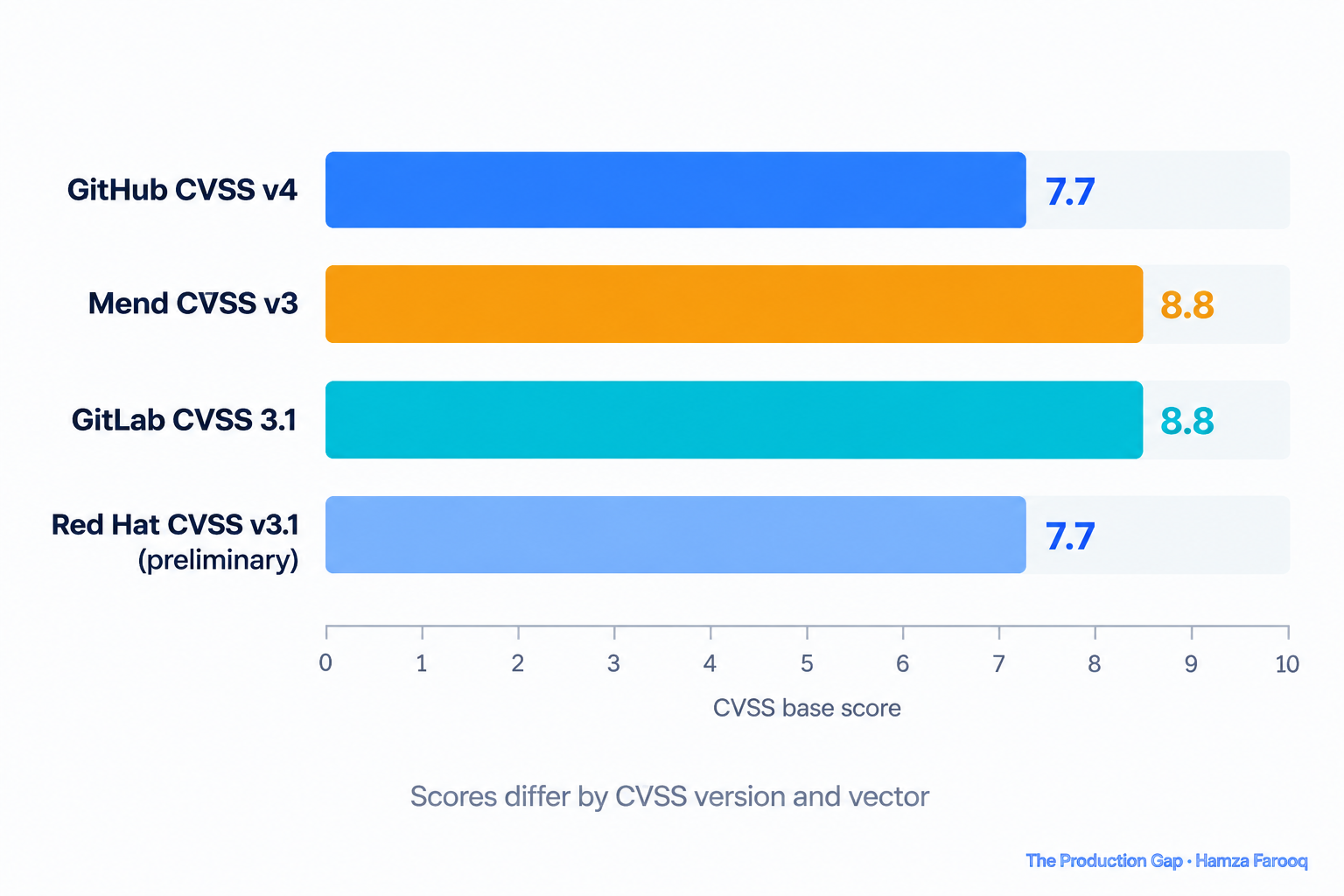
GitHub assigns High severity and a CVSS v4 base score of 7.7. Mend reports the same v4 score and adds a v3 score of 8.8. GitLab's advisory database lists CVSS 3.1 at 8.8 (High). Red Hat rates it Important with a CVSS v3.1 score of 7.7 that its page calls preliminary and subject to review, and its page lists NVD and cve.org scores as N/A.
The scores come from different CVSS versions and different vectors. Red Hat's vector uses a local attack vector (AV:L); GitLab's uses a network one (AV:N). I settle neither and use GitHub's v4 score as the headline, as it sits in the vendor's own repository.
The advisory says exploitation "required the ability to run attacker-controlled code inside the sandbox." My inference: a team that opens only reviewed code faces a narrower path than one that routinely runs unreviewed repositories or third-party dependency scripts.
Dates differ too. GitHub shows the advisory published October 26, 2026. Mend shows November 3, 2026, last updated November 24. GitLab dates its page November 9, 2026.
What should you check on your fleet?
My suggestion: run claude --version on every developer laptop, CI runner and shared workstation, and record the result next to the operating system. Start with macOS, since the advisory describes the attack there.
My suggestion: find machines where updates are manual or a version is pinned. The advisory says standard auto-update users received the fix automatically, so pinned installs are where I would look for stragglers. Move them to 2.1.251 or later.
My suggestion: update Linux and Windows machines as well. Red Hat's mitigation text, which the page labels as AI-generated, says non-macOS environments are unaffected. I could not confirm that on a vendor page.
My suggestion: until machines are current, keep unreviewed repositories and dependency scripts out of the Bash sandbox on unpatched macOS machines. Red Hat gives a similar caution and says it does not fix the defect.
How do the sources compare?
| Source | Scores and severity | Dates and versions |
|---|---|---|
| GitHub advisory | High, CVSS v4 7.7 | Published Oct 26, 2026; affected below 2.1.251; patched 2.1.251 |
| Claude Code changelog | None stated | 2.1.251 entry on file tools following a swapped symlink |
| Mend | CVSS v4 7.7, v3 8.8 | Published Nov 3, 2026; affected from 0.2.9 |
| GitLab | CVSS 3.1 8.8 (High) | Page dated Nov 9, 2026; fixed in 2.1.251 |
| Red Hat | Important; CVSS v3.1 7.7 | Recommends 2.1.251 |
Frequently Asked Questions
Which Claude Code version fixes CVE-2026-88968?
The GitHub advisory names 2.1.251 as the patched version and lists versions below it as affected. GitLab and Red Hat also point to 2.1.251. The advisory says standard auto-update users received the fix automatically and advises manual updaters to move to the latest version.
Can anyone exploit CVE-2026-88968 remotely?
The advisory says exploitation required the ability to run attacker-controlled code inside Claude Code's sandbox, such as through a malicious repository or dependency script. Its CVSS v4 vector lists a network attack vector with passive user interaction, so read the score together with that precondition.
Does CVE-2026-88968 affect Linux or Windows?
The advisory describes the attack on macOS and does not discuss other platforms. Red Hat's page, which labels its mitigation text AI-generated, says non-macOS environments are unaffected, which I could not confirm on a vendor page. My suggestion is to update every platform to 2.1.251 or later.
Conclusion
Treat CVE-2026-88968 as a patch-and-verify item. The advisory names 2.1.251 as the fixed version, and the check is quick: read the installed version on every machine, with macOS and manually updated installs first. Scores and dates differ by tracker, so cite the GitHub advisory in your records and note which source you used for each figure.
Learn from me

Claude Code in Practice, my Maven cohort. Master Claude Code from fundamentals to advanced orchestration: skills, subagents, hooks, MCP, and production automation. Join the next cohort →
Hire us
Traversaal.ai. We're a team of forward deployed engineers solving the toughest AI problems for Fortune 100 companies: document intelligence, agentic data platforms, and real-time web intelligence, deployed in production. Work with our team to deploy your next agentic ecosystem. Talk to Traversaal.ai →
Join us
Want to solve these problems with us? We're always looking for forward deployed engineers who want to ship production AI. jobs@traversaal.ai
