
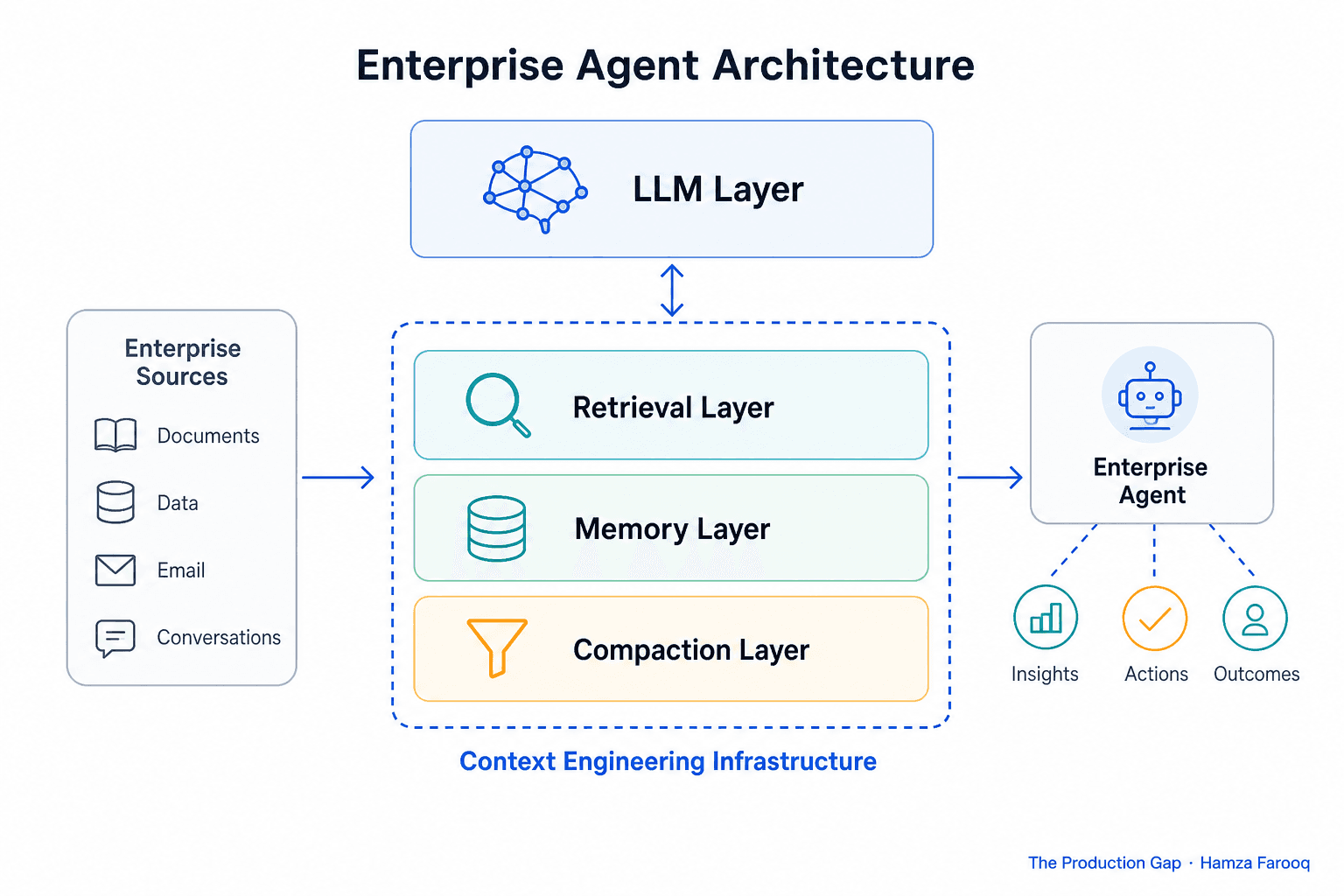
TL;DR: As of 2026, context engineering infrastructure is a recognized Gartner budget category, meaning retrieval, memory, and context compaction are no longer incidental LLM costs but discrete line items teams must scope and fund independently. Evaluate each of the three components separately before starting your next agent build. According to Anthropic's published engineering guidance, unmanaged token accumulation is a documented cause of agent reliability failure at scale, and underfunding any single layer compounds that risk.
Key Takeaways
- Three layers need separate budget lines: retrieval, memory, and compaction are distinct components with their own vendors and failure modes.
- Agent memory is an architecture decision: all three memory types must be designed upfront, because retrofitting causes production failures.
- Context compaction is a scaling bottleneck: Anthropic's published engineering guidance documents unmanaged token accumulation as a cause of cost and reliability failure that prompt tuning cannot resolve.
- Context engineering is not prompt engineering: one is a developer habit; the other is a governed system requiring infrastructure spend.
- The vendor market is forming now: teams that define requirements today negotiate from strength; teams that wait inherit vendor defaults.
What Does Gartner's Coverage of Context Engineering Mean for Your Budget?
Gartner frames context engineering as giving AI systems "the situational awareness needed to act with relevance and precision," explicitly positioning it as a discipline that supersedes prompt engineering. That framing gives procurement teams a recognized category to attach to vendor evaluation and infrastructure spend. Before a discipline has published analyst coverage, budget requests for it tend to dissolve into general "AI tooling" lines with no accountability.
Google Cloud reinforces the framing, defining context engineering as "the bigger job of designing the entire data system and memory that the AI uses". That is infrastructure-tier language, not developer-habit language.
In the author's view, teams that move now set their own requirements. Teams that wait are more likely to inherit vendor defaults rather than negotiate from a position of defined need.
What Infrastructure Components Need Separate Budget Lines for Context Engineering?
Retrieval, memory, and context compaction are three distinct infrastructure layers, each with its own tooling category, vendor market, and failure mode. Lumping them into a single "AI infrastructure" line item risks under-investment in whichever component breaks first.
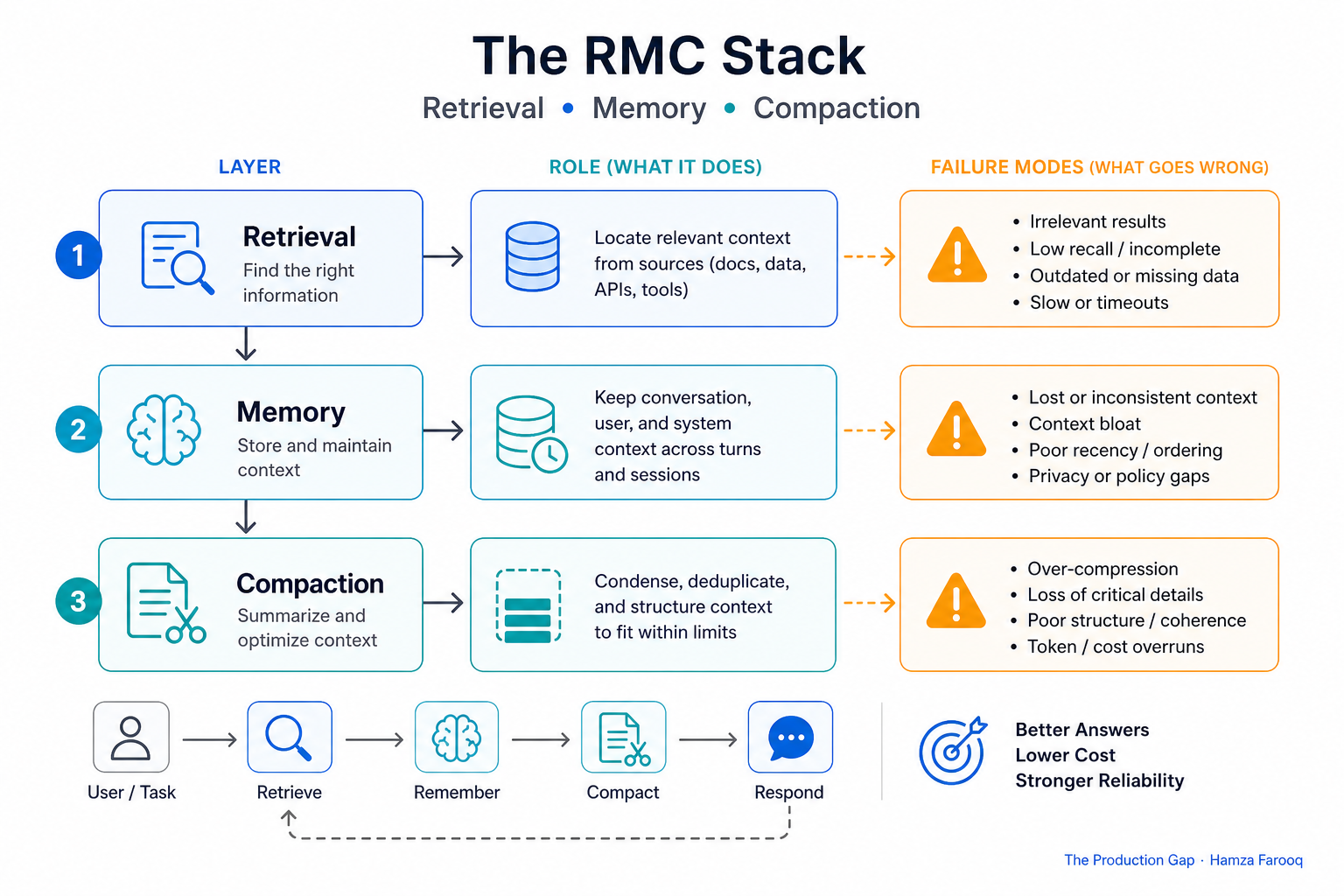
This is the RMC Stack (Retrieval, Memory, Compaction), Author Synthesis, 2026: a practical framework used in this guide to separate the three budget-line components of context engineering infrastructure.
Retrieval (RAG layer): Populates the context window at inference time with relevant data, metadata, and knowledge. Budget items: vector database hosting, embedding pipeline compute, chunking and indexing tooling, retrieval latency SLAs.
Memory (agent state layer): Three types, short-term (in-context session state), long-term (persisted knowledge across sessions), and episodic (task-specific history an agent can replay). The architecture decision should happen before you build; in the author's experience, retrofitting memory into a production agent introduces significant disruption. Budget items: memory store infrastructure, TTL and eviction policies, access control layers.
Context compaction: Anthropic defines it as "the set of strategies for curating and maintaining the optimal set of tokens during LLM inference." Left unmanaged, accumulating context becomes a cost multiplier and a reliability failure simultaneously. Anthropic's published engineering guidance documents this as a root cause of agent failure in long-horizon tasks, not a symptom addressable by prompt refinement. Budget items: summarization pipelines, token accounting tooling, compaction scheduling logic.
RMC Stack, Author Synthesis, 2026
| Layer | What it does | Primary failure mode | Tooling budget driver |
|---|---|---|---|
| Retrieval | Populates context with relevant data at inference time | Wrong or stale information retrieved; hallucination spikes | Vector DB, embedding pipeline, indexing compute |
| Memory | Persists agent state across steps and sessions | Context amnesia mid-task; reliability failures in multi-step workflows | Memory store, TTL management, access control |
| Compaction | Manages token budget across long-horizon tasks | Cost explosion; context overflow causing agent failure | Summarization pipeline, token accounting, compaction scheduler |
Why Does the Distinction Between Context Engineering and Prompt Engineering Control Your Budget?
Prompt engineering is a developer skill applied to a single inference call. Context engineering is a repeatable, governed system for deciding what information an agent sees and when. Only one of them requires infrastructure spend, and conflating the two is the most common reason context infrastructure requests get blocked.
When leadership conflates the two, context infrastructure requests get routed back to "have the devs write better prompts." DataHub draws the line clearly: context engineering is "the practice of designing dynamic systems that curate the right information, tools, memory, and guardrails for an AI." The word systems is doing real work in that definition.
A practical rule of thumb for leadership conversations: prompt engineering is coaching an employee to ask better questions. Context engineering is building the intranet, knowledge base, and data systems they consult before asking anything. One is a habit; the other is a capital investment.
Gartner's published framing positions context engineering as superseding prompt engineering as a discipline. If your agent strategy relies primarily on prompt refinement to handle context, that approach has a scaling ceiling worth examining before the next build cycle.
How Should You Evaluate Vendors and Assign Ownership Before the Next Agent Build?
Assign a named internal context infrastructure owner before evaluating a single vendor. Vendor selection without a named owner risks defaulting to whoever answered the sales call first.
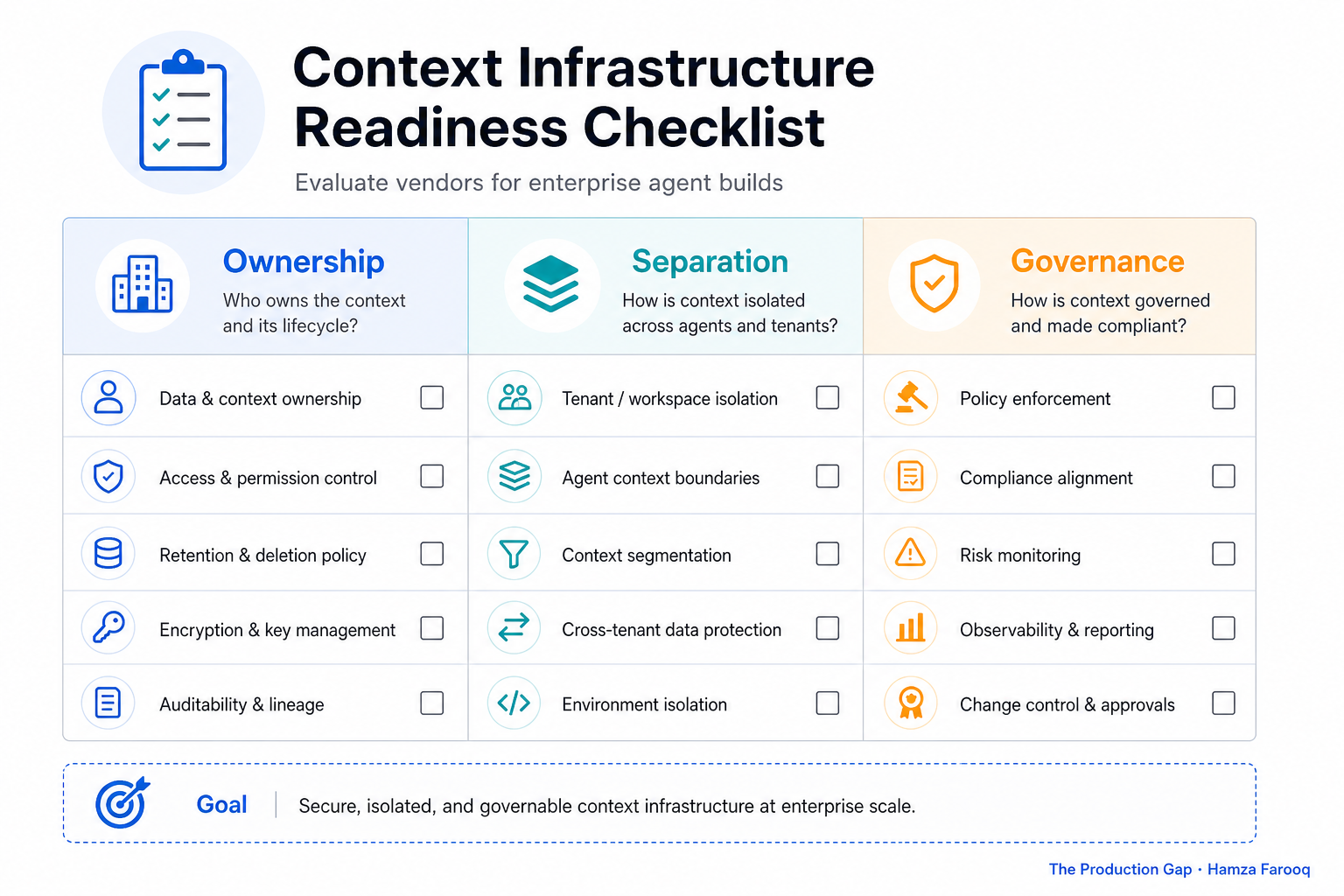
Use the Context Infrastructure Readiness Checklist (a practical framework used in this guide) before any agent build starts:
- Ownership: Who is the named context infrastructure owner accountable for retrieval, memory, and compaction decisions?
- Separation: Are retrieval, memory, and compaction scoped as separate budget lines with independent vendor evaluation tracks?
- Governance: Is there a documented policy for what data enters the context layer, who can access memory stores, and how token budgets are audited?
Frequently Asked Questions
What is the difference between context engineering and prompt engineering? Prompt engineering crafts a single effective instruction. Context engineering designs the full information system, retrieval, memory, and compaction, that determines what the model sees before processing any instruction. One is a developer habit; the other requires owned infrastructure and budget. Gartner's 2025 coverage explicitly positions context engineering as superseding prompt engineering as a discipline.
What specific infrastructure components should an engineering team budget for separately? Three components warrant separate lines: retrieval (RAG layer), memory (short-term, long-term, and episodic state), and context compaction (token budget management). Each carries distinct vendors, failure modes, and scaling costs, as described in the RMC Stack framework used in this guide.
Why does context compaction become a scaling problem in production agentic systems? Long-horizon agents accumulate context across many steps. Without summarization pipelines and token accounting, the context window fills with low-value tokens, driving up inference cost and triggering reliability failures that prompt tuning cannot fix. [2]
What does Gartner's coverage mean practically for enterprise AI budget cycles in 2025? Teams can now request a discrete context infrastructure line item, separate from general LLM spend, and cite Gartner's framing as discipline-level justification. That published framing makes the category easier to defend in procurement conversations and separates context infrastructure from the "AI tooling" catch-all where it previously disappeared.
Conclusion
When analysts name a discipline, enterprise procurement takes notice. As of 2026, context engineering infrastructure has that coverage. Teams relying on prompt refinement alone to manage context carry a scaling risk that grows with every agent added to production.
In the author's view, teams that assign a context infrastructure owner today will negotiate with vendors from a position of requirement clarity. Teams that wait are more likely to inherit whatever the market decided was good enough.
Before your next agent build: name your context infrastructure owner, open three separate budget lines for retrieval, memory, and compaction, and evaluate vendors against requirements you wrote, not requirements the vendor pre-filled.
Learn from me
Agent Engineering Bootcamp: Developers Edition, my Maven cohort. Advanced agentic RAG, multi-agent orchestration, memory, evals, and guardrails. Take agents from prototype to production. Join the next cohort →
Hire us
Traversaal.ai. We're a team of forward deployed engineers solving the toughest AI problems for Fortune 100 companies: document intelligence, agentic data platforms, and real-time web intelligence, deployed in production. Work with our team to deploy your next agentic ecosystem. Talk to Traversaal.ai →
Join us
Want to solve these problems with us? We're always looking for forward deployed engineers who want to ship production AI. jobs@traversaal.ai
