
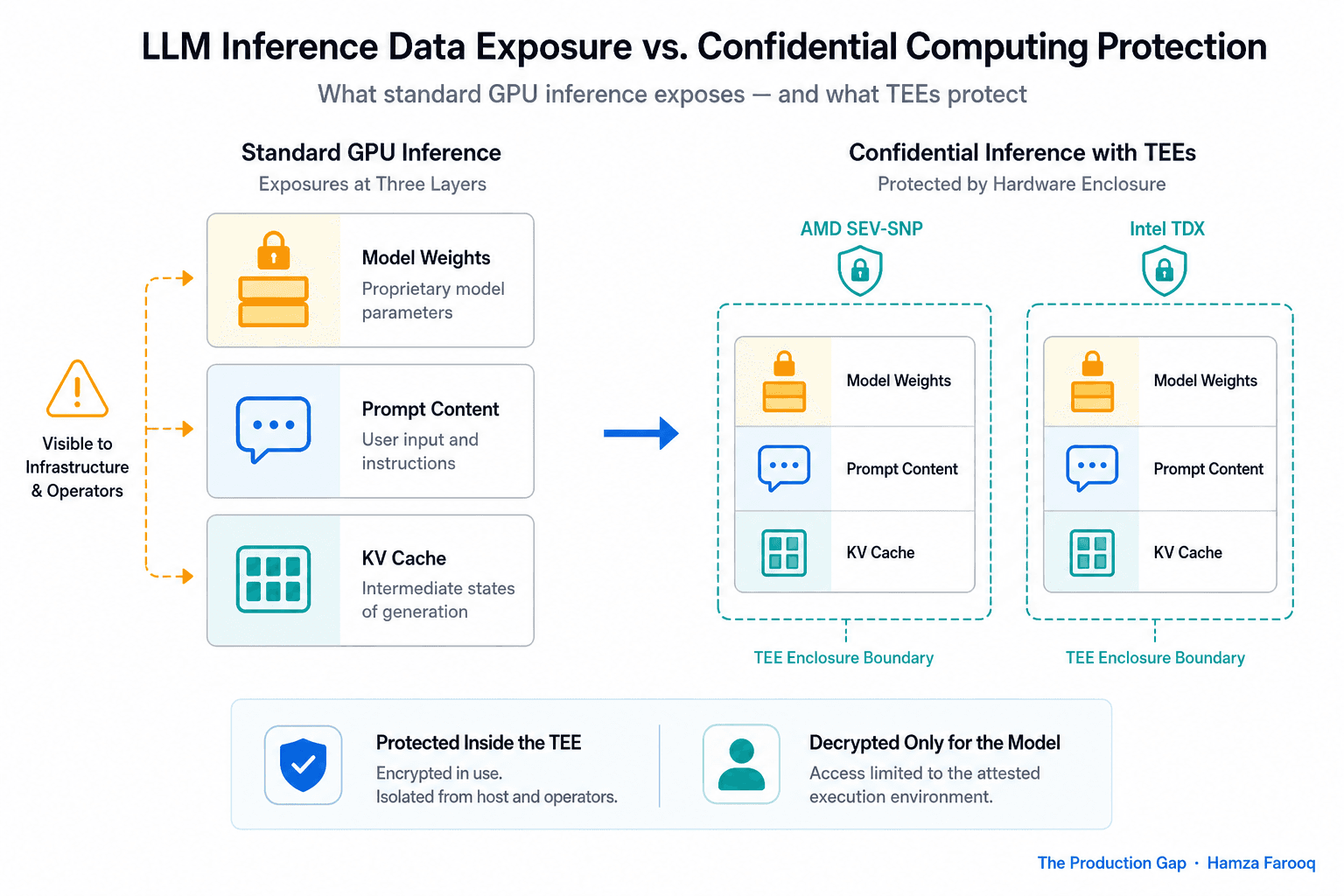
TL;DR: Confidential computing runs LLM inference inside a hardware-enforced enclave that keeps model weights, prompt content, and the KV cache encrypted even from the cloud provider. Three compounding overhead sources, memory encryption latency, attestation handshake cost, and reduced PCIe bandwidth, each reduce throughput or raise latency relative to standard GPU deployments, which directly raises per-token cost at today's pricing. For regulated workloads touching clinical, classified, or sensitive personal data, that overhead is the cost of the only control set that closes the threat model.
Key takeaways
- TEEs protect what encryption misses: Standard cloud encryption leaves model weights, prompt content, and KV cache exposed to hypervisor-level processes. Confidential computing keeps all three hidden even from the cloud provider.
- Compliance sets the bar: For certain regulated workloads, confidential computing is the only control set that plausibly addresses the threat model, not a preference.
- Provider observability disappears permanently: Once inference runs inside an enclave, the cloud provider loses diagnostic visibility by design, shifting optimization entirely to the buyer.
- Attestation proves the guarantee: Cryptographic attestation verifies the enclave is genuine without exposing any data or weights inside it.
What does confidential computing actually protect that standard encryption does not?
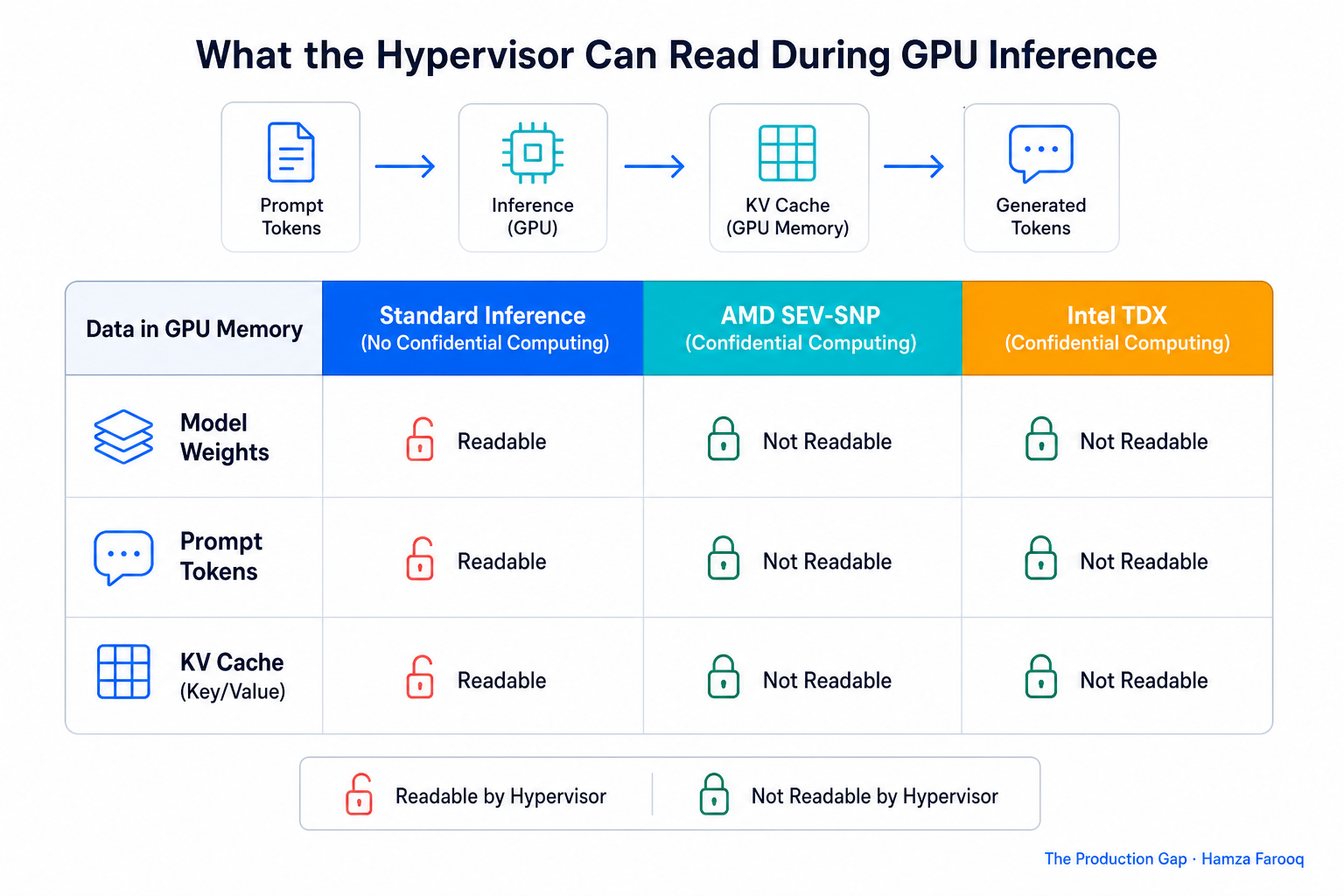
A trusted execution environment (TEE) protects model weights, prompt content, and the KV cache from hypervisor-level access during active inference, the three assets standard encryption leaves exposed while computation runs.
TLS and AES disk encryption stop at the point of computation. When inference runs, weights are decrypted into memory that the cloud provider can reach at the hypervisor layer. A TEE closes this gap with a hardware-enforced boundary that excludes the hypervisor itself. Standard encryption is a locked truck; a TEE is a locked truck where even the warehouse manager cannot open the cargo bay.
What does the performance and cost overhead actually look like?
Confidential GPU inference carries compounding overhead from three sources: memory encryption latency, attestation handshake cost, and reduced PCIe bandwidth. Each source cuts throughput or raises latency relative to identical standard hardware, and the three effects stack rather than cancel.
Memory encryption introduces per-access latency to weight reads, which compresses tokens-per-second when memory bandwidth is already the bottleneck. Attestation handshake cost hits short, high-frequency sessions hardest: each session requires a cryptographic enclave integrity proof before the client sends data, which amortizes poorly across agentic workloads making dozens of short tool-calling loops per turn. Reduced PCIe bandwidth throttles weight loading and KV cache transfers across the encrypted CPU-GPU boundary.
The table below uses directional indicators rather than specific benchmark figures because published numbers vary materially by model size, batch configuration, and hardware generation. Treat this as a framework for structuring your own benchmark, not as a source of measured values for your environment.
| Overhead source | Mechanism | Impact direction | Practical concern |
|---|---|---|---|
| Memory encryption | Per-access latency on weight reads | Throughput down | Worst when memory bandwidth is already the bottleneck |
| Attestation handshake | Per-session cryptographic proof | First-token latency up | High cost for short, frequent sessions |
| PCIe bandwidth reduction | Encrypted DMA across CPU-GPU boundary | Batch throughput down | Compounds in multi-turn, long-context workloads |
Any throughput reduction requires proportionally more compute to serve the same request volume. At $4.50--$27/million tokens, that capacity premium is an immediate unit-economics problem. Before any procurement decision, benchmark your specific model and context lengths on both standard and confidential SKUs to measure the delta in your environment.
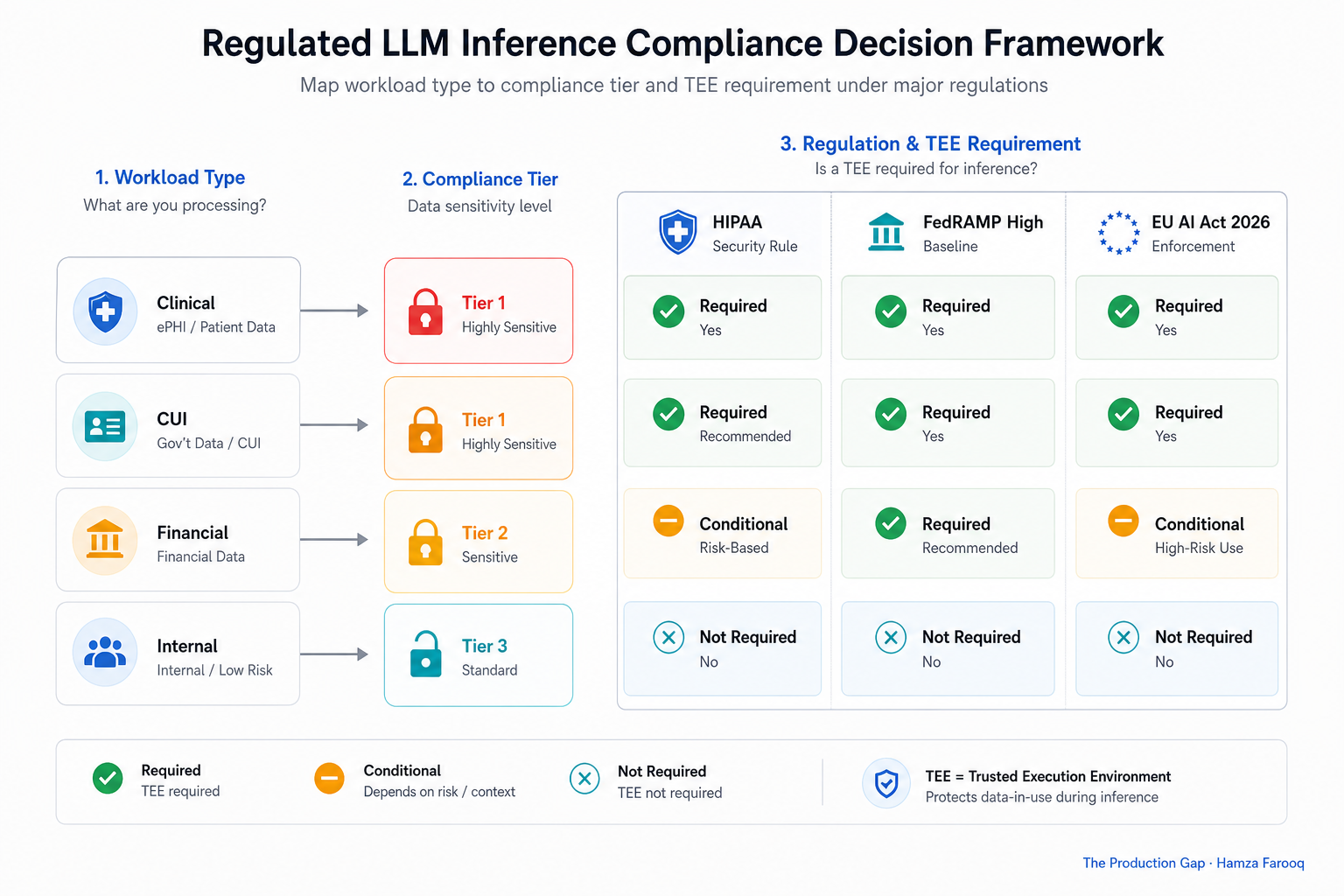
Does HIPAA require confidential computing for LLM inference?
Whether a specific HIPAA-covered workload requires confidential computing depends on the data involved and the controls available, confirm the applicability of any regulatory determination with qualified compliance counsel before acting on it.
As a practical framework used in this guide, regulated LLM workloads fall into three tiers based on the threat model they face:
Tier 2, Defensible but not mandatory: Financial services workloads under GDPR or DORA may satisfy obligations through contractual SLAs, audit rights, and tokenization, depending on the specific regulatory interpretation applied. The decision here involves risk appetite, not a binary compliance gate.
Tier 3, Standard controls sufficient: Internal analytics on non-PII data, customer-facing assistants where no regulated data class enters the prompt, or workloads where the provider is already in scope for audit. TEE overhead here produces no compliance return.
Why does confidential inference create a permanent performance ceiling?
Confidential computing permanently removes the cloud provider's ability to observe and optimize the inference workload, a structural ceiling that persists even as raw encryption overhead shrinks with better hardware.
This distinction matters because the two gaps close on different timelines. Raw encryption overhead will likely shrink as hardware matures. The observability gap will not, it is permanent by design. When a workload enters a confidential enclave, performance telemetry, batch tuning, tail-latency ownership, and attestation operations all move from provider to buyer. The practical question no hardware roadmap resolves is whether the buyer has the inference engineering depth to replace what the provider's observability tooling was handling.
FAQ
Is confidential computing worth the extra cost? For workloads where hypervisor-layer exposure is a real threat, clinical notes, classified queries, proprietary model weights, yes, because no cheaper control set closes the same gap. For workloads where the provider is already in audit scope and no regulated data class enters the prompt, the overhead produces no compliance or security return and is not worth it.
What is the difference between data-at-rest encryption and a TEE for LLM inference? Data-at-rest encryption protects storage. A TEE protects data while it is actively being computed on, keeping weights and prompt tokens encrypted through the forward pass itself. The two controls address different threat surfaces and do not substitute for each other.
Does attestation expose model weights or prompt data to outside parties? No. Attestation is a cryptographic proof of enclave identity and code integrity. It verifies that correct, unmodified software is running without revealing any data or weights inside the enclave.
Can a cloud provider offer throughput SLAs on a confidential instance? In practice, no. Workload throughput SLAs require visibility into the running job, visibility that is cryptographically removed inside a TEE, making performance commitments the buyer's internal responsibility rather than the provider's.
Conclusion
Confidential computing protects what standard encryption leaves exposed: model weights, prompt content, and the KV cache during active inference. None of those protections overlap with TLS or disk encryption, and the threat they address, hypervisor-layer access by the cloud provider or a compromised co-tenant, is real in any multi-tenant GPU environment.
Overhead from memory encryption, attestation handshakes, and PCIe bandwidth reduction compounds directly into per-token cost at pricing already reaching $4.50--$27/million tokens. Whether that overhead is worth paying is, by this guide's practical framework, a function of which compliance tier your workload occupies. For Tier 1 workloads, HIPAA clinical decision support, FedRAMP High CUI systems, EU AI Act-regulated personal data, confidential computing warrants serious evaluation as the only control set that plausibly closes the threat model.
The gap that hardware roadmaps will not close is the observability gap. Raw encryption overhead shrinks as silicon matures; the provider's cryptographic exclusion from the enclave does not.
Concrete next step: Benchmark your target workload, time-to-first-token and P99 inter-token latency, on both standard and confidential SKUs using your actual model and context lengths before any procurement decision. The provider's observability disappears the moment you enter an enclave. Make sure your internal instrumentation is ready before that happens.
Learn from me
Forward Deployed Engineering Bootcamp for Full-Stack Developers, my Maven cohort. Build and ship complete AI products end to end, from React and Node.js frontends to deployed models with caching and observability. Join the next cohort →
Hire us
Traversaal.ai. We're a team of forward deployed engineers solving the toughest AI problems for Fortune 100 companies: document intelligence, agentic data platforms, and real-time web intelligence, deployed in production. Work with our team to deploy your next agentic ecosystem. Talk to Traversaal.ai →
Join us
Want to solve these problems with us? We're always looking for forward deployed engineers who want to ship production AI. jobs@traversaal.ai
