
TL;DR: Coding agent portability lock-in persists even when one agent imports another's skill format, because transferring a configuration file is not the same as transferring the runtime dependencies, context history, and tool integrations that made those skills useful. Surface-level import compatibility masks deeper lock-in at the execution and memory layers, where real switching costs live.
Key takeaways
- Skill import is surface-level relief: Moving prompts and configurations eliminates the smallest, most recoverable part of your switching cost.
- Runtime lock-in is the harder wall: State management, tool contracts, retry logic, and logging become invisible dependencies your workflows quietly rely on.
- Accumulated context is the immovable moat: Business knowledge built up inside a platform over time is genuinely expensive to recreate elsewhere.
- Agentic workflows compound the problem: Multi-step automations bind your team to a single orchestration vendor in ways no skill-import tool can untangle.
- Lock-in audits need three distinct layers: Evaluate skill, runtime, and context exposure separately, before any layer becomes costly to leave.
- Open protocols reduce future exposure: MCP-compatible tool interfaces are a structural hedge worth prioritizing now.
What is coding agent portability lock-in?
Coding agent portability lock-in is the condition in which switching from one AI coding agent platform to another costs far more than the surface-level skill-import step suggests, because runtime dependencies, tool contracts, and accumulated business context do not move with the configuration files.
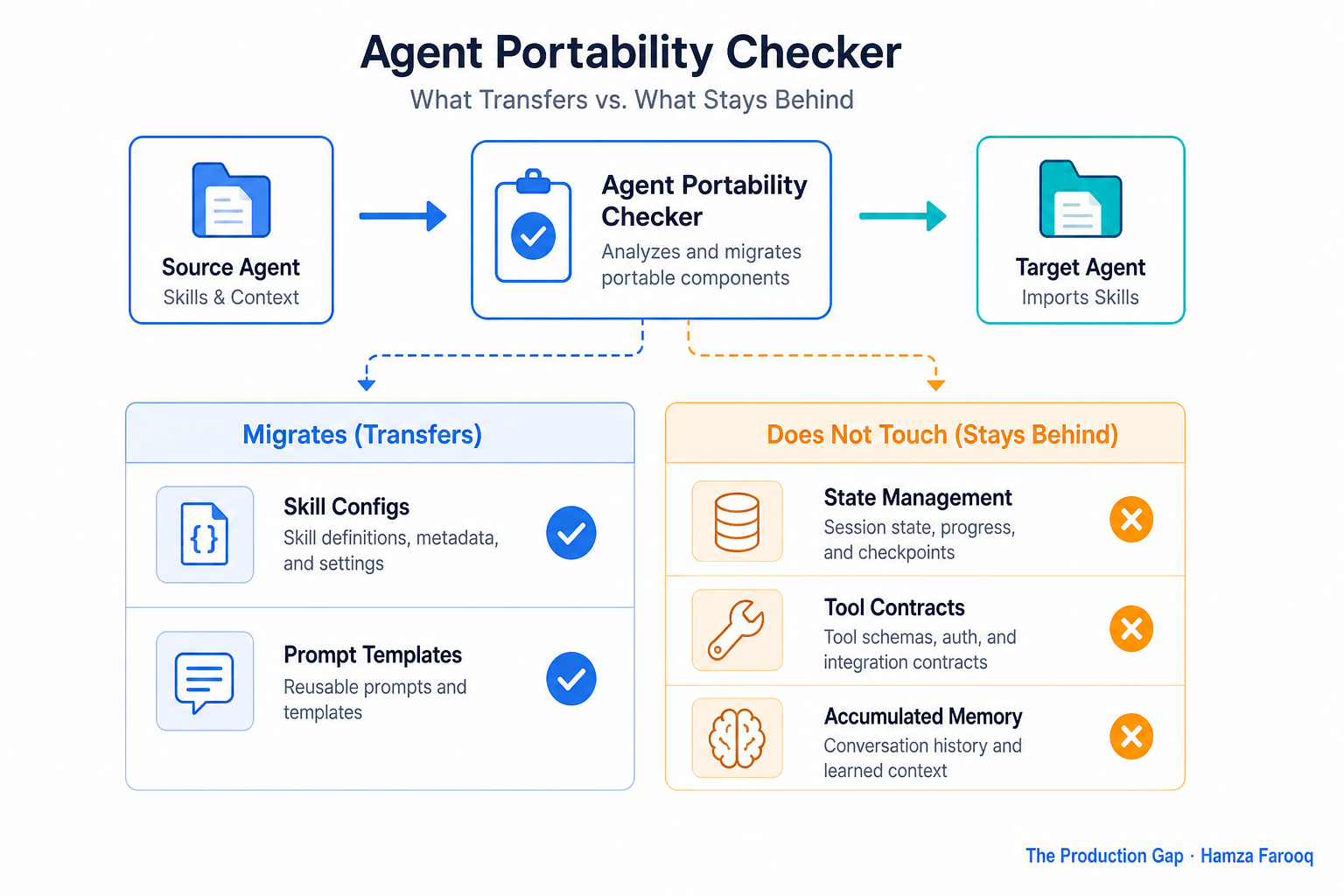
Tools like the Agent Portability Checker on MCP Market can audit and migrate coding agent skills between platforms like Claude Code and OpenClaw. That is genuine progress. But coding agent switching cost and skill portability are not the same thing. Vendor lock-in in AI systems hits at the API layer, data format, and training pipeline, not just surface-level configuration. This article, using the three-layer framework developed in this guide, separates what AI agent skill import actually removes from what it quietly leaves behind.
Does importing another agent's skills actually reduce your switching cost?
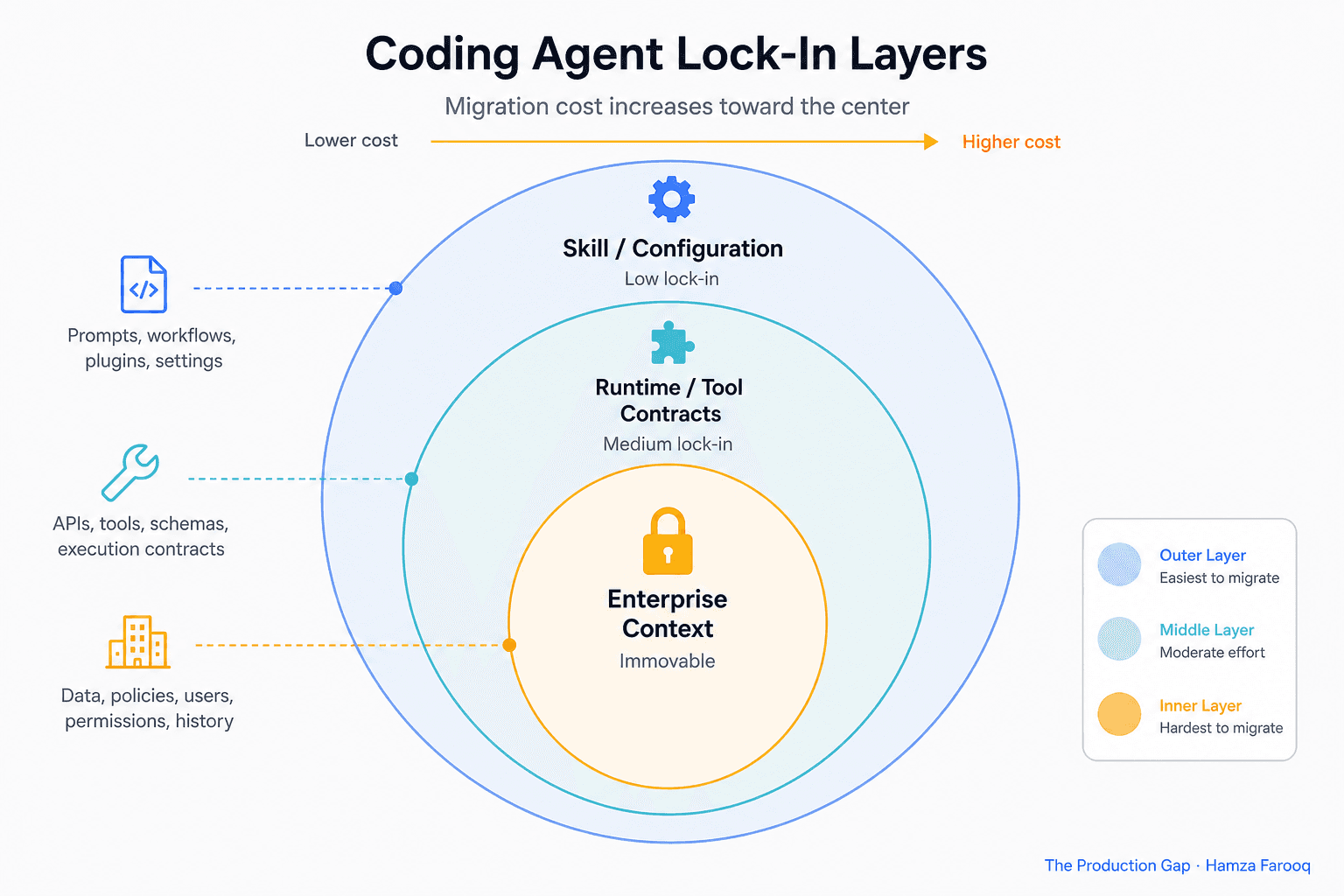
Skill import moves prompt templates, tool definitions, and configuration schemas. Useful, and also the outermost ring of a three-ring problem. This guide uses the following author-synthesized framework to separate those rings:
- Layer 1, Skill/Configuration: Prompts, tool definitions, config schemas. Portable today with existing tooling.
- Layer 2, Runtime: State management, tool contracts, retry logic, observability hooks. Partially portable with significant engineering effort.
- Layer 3, Enterprise Context: Accumulated agent memory, business semantics, domain knowledge. Effectively immovable at scale.
Importing skills is like moving your keyboard shortcuts to a new IDE, genuinely useful, but your custom linter configs, tribal knowledge about the pipeline, and debugger muscle memory do not come with them. Claude Code portability at the skill layer is progress. It is not migration.
What makes runtime lock-in harder to escape than skill lock-in?
Runtime lock-in is harder to escape than skill lock-in because a platform's state management, tool contracts, retry logic, and observability hooks quietly become implicit platform APIs that your entire workflow depends on, and no import tool touches them.
Runtime lock-in is not the model. It is the behavioral contract your workflows have formed with the platform's execution layer. Practitioners have identified this directly: these components become "implicit platform APIs," visible only after a migration attempt. A team that built a multi-step code review agent on Platform A discovers on Platform B that retry logic is now their responsibility, and every observability hook feeding their alerting dashboard needs rewiring from scratch. Each step in an agentic workflow adds another hidden runtime dependency.
One practical canary signal: if your incident response playbook references platform-specific trace IDs or log formats, you have runtime lock-in that no skill-import plan will flag.
Comparison table: the three layers of coding agent lock-in (author synthesis)
| Lock-in layer | What it includes | Portable with skill import? | Relative migration effort |
|---|---|---|---|
| Skill / Configuration | Prompts, tool definitions, config schemas | Yes (tools like Agent Portability Checker) | Lowest |
| Runtime | State management, tool contracts, retry logic, observability hooks | No | Higher |
| Enterprise Context | Agent memory, business semantics, accumulated domain knowledge | No | Highest |
Why is accumulated enterprise context the layer that actually never moves?
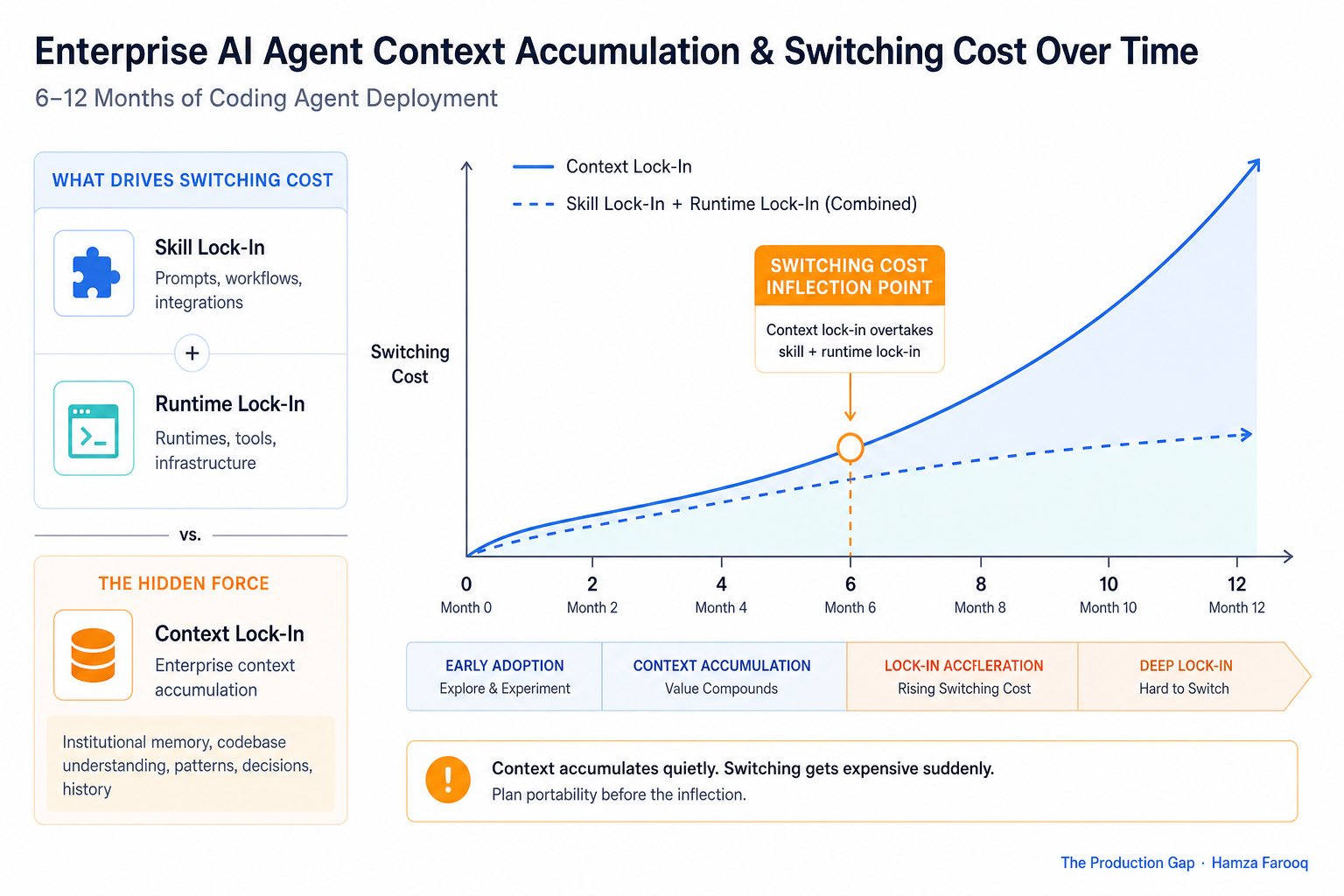
Accumulated enterprise context, the business semantics, agent memory, and domain knowledge that build up inside a platform over time, is the coding agent lock-in layer that is genuinely expensive, and sometimes impossible, to recreate elsewhere.
This is not a file or a config. It is the implicit knowledge your agents have built about your codebase, conventions, domain exceptions, and workflow edge cases. As pvgomes argues: "context is not portable in the same way a model endpoint is portable", once your agents depend on accumulated platform context, the moat dynamic takes hold. Lock-in has moved from data storage to semantics: your data may be exportable, but the meaning your platform has built around it is not.
Skill-layer portability tools can actively mask context lock-in. A team that imports its skills and feels flexible may keep deepening its context investment, only to find the real switching cost has been compounding the whole time. The questions worth putting to any vendor directly: Can I export agent memory? In what format, and can another agent ingest it natively? Vague answers indicate existing exposure.
How do you audit your team's actual lock-in exposure before it becomes expensive?
To audit your coding agent lock-in exposure before it becomes expensive, evaluate three distinct layers separately, skill portability, runtime dependency depth, and accumulated context replaceability, in that order.
This sequencing is a practical rule of thumb developed in this guide, not an industry-certified methodology.
Layer 1 audit (Skill): Run the Agent Portability Checker and attempt a dry-run import to an alternative platform. Friction at this stage signals configs are less standardized than assumed.
Layer 2 audit (Runtime): Map every place your workflows touch the platform's execution layer, state persistence, tool contract versioning, retry handling, observability integrations. For each one, ask: is this a platform-native feature or an open standard? Count the coupling points explicitly.
Layer 3 audit (Context): Ask your vendor directly whether agent memory is exportable, in what format, and whether a competing platform can ingest it natively. A team that clears Layer 1 quickly but finds agent memory has no export path has located its real migration cost. The earlier that finding surfaces, the more options remain.
Frequently asked questions
If I can import my Claude Code skills into another coding agent, does that eliminate my switching cost?
No, it eliminates the smallest layer. Skill import removes prompt and configuration friction but leaves runtime and context lock-in completely untouched; those two layers compound silently the longer you stay on a platform.
What is runtime lock-in in coding agents, and why is it harder to migrate than skills?
Runtime lock-in is the dependency your workflows form on a platform's state management, tool contracts, retry logic, and observability. These become implicit platform APIs requiring significant engineering work to rebuild. Skills have a defined file format; runtime behavior does not.
How do agentic workflow automations increase coding agent switching costs?
Each step in a multi-step agentic workflow adds a coupling point to the vendor's orchestration framework. These automations can't be disentangled from one vendor's execution model, and none of those dependencies show up in a skill audit report.
Conclusion (skill portability is a feature; runtime and context portability is a strategy)
The three-layer framework used in this guide, skill, runtime, and enterprise context, exists to make a straightforward point: a successful skill import is not a successful migration, and the difference between those two things is where real switching costs live.
Run the three-layer portability audit before your next vendor contract renewal. Start with the Agent Portability Checker for Layer 1, then map your runtime coupling points and ask direct questions about context export while the findings are still actionable. The teams that avoid costly lock-in are not the ones that never commit to a platform, they are the ones that audit early enough to negotiate from a position of knowledge.
Learn from me

Claude Code in Practice, my Maven cohort. Master Claude Code from fundamentals to advanced orchestration: skills, subagents, hooks, MCP, and production automation. Join the next cohort →
Hire us
Traversaal.ai. We're a team of forward deployed engineers solving the toughest AI problems for Fortune 100 companies: document intelligence, agentic data platforms, and real-time web intelligence, deployed in production. Work with our team to deploy your next agentic ecosystem. Talk to Traversaal.ai →
Join us
Want to solve these problems with us? We're always looking for forward deployed engineers who want to ship production AI. jobs@traversaal.ai
