
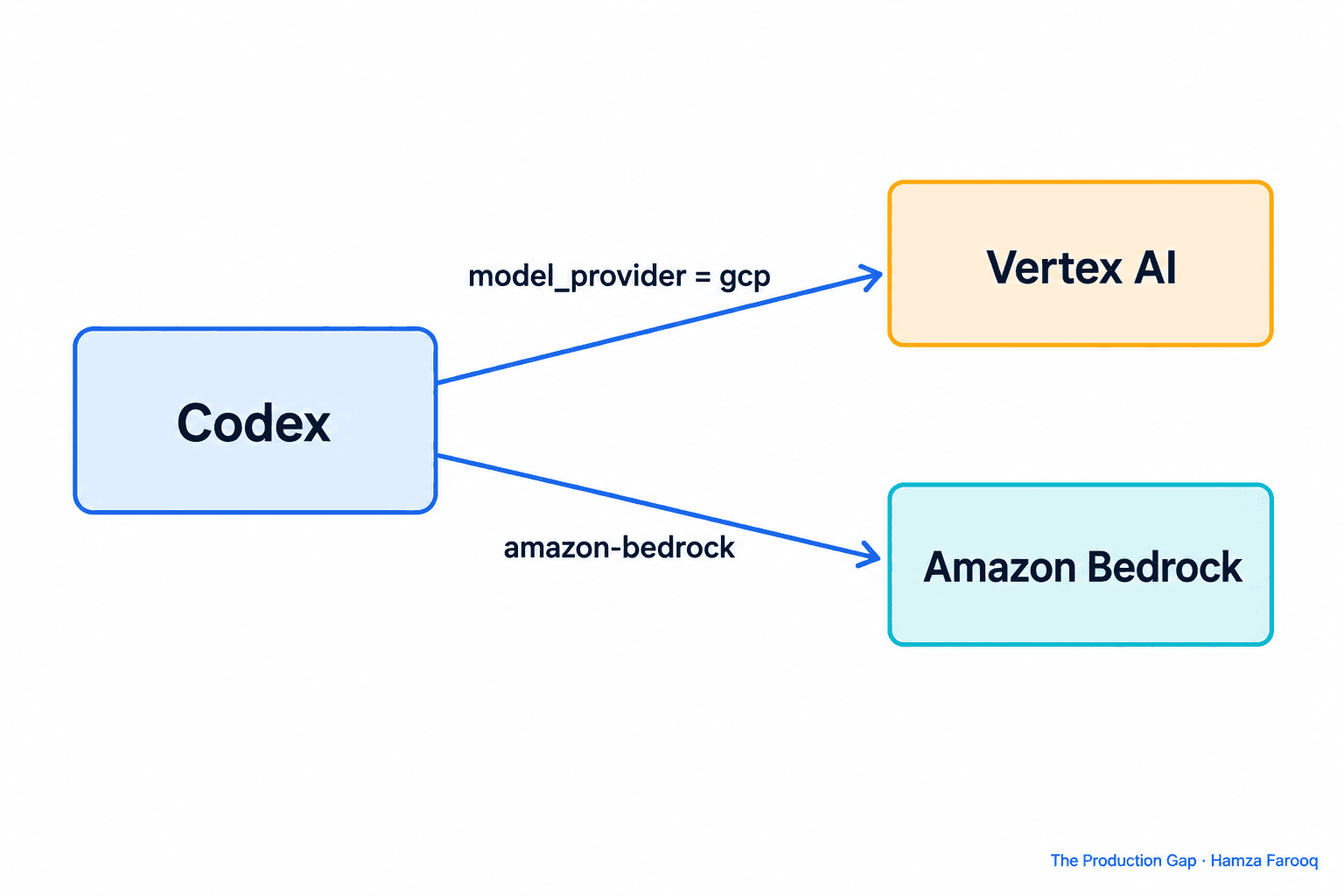
Codex can send its model requests to Google Cloud Vertex AI with the built-in gcp provider, or to Amazon Bedrock with the amazon-bedrock and amazon-bedrock-runtime providers. The GitHub release notes date the Bedrock setup wizard default to Oct 23 and the Vertex provider to Oct 27. Both are configured in your user-level ~/.codex/config.toml.
TL;DR: Setmodel_provider = "gcp"for Vertex AI ormodel_provider = "amazon-bedrock"for Bedrock in~/.codex/config.toml. Vertex uses Application Default Credentials through the gcloud CLI. Bedrock uses a Bedrock API key or AWS credentials, with a region you choose. The Bedrock docs list some features as unavailable.
Key Takeaways
- Vertex provider: The Oct 27 release notes for rust-v0.165.0 added a built-in Vertex AI provider configured with
model_provider = "gcp". - Vertex sign-in: The docs say you sign in locally with
gcloud auth application-default login. - Bedrock sign-in: The docs say users authenticate with a Bedrock API key or AWS credentials, not ChatGPT sign-in or
OPENAI_API_KEY. - Config location: Provider settings belong in the user-level
~/.codex/config.toml, because project-level config can't set provider keys. - Gaps: The Bedrock page lists Codex cloud, Fast Mode and image generation and editing as unavailable, and I found no equivalent list for Vertex.
How do you run Codex on Google Cloud Vertex AI?
You set the built-in gcp provider in config.toml, add a project and location, and sign in with the Google Cloud CLI. The Codex config docs show model_provider = "gcp" plus a [model_providers.gcp] table with project_id and location. If you omit them, Codex reads GOOGLE_CLOUD_PROJECT or GOOGLE_CLOUD_LOCATION, and the location defaults to global.
For credentials, the same docs say to install the Google Cloud CLI on the machine running Codex and sign in locally with gcloud auth application-default login. To use a specific credentials file, set credential_file to its absolute path. For a different endpoint, authentication or extra headers, the docs point to base_url, auth or http_headers under [model_providers.gcp].
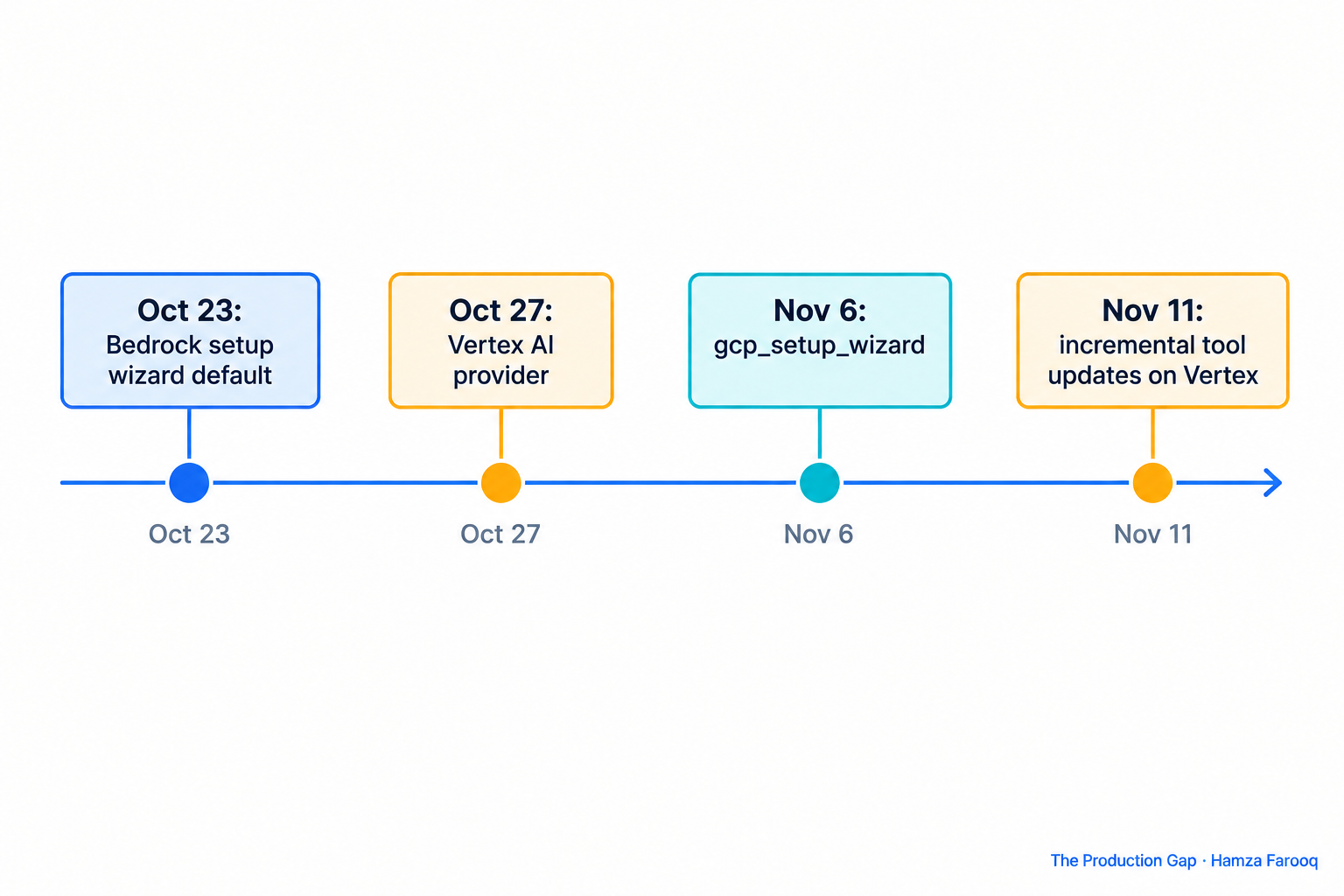
Three Vertex-related releases are dated on GitHub. The rust-v0.165.0 release from Oct 27 says "Added a built-in Google Cloud Vertex AI provider, configured with model_provider = "gcp"." The rust-v0.167.0 release from Nov 6 says to enable gcp_setup_wizard to set up Vertex AI with Application Default Credentials or a credential file. The rust-v0.167.2 release from Nov 11 says Codex now sends tool updates incrementally by default on Vertex AI, with an opt-out of incremental_tools_legacy_gcp = false under [features] in config.toml.
How do you run Codex on Amazon Bedrock?
You set model_provider to amazon-bedrock for the Bedrock Mantle endpoint or amazon-bedrock-runtime for the Runtime endpoint, then configure an aws profile and region table, which the config docs describe for amazon-bedrock (Mantle). The config docs show [model_providers.amazon-bedrock.aws] with a profile and a region. They say that if you omit profile, Codex uses the standard AWS credential chain, and that region is the supported Bedrock region that should handle requests.
The Codex on Amazon Bedrock page lists four requirements: credentials for the AWS account you want to use, access to supported OpenAI models in Bedrock, access to an AWS Region where the selected model is available, and AWS permission to invoke the selected model or inference profile. It says to use Bedrock Runtime for new configurations and that you must specify a Region when using API-key authentication.
On the release side, the rust-v0.164.0 notes, dated Oct 23, say the Amazon Bedrock setup wizard is now enabled by default, with API key entry grouped alongside other AWS sign-in methods when credentials are detected.
How do the two providers compare?
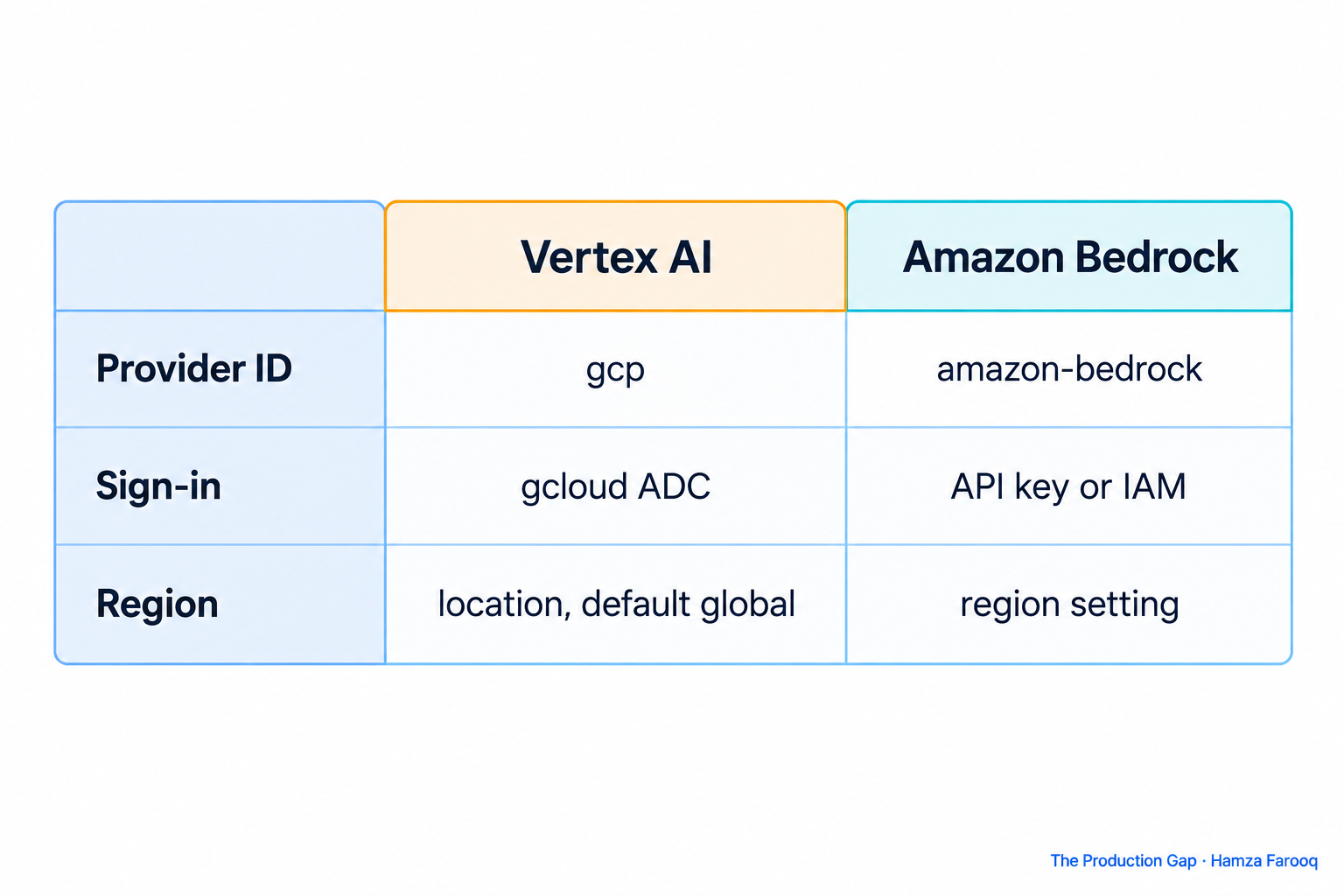
The two providers differ in provider ID, sign-in path and how the region or location is chosen. The table uses only statements from the pages I read.
| Topic | Amazon Bedrock | Vertex AI (gcp) | Source |
|---|---|---|---|
| Provider ID | amazon-bedrock (Mantle) or amazon-bedrock-runtime (Runtime) | gcp | Config docs |
| Sign-in | Bedrock (Mantle): Bedrock API key or AWS credentials; profile omitted means the standard AWS credential chain | gcloud auth application-default login; Codex runs gcloud auth application-default print-access-token | Bedrock page, config docs |
| Region | Bedrock (Mantle): region setting; a Region is required with API-key authentication | location, which defaults to global | Bedrock page, config docs |
| Release note | Oct 23: setup wizard enabled by default | Oct 27: provider added; Nov 6: gcp_setup_wizard; Nov 11: incremental tool updates by default | Release notes linked above |
What do the AWS and Google Cloud data pages say?
These two pages describe their platforms, not Codex traffic. On Bedrock in general, the AWS data protection page says model providers don't have access to Bedrock logs or to customer prompts and completions. That page does not mention OpenAI models or Codex. On Vertex AI, the Google Cloud data governance page says "Google won't use your data to train or fine-tune any AI/ML models without your prior permission or instruction."
Retention needs a closer read. For OpenAI flagship models, the Google page says zero data retention is available on an approved project basis. I did not find a page that maps Codex's model choice on Vertex to those terms, so confirm which model your configuration calls before you promise a retention posture.
What does Codex not support on Bedrock, and what could I not verify?
The Bedrock page lists Codex cloud under its feature limitations. Its feature table marks image generation and editing as unavailable, and it states "Fast Mode isn't available with Amazon Bedrock." It also says hosted web search is unavailable on Runtime.
The pages I read do not state a feature-availability list for the Vertex AI provider, so I cannot say what is missing there. I did not test either setup myself. The release dates above are the ones shown on the GitHub release pages, which show a day and month without a year.
Frequently Asked Questions
Does Codex on Vertex AI need ChatGPT sign-in?
The pages I read do not say either way for Vertex. They describe the Vertex path as Google Cloud CLI sign-in with Application Default Credentials. For Bedrock, the docs say users do not use ChatGPT sign-in or OPENAI_API_KEY for that provider.
Where do I put the provider settings?
Put them in your user-level ~/.codex/config.toml. The config docs say project-level config can't set provider keys, so a repository's own .codex/config.toml is not the place for model_provider.
Which Bedrock endpoint should I choose?
The Bedrock page says to use Bedrock Runtime for new configurations. The config docs map amazon-bedrock to the Mantle endpoint and amazon-bedrock-runtime to the Runtime endpoint.
Can I opt out of incremental tool updates on Vertex?
Yes. The rust-v0.167.2 release notes say to set incremental_tools_legacy_gcp = false under [features] in config.toml.
Conclusion
Pick the provider that matches the cloud account your security team approves, then set it in the user-level config and sign in with that cloud's own credentials. For Bedrock, review the list of unavailable features first. For Vertex, confirm which model your project calls and what retention terms apply before you answer a data-flow questionnaire.
Learn from me
Claude Code in Practice, my Maven cohort. Master Claude Code from fundamentals to advanced orchestration: skills, subagents, hooks, MCP, and production automation. Join the next cohort →
Hire us
Traversaal.ai. We're a team of forward deployed engineers solving the toughest AI problems for Fortune 100 companies: document intelligence, agentic data platforms, and real-time web intelligence, deployed in production. Work with our team to deploy your next agentic ecosystem. Talk to Traversaal.ai →
Join us
Want to solve these problems with us? We're always looking for forward deployed engineers who want to ship production AI. jobs@traversaal.ai
