
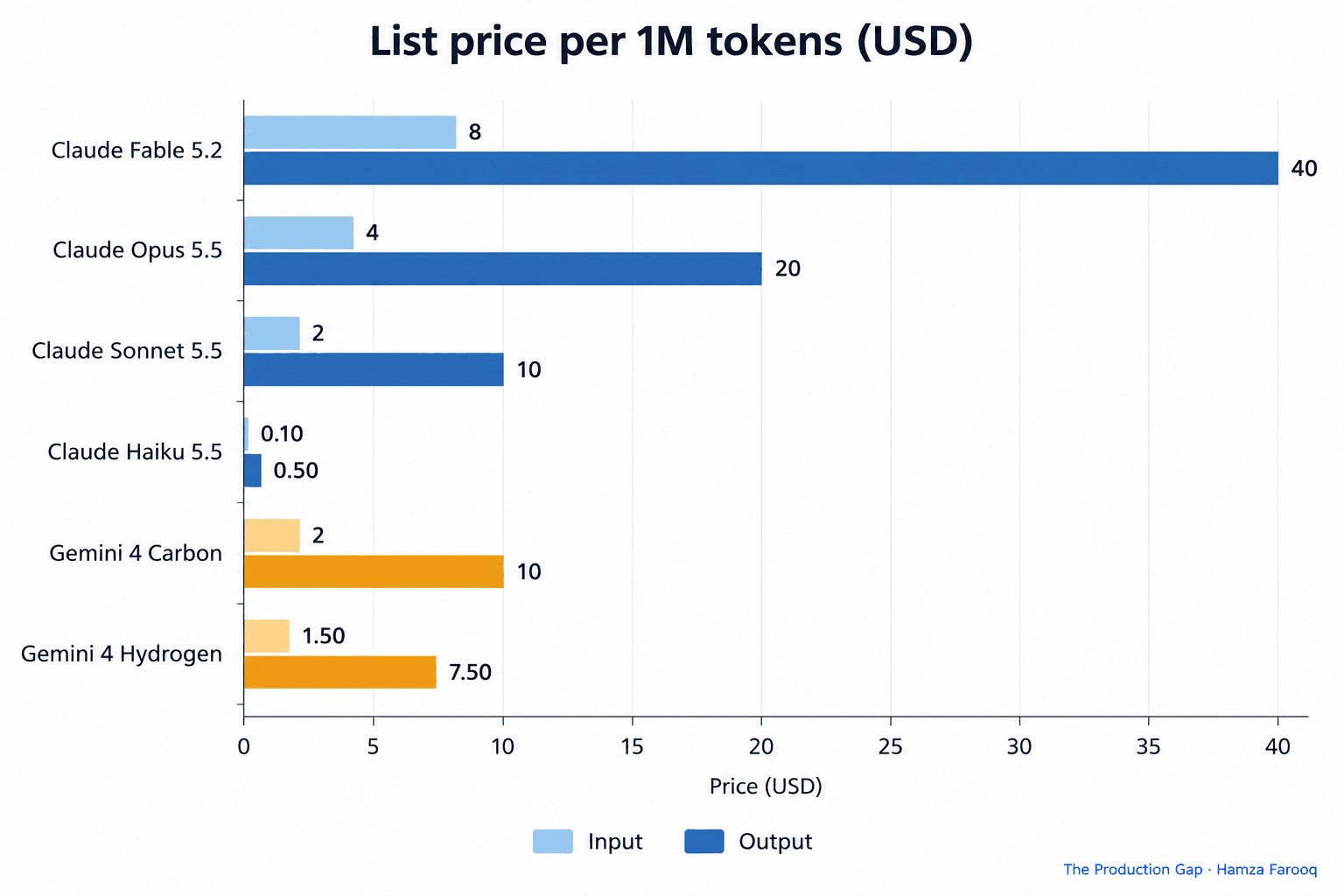
Claude vs Gemini now comes down to cost per finished task more than peak scores. This article compares Claude models with Gemini 4 Hydrogen and Gemini 4 Carbon and does not cover Gemini 4 Argon, which Google's AI Studio pricing page lists separately. Anthropic's lineup runs from Claude Haiku 5.5 (from $0.10 input and $0.50 output per million tokens) to Claude Fable 5.2 at $8 and $40, all with a 1M-token context window (Anthropic models overview). Google's new Gemini 4 Hydrogen costs $1.50 and $7.50, and Gemini 4 Carbon costs $2 and $10 through November 30, then $4 and $20 (Google AI Studio pricing). On the independent Artificial Analysis leaderboard, Fable 5.2 leads with an Intelligence Index of 65, ahead of Carbon at 60.
TL;DR: Anthropic reports Claude Sonnet 5.5 at 70.6% on Terminal-Bench 4.0, above Opus 5.5, at $2 input and $10 output per million tokens. Claude Fable 5.2 tops the independent Artificial Analysis index but costs $8 and $40. Gemini 4 Hydrogen at $1.50 and $7.50 is the cheaper Gemini 4 option compared here, and Claude Haiku 5.5 is the cheapest model here. Vendor tables differ in benchmark version and effort setting, so compare within one source.
Key Takeaways
- Price spread: Claude runs from $0.10/$0.50 (Haiku 5.5) to $8/$40 (Fable 5.2) per million tokens; Gemini 4 Hydrogen is $1.50/$7.50.
- Context: The six models compared here accept 1M tokens, but Hydrogen returns 64K tokens per synchronous response and Claude up to 128K.
- Coding: Anthropic reports Sonnet 5.5 at 70.6% on Terminal-Bench 4.0, above Opus 5.5 at 66.4%, for half the price.
- Independent view: Artificial Analysis scores Fable 5.2 at 65, Gemini 4 Carbon 60, Opus 5.5 59, Sonnet 5.5 55, Hydrogen 54 and Haiku 5.5 36.
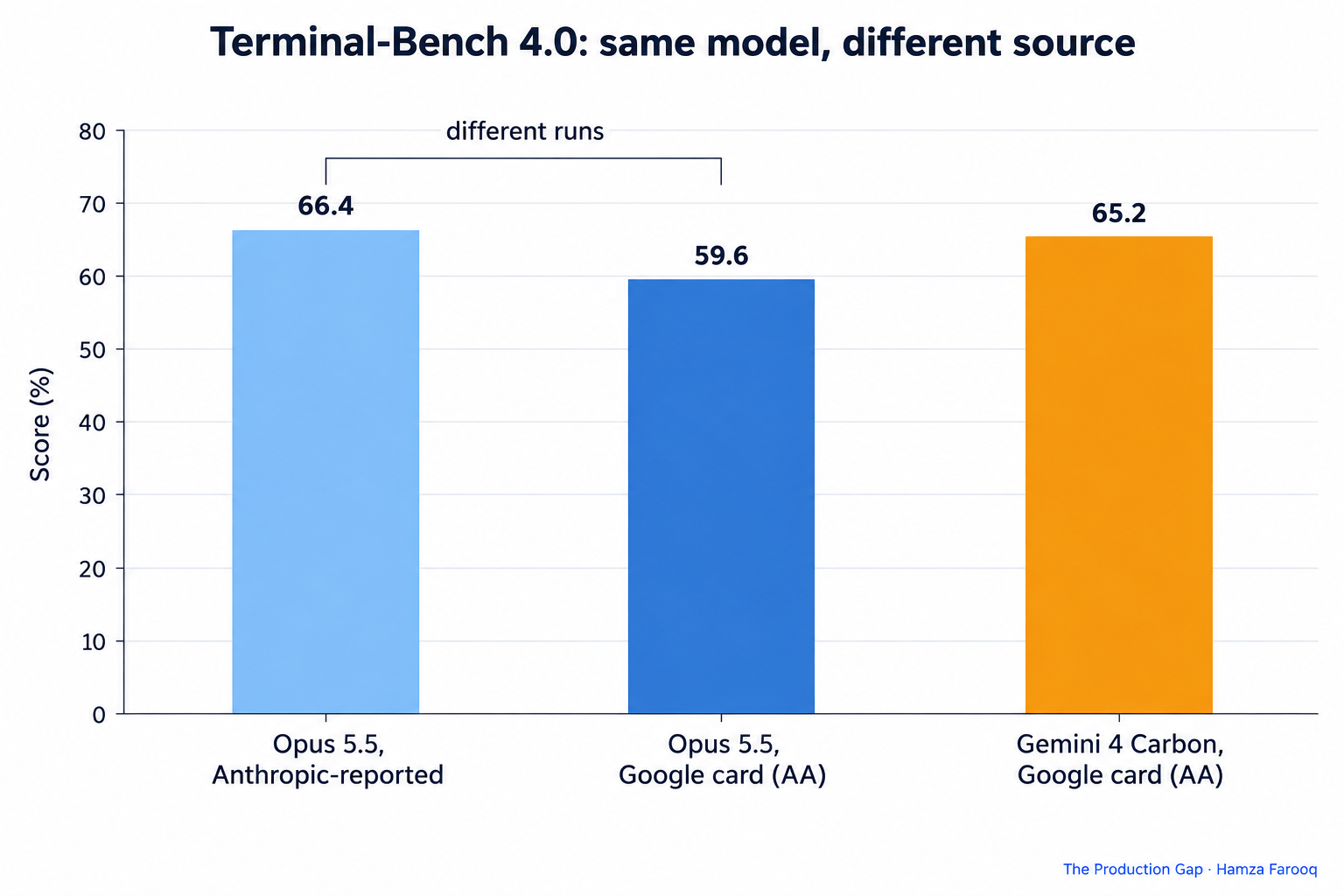
- Comparability: Anthropic lists Opus 5.5 at 66.4% on Terminal-Bench 4.0; Google's card, citing Artificial Analysis, lists 59.6%.
How do Claude models, Gemini 4 Hydrogen and Gemini 4 Carbon compare on price, context and scores?
Claude Fable 5.2 scores highest on the independent index and costs the most, while Gemini 4 Hydrogen and Claude Haiku 5.5 are the cheapest options here. Vendor scores are each lab's own claim; the Artificial Analysis columns come from one third-party leaderboard.
| Model | Price in / out per 1M tokens | Context | Max output | Vendor-reported score (benchmark, publisher) | Artificial Analysis Index (independent) | AA cost per task |
|---|---|---|---|---|---|---|
| Claude Fable 5.2 | $8 / $40 | 1M | 128K | FrontierCode 2.0: 49.1% at Xhigh, Anthropic | 65 (Max) | $26.54 |
| Claude Opus 5.5 | $4 / $20 | 1M | 128K | Terminal-Bench 4.0: 66.4% at Xhigh, Anthropic | 59 (Max) | $10.04 |
| Claude Sonnet 5.5 | $2 / $10 | 1M | 128K | Terminal-Bench 4.0: 70.6%, Anthropic | 55 (Max) | $10.02 |
| Claude Haiku 5.5 | From $0.10 / $0.50 | 1M | 128K | Terminal-Bench 4.0: 39.2%, Anthropic | 36 (Max) | $0.41 |
| Gemini 4 Carbon | $2 / $10 to Nov 30, then $4 / $20 | 1M, shared in/out | Up to 1M via long decode | Terminal-Bench 4.0 (AA): 65.2%, Google | 60 (High) | $5.48 |
| Gemini 4 Hydrogen | $1.50 / $7.50 | 1M, unified | 64K; 1M via background decode | Terminal-Bench 4.1: 57.0%, Google | 54 (Xhigh) | $3.16 |
Google's AI Studio pricing page applies Hydrogen's $7.50 output rate to thinking tokens too. Anthropic prices Haiku 5.5 90% below Haiku 4.5 for requests up to 100,000 tokens and only 50% below above that (Claude Haiku 5.5 announcement).
Why can't you compare vendor benchmark scores across Anthropic and Google?
The two labs' tables list the same model at different scores. Anthropic reports 66.4% for Claude Opus 5.5 on Terminal-Bench 4.0 at Xhigh effort, which it says represents the model's highest score (Claude Sonnet 5.5 announcement). Google's model card lists the same model at 59.6% on a row it labels Terminal-Bench 4.0 (AA), next to 65.2% for Gemini 4 Carbon (Gemini 4 Carbon model card). Google's evaluation methodology says those (AA) results are sourced from Artificial Analysis. Anthropic publishes no Carbon score on that benchmark.
Effort settings also differ within one table. Anthropic's table shows Fable 5.2 at 49.1% on FrontierCode 2.0 at Xhigh effort beside Gemini 4 Carbon at 41.1% at Medium effort (Claude Fable 5.2 announcement).
Versions differ as well. Google reports Hydrogen on Terminal-Bench 4.1 with cheating-adjusted scoring, where its own table puts Claude Sonnet 5.5 at 63.9% against Hydrogen's 57.0% (Gemini 4 Hydrogen model card). Anthropic publishes 4.0.
What do independent measurements show?
On the Artificial Analysis Intelligence Index, Claude Fable 5.2 scores 65, Gemini 4 Carbon 60, Claude Opus 5.5 59, Claude Sonnet 5.5 55, Gemini 4 Hydrogen 54 and Claude Haiku 5.5 36 (Artificial Analysis leaderboard).
Cost per task reshuffles that order. Artificial Analysis puts Fable 5.2 at $26.54 per task, Carbon at $5.48 and Hydrogen at $3.16 (Artificial Analysis leaderboard). Opus 5.5 and Sonnet 5.5 land at $10.04 and $10.02, although Sonnet's list price is half of Opus's. That implies Sonnet burns more tokens per task at Max effort.
Which model should you pick for each job?
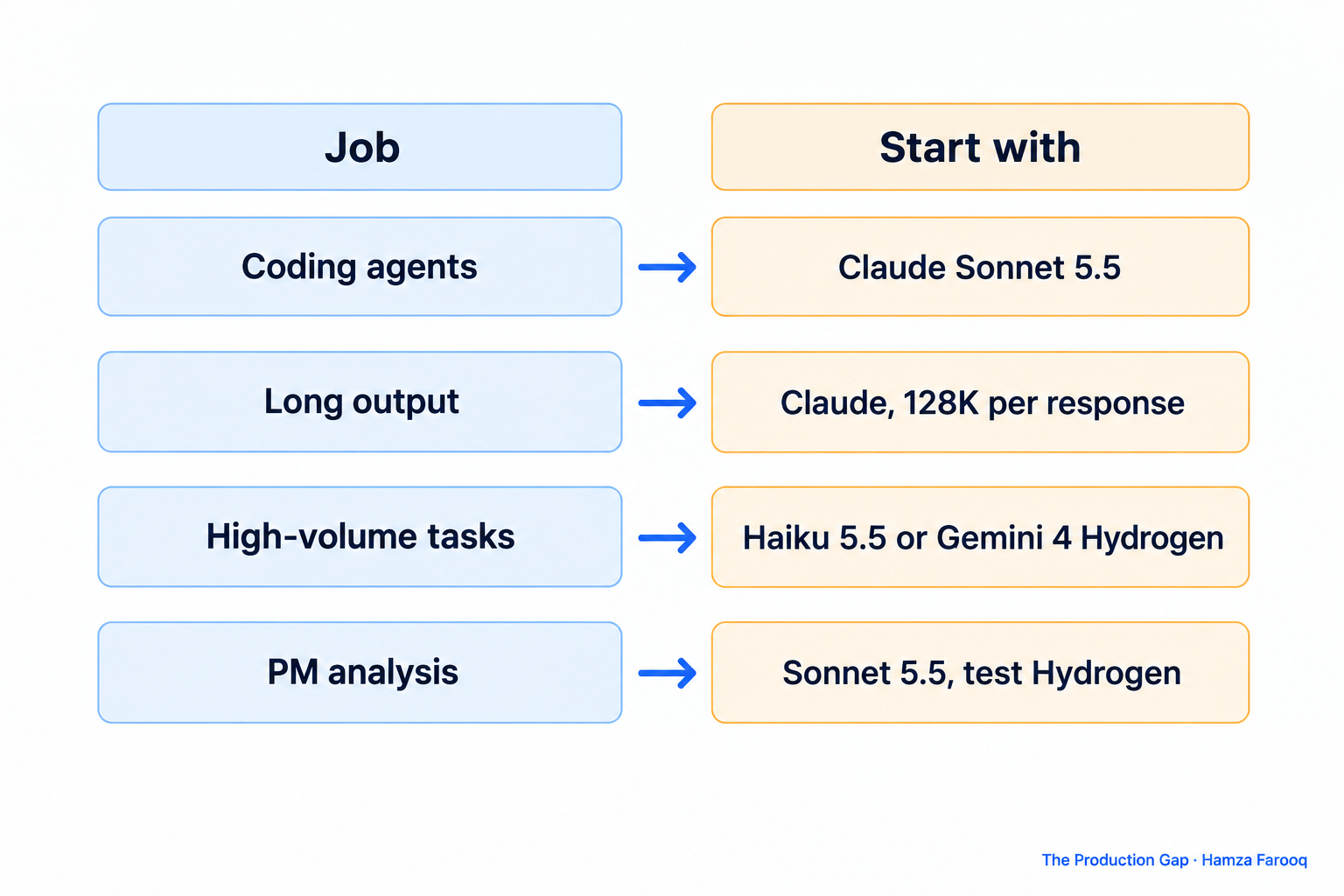
Start with Claude Sonnet 5.5 for coding and analysis, use Claude Haiku 5.5 or Gemini 4 Hydrogen for volume, and reserve Claude Fable 5.2 for work your evals show cheaper models cannot finish.
- Coding agents: Sonnet 5.5 scores 70.6% on Terminal-Bench 4.0 against Opus 5.5's 66.4% in Anthropic's table (Claude Sonnet 5.5 announcement). Google's own card puts Sonnet 5.5 ahead of Hydrogen on OSWorld-2.1, 83.9% to 77.6% (Gemini 4 Hydrogen model card).
- Long-context work: Every model here accepts 1M tokens. For long output, Claude returns up to 128K tokens per synchronous response (Anthropic models overview), while Hydrogen returns 64K synchronously and reaches 1M only through background long decode (Gemini 4 Hydrogen model card).
- High-volume cheap tasks: Haiku 5.5 costs $0.41 per task on Artificial Analysis versus $3.16 for Hydrogen, but Hydrogen scores 54 to Haiku's 36 (Artificial Analysis leaderboard). Use Haiku for labels and routing, Hydrogen when tasks need reasoning.
- PM analysis workloads: On GDPval-AA, which Artificial Analysis ran, Sonnet 5.5 scored 1844 against 1846 for Opus 5.5 (Claude Sonnet 5.5 announcement). Google reports Hydrogen at 71.6% on Agents' Last Exam v1.1 against 60.4% for Sonnet 5.5 (Gemini 4 Hydrogen model card). Test both on your own documents.
Frequently Asked Questions
Is Gemini 4 Hydrogen cheaper than Claude Sonnet 5.5?
Yes. Hydrogen lists at $1.50 input and $7.50 output per million tokens (Google AI Studio pricing). Sonnet 5.5 lists at $2 and $10 (Anthropic models overview). Per task the gap is wider: $3.16 versus $10.02 on Artificial Analysis.
Is Claude or Gemini better for coding?
Claude Sonnet 5.5 leads Gemini 4 Hydrogen even in Google's own table, 63.9% to 57.0% on Terminal-Bench 4.1 (Gemini 4 Hydrogen model card). Google's card puts Gemini 4 Carbon ahead of Claude Opus 5.5, 65.2% to 59.6% on Terminal-Bench 4.0 (AA) (Gemini 4 Carbon model card).
Can I trust vendor-reported benchmark scores?
Treat them as claims and compare within one source. Rank with a third-party index such as Artificial Analysis, then run your own evals.
Conclusion
Default to Claude Sonnet 5.5, drop to Haiku 5.5 or Gemini 4 Hydrogen for volume, and pay for Claude Fable 5.2 only where evals prove the gain. If you test Gemini 4 Carbon, budget at $4 and $20 per million tokens, the rate Google lists from December 1 (Google AI Studio pricing).
Learn from me
Agent Engineering Bootcamp: Developers Edition, my Maven cohort. Advanced agentic RAG, multi-agent orchestration, memory, evals, and guardrails. Take agents from prototype to production. Join the next cohort →
Hire us
Traversaal.ai. We're a team of forward deployed engineers solving the toughest AI problems for Fortune 100 companies: document intelligence, agentic data platforms, and real-time web intelligence, deployed in production. Work with our team to deploy your next agentic ecosystem. Talk to Traversaal.ai →
Join us
Want to solve these problems with us? We're always looking for forward deployed engineers who want to ship production AI. jobs@traversaal.ai
