
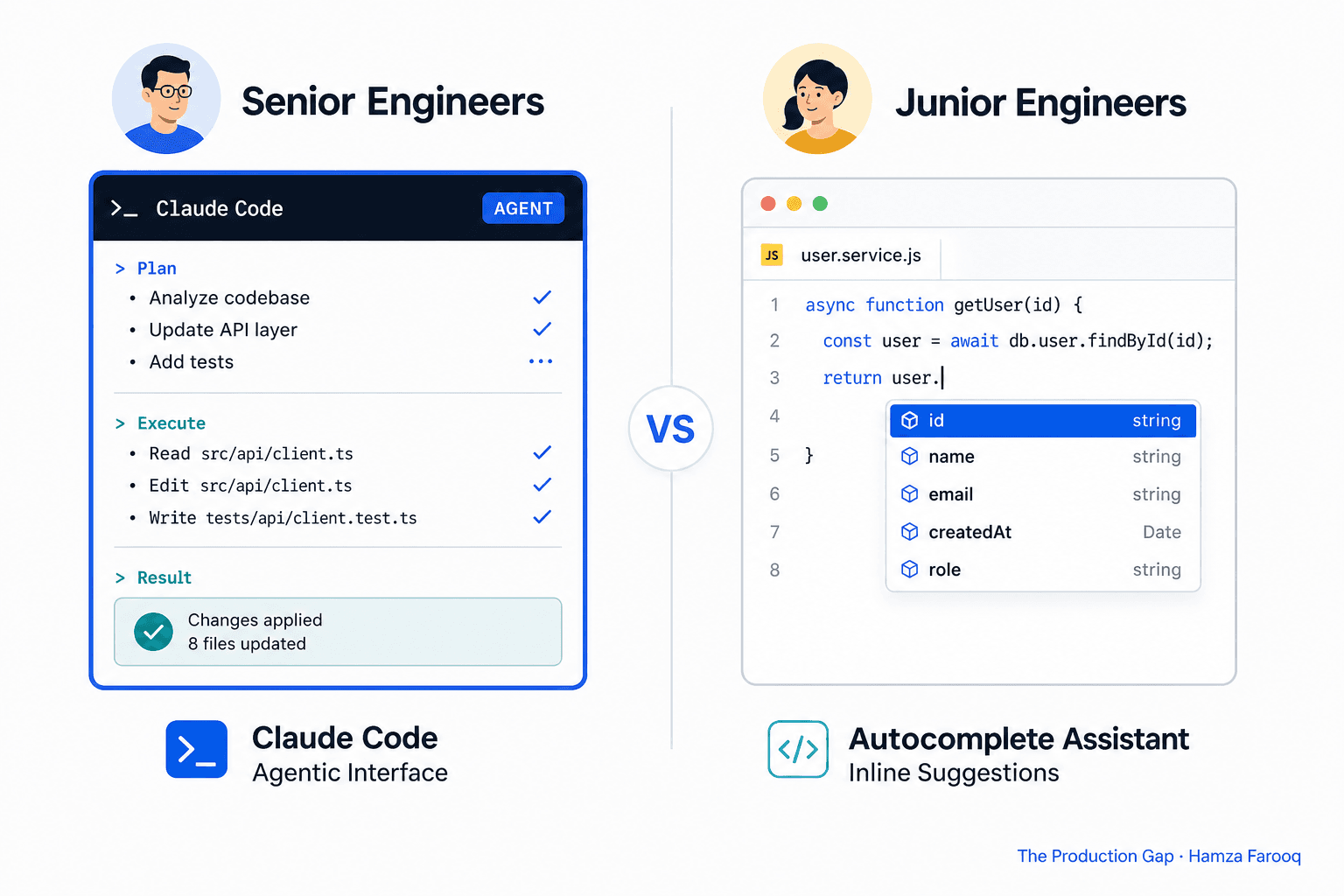
TL;DR: Claude Code senior engineers adopt at dramatically higher rates than junior engineers, and forcing both groups onto a single AI coding tool sacrifices productivity at one end of the spectrum to achieve administrative simplicity. A tiered tooling policy, matching agents to experience level, recovers that lost output without adding meaningful management overhead.
Key Takeaways
- Standardization has a hidden seniority tax: Forcing one AI coding tool on the whole team drains productivity from whichever group gets the worse fit.
- Claude Code is built for architectural thinking: Directing it well requires system-level judgment that only comes with experience.
- Juniors thrive with different tool designs: Less experienced developers need more guidance and simpler prompting interfaces.
- The skills gap is widening: Claude Code raises the senior ceiling while absorbing the entry-level work juniors use to build skills.
- Tiered tooling is the practical fix: Role-appropriate tools return more in productivity than a single standard.
Engineering leaders are increasingly being asked to pick one AI coding tool for the whole org. The problem: senior and junior engineers don't want the same thing, and ignoring that divergence creates an asymmetric productivity cost that falls hardest on the engineers a team can least afford to slow down.
Why do senior engineers prefer Claude Code over other AI coding tools?
Claude Code's core design assumption is that the user supplies judgment, not syntax. Joinleland.com frames it as a "Virtual Senior Engineer" that requires you to provide the logic, not the code. If you already think in systems, you can direct it at scale. If you don't, the interface offers little scaffolding.
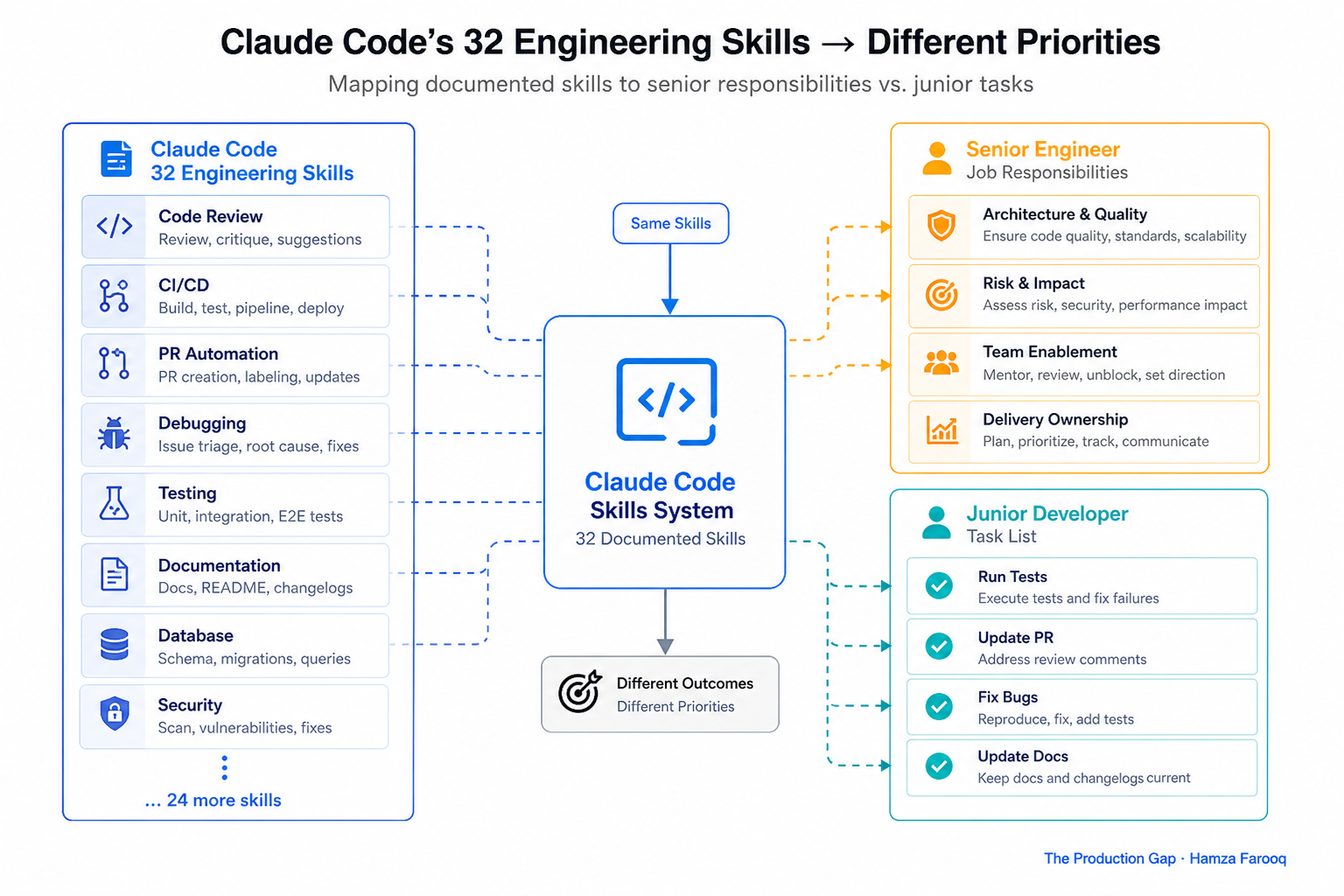
One 10-year veteran on Reddit described how Claude Code improved robustness, security, test coverage, and CI/CD practices, the exact vocabulary of a principal engineer's daily concerns. The claude-skills repository makes this concrete: 32 production-ready skills covering code review, debugging workflows, and PR automation. A senior engineer recognizes those as the hardest parts of the job. A junior developer may not yet know what half those workflows involve.
How is Claude Code widening the skills gap between junior and senior developers?
The displacement is documented. Claude Code is reshaping junior developer hiring, with data suggesting entry-level work is shifting as AI coding tool adoption grows. Claude Code absorbs work that once required junior engineers (turning vague requirements into executable code) while making seniors faster at the same time.
Juniors traditionally learn by doing the foundational work: debugging, boilerplate, straightforward features. When Claude Code absorbs that work, they lose their primary learning surface before they have developed the judgment the tool itself demands.
What is the real productivity cost of standardizing on one AI coding tool across a mixed-seniority team?
The real cost is not the licensing fee, it's a cognitive tax on whichever seniority group gets the worse-fit tool, and that cost is easy to miss in procurement models.
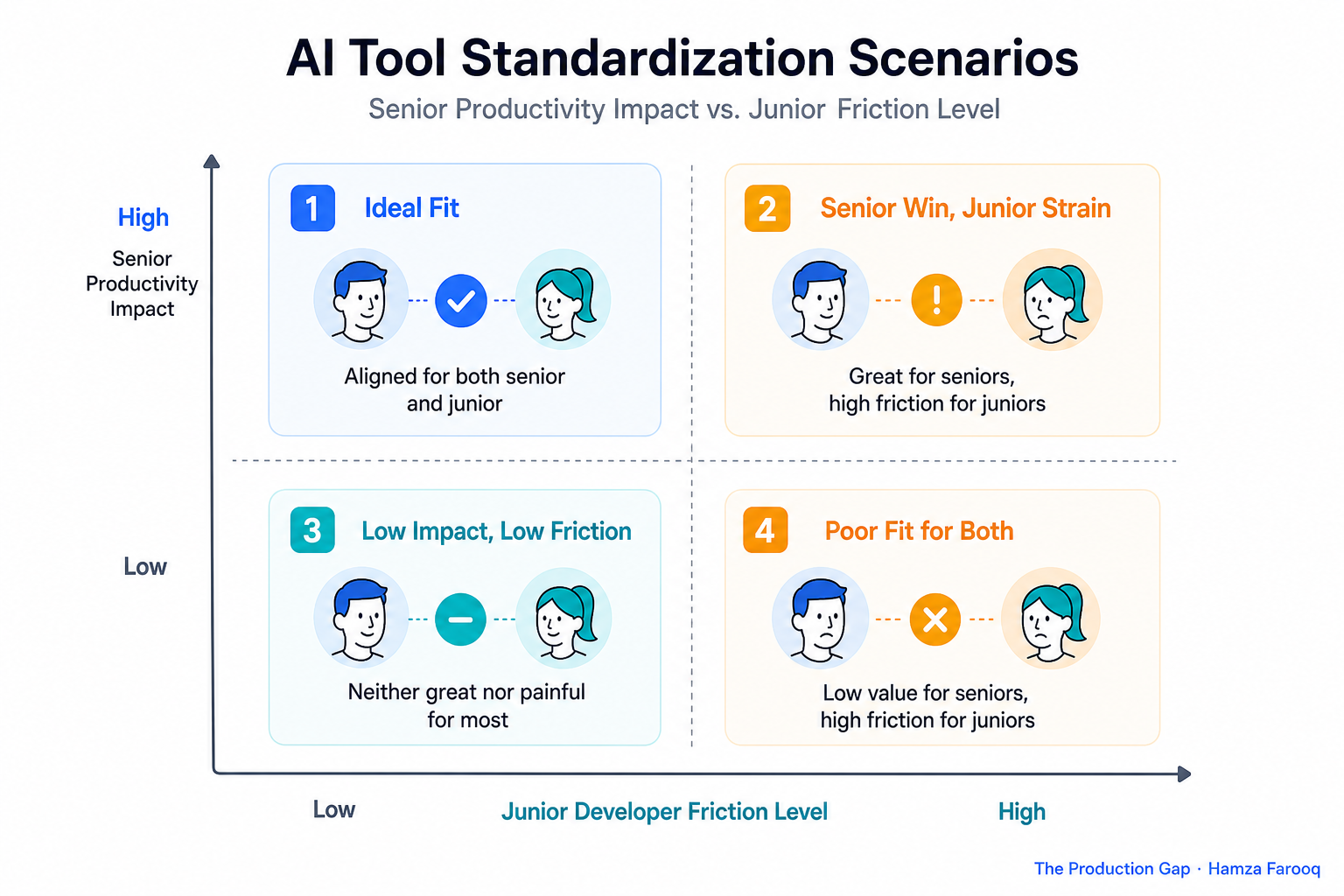
Standardizing downward caps your highest-leverage contributors. Mandating Claude Code for everyone doesn't hurt seniors, but it creates friction and disorientation for juniors who aren't yet equipped to supply the engineering judgment it demands.
| Standardization Choice | Senior Engineer Impact | Junior Engineer Impact | Org-Level Risk |
|---|---|---|---|
| Mandate junior-preferred tool org-wide | High cognitive tax; architectural capabilities lost | Low friction; familiar UX | Caps senior output ceiling |
| Mandate Claude Code org-wide | Productivity multiplied | High friction; judgment gap exposed | Junior learning pathway disrupted |
| Tiered tooling policy | Optimized | Optimized | Higher admin cost, higher total output |
| No policy / ad hoc | Inconsistent | Inconsistent | Security, compliance, and review risk |
In my observation, senior engineers rarely file formal complaints about being forced onto a lesser tool, the signal tends to show up in attrition before leadership connects it to tooling.
Should engineering teams use tiered AI tooling policies instead of one standard?
In practice, this means senior engineers and tech leads get Claude Code with full agentic capabilities, while junior and mid-level engineers work with a tool that offers stronger guardrails and simpler prompting. This is not gatekeeping, it's matching interface complexity to where someone actually is in their career.
There is also a practical middle path. Varun Gupta documented it: Claude Code skills can be encoded once by senior engineers and distributed to everyone, covering code review standards, debugging workflows, and PR norms. Junior engineers consume those skills through simpler interfaces, senior judgment scales without requiring juniors to operate Claude Code at full agentic complexity.
The administration objection ("two tools cost more than one") deserves scrutiny. The relevant comparison is productivity lost from the wrong fit versus the cost of managing two tools, and that calculation will differ for every team based on how much of their architectural output depends on senior engineers operating at full capacity.
Frequently Asked Questions
What is Claude Code and why do senior engineers like it? Claude Code is an agentic coding tool from Anthropic that requires users to direct it at the system and architectural level. Senior engineers gravitate toward it because it amplifies existing judgment rather than replacing it with autocomplete.
Does forcing junior developers to use Claude Code hurt their career development? It may. Claude Code absorbs the entry-level tasks (boilerplate, debugging, straightforward feature work) that juniors use to build foundational skills, which can reduce the learning surface available to early-career engineers over time.
What is a tiered AI tooling policy in engineering teams? A tiered tooling policy assigns different AI coding tools to different seniority levels based on the engineering judgment each tool requires, matching interface complexity to cognitive readiness rather than mandating one tool for all roles.
How do Claude Code skills help bridge the senior-junior gap? Senior engineers can encode judgment into Claude Code skill files covering code review standards, debugging workflows, and PR norms, then distribute those to junior teammates, scaling senior decision-making without requiring juniors to operate Claude Code at full agentic complexity, a pattern documented in practice by engineering leads.
Conclusion
Picking one tool for everyone means deciding who pays the friction cost, and that cost lands hardest on the people running the highest-leverage work. Before your next procurement renewal, consider running a seniority-split usage audit: ask senior and junior engineers separately what they need, then compare the two lists. The gap will tell you whether one tool can honestly serve both groups.
The most expensive AI tooling decision you can make is the one that looks cheapest on a spreadsheet.
Learn from me

Claude Code in Practice, my Maven cohort. Master Claude Code from fundamentals to advanced orchestration: skills, subagents, hooks, MCP, and production automation. Join the next cohort →
Hire us
Traversaal.ai. We're a team of forward deployed engineers solving the toughest AI problems for Fortune 100 companies: document intelligence, agentic data platforms, and real-time web intelligence, deployed in production. Work with our team to deploy your next agentic ecosystem. Talk to Traversaal.ai →
Join us
Want to solve these problems with us? We're always looking for forward deployed engineers who want to ship production AI. jobs@traversaal.ai
