
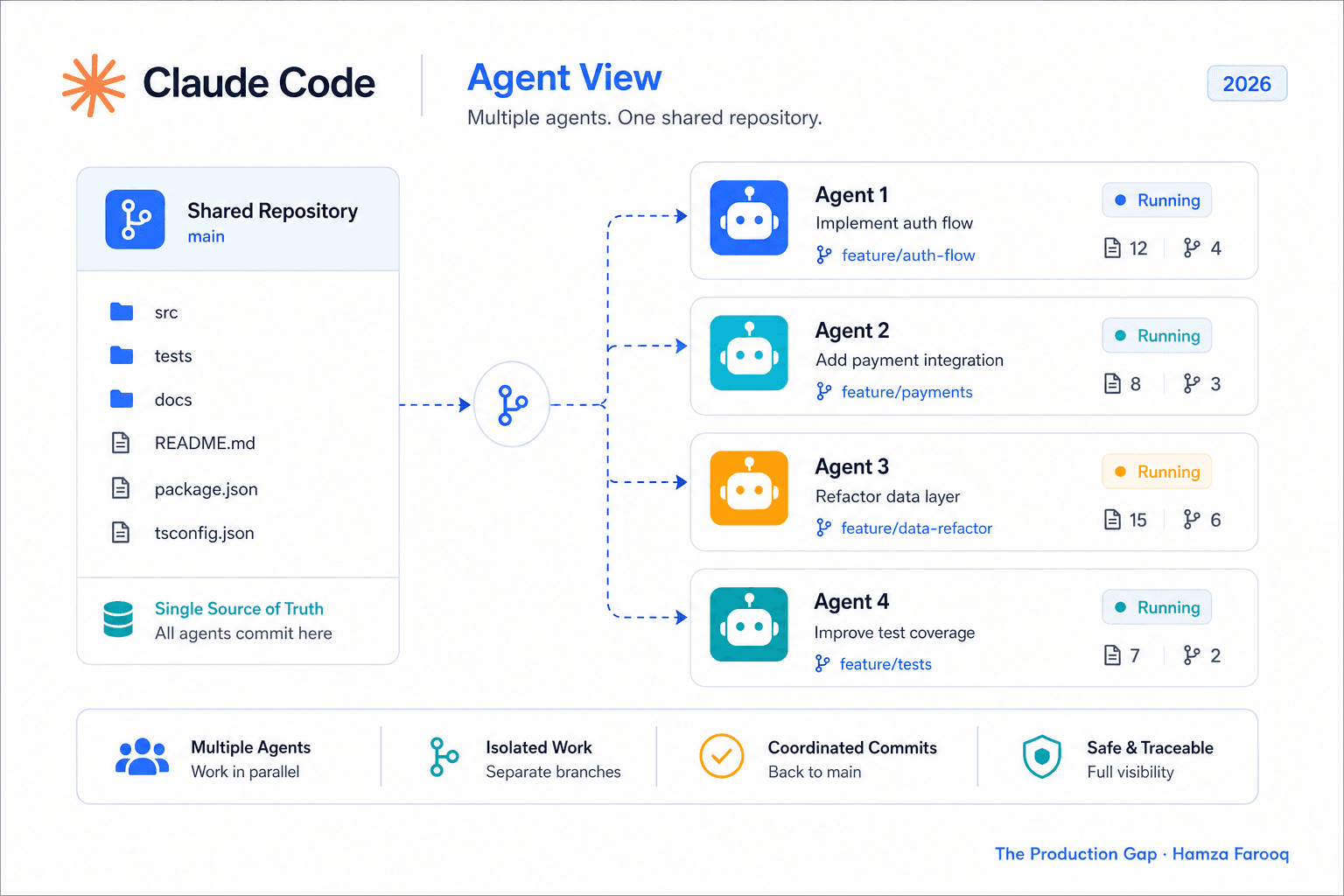
TL;DR: Claude Code multiplayer agents let multiple AI instances write to a shared codebase simultaneously, coordinated via Agent View and agents.md. Anthropic's Thariq Shihipar frames this as "mutable software," code that AI agents continuously reshape alongside human engineers. Some orchestration capabilities are already shipping; deeper multiplayer coordination remains directional. This guide is written for engineering leads and platform teams evaluating Claude Code's multi-agent capabilities in 2026.
Key Takeaways
- Mutable software changes everything: Codebases become living documents continuously rewritten by agents, not fixed artifacts updated in sprints.
- Multiplayer agents are already here: Agent View is shipped; teams can run multiple Claude Code agents against the same repository simultaneously.
- agents.md is your coordination layer: This specification file acts as a shared rulebook that tells concurrent agents how to divide work.
- Thariq Shihipar's three-pillar vision: Mods, Mutable Software, and Multiplayer Agents form a mutually reinforcing framework for evaluating AI's role in your workflow.
- Conflict resolution is the unsolved frontier: How Claude Code handles competing changes to the same files remains an open governance challenge.
- Mods extend Claude Code's behavior: The Mods system lets teams customize agent operation per environment, not per preference.
What is Claude Code's multiplayer-agent vision?
Claude Code multiplayer agents let multiple AI instances write to a shared codebase simultaneously, coordinated via Agent View and agents.md. What began as a solo productivity tool has become a multi-agent development platform. In a widely discussed Latent Space episode, Anthropic's Thariq Shihipar laid out three interlocking concepts, Mods, Mutable Software, and Multiplayer Agents, that describe what development looks like when multiple AI agents write code simultaneously against a production codebase. Agent View has shipped, agents.md is rolling out, and cross-session messaging is live. The capability gap is closing. The governance gap is barely being talked about.
What exactly did Thariq Shihipar say about Anthropic's three-pillar vision for Claude Code?
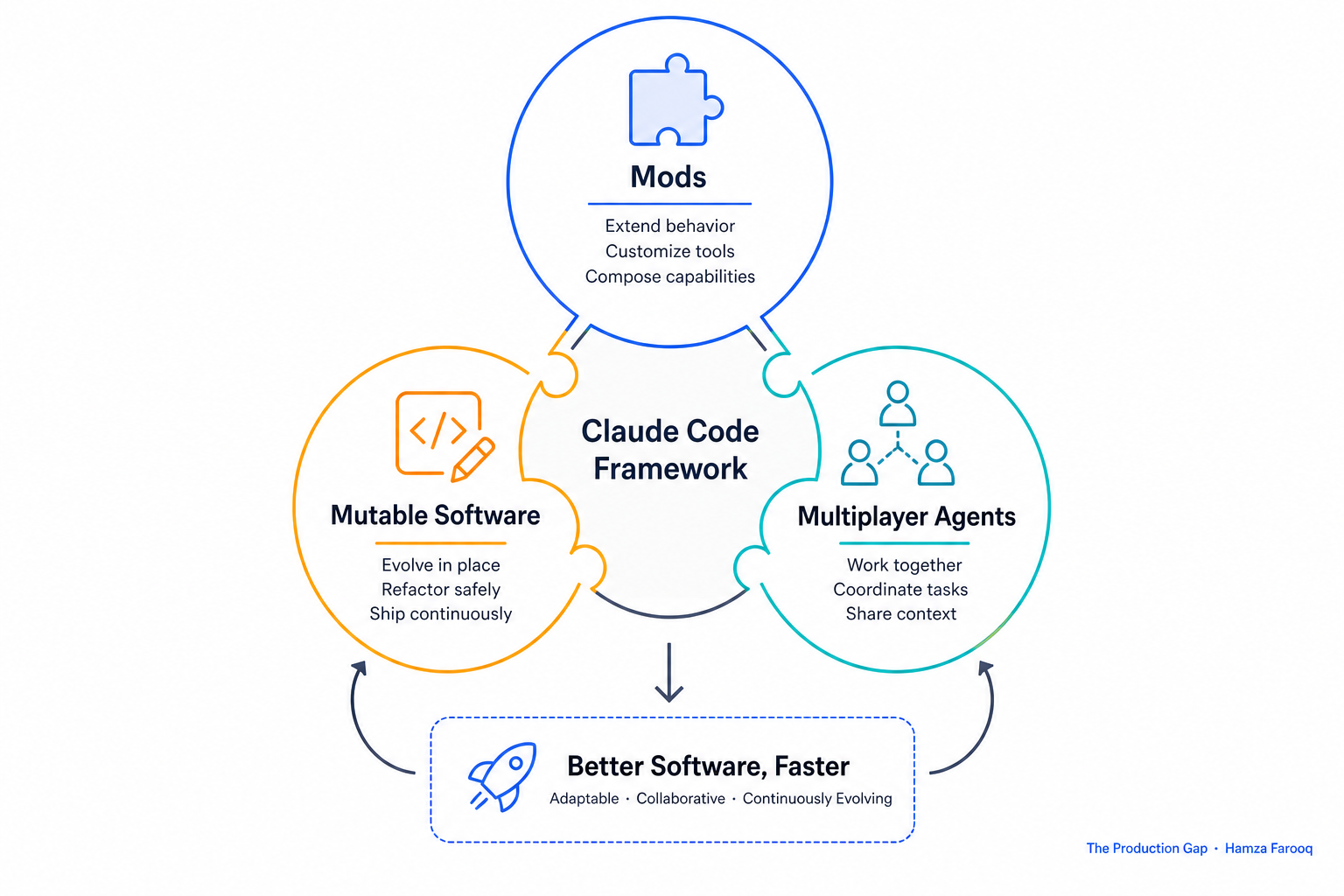
Anthropic's Thariq Shihipar publicly defined Claude Code's next phase around three interlocking pillars in a Latent Space episode that has become the go-to reference for where Anthropic is taking the product.
Mods are composable extensions that customize Claude Code's behavior for a specific codebase, letting teams encode their conventions at the workflow level rather than adjusting settings per session.
Mutable Software is Shihipar's most striking framing: software stops being a fixed artifact and becomes a continuously rewritten object reshaped by agents in near-real-time, a living document rather than a published book.
Multiplayer Agents means multiple Claude Code instances running concurrently on a shared codebase, coordinating via cross-session messaging rather than overwriting each other's work.
These three pillars are mutually reinforcing: Mods define how agents behave, Mutable Software describes what agents are operating on, and Multiplayer is what makes running them simultaneously viable at all.
Which Claude Code multiplayer-agent features are already shipping, and which are still directional?
Agent View, cross-session messaging, and agents.md are shipping now; inter-agent conflict resolution and persistent-artifact support are still on the roadmap.
Feature Status as of July 2026
| Feature | Status | What It Does |
|---|---|---|
| Agent View UI | Shipped | Dashboard for launching and monitoring concurrent Claude Code agents |
| Cross-session messaging | Rolling out | Lets agents communicate state and progress across parallel sessions |
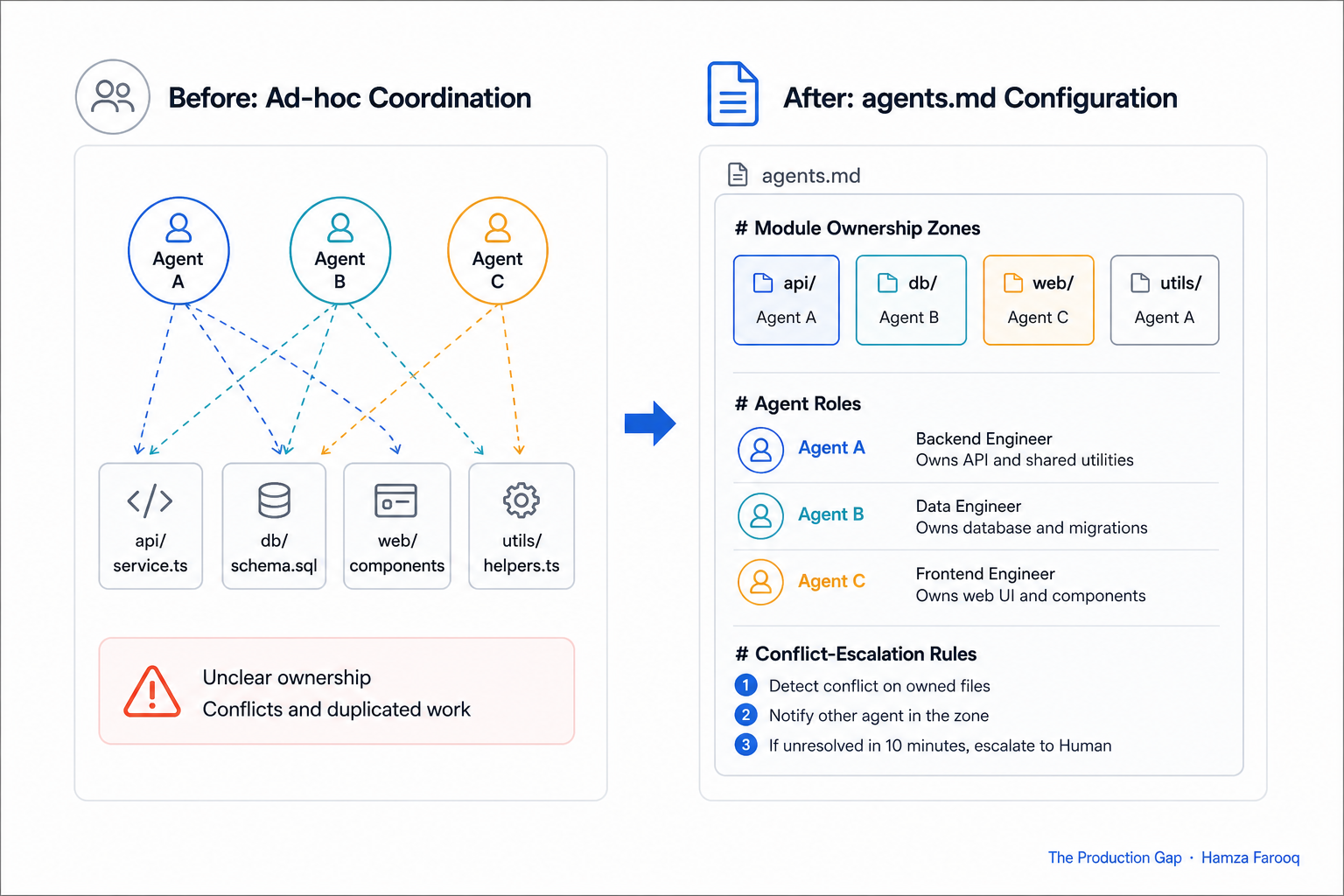
| agents.md specification file | Rolling out | Shared rulebook defining how concurrent agents divide and claim work |
| Claude Code Mods | Available | Composable extensions that customize per-environment behavior |
| Persistent artifacts | Roadmap | Long-lived outputs that survive across agent sessions |
| Dreams and Routines orchestration | Announced | Multi-agent orchestration pipelines announced for 2026 |
Agent View lets a team run one agent refactoring authentication logic while a second writes tests for payments, with no serialized task queues required. The coordination surface exists; the safety net does not. Automated conflict resolution, auditable non-human commits, and inter-agent arbitration are all still ahead. Running agents in this model is a posture teams should consciously choose, not accidentally inherit.
How does agents.md work, and how should engineering teams configure it?
As a practical starting point, the framework used in this guide suggests three configuration priorities for teams beginning with agents.md:
- Define module ownership zones: Map top-level directories to agent roles so that each agent has a declared area of responsibility before any session begins.
- Set conflict-escalation rules: Specify that overlapping file edits require human review before merge, making the resolution path explicit rather than implicit.
- Version the file: Treat agents.md changes as a governance event requiring engineer sign-off, not routine housekeeping.
Why is governance, not AI capability, the real bottleneck for multiplayer-agent adoption?
When multiple Claude Code agents commit to a shared codebase simultaneously, the primary constraint on team velocity is not what the agents can do; it is whether the team has the permissions models, audit practices, and conflict-resolution workflows to govern non-human commits safely.
This guide frames the governance challenge using what it calls the Three-Layer Agent Governance Model, an author synthesis of the questions most teams encounter when moving from single-agent to multiplayer configurations:
- RBAC scoping: Teams need a clear model for what write access AI agents hold versus human developers. Scoping agents to branch-level or module-level access before enabling Agent View limits blast radius and makes permission boundaries explicit from the start.
- Commit metadata conventions: Standard version control attribution was not designed with agent sessions in mind. Establishing consistent metadata conventions for agent-authored commits, covering author field, session identifier, and task reference, creates an audit trail that supports both review and rollback.
- Conflict-resolution ownership: When two agents produce overlapping pull requests, a named human owner and a defined timeline for resolution should exist before the first multi-agent session runs, not after the first collision occurs.
These three layers are pre-session decisions, not reactive fixes. Treating agent permissions as a first-class architectural decision before any multi-agent session runs is the approach this guide recommends. Teams that skip this step tend to manage coordination overhead they did not plan for and cannot easily unwind.
FAQ
Q2: What does "mutable software" mean in this context? Mutable software describes a codebase that is no longer a fixed artifact updated in discrete releases but a continuously evolving object reshaped by agents in near-real-time, which changes how teams need to think about versioning, review, and ownership.
Q4: How do Claude Code Mods differ from standard configuration? Mods are composable extensions that change agent behavior at the workflow level for a specific codebase, rather than adjusting session-level output settings.
Conclusion
Anthropic's three-pillar vision is not a distant roadmap. Agent View and agents.md are available now, and the teams that extract lasting value from them will not be the ones who simply enable Agent View and move on. They will be the ones who defined which agents get write access to which branches, how non-human commits get tagged, and who owns resolution when two agent pull requests collide before the first session ran.
The Three-Layer Agent Governance Model described in this guide gives engineering leads a concrete starting point: scope RBAC for agents, establish commit metadata conventions, and assign conflict-resolution ownership. Treat those decisions as architecture, not afterthought.
Start today: Commit a draft agents.md to your most active repository, define module ownership zones, and make agent permissions a first-class decision before your first multi-agent session runs.
Learn from me
Claude Code in Practice, my Maven cohort. Master Claude Code from fundamentals to advanced orchestration: skills, subagents, hooks, MCP, and production automation. Join the next cohort →
Hire us
Traversaal.ai. We're a team of forward deployed engineers solving the toughest AI problems for Fortune 100 companies: document intelligence, agentic data platforms, and real-time web intelligence, deployed in production. Work with our team to deploy your next agentic ecosystem. Talk to Traversaal.ai →
Join us
Want to solve these problems with us? We're always looking for forward deployed engineers who want to ship production AI. jobs@traversaal.ai
