
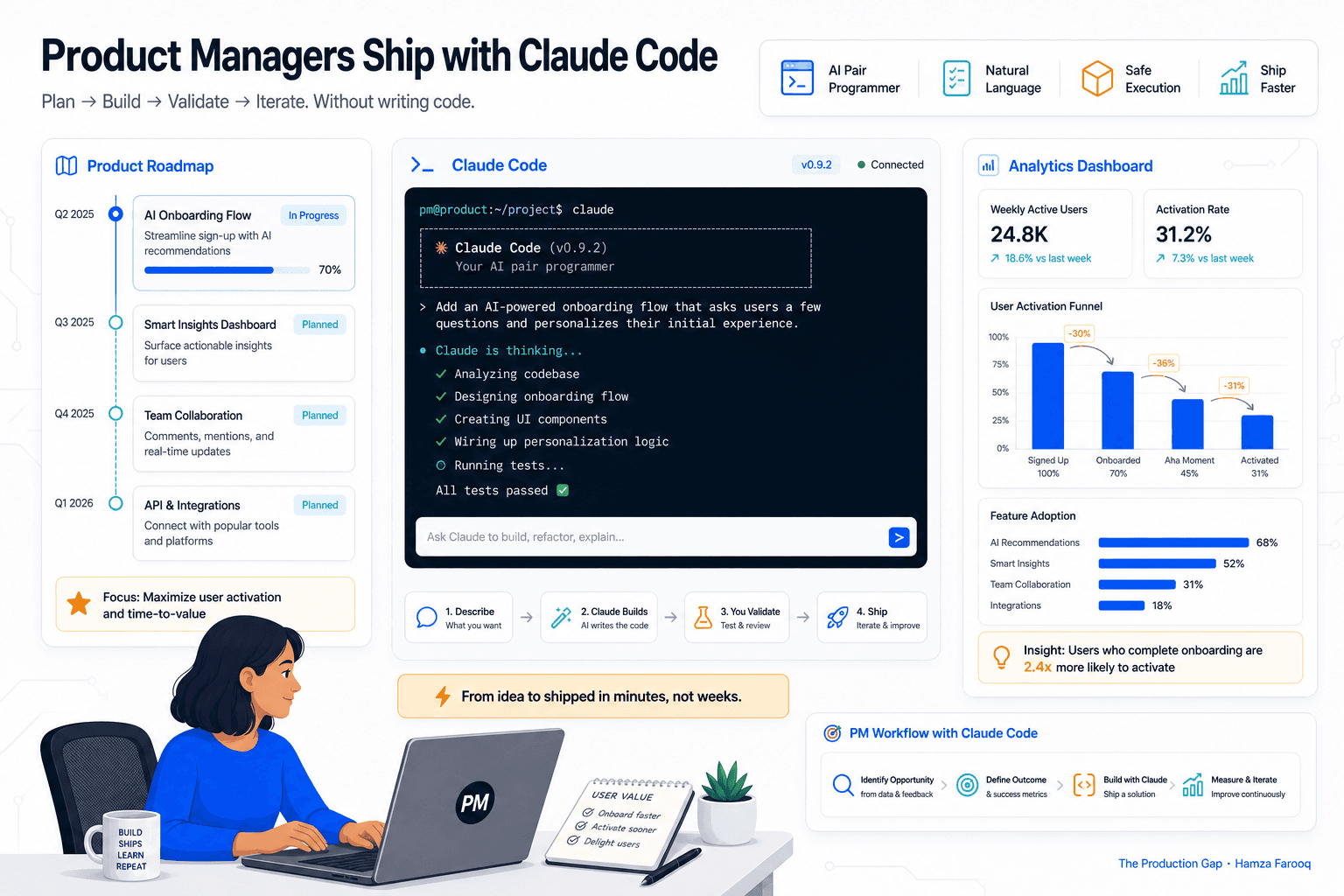
TL;DR: Claude Code gives product managers a direct path to prototyping, data analysis, and shipping internal tools without writing a single line of code or filing an engineering ticket. Non-technical PMs can use Claude Code to generate working prototypes from a description, query real datasets, and extract PRD-ready context straight from an existing codebase, compressing days of back-and-forth into hours of independent execution.
She filed the ticket on a Tuesday. Engineering triaged it Thursday. By the time the prototype was ready, the customer conversation it was built for had already happened, without any data to show.
Key Takeaways
- Claude Code closes the build gap: Non-technical PMs can prototype, build internal tools, and analyze data without filing a single engineering ticket.
- Codebases become readable context: Claude Code scans actual code to generate PRDs that reflect how the product truly works.
- Competitive teardowns get sharper: Scrape competitor changelogs and public data for structured, shareable intelligence.
- Internal tools ship without a ticket: Dashboards, trackers, and Slack bots that lived in the backlog for months can be built in an afternoon.
- The PM role is expanding: Claude Code makes rising technical expectations realistic for people who never learned to code.
Introduction
The engineering queue has always been the PM's invisible ceiling, but that ceiling has cracked. Claude Code is the tool doing the cracking, and PM communities on LinkedIn, Every, and private Slack groups are passing around terminal-based workflows like trading cards.
This article isn't about writing better PRDs. It's about eliminating whole categories of engineering dependency.
What actually is Claude Code, and why is it different from just using Claude?
Claude Code is a terminal-based agentic coding tool, not a chat interface, that reads your actual codebase, executes commands, and completes multi-step technical tasks autonomously.
Most PMs have used Claude or ChatGPT to draft PRDs. Useful, but it's still text in a box. Claude Code runs in your terminal, opens files, traverses directories, reads tens of thousands of lines of code, and drafts specs based on what the code actually does. Using Claude.ai to understand your product is like describing your car's symptoms over the phone. Using Claude Code is like handing the mechanic the keys.
| Feature | Claude.ai (Chat) | Claude Code (Terminal Agent) |
|---|---|---|
| Reads your actual codebase | ❌ | ✅ |
| Executes multi-step tasks autonomously | ❌ | ✅ |
| Analyzes CSV/analytics files directly | Limited | ✅ |
| Builds and runs code end-to-end | ❌ | ✅ |
| Requires coding knowledge to use | No | No |
| Useful for PRD writing from scratch | ✅ | ✅ (with real code context) |
| Scrapes and analyzes external pages | ❌ | ✅ |
Setup takes under ten minutes: install via npm install -g @anthropic-ai/claude-code, authenticate with your Anthropic API key, and run claude inside any project directory. You don't need to understand the code it reads. That's the point.
How to use Claude Code to write PRDs that actually reflect your codebase
The best PRD matches how your product actually works, and Claude Code writes it by reading the codebase itself, not by trusting your summary.
Stop guessing at technical constraints
Every non-technical PM has written a spec engineering handed back covered in red: "this isn't how the API works," "we don't store that field." Claude Code cuts out that loop. Point it at your backend directory and ask: "What data do we currently store per user session, and what would need to change to support usage-based billing?" It reads actual schema files and returns precise answers with real field names and real limitations, before you write the first word of the spec.
Generate specs engineers won't rewrite
When Claude Code drafts a spec from codebase context, engineers recognize their own architecture in it. Run it against your API routes, ask it to map the current authentication flow, then layer your product requirements on top. The output reflects the technical reality of the system because it was built from that reality directly.
Self-serve data analysis: no SQL, no BI tool, no ticket
Claude Code turns any CSV export into a working analysis in minutes, plain-English question in, executable analysis out.
From Mixpanel export to insight in an afternoon
Export your Mixpanel or Amplitude data as a CSV, drop it in a folder, and say: "Find the drop-off point in the onboarding funnel for users who signed up in Q1 2026 but never completed their first action." Claude Code writes a Python script, runs it, and surfaces the answer, with a chart if you ask. PMs at mid-size B2B SaaS companies are using this workflow to answer questions in customer calls that previously required two weeks and a data team.
Spot anomalies before they become incidents
The same workflow applies to support tickets, NPS data, and revenue cohort files. Paste in three months of Zendesk exports and ask Claude Code to cluster tickets by theme, identify friction-heavy features, and flag spikes in the last 30 days. What used to require a data analyst and a JIRA ticket now takes 20 minutes.
Competitive teardowns at terminal speed
Claude Code pulls structured intelligence from competitor changelogs and public documentation in the time it takes to schedule a competitive review meeting.
Ask it to fetch a competitor's public changelog, extract every feature release from the past six months, categorize them by product area, and cross-reference against your roadmap. What most PMs do manually, tabbing between pages, copying notes into spreadsheets, Claude Code does in one run. The output is a structured, shareable teardown, not a wall of screenshots in a Notion doc.
Ship internal tools without filing a ticket
A lightweight internal tool that would sit in the backlog for four months can be built and deployed by a PM in a single afternoon.
The most common use cases in 2026: a Slack bot posting weekly retention metrics every Monday, a dashboard pulling from a Google Sheet to show current sprint customer commitments, a CSV-to-email report firing when a key account hits a usage threshold. None require a senior engineer, all have historically required one. Claude Code builds the script; Railway or Render deploys it in minutes with no infrastructure knowledge needed.
Product orgs are taking on work that previously required a dedicated data analyst or a technical PM title. The role isn't shrinking, it's expanding into territory that used to require a separate hire.
Frequently asked questions
Do I need to know how to code to use Claude Code as a PM? No. Claude Code operates in plain English, you describe what you want, it handles the technical execution.
Is Claude Code safe to use with a production codebase? Claude Code reads files and runs code in your local environment. For sensitive codebases, run it in a sandboxed copy of the repo rather than directly in production. Anthropic's documentation covers permission scoping in detail.
Learn from me

Agentic AI for Product Managers, my Maven cohort. Learn how to design, evaluate, and ship reliable AI systems: the technical fluency PMs need to lead agentic products, no engineering background required. Join the next cohort →
Hire us
Traversaal.ai. We're a team of forward deployed engineers solving the toughest AI problems for Fortune 100 companies: document intelligence, agentic data platforms, and real-time web intelligence, deployed in production. Work with our team to deploy your next agentic ecosystem. Talk to Traversaal.ai →
Join us
Want to solve these problems with us? We're always looking for forward deployed engineers who want to ship production AI. jobs@traversaal.ai
