
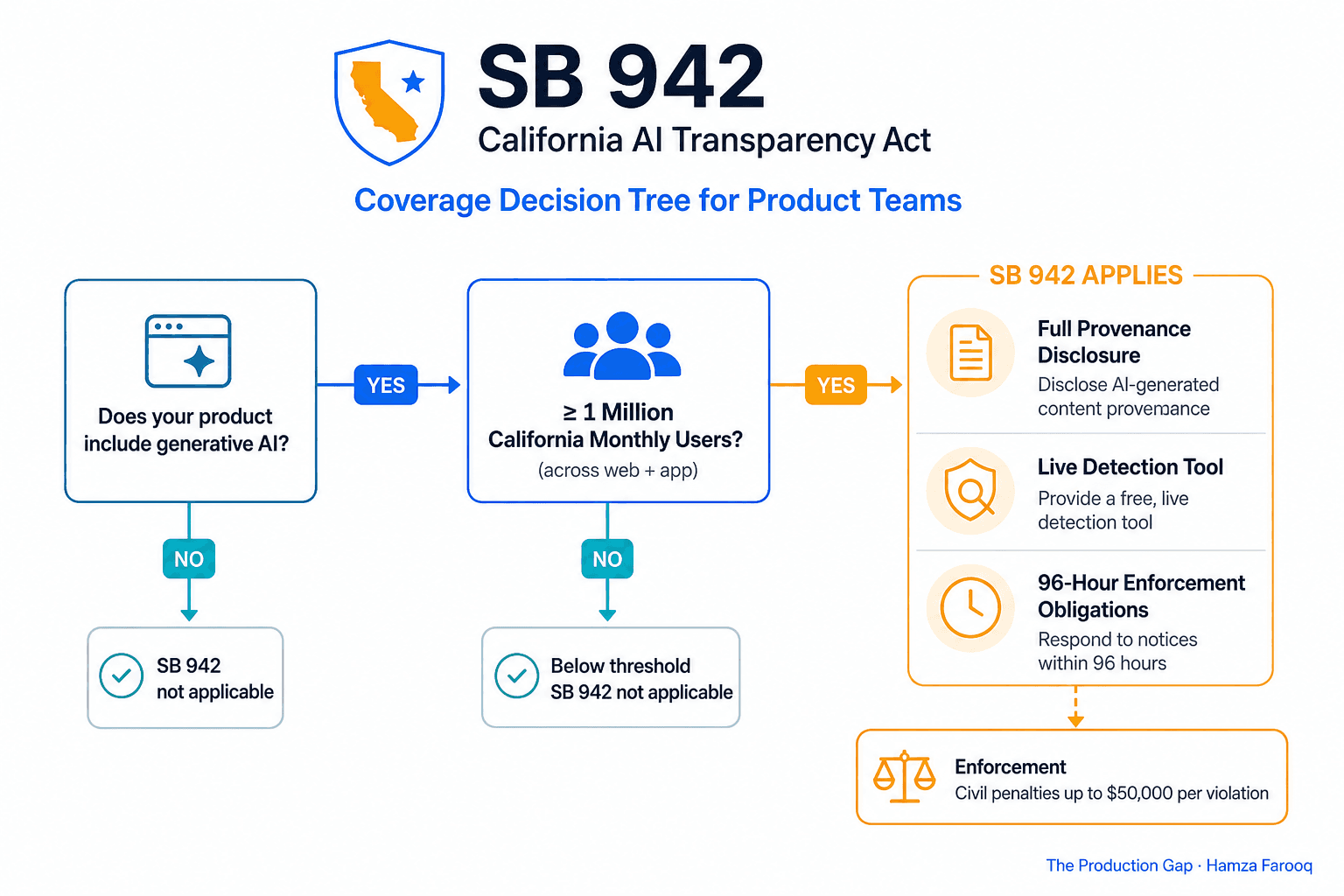
TL;DR: The California AI Transparency Act (SB 942) requires any generative AI system with over one million monthly California users to disclose AI-generated content through both visible labels and detectable provenance signals embedded in the output. Covered product teams must implement these technical disclosure mechanisms or face enforcement through California's Attorney General. Unlike the EU AI Act's risk-tiered structure, SB 942 focuses narrowly on transparency obligations, making compliance faster to scope but requiring immediate vendor contract audits.
Key Takeaways
- Coverage threshold is one million monthly users: Full compliance applies once SB 942's trigger is met, no phase-in remains.
- Provenance disclosure is non-negotiable: Every AI-generated output must carry an embedded label, regardless of whether you built the model.
- A live detection tool is a hard requirement: A static disclosure page does not satisfy this obligation.
- Third-party APIs do not transfer your liability: If a vendor's model produces unlabeled output, your product faces enforcement.
- SB 942 and the EU AI Act target different problems: Both can apply to the same product simultaneously.
- The remediation clock starts at the moment a violation is flagged: Teams without a pre-built fast-path process are structurally exposed.
Introduction
California's AI Transparency Act (SB 942) became operative in August 2026. No grace period remains. Generative AI systems serving more than one million monthly California users must embed provenance disclosures, operate a live detection tool, and remediate flagged violations within the statute's cure window or face enforcement consequences.
This is not a content-labeling problem. It is an always-on engineering obligation with a penalty timeline that can run faster than most legal review cycles.
Does Your Product Cross the One-Million-User Threshold That Triggers SB 942?
SB 942 covers generative AI systems with more than one million monthly California users, and liability binds the deploying product, not the model provider.
SB 942 and AB 2013 form California's paired AI compliance picture: together they govern both disclosure and implementation obligations for businesses operating at scale. If you serve California at that scale, measure your coverage exposure against the one-million monthly user threshold and assume obligations apply while you verify.
What Does SB 942 Actually Require You to Build?
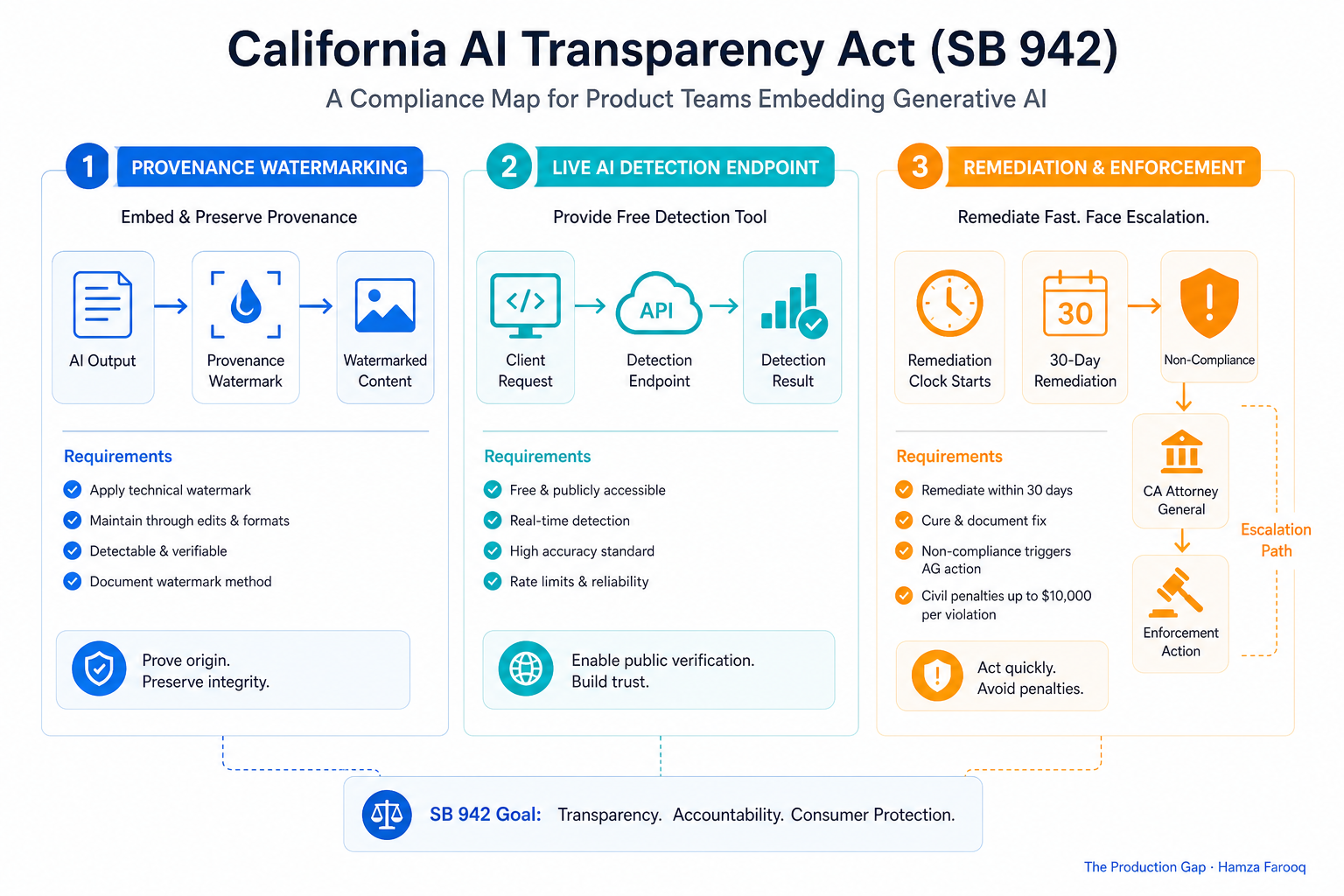
SB 942 imposes concrete engineering obligations: embed provenance metadata in every AI-generated output, operate a live detection tool, and remediate violations within the statute's prescribed cure window.
Obligation 1: Provenance Disclosure and Watermarking
Every AI-generated output must carry an embedded signal identifying it as machine-made, not a footer disclaimer. California's law forces AI companies to watermark what they make, and that signal must be meaningful and durable across downstream use. The statute does not name a specific technical standard, but teams should design for signal persistence across common content transformations.
Who Is Liable When a Third-Party AI API Produces Non-Compliant Output?
The product delivering AI-generated content to California users bears full compliance liability. Embedding a third-party model API transfers none of that obligation upstream.
Consider a SaaS email-drafting tool that calls an LLM via API, receives output as plain text, and renders it in a rich-text editor. Unless the product team explicitly preserves provenance metadata through that entire pipeline, no compliant signal survives to the end user. The API vendor is not liable for what your rendering layer removes. Your product is.
The SB 942 Vendor Risk Framework
- Build: Implement provenance tagging at the output rendering stage, not the API call layer, where metadata can be lost downstream.
- Buy: Evaluate watermarking vendors that wrap model output at the API response layer, before it reaches your rendering pipeline.
- Contract: Audit every LLM vendor agreement for the words "provenance," "watermarking," or "AI content disclosure." If those terms are absent, assume you own the obligation entirely and add contractual addenda before your next renewal.
This three-category structure is a practical tool for scoping vendor risk, not a statutory definition. Apply it alongside qualified legal review.
How Does SB 942 Compare to EU AI Act Obligations for the Same Product?
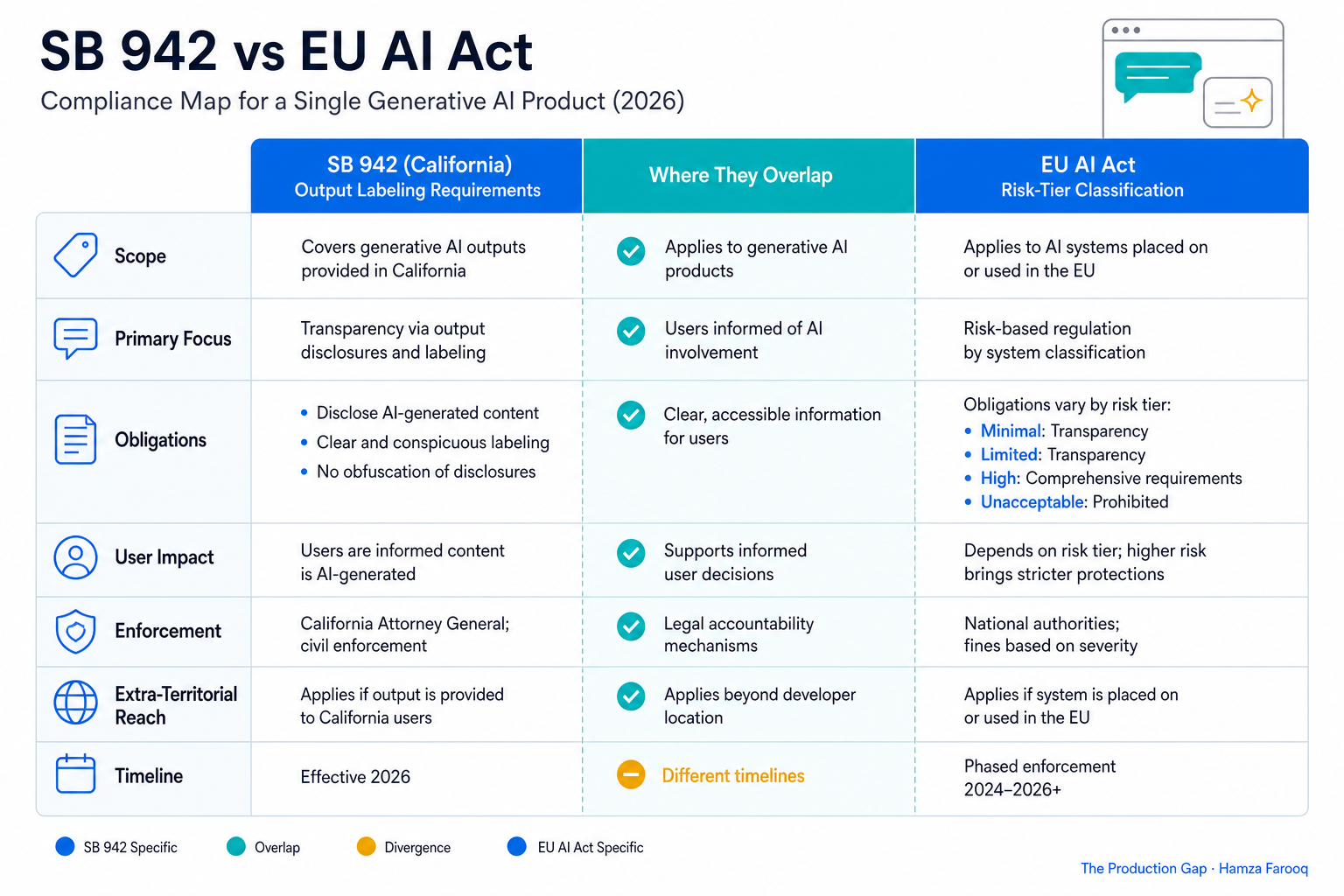
SB 942 requires labeling what AI produces. The EU AI Act restricts how much autonomous risk an AI system may carry. A single product can be subject to both simultaneously.
| Dimension | California SB 942 | EU AI Act |
|---|---|---|
| Core obligation | Label AI-generated outputs; provide detection tool | Classify systems by risk tier; restrict high-risk uses |
| Coverage trigger | More than one million monthly California users | Any EU market deployment; risk-tiered thresholds |
| Technical requirement | Provenance watermarking plus live detection endpoint | Conformity assessments, human oversight, documentation |
| Enforcement mechanism | Cure window, then escalation | Fines scaled to global annual turnover |
| Liable party | Deploying product, not model provider | Both provider and deployer, depending on tier |
| Content scope | All AI-generated outputs: text, image, audio, video | Risk-categorized by use case, not output type |
| Status (Aug 2026) | Operative, enforcement active | Active; implementation timelines vary by obligation |
Frequently Asked Questions
Does SB 942 apply if I embed a third-party AI API rather than operate my own model? Yes. Obligations attach to the deploying product, not the model provider. Your vendor's compliance posture is irrelevant to your enforcement exposure.
What is the one-million-user threshold, and how is it measured? SB 942's coverage trigger is more than one million monthly California users of a generative AI system. Measure by California user activity against the statute's threshold criteria, not global monthly active users.
What technical standard must I use to satisfy SB 942's watermarking requirement? No specific standard is named in the statute, but provenance metadata must be meaningful and durable. A signal that disappears on export or copy-paste warrants careful review against the law's intent.
If my product is EU AI Act-compliant, does that satisfy SB 942? No. The EU framework does not require output-level watermarking. Both compliance tracks must be built and maintained independently.
How does the enforcement clock start, and what satisfies the cure requirement? The clock begins when a violation is formally flagged, by user complaint, regulatory notice, or internal audit. Only verified remediation of the specific violation satisfies the cure requirement. Because the cure window is short relative to standard release cycles, a pre-built fast-path remediation process is the most important structural investment a covered product team can make.
Conclusion
SB 942 is an always-on engineering problem with a penalty clock that does not wait for legal review.
Three actions worth prioritizing now:
- Audit your coverage exposure. Measure by California user activity against the one-million monthly user threshold, not global MAU.
- Review your LLM vendor contracts. If "provenance," "watermarking," or "AI content disclosure" are absent, assume you own that obligation entirely and add addenda before your next renewal.
- Build the live detection endpoint before anything else. A disclosure policy alone does not satisfy the statute
Learn from me
Agentic AI for Product Managers, my Maven cohort. Learn how to design, evaluate, and ship reliable AI systems: the technical fluency PMs need to lead agentic products, no engineering background required. Join the next cohort →
Hire us
Traversaal.ai. We're a team of forward deployed engineers solving the toughest AI problems for Fortune 100 companies: document intelligence, agentic data platforms, and real-time web intelligence, deployed in production. Work with our team to deploy your next agentic ecosystem. Talk to Traversaal.ai →
Join us
Want to solve these problems with us? We're always looking for forward deployed engineers who want to ship production AI. jobs@traversaal.ai
