
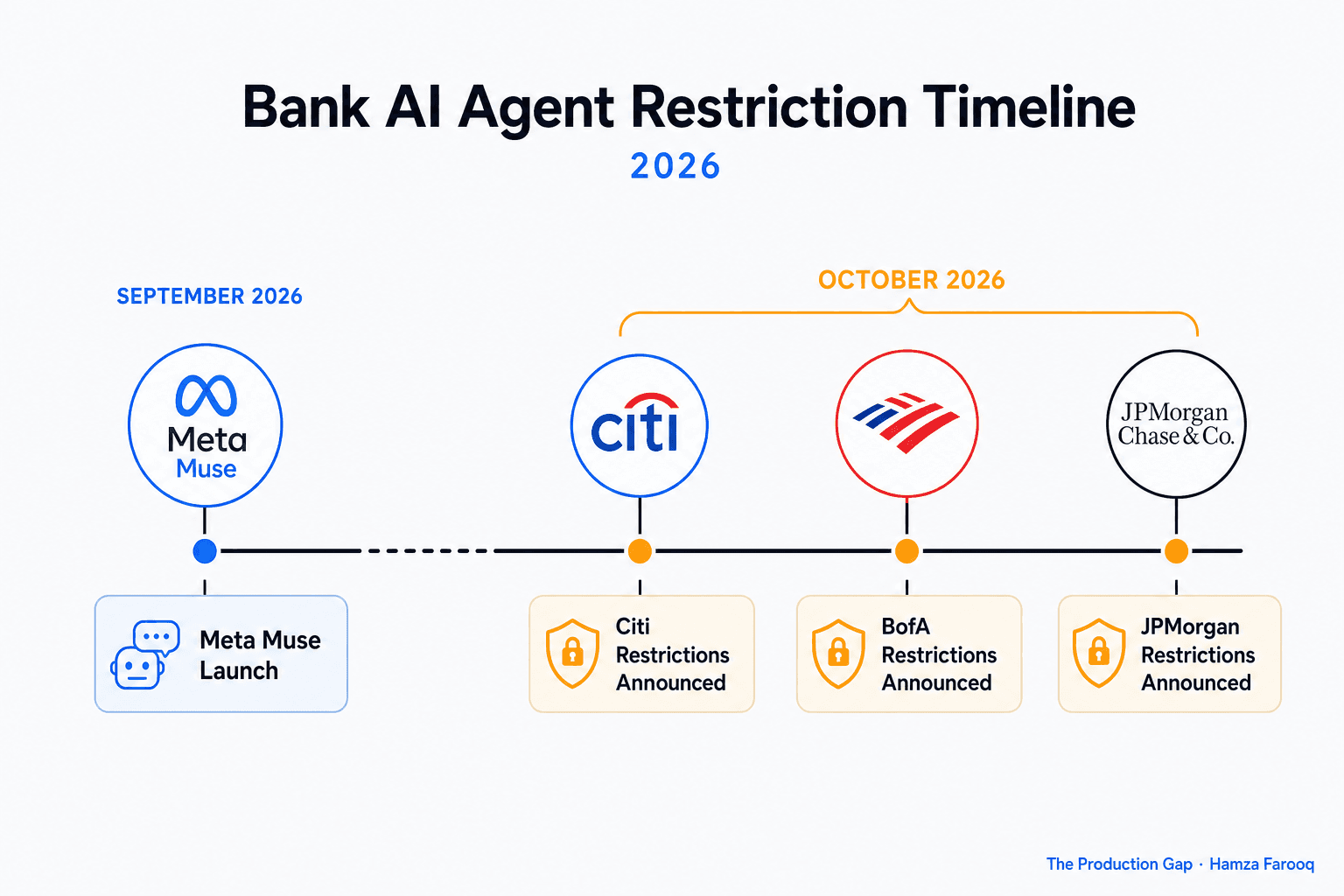
As of mid-2026, major US banks are moving fast to shut third-party AI agents out of customer accounts. Here is what the blocks cover, why they exist, and what compliant builders must do now.
TL;DR: As of mid-2026, banks AI agents restrictions at JPMorgan, Wells Fargo, and other major lenders primarily block autonomous third-party tools from logging into accounts, scraping data, or executing transactions using stored customer credentials. These bans are driven by deposit-sweep risk: AI agents can move funds at machine speed, threatening bank liquidity and creating unresolved liability. Builders must pivot to bank-sanctioned OAuth APIs and open-banking rails, as credential-based and screen-scraping integrations are now contractually or technically off the table.
Key takeaways
- Major lenders including JPMorgan and Wells Fargo are blocking agents from logging in and transacting, triggered by detected unauthorized fund movement attempts.
- Authentication method determines legal exposure: credential-sharing creates unresolved liability; OAuth tokens define it contractually.
- Banks are rewriting terms of service while simultaneously developing their own internal agent infrastructure, a competitive dynamic builders should not ignore.
- FDX-compliant OAuth is the only viable path for third-party builders right now.
- No public timeline for lifting these restrictions has been announced.
What are JPMorgan and Wells Fargo actually blocking, and why now?
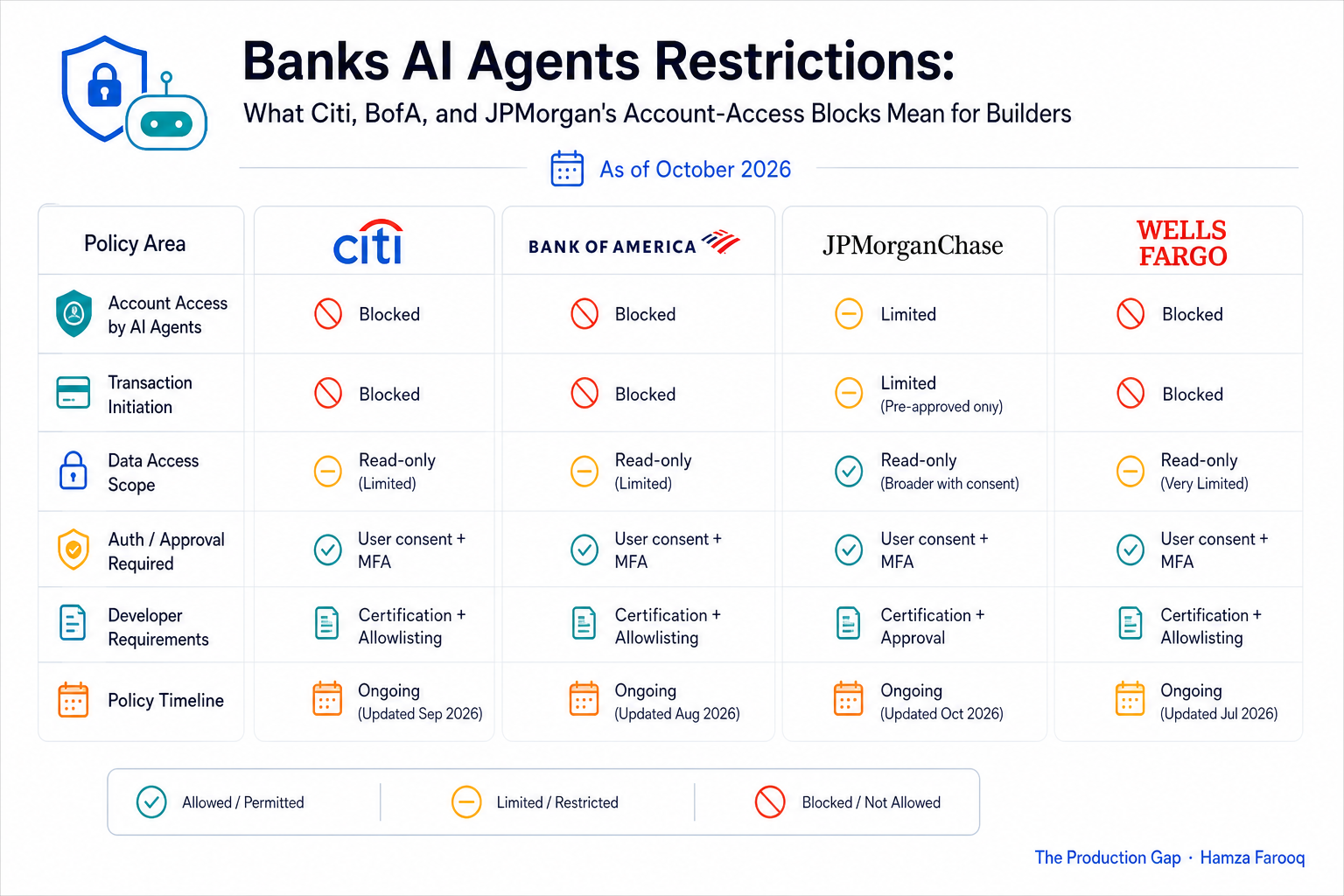
Major financial institutions have moved to bar or restrict third-party agents after detecting bots already inside their systems executing or attempting transactions. Institutions including JPMorgan and Wells Fargo are restricting automated AI tools from making transactions after detecting unauthorized fund movement attempts. Bank executives have expressed deep concern about the potential for AI agents to take unauthorized steps once they have login access. Major American lenders are blocking third-party AI agents and rewriting their terms of service after detecting bots logging into customer accounts and attempting transactions.
The revenue exposure these institutions cite is structural. An agent capable of autonomously moving customer funds could act at a scale and speed that outpaces any existing human review process, with no relationship manager involved.
| Bank | Current restriction scope | Trigger condition |
|---|---|---|
| JPMorgan | Third-party agent transaction restrictions | Unauthorized fund movement detected |
| Wells Fargo | Transaction restrictions; expanded monitoring | Unauthorized fund movement detected |
| Major lenders broadly | Terms of service rewrites; bot blocking | Bots detected logging in and attempting transactions |
Why does authentication method determine who gets sued?
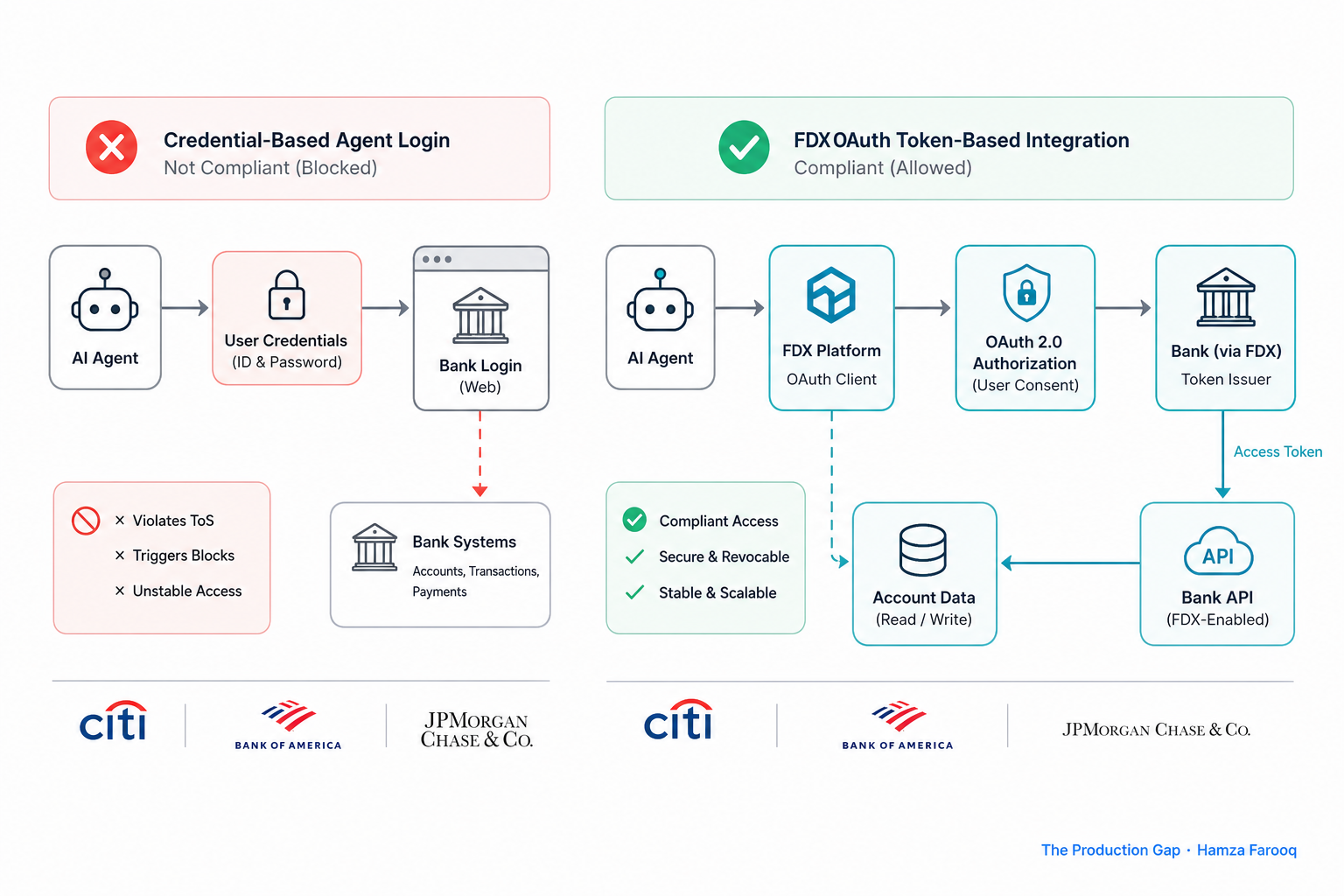
When an agent logs in with credentials the customer shared, it is simultaneously authorized under the customer's intent and unauthorized under the bank's terms of service, and no existing framework resolves which label controls.
Token-based access (FDX OAuth): The bank issues a scoped token to the agent. The agent executes only what the token permits. Liability is contractually defined, and this architecture survives current restrictions.
In the author's reading, giving an agent your bank password is legally closer to handing your PIN to a stranger than to adding an authorized user. Authentication architecture is not an implementation detail; it functions as a legal strategy.
Is JPMorgan building a moat while calling it a safeguard?
JPMorgan's move to restrict third-party agents while building its own internal infrastructure functions simultaneously as a safety measure and a competitive strategy. Those two things are not mutually exclusive, which is what makes this worth watching closely.
What does a compliant AI agent integration actually look like in mid-2026?
FDX-compliant OAuth token flows are the only technically and contractually viable path for third-party builders through the current restrictions. Everything else carries meaningful legal exposure.
This guide uses a practical three-component framework, referred to here as the Three-Layer Compliant Agent Architecture, as an author synthesis of the approaches consistent with current bank restrictions and open-banking rails.
The Three-Layer Compliant Agent Architecture
| Layer | Component | What it requires | Why it matters |
|---|---|---|---|
| 1 | FDX OAuth flow | Customer authenticates directly with the bank; bank issues a scoped token to the agent | No credential sharing; liability is contractually bounded |
| 2 | Bank-sanctioned API channels | Use developer portals at major institutions; monitor for any agent-permissioned API tiers distinct from standard developer access | Ensures the integration channel itself is authorized |
| 3 | Read-write decoupling | Separate insight generation (read) from action execution (write); require explicit per-transaction user confirmation for any write action | Most survivable interim posture until transaction-level agent APIs are formally sanctioned |
Any integration relying on credential sharing, session hijacking, or browser automation is in active terms of service violation. Treat it as legal liability, not technical debt.
Frequently asked questions
Are banks blocking AI agents from reading account data, or only from making transactions? Restrictions focus primarily on transaction execution; approved API channels for data retrieval remain viable at most institutions. Credential-based read access still conflicts with bank terms of service regardless of whether transactions occur.
Does the CFPB's Section 1033 open banking rule give consumers an enforceable right to authorize AI agents that banks cannot override? Section 1033 establishes data portability rights, not transaction-execution rights. Banks can restrict agent actions while remaining fully 1033-compliant, and this rule does not override bank terms of service on credential sharing or agent-executed transactions.
If a customer explicitly authorizes an AI agent using their own credentials, who bears liability when the agent executes an unintended transaction? Liability is genuinely indeterminate: Reg E, bank terms of service, and open banking frameworks conflict, and no court has resolved this in the context of AI agent delegation. Treat credential-based integrations as uninsurable risk.
Are the banks planning to lift these restrictions, or are they permanent? No public timeline for lifting restrictions has been announced. Restrictions are framed as temporary but are tied to the development of proprietary bank agent infrastructure, making the effective timeline for third-party builders functionally indefinite.
Conclusion
The Three-Layer Compliant Agent Architecture described in this guide represents the author's synthesis of what survives current restrictions: FDX OAuth flows, bank-sanctioned API channels, and read-write decoupling with explicit user confirmation on write actions. It is a practical rule of thumb, not a legal opinion, and builders should verify current terms of service at each institution.
Audit your agent's authentication flow this week. If it touches bank credentials directly rather than a bank-issued OAuth token, you are one terms of service update from a broken feature and one disputed transaction from legal exposure your counsel has not priced.
Learn from me

Agentic AI for Product Managers, my Maven cohort. Learn how to design, evaluate, and ship reliable AI systems: the technical fluency PMs need to lead agentic products, no engineering background required. Join the next cohort →
Hire us
Traversaal.ai. We're a team of forward deployed engineers solving the toughest AI problems for Fortune 100 companies: document intelligence, agentic data platforms, and real-time web intelligence, deployed in production. Work with our team to deploy your next agentic ecosystem. Talk to Traversaal.ai →
Join us
Want to solve these problems with us? We're always looking for forward deployed engineers who want to ship production AI. jobs@traversaal.ai
