
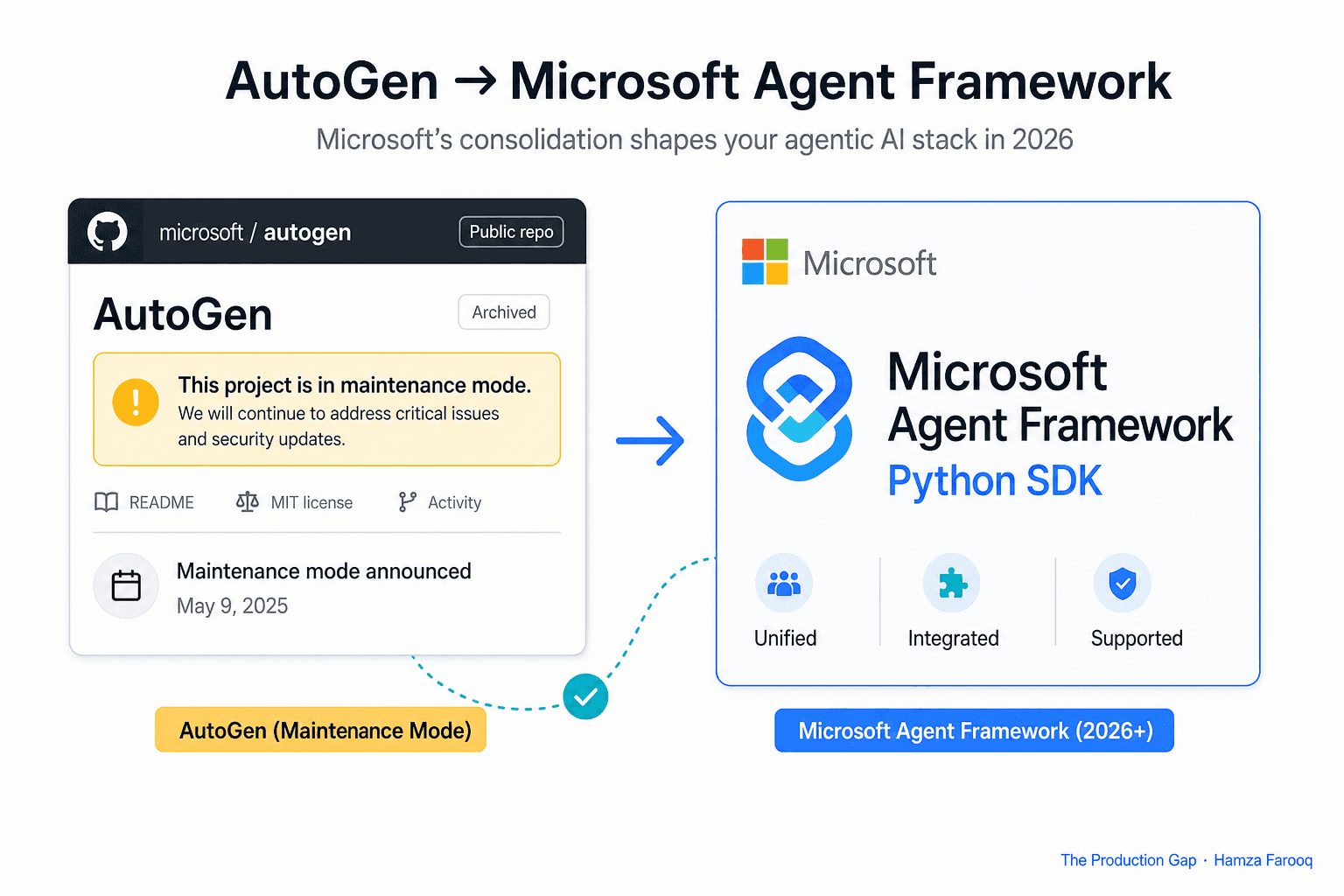
TL;DR: AutoGen migration risk is real but manageable. Microsoft is consolidating its agent frameworks, meaning teams on older AutoGen versions face breaking changes, narrowing community support, and growing maintenance debt if they delay action. Evaluate your exposure by auditing API dependencies and workflow complexity, then decide whether to migrate, wrap, or replace based on your team's actual switching costs.
Key Takeaways
- AutoGen is in maintenance mode: Bug fixes only, no new features.
- Microsoft Agent Framework is the official successor: Microsoft is actively steering all users toward it.
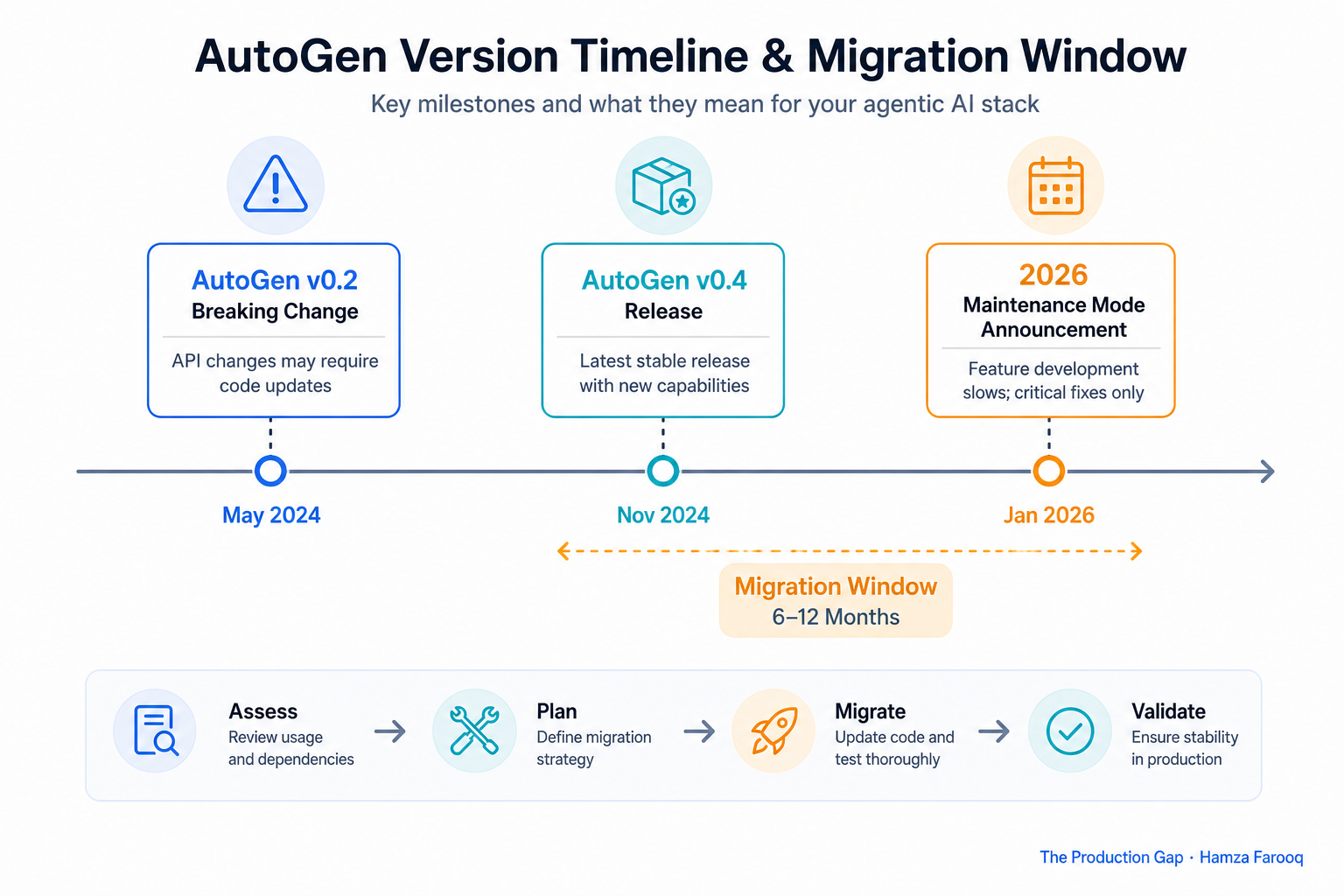
- The migration window is already open: Third-party analysis estimates 6-12 months before risk becomes serious.
- Framework dependency is the deeper risk: Vendor consolidation can strand any stack built on a single framework.
- Preserve behavioral evidence before migrating: Your agents' current outputs are the only baseline you can verify against.
- Stability promises deserve scrutiny: AutoGen once looked safe too.
What is AutoGen migration risk and why does it matter now?
AutoGen's README officially redirects new users to the Microsoft Agent Framework Python SDK. Community discussion confirms the signal is unambiguous , and Microsoft has published an official migration guide, an institutionally sanctioned transition, not speculation. Third-party analysis estimates a 6-12 month practical window already open before the gap becomes operationally significant. The API translation work is only one part of the cost. The accumulated organizational debt already sitting in your codebase is the other.
AG2 refers to the community-maintained fork of AutoGen that emerged after Microsoft's consolidation announcement. AutoGen Studio is a no-code interface that was built on top of AutoGen for prototyping multi-agent workflows. Neither is Microsoft's recommended path forward; the Microsoft Agent Framework Python SDK is the official successor for production systems.
What does AutoGen's maintenance mode actually mean for production systems?
AutoGen is in maintenance mode, receiving bug fixes only, with Microsoft's official documentation directing all users to migrate to the Microsoft Agent Framework Python SDK.
Maintenance mode is not deprecation, but it is a commitment that the framework's ceiling has been reached. New LLM integrations, agentic primitives, and orchestration patterns will not arrive. Stale PRs and minimal commit activity reflect a deliberate shift in Microsoft's investment priorities. The practical result is a framework that stops serving users and starts serving platform consolidation goals.
This is also AutoGen's second major disruption. The v0.2 to v0.4 migration was already a breaking transition with real organizational cost, and the current consolidation is larger in scope. If your roadmap requires new agentic capabilities, you are no longer on the right foundation.
What are the real breaking changes, and what does the migration guide miss?
The biggest breaking changes involve the conversation model, agent lifecycle management, and tool-binding APIs, but the migration guide covers only the API translation layer, not the organizational debt teams have built around AutoGen-specific abstractions.
Microsoft's official migration guide addresses API surface translation in detail. In the author's assessment, it does not address the layers surrounding the API. Teams should expect at least three categories of migration cost, and most budgets account for only one:
Table current as of July 2026
| Migration Layer | What the Official Guide Covers | What It Misses |
|---|---|---|
| API Translation | Yes: Agent classes, tool binding, conversation loops | No: Custom wrappers built on AutoGen abstractions |
| Prompt Engineering | Not addressed | Prompts tuned to AutoGen's message schema |
| Institutional Knowledge | Not addressed | Edge-case behavior in wikis, runbooks, Slack threads |
The less visible cost is accumulated organizational debt, including prompts, internal tooling, and documented agent behavior, that cannot be migrated by updating class names. Consulting guidance from metacto.com identifies the same risk: preserve evidence and migrate deliberately. Without a behavioral record of your current AutoGen agents, you have no baseline to verify against after migration.
Is Microsoft Agent Framework actually safer long-term?
Microsoft Agent Framework is the safer near-term choice, but AutoGen once looked equally stable, and durable protection comes from architectural patterns that reduce framework lock-in, not from picking the right framework today.
LangChain states plainly: "AutoGen is no longer the framework Microsoft recommends for new projects, and the architectural decisions that defined AutoGen 0.4 have been superseded." That observation is worth keeping in mind when evaluating any framework currently absorbing active vendor investment.
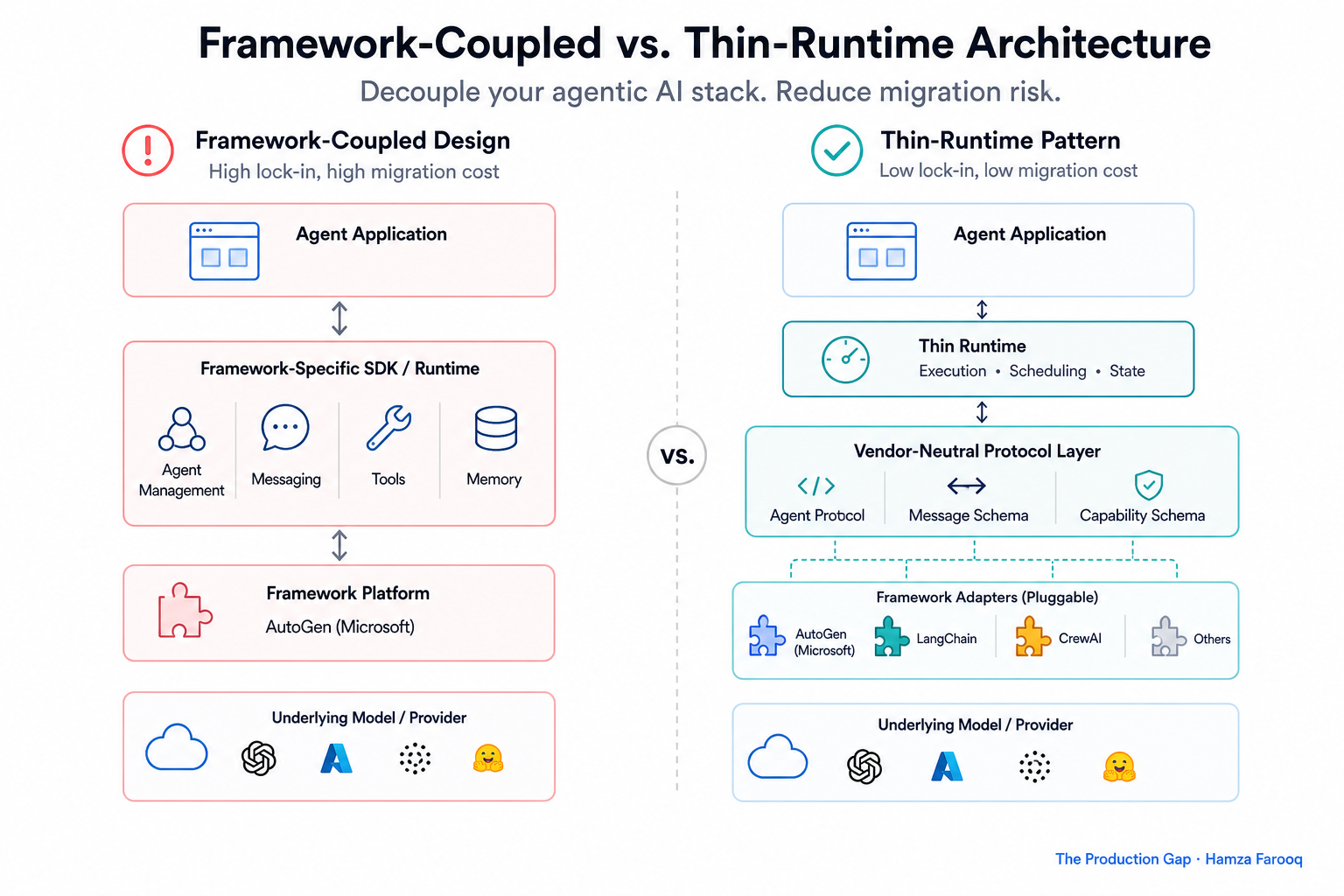
In the author's view, the more durable approach is a thin runtime pattern: build agent logic against a stable, vendor-neutral protocol (Model Context Protocol, OpenAI tool-calling schema) and treat the framework as an interchangeable runtime beneath your logic layer rather than the foundation the logic is built on top of.
Table current as of July 2026
| Stability Signal | AutoGen (2023) | AutoGen (2026) | Microsoft Agent Framework (Current) |
|---|---|---|---|
| Vendor backing | Strong | Maintenance only | Active |
| New feature velocity | High | Frozen | Active |
| Migration guide exists | No | Yes | No |
| Breaking change history | None yet | v0.2 to v0.4 plus consolidation | Unknown |
| Vendor-neutral escape hatch | No | No | No |
Migrate to Microsoft Agent Framework, but consider building the new system with a thin runtime layer so future consolidations reduce rather than multiply migration scope.
How should teams sequence the migration without losing behavioral evidence?
Before writing a single line of migration code, capture a complete behavioral record of your current AutoGen agents, because that record is the only baseline you can verify the migrated system against.
The deliberate migration sequence below is a practical framework used in this guide, not a Microsoft-published standard:
- Capture: Log current agent behavior exhaustively, including conversation transcripts, tool invocations, decision branch points, and known edge cases. This is your behavioral contract.
- Audit: Map every AutoGen-specific abstraction your codebase depends on, including internal tooling, prompt templates, and runbook references.
- Translate: Use the official Microsoft migration guide for API translation. Teams still on v0.2 should also reference the v0.4 migration guide.
- Verify: Run the migrated system against your behavioral capture from step one. Treat divergence as a migration failure, not a configuration issue.
FAQ
Q1: How long will Microsoft continue supporting AutoGen with bug fixes before end-of-life? Microsoft has not published a formal end-of-life date; third-party analysis estimates a 6-12 month practical window before the gap becomes operationally significant. Plan for completion within that window rather than at its edge.
Q2: Is AutoGen still a viable choice for new projects starting today? No. AutoGen's README explicitly directs new users to Microsoft Agent Framework, and the architectural decisions that defined AutoGen 0.4 have been superseded. Starting on AutoGen today means accepting a near-term migration with no strategic justification.
Q3: What architectural patterns protect agent systems from framework-level migration risk in the future? The thin runtime pattern is worth considering as a practical rule of thumb: build agent logic against vendor-neutral protocols such as Model Context Protocol or standardized tool-calling schemas, and treat the framework as a swappable runtime beneath your logic layer. The goal is to reduce the scope of future migrations rather than eliminate them entirely.
Q4: Could Microsoft Agent Framework face the same consolidation fate as AutoGen? Yes. AutoGen had strong vendor backing, an active community, and enterprise adoption before consolidation; Microsoft Agent Framework has all three right now. Architectural patterns that reduce framework dependency are the hedge, not trust in any vendor's roadmap.
Conclusion
AutoGen's maintenance mode creates costs beyond API translation work. Every prompt tuned to its conversation model, every internal tool built around its agent lifecycle, and every runbook written against its behavior is now technical debt that no migration guide addresses directly. Microsoft's official guide covers the visible API layer. The organizational debt is your team's scope to define and manage.
Framework consolidations are not one-time events. The teams that navigate future transitions with the least disruption are the ones who treat frameworks as interchangeable runtimes beneath stable, vendor-neutral logic, not simply the ones who chose the right framework at a given moment.
Your concrete next step: Audit your AutoGen codebase this week for organizational debt, including internal tooling, prompt templates, and runbook references, before you open the migration guide. That audit is the real scope document.
Learn from me
Agent Engineering Bootcamp: Developers Edition, my Maven cohort. Advanced agentic RAG, multi-agent orchestration, memory, evals, and guardrails. Take agents from prototype to production. Join the next cohort →
Hire us
Traversaal.ai. We're a team of forward deployed engineers solving the toughest AI problems for Fortune 100 companies: document intelligence, agentic data platforms, and real-time web intelligence, deployed in production. Work with our team to deploy your next agentic ecosystem. Talk to Traversaal.ai →
Join us
Want to solve these problems with us? We're always looking for forward deployed engineers who want to ship production AI. jobs@traversaal.ai
