
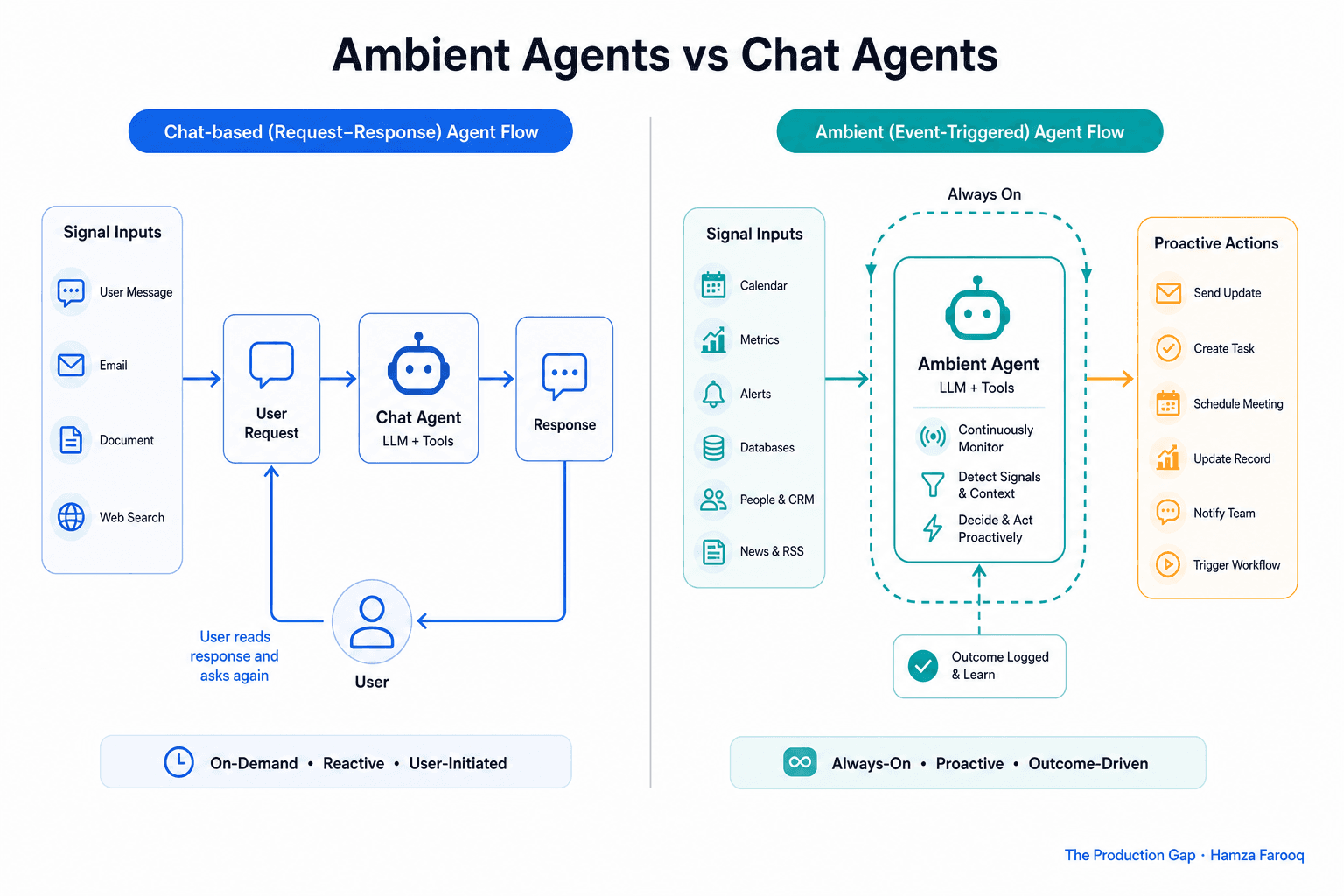
TL;DR: Ambient agents product design requires a complete rethink of how product managers write specs, define success, and sequence roadmaps. As of 2026, platforms are shipping always-on, event-driven agents that act without user prompts, making signal maps, boundary rules, interruption thresholds, and trust-calibrated rollout phases the new core PM artifacts. This guide provides a practical framework for building that infrastructure before shipping a single capability.
Key Takeaways
- Ambient agents flip the interaction model: they watch for signals and act without anyone pressing a button.
- Platforms are actively shipping always-on agent capabilities, making this a live roadmap problem, not a future-state one.
- Interruption logic is a core design decision: PMs must define when agents pause for human approval rather than assuming full automation is the right default.
- Success metrics must work without user interaction, because standard engagement numbers are meaningless for silent agents.
- A practical rule of thumb from this guide: expand autonomy incrementally as users verify correctness, and do not ship full capability at launch.
Introduction
Every PM artifact, user stories, acceptance criteria, engagement dashboards, was built for humans initiating actions. Ambient agents break that assumption entirely. Platforms including Moveworks, Snowplow, and Zapier have been building toward always-on capabilities, and as of 2026 that work is becoming a production-level concern for product teams. This article gives product managers a concrete framework, covering new artifacts, new metrics, and new trust logic, built for proactive AI from the ground up.
How Are Ambient Agents Fundamentally Different from Chat-Based AI Agents?
Ambient agents act continuously on environmental signals without waiting for a user prompt; chat agents are stateless responders that only run when a human sends a message.
The PM implication is direct: replace user-initiated flows with signal maps that specify what events trigger the agent, what context it reads, and what action it takes.
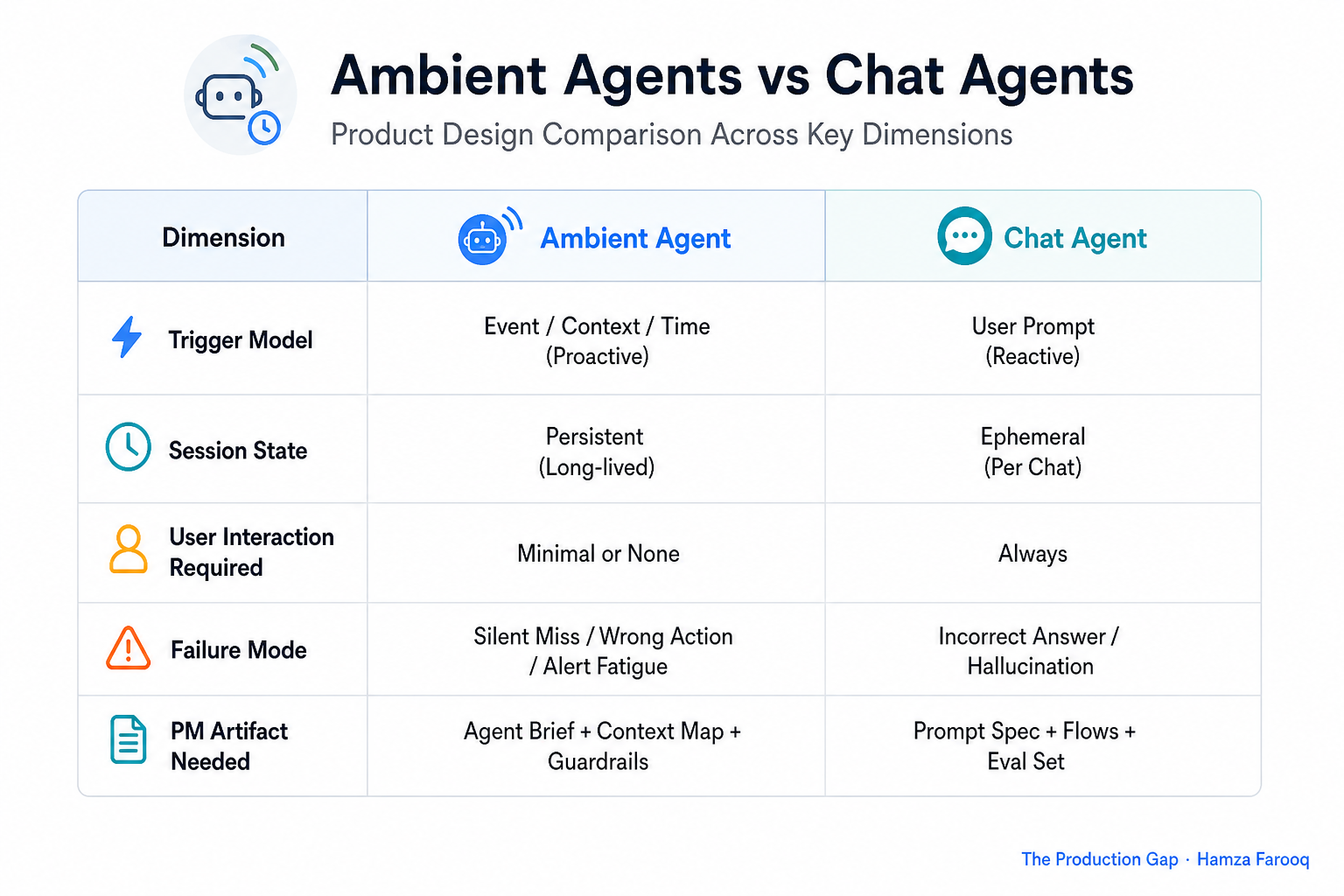
Table 1: Chat Agent vs. Ambient Agent, Six Core Dimensions
| Dimension | Chat Agent | Ambient Agent |
|---|---|---|
| Trigger | User prompt | Environmental signal or event |
| Session state | Stateless per conversation | Persistent, always-on |
| User interaction required | Every action | Optional or exception-only |
| Primary failure mode | Wrong answer | Wrong unsolicited action |
| Core PM artifact | User story and flow | Signal map and boundary rule |
| Success metric | Task completion rate | Autonomous-action correction rate |
What Design Decisions Must Product Managers Make Before Shipping an Ambient Agent?
Before shipping, PMs must define three things: which signals trigger the agent, what the hard boundaries on autonomous action are, and when the agent must pause for human confirmation instead of acting.
Ambient agent acceptance criteria, using the framework in this guide, read as: "when the agent detects signal X in context Y, it takes action Z, unless condition W, in which case it surfaces a confirmation request." Writing specs in that format is a meaningful departure from standard user story practice and one worth making explicit in team process.
Signal taxonomy defines what counts as a trigger: enumerated signal types, priority weights, and minimum confidence thresholds before action. Without this, agents fire on noise. Snowplow roots its enthusiasm for ambient agents in behavioral data infrastructure, which makes clean signal taxonomy a prerequisite rather than an implementation detail.
Boundary rules define what the agent can do without approval. As a practical rule of thumb in this guide, actions should be mapped on a reversibility axis: lower-reversibility actions warrant human oversight regardless of confidence, and that distinction belongs in product policy rather than left to implementation defaults. Seven UX patterns for human oversight in ambient agents have been documented, confirming that oversight design is now a pattern-level discipline with real structure behind it.
Interruption logic sets the confidence floor below which the agent escalates to a human. That threshold belongs in the spec, where it can be reviewed and deliberately set, rather than surfacing only at the design stage.
What Is the Trust Calibration Ladder for Ambient Agent Rollouts?
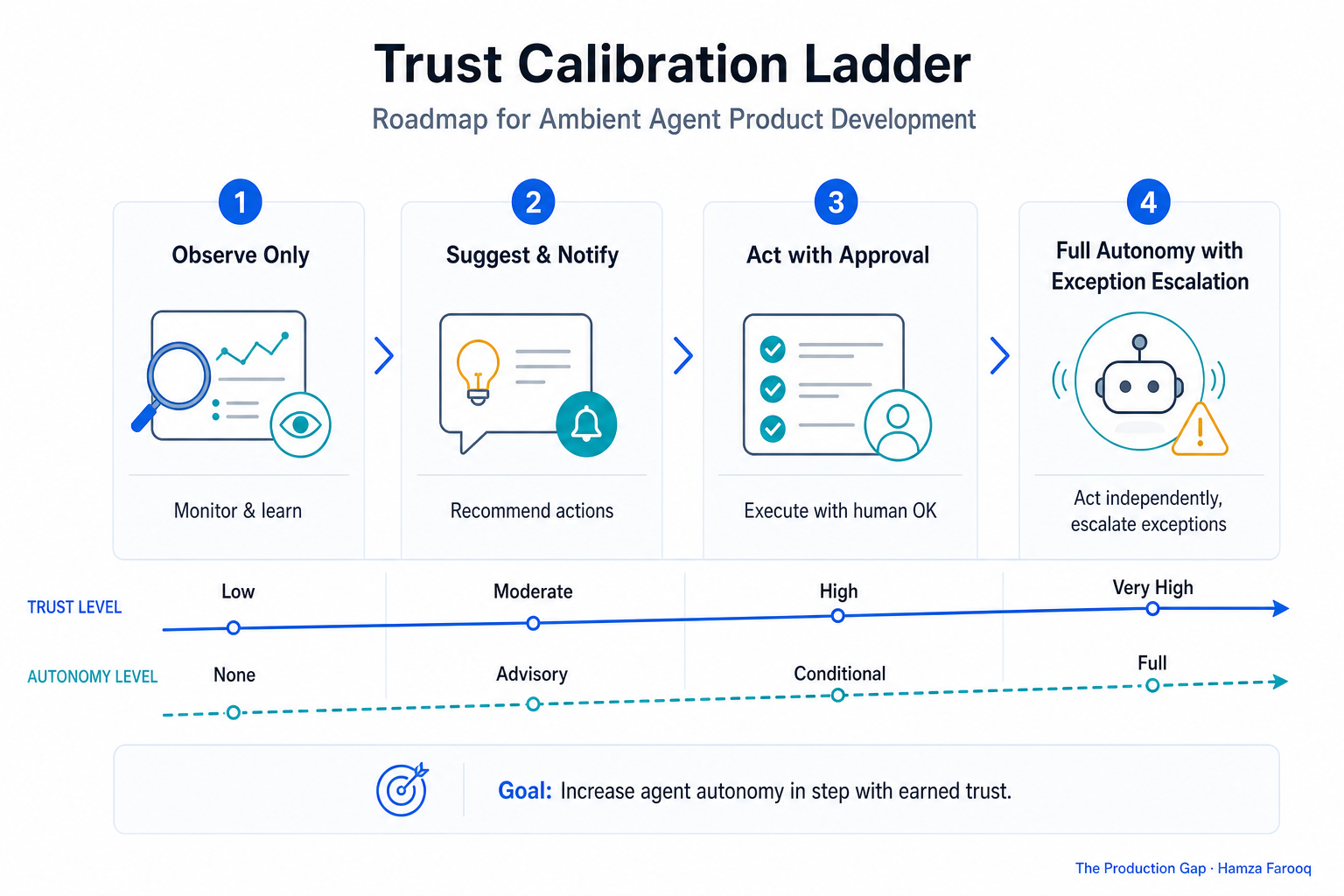
The trust calibration ladder, the original sequencing framework used in this guide, structures an ambient agent roadmap around expanding autonomy incrementally as users verify correctness rather than shipping a full feature set at launch.
The 2026 AI Product Manager Roadmap flags ambient and agentic AI as core competencies PMs must develop now. ProdPad's guidance reinforces that scope and delivery for this category need to be restructured accordingly. The trust calibration ladder provides that structure across four phases.
- Phase 1, Observe Only: The agent detects signals and logs what it would have done. No autonomous action fires. Validate signal quality and boundary rules against real data before anything executes.
- Phase 2, Notify and Confirm: The agent surfaces recommendations with single-click approval. Collect approval rate and correction rate as calibration data to gate the move to Phase 3.
- Phase 3, Act with Audit Trail: The agent acts autonomously on high-confidence, low-risk signals. Every action is logged and reversible. Users see a clear activity feed, and trust is built through transparency rather than assumption.
- Phase 4, Full Autonomy with Exception Escalation: The agent handles its defined scope independently, surfacing only true exceptions. Scope expands only after Phase 3 metrics confirm trust, never on a calendar date alone.
How Do You Measure Success for an AI Agent Users Never Directly Interact With?
Success is measured by the autonomous-action correction rate, along with other outcomes the agent produces such as errors caught and tasks completed without human intervention, rather than by engagement metrics tied to user-initiated sessions.
Rather than standard engagement metrics, consider tracking the rate at which autonomous actions require no human correction, broken down by signal type and action category. A complementary signal is whether escalations to humans were genuinely warranted. High false-escalation rates suggest an overly cautious threshold, while frequent post-hoc corrections suggest the opposite. Both are adjustable once they are measured.
Dedicated production guidance on ambient agents in enterprise environments confirms that outcome-oriented measurement rather than click rates or session counts is the appropriate frame for this class of system. Defining those outcome measures before launch is itself a roadmap decision.
Frequently Asked Questions
What is an ambient agent in product design? An ambient agent in product design is an always-on AI system that continuously monitors environmental signals and takes proactive, contextually appropriate actions without waiting for a user prompt, representing a fundamental shift from request-response features to event-triggered intelligence embedded directly in existing workflows.
How do you write user stories for an AI agent that acts without user prompts? Replace "as a user, I want to..." with a trigger-condition-action structure: "when the agent detects [signal] in context [condition], it takes [action], unless [exception], in which case it requests human confirmation." Each story must specify action reversibility and the confidence threshold required before autonomous firing.
How should product managers define the boundaries of autonomous agent behavior? Map all potential agent actions on a reversibility axis. Higher-reversibility, lower-stakes actions can operate autonomously with logging; lower-reversibility or higher-stakes actions warrant explicit human approval regardless of confidence. Treating boundary definition as a product decision rather than an implementation detail keeps the policy visible and intentional.
What makes ambient agents different from traditional automation or workflow tools? Traditional automation executes fixed pre-configured rules. Ambient agents apply contextual judgment to variable inputs, deciding dynamically whether to act, what action to take, and whether to escalate. The intelligence is in the judgment layer, not just the execution layer.
Conclusion
Signal maps replace user flows. Outcome accuracy replaces engagement metrics. Interruption thresholds replace "done" criteria. The trust calibration ladder replaces the feature release cadence. Teams applying old frameworks risk shipping agents that are either too timid to create value or too autonomous to maintain trust.
As of 2026, these are not theoretical concerns. The design decisions covered in this guide, signal taxonomy, boundary rules, interruption thresholds, and phased trust calibration, belong in your process before the first line of implementation work begins.
Your first concrete action: Take one ambient agent capability your team is planning. Write its signal taxonomy, boundary rule, and interruption threshold before writing a single user story. If that exercise cannot be completed, the feature is not ready to be scoped, and recognizing that is itself a roadmap decision
Learn from me

Agentic AI for Product Managers, my Maven cohort. Learn how to design, evaluate, and ship reliable AI systems: the technical fluency PMs need to lead agentic products, no engineering background required. Join the next cohort →
Hire us
Traversaal.ai. We're a team of forward deployed engineers solving the toughest AI problems for Fortune 100 companies: document intelligence, agentic data platforms, and real-time web intelligence, deployed in production. Work with our team to deploy your next agentic ecosystem. Talk to Traversaal.ai →
Join us
Want to solve these problems with us? We're always looking for forward deployed engineers who want to ship production AI. jobs@traversaal.ai
