
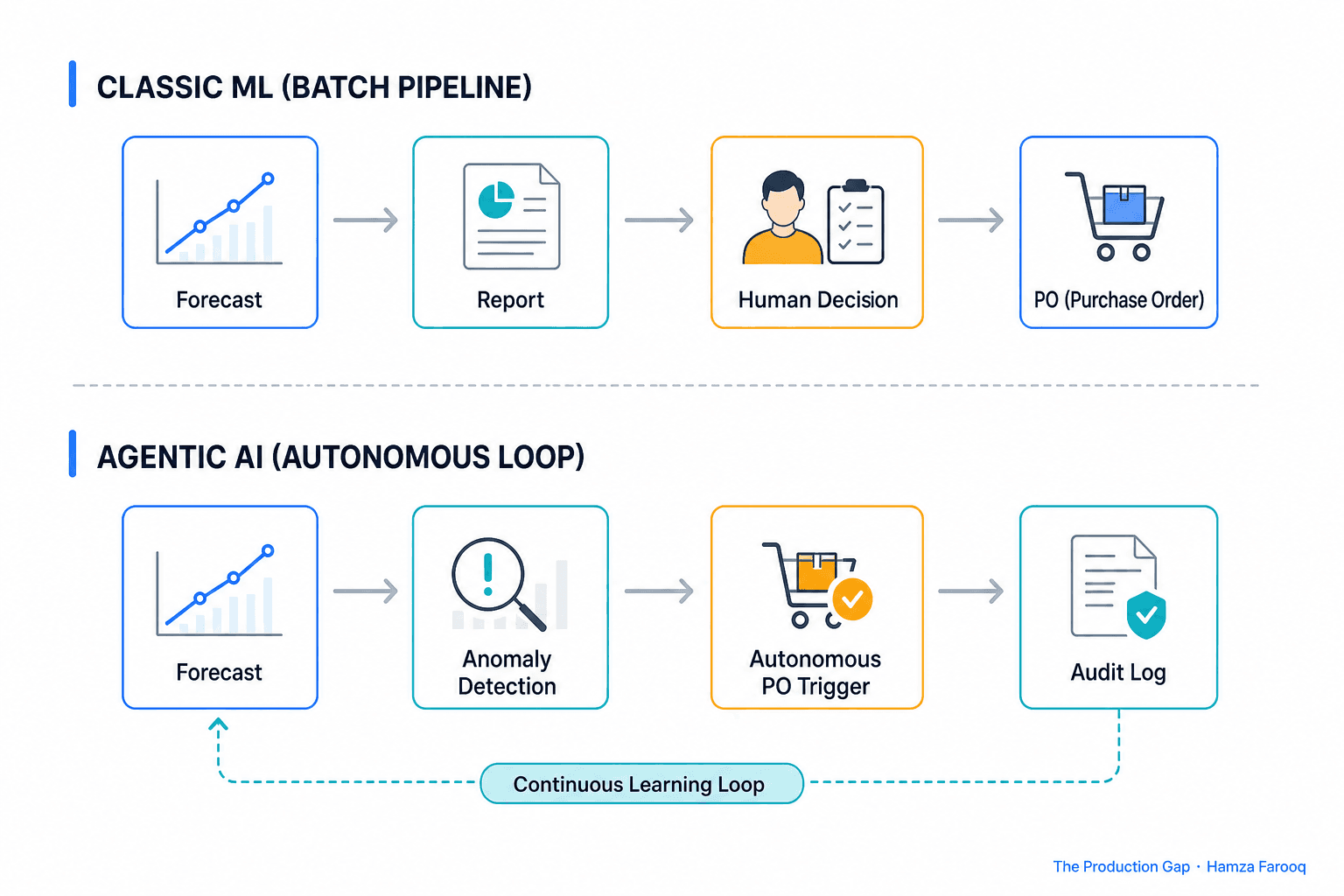
TL;DR: AI retail demand forecasting powered by agentic AI goes further than classic ML by acting on predictions autonomously, adjusting purchase orders, flagging SKU-level stockout risks, and running natural-language what-if scenarios without waiting for human intervention. Classic ML models predict; agentic systems predict and respond, closing the gap between forecast and action at the speed retail operations actually require.
Key Takeaways
- Agentic AI operates at SKU-level precision: Individual product-location combinations, not category aggregates.
- Stockout prevention is proactive: Agents trigger replenishment before the shelf empties.
- External signals close the classic ML blind spot: Weather, events, and social trends are ingested automatically.
- Plain-language queries unlock forecasting for non-data teams: No SQL, no dashboard, no ticket queue.
- Governance guardrails are non-negotiable: Human-override controls and audit trails must precede autonomous deployment.
- The TRACE framework provides a practical starting structure: Use it as the author's recommended governance template before evaluating any agentic vendor.
What is AI retail demand forecasting and why does action speed matter?
AI retail demand forecasting uses machine learning to estimate future product demand by analyzing real-time and historical data simultaneously, and action speed matters because a forecast that arrives too late to trigger replenishment has failed the operation, regardless of its accuracy.
ML-based AI retail demand forecasting is already well-established for mid-to-large operators, and AI integration has delivered unprecedented accuracy in retail demand forecasting. The gap is not the model. It is the latency between what the model knows and what the operation does. Accuracy without action speed leaves half the problem unsolved. The central competitive question in retail forecasting is not which model is most accurate, but which architecture closes that latency gap fastest.
How does agentic AI demand forecasting differ from classic ML pipelines?
Agentic AI demand forecasting replaces the batch-predict-then-wait cycle with a continuous loop of sensing, deciding, and acting, without waiting for a human to relay the forecast into an operational decision.
The architecture contrast
Classic ML is linear and passive: ingest historical data, train model, output batch forecast, analyst reviews, ops lead acts. Each handoff adds hours or days of latency.
An agentic architecture runs differently. A persistent agent monitors real-time POS transactions, inventory sensors, and external APIs; updates its forecast continuously; evaluates results against policy thresholds; and executes or recommends action within the same loop. IBM defines AI demand forecasting as analyzing real-time and historical data simultaneously. That real-time capability is an architectural shift, not a minor upgrade. Oracle's framework illustrates multi-source ingestion from marketing, production, and POS simultaneously, which is exactly what agents handle natively.
The SKU-level granularity point
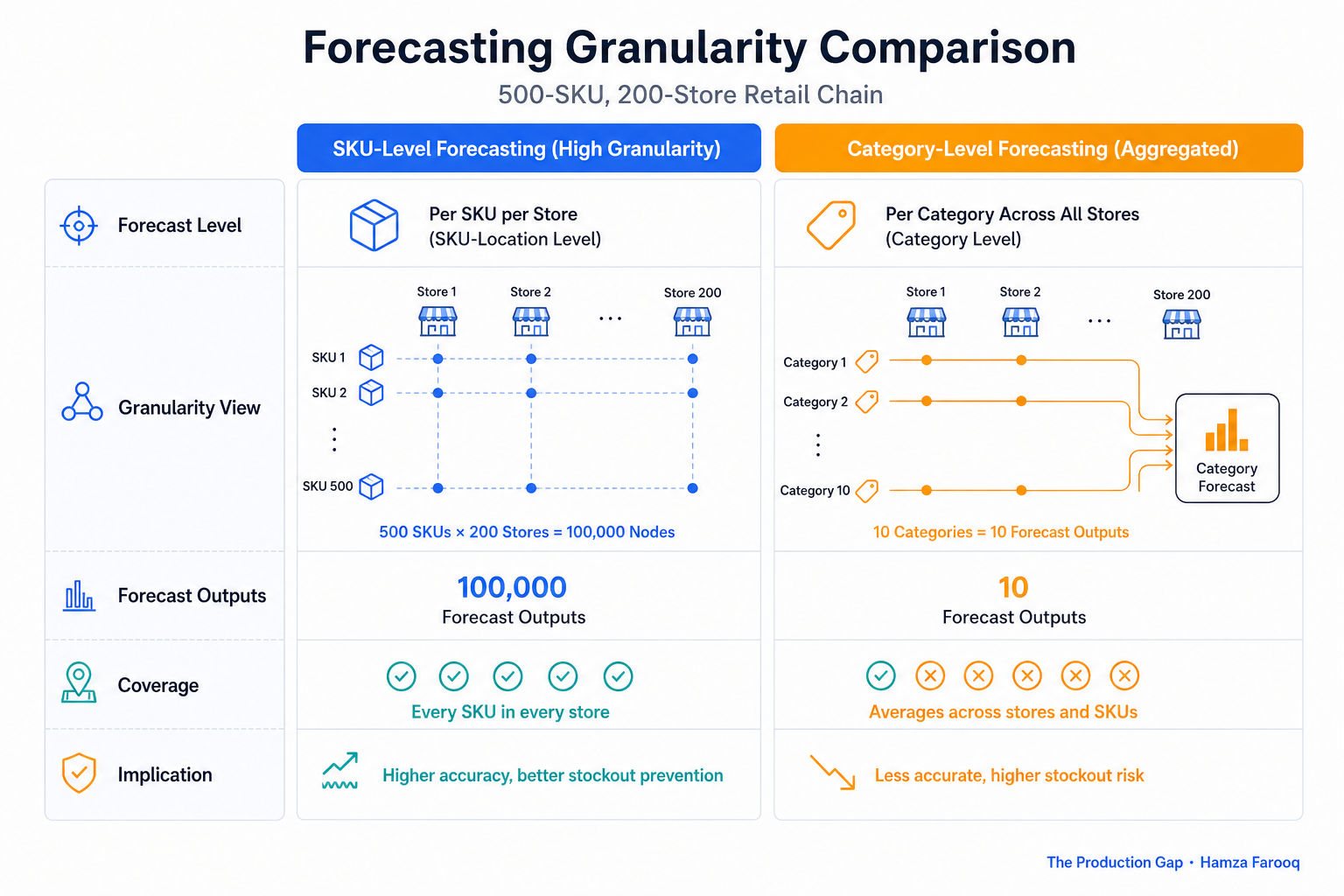
Category-level models aggregate demand, smoothing out variance at the SKU-location level. A category forecast can look accurate in aggregate while individual SKUs stockout and adjacent SKUs overstock. The agent's job is to operate at the level where stockouts actually happen: one product, one location, one shelf.
Table 1: Classic ML Pipeline vs. Agentic AI System, Six Key Dimensions
| Dimension | Classic ML pipeline | Agentic AI system |
|---|---|---|
| Forecast granularity | Category or store cluster | SKU x location |
| Update frequency | Batch (daily or weekly) | Continuous or real-time |
| Signal ingestion | Historical and structured data | Historical, real-time, and external APIs |
| Output | Forecast number | Decision or triggered action |
| Human role | Interprets and acts | Reviews, overrides, sets authority bounds |
| Latency to action | Hours to days | Minutes to seconds |
Classic ML was designed to inform. Agentic systems are designed to act.
How do agentic systems prevent stockouts, and what external signals do they use that classic ML ignores?
Agentic systems prevent stockouts by continuously monitoring inventory velocity against real-time external signals, including weather, local events, and social trend spikes, and triggering replenishment before the shelf empties.
The proactive vs. reactive distinction
External signals that stockout prevention agents can monitor continuously, but batch pipelines cannot ingest on demand, include:
- Weather APIs (precipitation, temperature deviation from seasonal norm)
- Local event calendars (sports, concerts, community events)
- Social trend monitoring (viral products, hashtag velocity)
- Competitor promotional calendars (publicly available or price-inferred)
- Macroeconomic signals (consumer confidence, regional employment shifts)
Each of these signals can shift demand at the SKU-location level faster than a weekly batch cycle can detect. That gap is where stockouts occur.
How do AI agents enable plain-language scenario analysis, and what governance structure must accompany autonomous replenishment?
AI agents enable plain-language scenario analysis by layering a natural-language interface over forecast models, so a category manager can ask "What happens to wing sales if we run a Tuesday promo?" and get an immediate, readable answer without SQL, a dashboard, or a data science ticket.
The governance problem
An agent that triggers a purchase order at 2 a.m. is operationally useful and organizationally disruptive if no one defined its authority before deployment. The bottleneck shifts from forecast accuracy to authority boundary design. The agent may be technically ready before your org chart is. Governance design is the real deployment milestone.
The TRACE Governance Framework
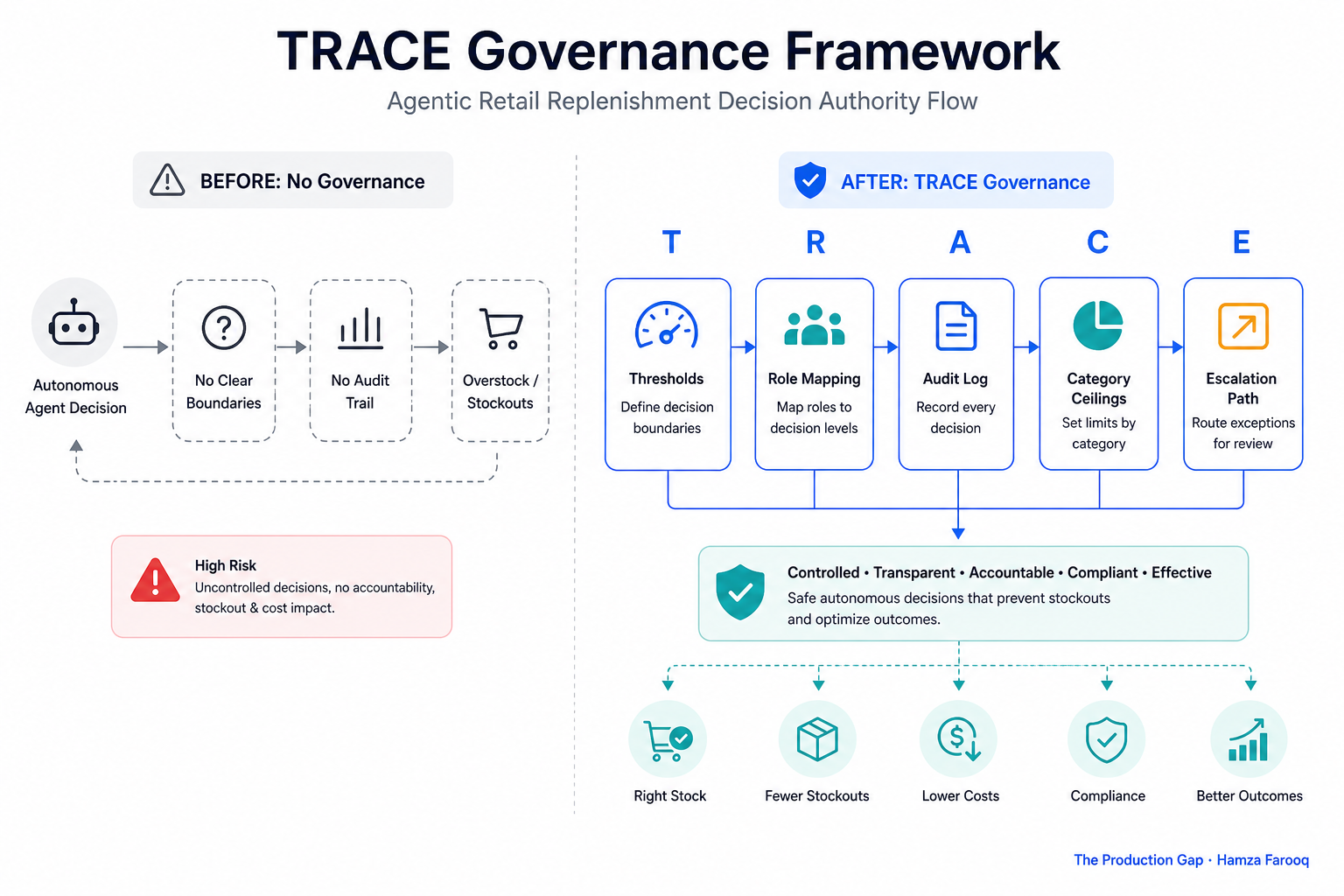
TRACE is a five-part governance framework for agentic forecasting covering Threshold, Role mapping, Audit log, Ceilings by category, and Escalation path. Applied as the framework used in this guide, it structures autonomous replenishment authority before the first agent goes live.
- Threshold: Maximum autonomous spend or action size before human approval is required
- Role mapping: Which roles receive alerts vs. hold override authority
- Audit log: Every agent action produces a human-readable decision record
- Ceilings by category: Perishables, seasonal, and promo SKUs warrant stricter review limits
- Escalation path: Triggers that pause autonomous action pending human review
These five controls do not eliminate autonomy. They define the boundary inside which autonomy is safe to grant.
Frequently asked questions
What is AI retail demand forecasting and how does it differ from traditional forecasting?
AI demand forecasting uses AI to estimate future product demand by analyzing real-time and historical data simultaneously. Traditional forecasting relies on statistical rules and historical patterns alone. AI models update continuously and incorporate signals like weather and events that rules-based systems cannot process at scale.
How do agentic AI systems differ from traditional ML demand forecasting pipelines in retail?
Agentic systems produce decisions rather than forecast numbers, and they operate at SKU-location granularity rather than category aggregates. The defining difference is the continuous sense-decide-act loop, which eliminates the human relay step that adds hours or days of latency to classic batch pipelines.
Can AI agents autonomously prevent stockouts without human intervention?
Yes, within defined authority bounds. Agents detect inventory velocity anomalies and trigger replenishment before a stockout occurs, but autonomous operation requires governance guardrails first. The TRACE framework provides the threshold-and-override structure that makes this organizationally manageable at scale.
What governance controls should retail ops leaders build before deploying autonomous forecasting agents?
Apply TRACE before launch: define spend thresholds, map roles to alert vs. override authority, require human-readable audit logs, set category-specific ceilings for perishables and promo SKUs, and document escalation paths that pause autonomous action pending human review. This is a change-management problem as much as a technical one, and skipping it is the most common reason agentic pilots stall at production.
Conclusion
The shift from classic ML to agentic AI changes what the system produces, moving from a number to a decision. SKU-level granularity, real-time external signal ingestion, and autonomous replenishment are not reachable by tuning a batch model, regardless of how well it is calibrated.
Before evaluating any agentic forecasting vendor, run the TRACE framework against your current replenishment policy. The gaps you find are not a reason to delay. They are your implementation roadmap
Learn from me
Agentic AI for Product Managers, my Maven cohort. Learn how to design, evaluate, and ship reliable AI systems: the technical fluency PMs need to lead agentic products, no engineering background required. Join the next cohort →
Hire us
Traversaal.ai. We're a team of forward deployed engineers solving the toughest AI problems for Fortune 100 companies: document intelligence, agentic data platforms, and real-time web intelligence, deployed in production. Work with our team to deploy your next agentic ecosystem. Talk to Traversaal.ai →
Join us
Want to solve these problems with us? We're always looking for forward deployed engineers who want to ship production AI. jobs@traversaal.ai
