
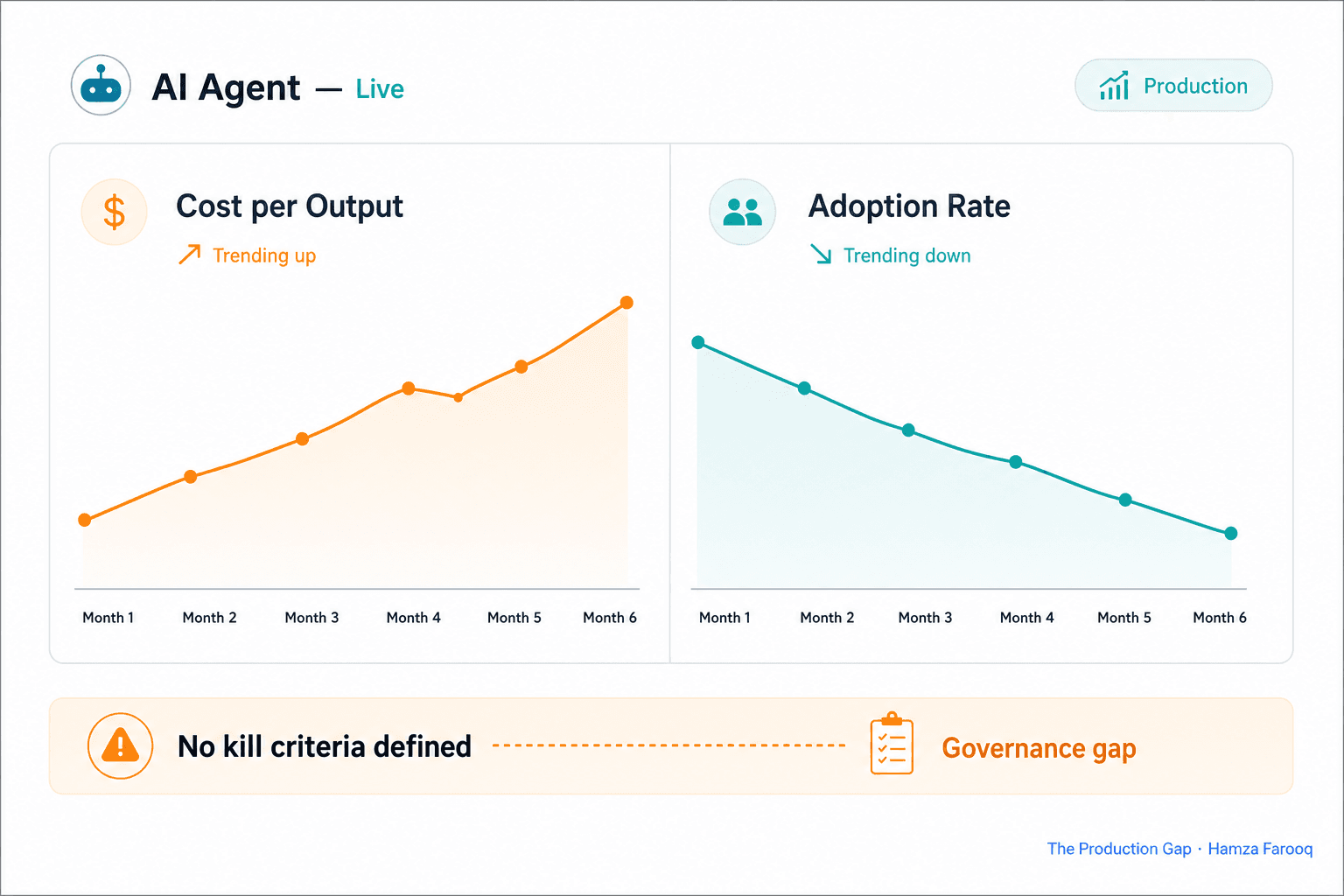
TL;DR: AI project kill criteria are predefined thresholds written into an agent PRD that trigger an automatic review or shutdown when a live initiative fails to deliver measurable value. Without them, low-performing AI projects survive on inertia rather than evidence. This sunset policy template gives PMs the exact governance language to embed those criteria before deployment, not after.
Key Takeaways
- Pilot gates and production stops are different tools: A kill gate prevents a weak pilot from going live; a sunset clause handles a shipped agent that is underperforming in the real world.
- Low ROI is measurable, not a judgment call: Exact thresholds tied to cost per output, error rate, and adoption rate remove politics from shutdown decisions.
- Kill decision ownership must be assigned in advance: Ambiguity about who pulls the trigger is how low-value agents survive indefinitely.
- Sunset clauses force honest accounting: A built-in expiry date makes teams justify continued investment rather than defaulting to inertia.
- The Five-Signal Production Kill Framework is the core tool: One signal breach triggers a review; two or more simultaneous breaches trigger a mandatory shutdown decision.
Introduction
The exit is the artifact nobody writes.
An AI agent running in production without a stop condition is an open financial commitment. It consumes compute budget, oversight time, and organizational trust, often quietly, for months, because nobody wrote down when it should stop. The sunset clause belongs in the agent PRD before a single line of code ships.
Kill criteria are defined as specific thresholds, established before capital is committed, at which an AI initiative stops receiving funding and capital is reallocated. Separately, duration thresholds are one practical trigger: if Phase 1 of an initiative exceeds a pre-agreed window, that breach is treated as a signal that something is fundamentally wrong, not a reason to keep pushing.
What exactly are AI project kill criteria, and why don't pilot gate definitions cover production?
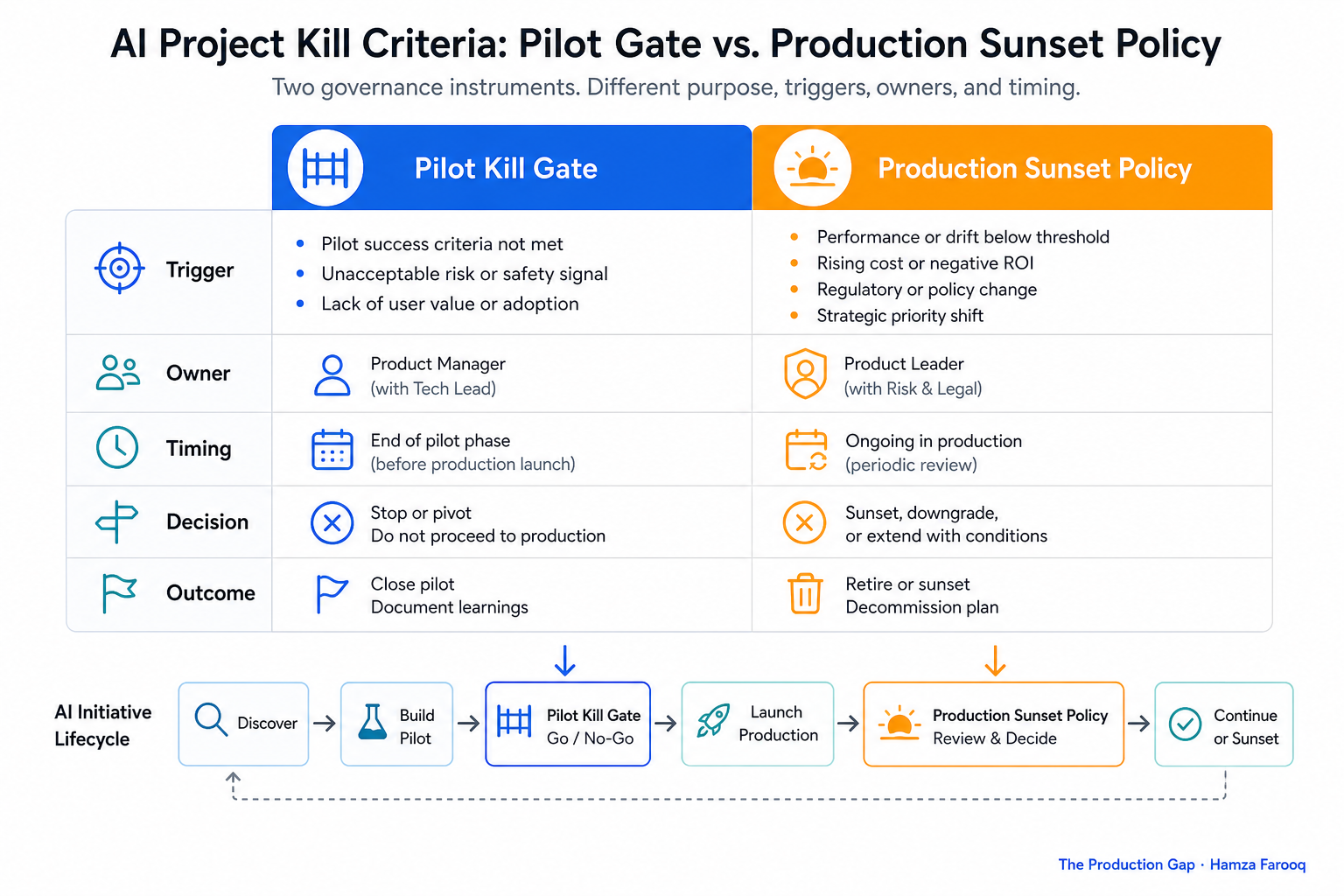
AI project kill criteria are predetermined thresholds tied to cost, error rate, adoption, or time that trigger a funding stop or shutdown decision; pilot gates and production sunset policies are two distinct tools that solve different problems.
A pilot kill gate asks: should this ship? A production sunset clause asks: should this keep running? Many governance frameworks address only the first question. That is a problem, because production is where spend is already running and sunk-cost psychology has set in. Kill criteria defined upfront turn abstract risk into a concrete decision trigger and give people permission to raise concerns before things become political. The production version is where many teams have nothing written down at all.
| Governance tool | Question it answers | When it applies |
|---|---|---|
| Pilot kill gate | Should this initiative ship to production? | Before deployment |
| Production sunset clause | Should this live agent keep running? | After deployment |
| Both combined | Full lifecycle governance | End-to-end PRD |
What specific metrics should trigger the shutdown of a live AI initiative already in production?
A live AI initiative should trigger a formal shutdown review when it breaches any one of five measurable signal categories: cost-per-output, task error rate, active adoption rate, human-override frequency, and time-since-last-value-event.
The table below presents the Five-Signal Production Kill Framework, an author synthesis built from the sources cited in each row.
| Kill signal | Threshold approach | Source logic |
|---|---|---|
| Cost-per-output | Set your ceiling before deployment; pre-agreed cost thresholds are recommended for general project governance | Onplana cancellation framework |
| Task error / hallucination rate | Define your acceptable ceiling before deployment | Forbes, January 2026 |
| Active adoption rate | Define target adoption and a minimum floor before deployment | Calibrate against your baseline |
| Human-override frequency | Set a maximum tolerable correction rate before deployment | Good Transformer four-signal framework |
| Time-since-last-value-event | Define a maximum no-improvement window before deployment | whyaifails.com premortem logic |
How do you write a sunset clause into an agent PRD before deployment?
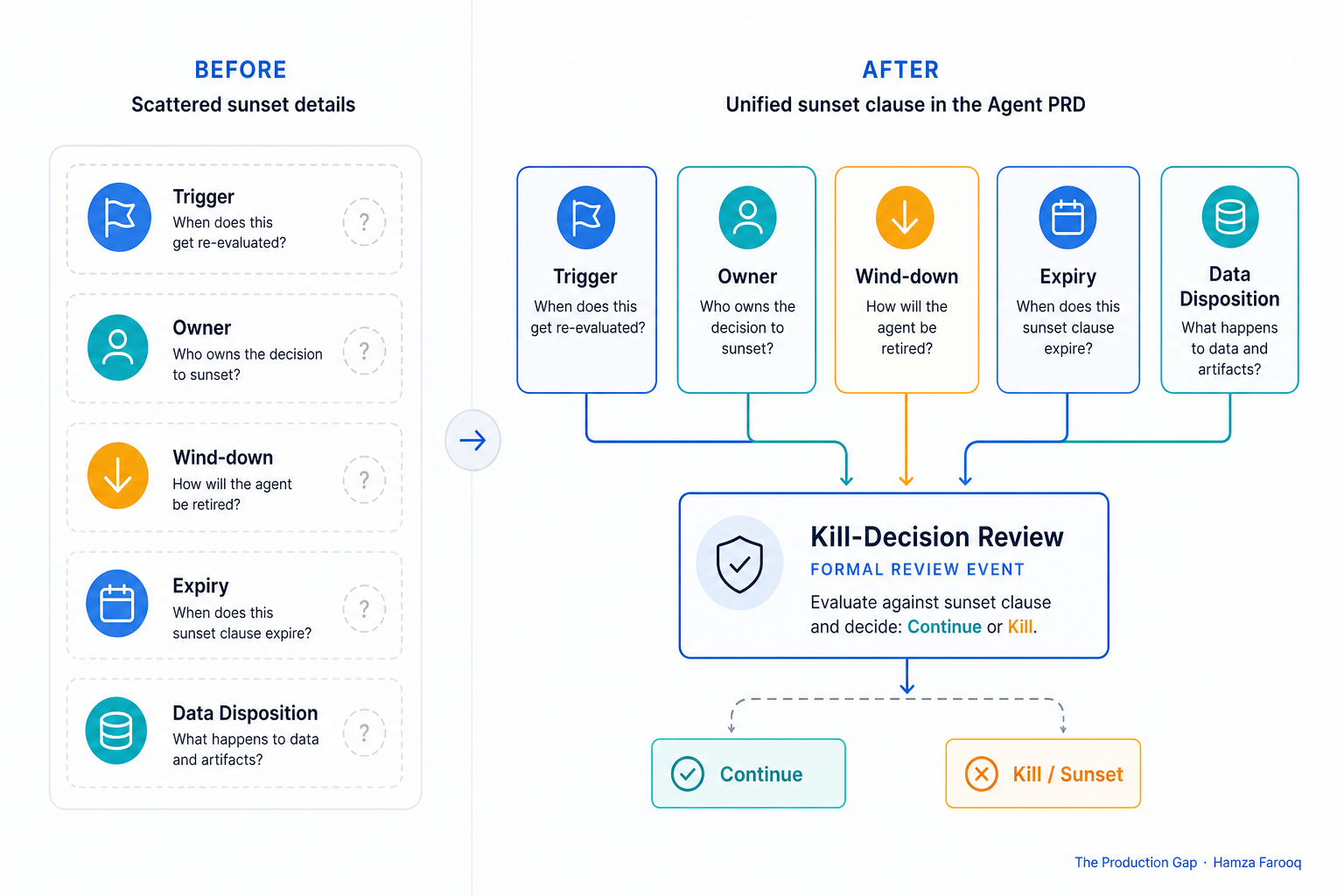
A sunset clause requires five fields: Trigger, Owner, Wind-down, Expiry, and Data Disposition. Together they form a named PRD section that specifies exact kill conditions, assigns decision authority, and defines the operational steps that activate if the agent fails to meet value thresholds within a defined window.
Trigger. Write kill signals as explicit if/then statements tied to the thresholds your team sets before deployment. Vague language is how underperforming agents survive; specificity removes the wiggle room.
Owner. Name a specific role, not a team, with authority to act. A team can diffuse responsibility indefinitely; a named role cannot.
Wind-down. Draft operational steps at PRD time: traffic rerouting, user notification timeline, model decommissioning, vendor contract termination. Written in advance, this takes an hour. Written reactively under political pressure, it takes far longer and costs more.
Expiry. Set a hard review date, agreed before deployment, at which continued operation requires active reauthorization. Define the signals that tell you to stop before deployment pressure creates inertia.
Data Disposition. Specify what happens to training data, logs, and model artifacts at shutdown. Skip this field and a governance event becomes a compliance incident.
Who owns the kill decision, and how do you prevent organizational inertia from overriding the criteria?
The kill decision should be owned by the product lead accountable for the business case, with finance and executive co-signs at higher cost tiers and a governance veto right for enterprise-wide risk exposure.
When product thinks finance will decide and finance thinks the CIO will decide, nothing gets decided. Assigning tiered ownership by compute cost closes that gap. As a practical rule of thumb used in this guide, a workable model looks like this:
| Initiative tier | Annual compute cost | Primary kill owner | Required co-sign | Escalation trigger |
|---|---|---|---|---|
| Departmental agent | Lower spend | Product Lead | Department Head | 2+ kill signals breached |
| Business-unit agent | Mid-range spend | Product Lead | Finance and BU VP | 2+ kill signals breached |
| Enterprise-wide agent | Higher spend | CIO or AI Governance Board | CFO and Legal | Any single high-severity signal |
Your organization should calibrate the spend thresholds that define each tier before capital is committed. Treating a production agent like a perpetual license makes cost invisible until sunk-cost psychology turns the shutdown conversation into a political fight.
Frequently Asked Questions
What is the difference between a pilot kill gate and a production stop-loss policy for AI? A production stop-loss policy for AI triggers the shutdown of a live, underperforming agent that has already shipped, while a pilot kill gate is a go/no-go checkpoint used before an initiative reaches production. Both are necessary, but only the sunset clause addresses the sunk-cost trap that emerges after deployment.
How do you calculate or set the right thresholds for AI kill criteria? Kill-criteria thresholds should be set for each of the five signal categories, cost-per-output, error rate, adoption relative to target, human-override frequency, and time since last measurable value, before deployment, using your team's own unit economics and tolerance for risk. The Five-Signal Production Kill Framework used in this guide treats these as if/then triggers rather than subjective judgments, which removes negotiation from the shutdown decision.
What is the difference between an AI kill criterion and an AI risk threshold? An AI kill criterion is a predefined, binary decision trigger: when a specific metric breaches a set level, a review or shutdown is mandatory. An AI risk threshold is a broader governance concept that may inform monitoring without mandating action. Kill criteria are a practical rule of thumb for operationalizing risk thresholds into enforceable PRD language.
Who should own the final kill decision, product, finance, or the CIO? Kill decision ownership should be tiered by compute cost, with product leads owning lower-spend initiatives, finance co-signing at mid-range spend, and the CIO holding veto authority for enterprise-wide deployments. The owner must be named in the PRD before deployment, not assigned reactively when the conversation turns political.
Conclusion
An AI agent with no sunset clause is an open financial commitment carrying risk across compute spend, oversight labor, regulatory exposure, and organizational trust. The fix is a five-field PRD section covering Trigger, Owner, Wind-down, Expiry, and Data Disposition, with the first kill-criteria review scheduled at a date agreed before deployment.
The Five-Signal Production Kill Framework in this guide gives PMs a named, citable structure to anchor that conversation. Shipping an AI agent without a sunset clause is optimistic accounting dressed up as ambition.
Open the PRD for any live AI initiative in your portfolio and add a "Sunset conditions" section today. If no thresholds exist, that absence tells you something about the governance.
Learn from me

Agentic AI for Product Managers, my Maven cohort. Learn how to design, evaluate, and ship reliable AI systems: the technical fluency PMs need to lead agentic products, no engineering background required. Join the next cohort →
Hire us
Traversaal.ai. We're a team of forward deployed engineers solving the toughest AI problems for Fortune 100 companies: document intelligence, agentic data platforms, and real-time web intelligence, deployed in production. Work with our team to deploy your next agentic ecosystem. Talk to Traversaal.ai →
Join us
Want to solve these problems with us? We're always looking for forward deployed engineers who want to ship production AI. jobs@traversaal.ai
