
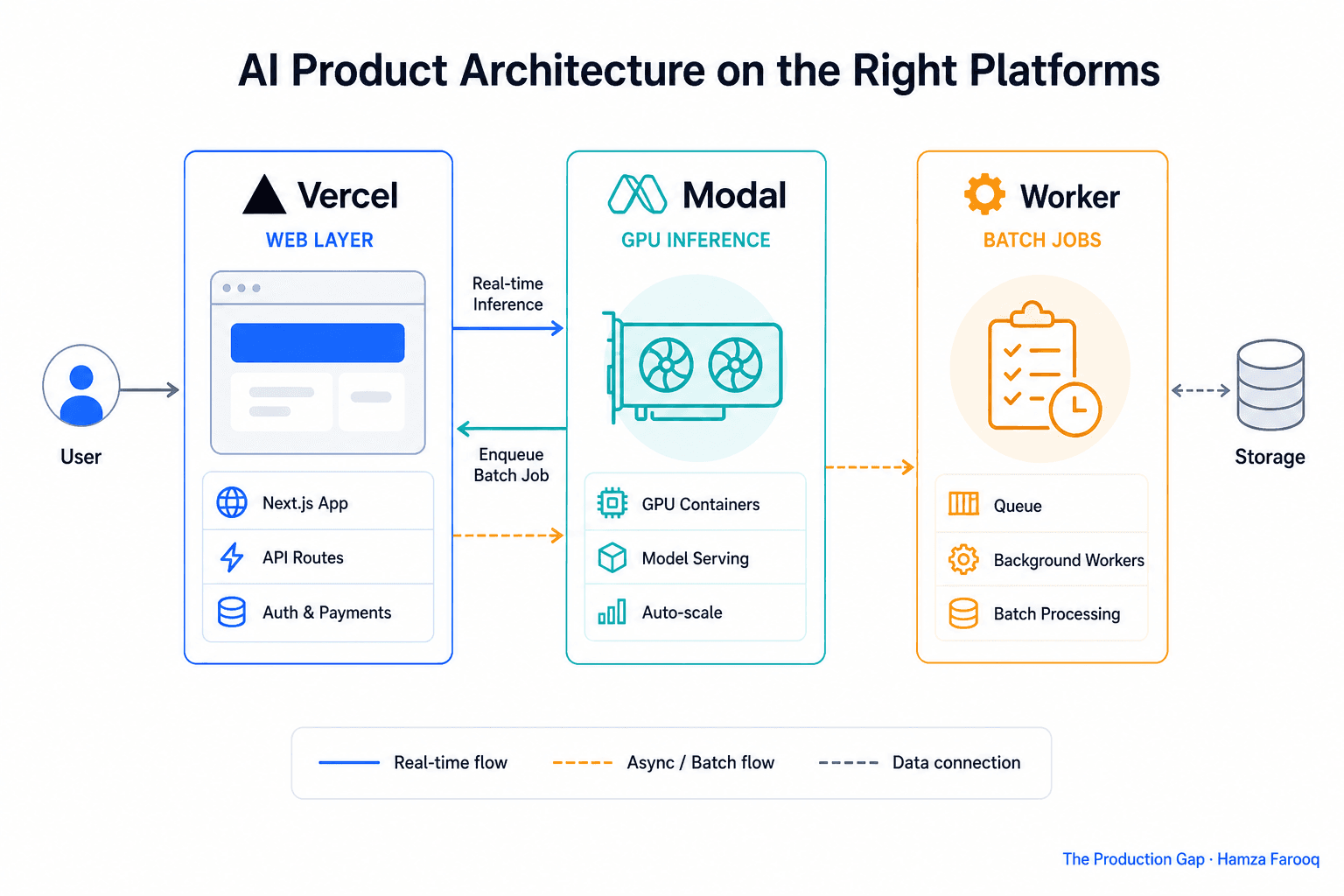
TL;DR: This guide targets small teams (1 to 5 engineers) shipping a first production AI product in 2026. The right AI deployment platforms comparison starts with your workload type, not the platform's landing page. Use managed cloud services like SageMaker or Vertex AI for scalable inference and enterprise governance, specialized GPU platforms like Modal for inference and batch jobs, and lightweight runtimes like Vercel for your web layer. Most teams end up using more than one.
Key Takeaways
- No single platform wins everything: The right choice depends on your workload type, not the platform with the best marketing.
- Cold starts affect inference performance: Serverless platforms spin down between requests, and heavy AI models can face meaningful initialization delays as a result.
- Pricing models are not interchangeable: Per-request billing suits low traffic; reserved compute tends to become more economical at sustained scale.
- Long-running agents need a different home: Strict timeout limits can terminate agents mid-task, making timeout behavior a critical selection criterion.
- GPU access is not a commodity: Platforms vary widely in hardware availability, cost, and provisioning time.
- You will likely use more than one platform: As a practical rule of thumb drawn from the framework used in this guide, production AI products commonly split workloads across two or three platforms as requirements diverge.
Introduction
This guide is for small engineering teams (1 to 5 engineers) deploying a first production AI product in 2026.
Deploying an AI product means wiring together three different workload types: web traffic, GPU inference, and async agent jobs. Pick the wrong platform for any one of them and you face a painful rewrite once real users arrive. Pick a single platform for all three and that problem tends to arrive sooner.
The question worth asking is not which platform to use. It is which platform to use for each layer.
What is the difference between web deployment, GPU inference, and batch AI jobs, and why does it matter?
The platform you need depends entirely on your workload type. Web traffic, GPU inference, and long-running batch jobs each have fundamentally different infrastructure requirements, and no single platform handles all three optimally.
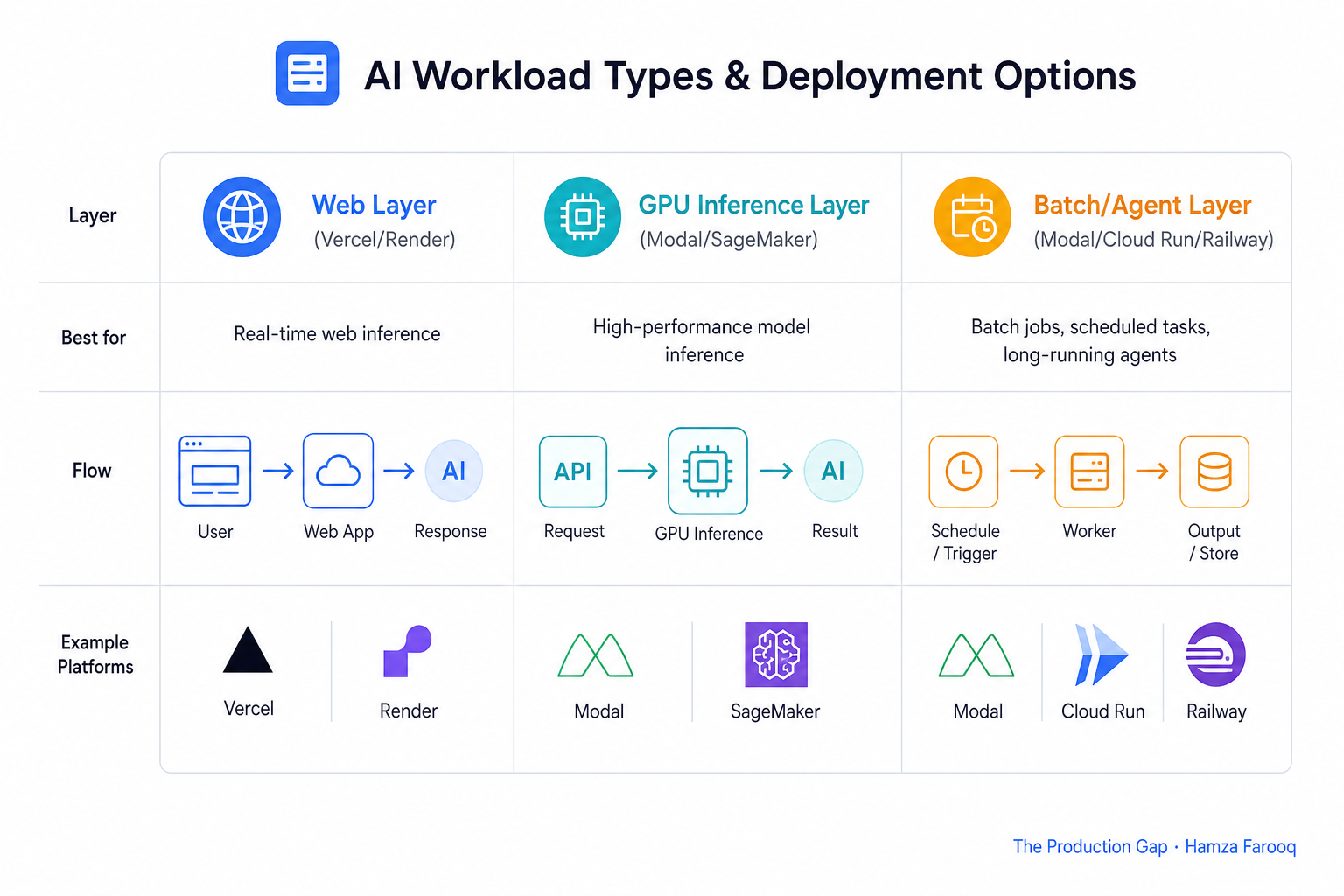
Three workload types appear in any production AI product:
- Web and API layer: Fast, stateless, millisecond response times, CPU-only.
- GPU inference: Memory-heavy, latency-sensitive, requires specific hardware.
- Batch and async jobs: Long-running, latency-tolerant. Agents, fine-tuning runs, and document queues fall here.
Mapping workload types to platforms before evaluating options is, in the framework used in this guide, the single most useful first step in the selection process.
Which AI deployment platform should I use in 2026: Modal, Vercel, Fly.io, AWS SageMaker, or something else?
Modal is a strong candidate for GPU inference, Vercel suits the web layer for most small teams, Fly.io handles persistent CPU-based services well, and AWS SageMaker fits organizations that require enterprise governance.
2026 AI Deployment Platform Decision Matrix
| Platform | Best For | GPU Support | Cold Start Risk | Timeout Limit | Pricing Model |
|---|---|---|---|---|---|
| Modal | GPU inference, batch jobs | Yes | Low (container reuse) | None for async functions | Per-second compute |
| Vercel | Web and API frontend layer | No | Medium (serverless) | Varies by plan (see Vercel docs) | Per-request |
| Fly.io | Persistent CPU services, lightweight agents | No | Low (always-on VMs) | None | Reserved VM |
| AWS SageMaker | Enterprise ML, regulated industries | Yes | Low (dedicated endpoints) | None | Reserved plus per-request |
| Google Cloud Run | Containerized inference, flexible scaling | Limited | Medium | Varies | Per-request |
| Railway and Render | Hobby to small-scale apps | No | Low | Varies | Subscription or usage |
Amazon SageMaker ranks at the top in several 2026 roundups, but that reflects enterprise adoption rather than small-team fit. For a two-person team, SageMaker's IAM policies and endpoint configuration will consume time that most small teams cannot afford early on. Render, Cloud Run, and Railway are actively recommended for agent deployments by developers in community discussions.
How do cold starts and pricing models affect AI product performance?
Cold start latency on serverless platforms occurs when a spun-down container reinitializes. For GPU containers loading large models, that delay is meaningfully longer than for lightweight web functions and is worth planning around before launch.
The following pricing considerations are author synthesis based on available platform comparisons, not externally measured benchmarks:
- Low-traffic products: Per-request serverless billing suits near-zero idle cost.
- High-volume, consistent traffic: Reserved compute tends to become more economical at sustained scale.
- Bursty batch workloads: Queue-backed workers that spin up, process, and spin down fit this pattern well.
Estimating your request volume and latency tolerance before evaluating platforms will eliminate most options on its own.
Do I need multiple deployment platforms for a production AI product, or can I run everything on one?
Running everything on a single platform is a reasonable early constraint, but the framework used in this guide treats workload divergence as the primary signal that it is time to split layers.
This pattern is sometimes called polyglot deployment. One architecture worth considering for small teams is what this guide calls The Lean AI Product Stack:
- Vercel for the web frontend and lightweight API routes
- Modal for the GPU inference endpoint
- Cloud Run or Railway for async agent workers and background job queues
Two risks to manage before committing to this pattern:
- Egress costs: Data moving between platforms incurs charges. Returning processed outputs rather than raw model data, and co-locating services in the same cloud region, helps limit this.
- Inter-service latency: A web request that fans out to a separate inference platform adds a network hop. Making that hop async where the user experience allows reduces user-facing impact.
Before launch with zero users, a single platform is entirely reasonable. Splitting layers makes sense once your GPU and web costs diverge enough to justify the added operational surface.
Frequently Asked Questions
Q: What is the cheapest way to deploy a GPU-backed AI model in production in 2026?
As of 2026, per-second GPU billing with container reuse tends to be cost-efficient for variable or low traffic. For predictable high-volume workloads, a reserved GPU instance may prove more economical at sustained load. Teams should model their own usage patterns against current platform pricing rather than rely on a fixed break-even figure, since hardware costs and billing structures change frequently.
Q: When should I use AWS SageMaker instead of a simpler platform like Modal or Fly.io?
Use SageMaker when your organization requires enterprise-grade governance, compliance controls, or deep AWS integration. For a small team shipping a first AI product, the operational overhead is likely to slow early delivery more than it helps.
Conclusion
The right question is not "which platform should I use?" It is "which platform should handle each layer?" For most production AI products in 2026, the answer involves more than one platform.
A reasonable starting point from the framework used in this guide: Vercel for your web layer, Modal for GPU inference, and Railway or Cloud Run for jobs that run longer than a few minutes. Before launch, a single platform is fine. Once your GPU and web costs diverge, splitting the layers becomes worth the added complexity.
Draw your workload diagram first. Label each component by its primary constraint: response speed, GPU requirement, or job duration. Then match it to the decision matrix above. That diagram is your deployment architecture.
Learn from me
Forward Deployed Engineering Bootcamp for Full-Stack Developers, my Maven cohort. Build and ship complete AI products end to end, from React and Node.js frontends to deployed models with caching and observability. Join the next cohort →
Hire us
Traversaal.ai. We're a team of forward deployed engineers solving the toughest AI problems for Fortune 100 companies: document intelligence, agentic data platforms, and real-time web intelligence, deployed in production. Work with our team to deploy your next agentic ecosystem. Talk to Traversaal.ai →
Join us
Want to solve these problems with us? We're always looking for forward deployed engineers who want to ship production AI. jobs@traversaal.ai
