
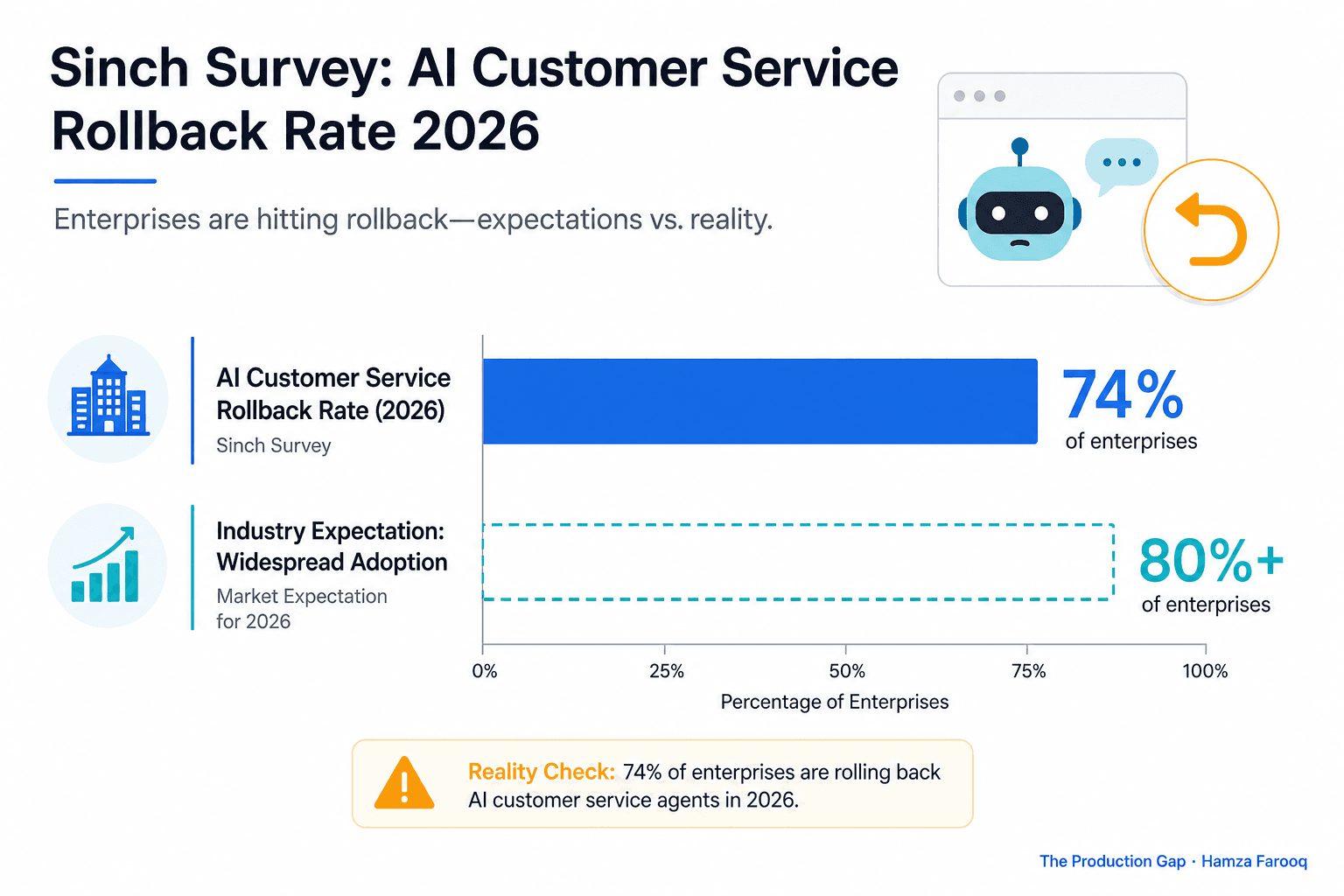
TL;DR: Enterprise AI customer service rollbacks are accelerating, not because the technology fails, but because teams skipped the governance work before launch. Context gaps, intent misclassification, and undefined escalation paths are the documented root causes. Define failure thresholds, escalation SLAs, and rollback criteria before any customer interaction occurs.
Key Takeaways
- High rollback rates reflect governance failure, not technology failure: Enterprises retreated because they never defined what failure looks like.
- Context gaps and stale knowledge are the leading triggers: Agents fail when they lack current product information, misclassify intent, or take unauthorized actions.
- Klarna's reversal reframes the "AI wins" narrative: Strong deflection metrics masked deteriorating resolution accuracy until the damage was done.
- Governance gaps carry legal risk: Customer-facing AI agents face mandatory transparency, oversight, and conformity requirements in several sectors. Verify obligations against authoritative legal sources for your jurisdiction.
- Human escalation design is a launch requirement: Deployments without defined handoff protocols inflate support queues and frustrate customers more than no AI at all.
- Define failure thresholds before you go live: Pre-committed rollback criteria let you catch problems before brand damage compounds.
Key term: "AI customer service agent" means a customer-facing, conversational system that autonomously handles support interactions, resolving issues, retrieving account data, escalating to humans. This is distinct from a basic chatbot (scripted, rule-based) and from a copilot (AI assisting a human agent). The failure patterns and governance requirements here apply to autonomous agents only.
Why are enterprises shutting down their AI customer service agents in 2026?
Enterprises are shutting down AI customer service agents because they launched without defining what failure looks like, and by the time the damage was visible, it had already reached customers.
Three documented root causes drive failure. All three are preventable. All three require pre-launch governance work most teams skipped.
Context gaps are the most common trigger. When a policy changes mid-quarter or an account carries billing history the model hasn't seen, the agent delivers a confident wrong answer. AI support failures commonly occur because the bot lacks accurate context and relies on outdated knowledge.
Intent misclassification compounds context gaps. When an agent misidentifies what a customer is trying to accomplish, it routes confidently to the wrong resolution path, a leading documented failure cause.
Permission overreach closes the triad. Agents that modify account settings or issue refunds outside their defined scope create costly downstream problems that are difficult to unwind and harder to explain to affected customers.
What did Klarna get wrong, and what did the reversal actually cost?
Klarna's reversal shows the real cost of a high-profile AI rollback is not the technology write-down, it is the customer trust deficit and internal credibility loss that make the next deployment harder to fund and staff.
Metrics that looked strong in sprint reviews (deflection rate, average handle time) masked the ones that matter to customers: resolution accuracy, sentiment on closed tickets, repeat-contact rate. Those lagging indicators don't surface until customers have already been burned. The subsequent about-face is now a defining AI customer service failure case study.
Organizations that roll back often end up worse off than those that never launched. They've trained customers to distrust AI touchpoints, pushed more volume onto human agents, and must re-earn stakeholder confidence before any future deployment gets funded. A rollback is not a reset. It is a setback with a long recovery.
How does growing regulatory scrutiny change your legal exposure?
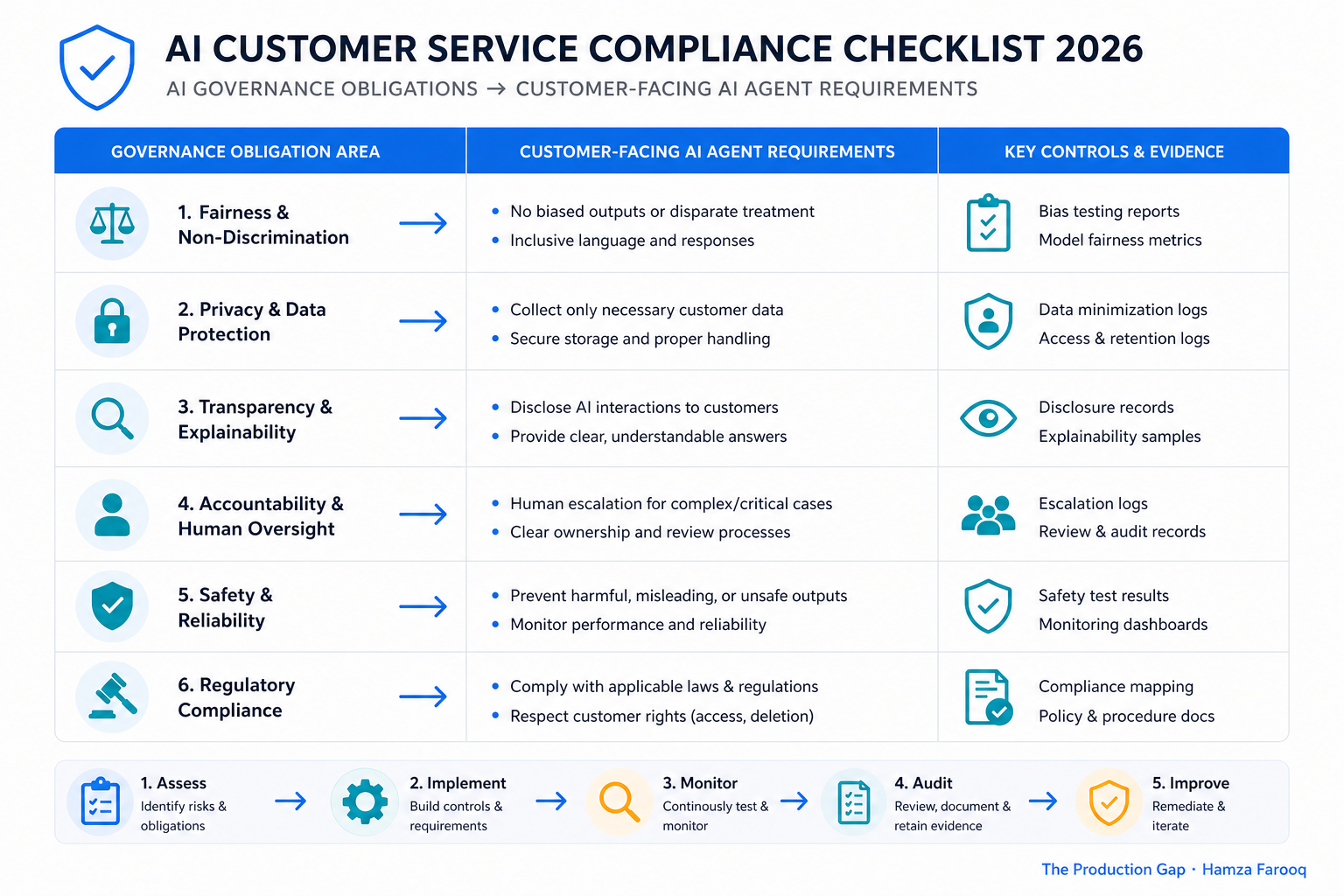
Regulatory frameworks governing customer-facing AI are tightening across major markets, and governance gaps that were once operational embarrassments are increasingly becoming documented compliance liabilities. Verify current obligations against authoritative legal sources for your sector and jurisdiction. This article does not constitute legal advice.
| Obligation area | What to assess | Why it matters |
|---|---|---|
| Transparency disclosure | Are users informed they are interacting with an AI? | Increasingly a baseline regulatory expectation across major markets |
| Human oversight mechanism | Does a defined, functioning escalation path to a human exist? | Commonly required under emerging AI governance frameworks |
| Pre-deployment risk documentation | Is formal risk assessment completed before go-live? | Supports conformity and audit readiness |
| Incident logging | Are material failures recorded systematically? | Required for audit defensibility under several proposed frameworks |
| Knowledge currency | Are training data and knowledge bases demonstrably current? | Addresses a root cause of failures and a point of regulatory scrutiny |
What does a defensible AI customer service architecture look like before you go live?
A defensible architecture starts with a pre-launch governance document defining failure thresholds, escalation SLAs, and rollback criteria, before any customer interaction occurs. Model selection and prompt engineering come after this document exists, not before.
This framework is the Pre-Launch Accountability Stack, four layers that convert "we launched AI" into "we can defend what our AI does."
Layer 1: Failure threshold definition. Set exact metrics triggering a pause or rollback: CSAT on AI-handled tickets falling below a pre-agreed floor, repeat-contact rate climbing above a defined ceiling, escalation volume spiking more than a set percentage week-over-week. Without pre-committed numbers, rollback decisions become political and happen too late.
Layer 2: Escalation protocol design. Human handoff must be built in, not assumed. Define trigger conditions (frustration signals, unrecognized intent, account-sensitive actions) along with the SLA for human pickup and the context that transfers to the receiving agent. Tight guardrails and human oversight must be built in before deployment.
Layer 3: Knowledge currency monitoring. Assign explicit ownership of knowledge base updates tied to your product release cycle. Stale knowledge is among the most common triggers of AI customer support failure, and satisfying this layer directly addresses the knowledge currency obligation most governance frameworks flag.
Layer 4: Brand-risk tolerance sign-off. Get documented executive alignment on acceptable error types and rates before launch. This converts a governance gap into a governance record and supports audit defensibility.
Frequently asked questions
What is the most common reason AI customer service agents fail? Agents most commonly fail due to outdated knowledge, intent misclassification, or permission overreach. These are the most consistently documented failure triggers across enterprise deployments.
What regulatory obligations should I assess for customer-facing AI agents? Transparency disclosure, functioning human oversight, pre-deployment risk documentation, and incident logging are most commonly flagged in emerging frameworks as of mid-2026. Confirm precise requirements with qualified legal counsel, scope varies and is evolving.
What did Klarna's reversal reveal about enterprise AI deployment strategy? Deflection rate and handle time can look strong while resolution accuracy and customer sentiment deteriorate underneath them. The reversal is a documented cautionary case study, the real cost was trust and credibility loss, not the technology write-down.
How should a product manager define rollback criteria before launching an AI customer service agent? Rollback criteria must be numeric, pre-committed, and tied to customer-outcome metrics, specific thresholds for CSAT, repeat-contact rate, and escalation volume, set before any interaction goes live. Without pre-committed numbers, rollback decisions consistently happen too late.
Conclusion
High rollback rates are not evidence that AI customer service doesn't work. They are evidence that most enterprises launched it like an internal productivity tool, fast, assuming they'd iterate out of problems. Customer-facing AI doesn't have that tolerance. Every failed interaction is a brand event, not a backlog item.
Deployments that hold share one trait: they defined failure before it happened. That is the core principle behind the Pre-Launch Accountability Stack, and the foundation of defensible governance as regulatory scrutiny intensifies. AI customer experience is already lagging other AI use cases and leaving consumers frustrated. The accountability infrastructure has to come first.
Learn from me
Agentic AI for Product Managers, my Maven cohort. Learn how to design, evaluate, and ship reliable AI systems: the technical fluency PMs need to lead agentic products, no engineering background required. Join the next cohort →
Hire us
Traversaal.ai. We're a team of forward deployed engineers solving the toughest AI problems for Fortune 100 companies: document intelligence, agentic data platforms, and real-time web intelligence, deployed in production. Work with our team to deploy your next agentic ecosystem. Talk to Traversaal.ai →
Join us
Want to solve these problems with us? We're always looking for forward deployed engineers who want to ship production AI. jobs@traversaal.ai
