
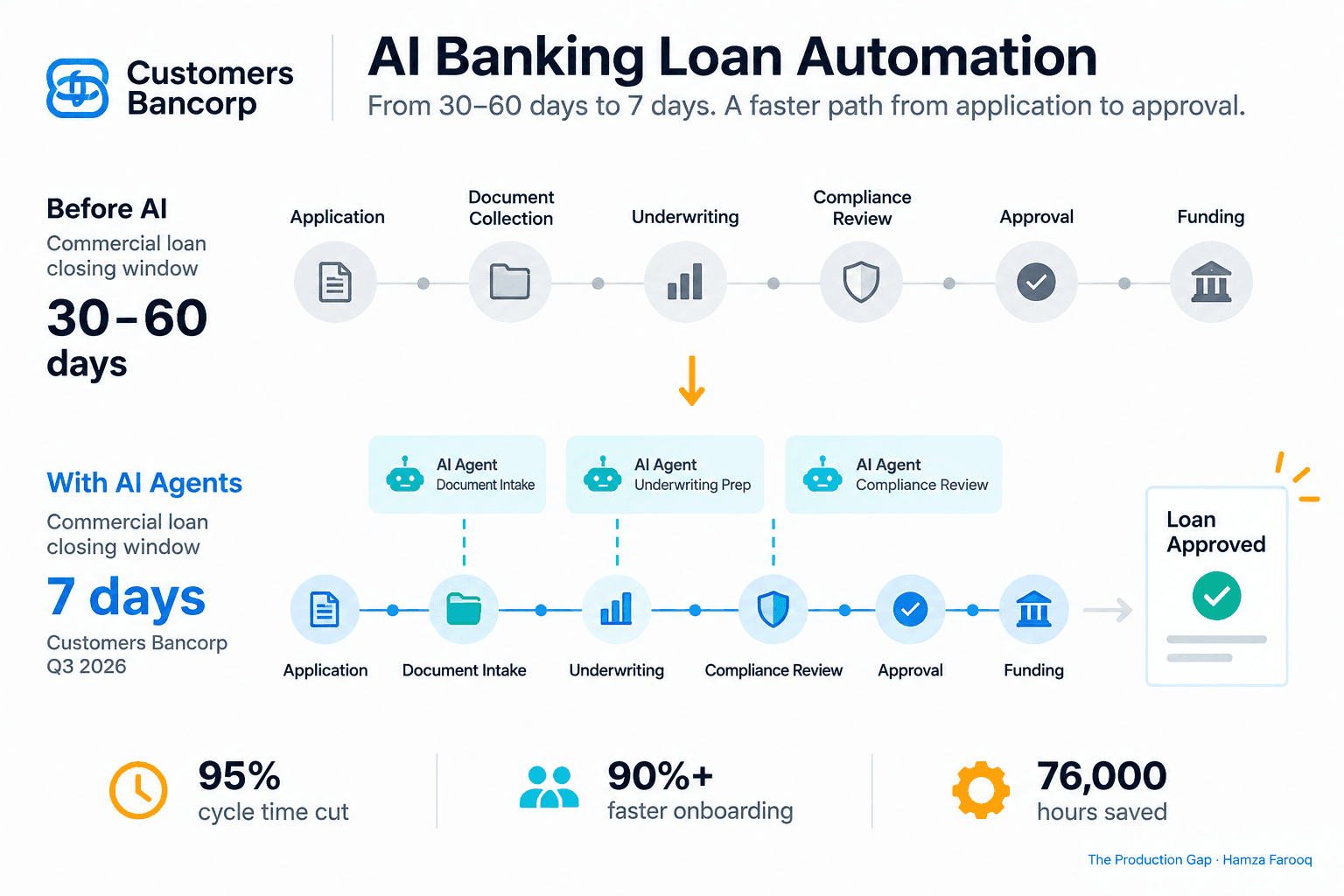
TL;DR: As of Q3 2026, Customers Bancorp publicly disclosed a 95% reduction in commercial loan underwriting cycle time and 90%+ faster deposit onboarding, achieved through agentic AI and a forward-deployed engineer pod model. A widely cited figure of 76,000 hours saved (self-reported; methodology not publicly detailed) warrants scrutiny before any bank treats it as a benchmark. The vendor model underneath these results may prove harder to replicate than the technology itself.
Key Takeaways
- 95% cycle-time cut is real, but narrow: Customers Bancorp reported a 95% reduction in commercial loan underwriting cycle time, though this applies to select loan types, not the entire portfolio.
- The pod model redefines vendor relationships: Engineers embedded directly inside bank teams co-build proprietary AI agents rather than license pre-built software.
- The 76,000 saved-hours figure warrants scrutiny: This self-reported figure (self-reported; methodology not publicly detailed) rests on internal estimates rather than system logs, making it unverifiable and unreliable as a peer benchmark.
- Faster underwriting raises compliance stakes: A 95% cycle-time reduction compresses the human review window and intensifies explainability obligations under fair lending law.
How did Customers Bancorp cut commercial loan underwriting cycle time by 95%?
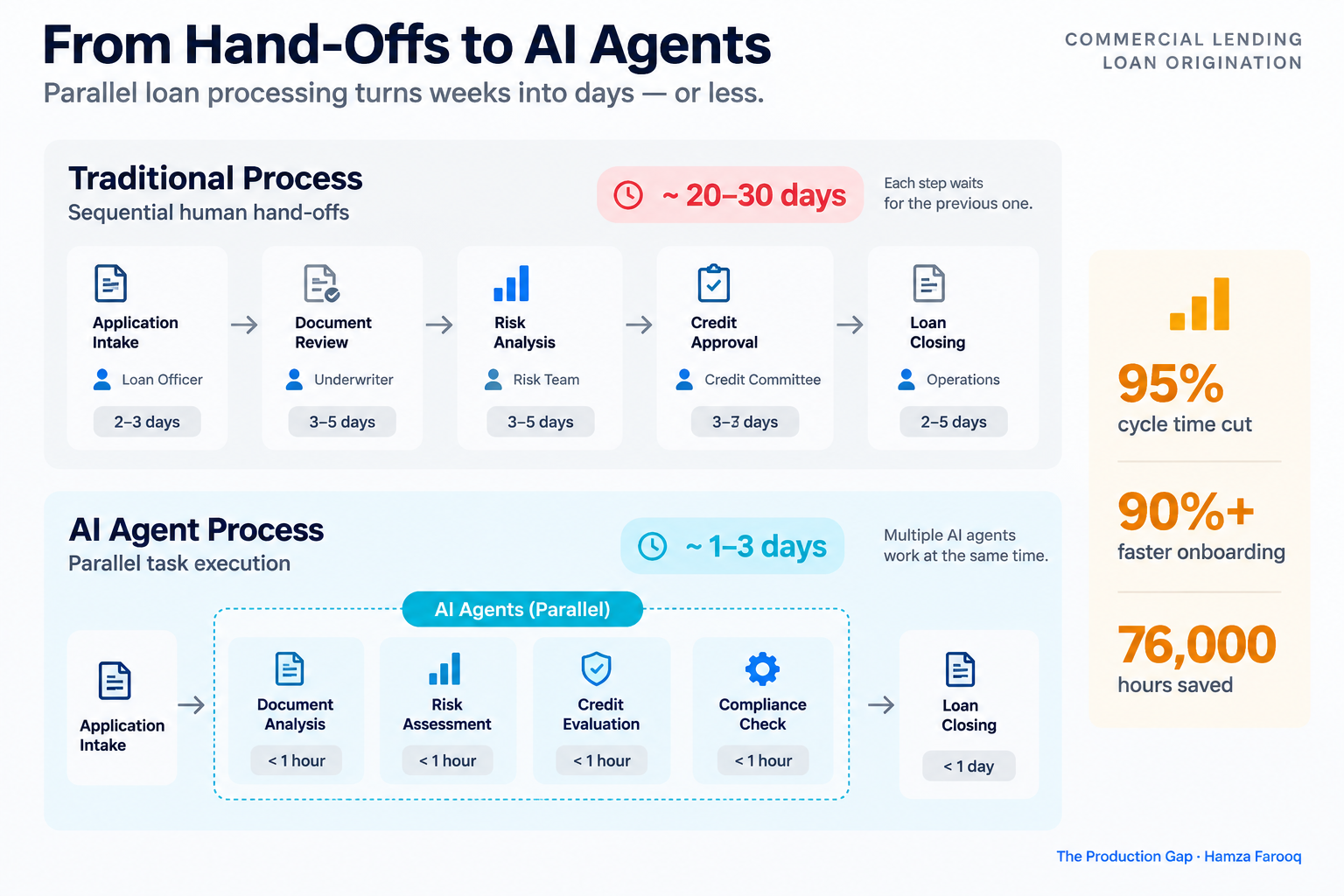
Customers Bancorp reported a 95% reduction in commercial loan underwriting cycle time by deploying agentic AI systems that automate document intake, verification, underwriting preparation, and compliance review as sequential, interconnected steps, removing hand-off-dependent queues rather than merely accelerating them.
The old workflow was a relay race. Each hand-off from loan officer to credit analyst to compliance to legal added days before the next step could begin. Agentic AI removes many of those hand-offs entirely. If a document is missing, the agent routes and requests it independently rather than waiting for a human to notice, which is what separates agentic AI from the rule-based automation tools that preceded it. Earlier automation stopped at exceptions. Agents reason through them.
One important qualifier: the 95% figure applies to select commercial loan types, not the entire origination portfolio. Banks benchmarking against this number should confirm which loan categories qualify before redrawing their roadmaps.
What is the forward-deployed engineer pod model?
A forward-deployed engineer (FDE) pod model embeds vendor engineers directly inside bank business units to co-develop proprietary AI tooling, rather than licensing pre-built software at arm's length.
Vendor engineers sit inside bank units, building and iterating on AI agents alongside bank staff. The bank acquires proprietary tooling it owns; the vendor acquires a reference deployment and domain training signals. Structurally, this is staffing arbitrage: the bank gets engineering capacity subsidized by the vendor's interest in a marketable case study.
Why is the FDE model hard for large banks to replicate?
Larger banks face structural friction that makes the FDE model difficult to adopt at scale, because vendor incentive diminishes precisely where large-bank bureaucracy is strongest.
Large banks' procurement processes and internal engineering organizations tend to resist external co-builders. More importantly, vendors' incentive to subsidize co-development shrinks when the reference case carries less novelty. Regional banks may have a narrow window to exploit the FDE arrangement before vendors standardize it into a packaged product and the arbitrage disappears.
Table 1: FDE Pod Model vs. Traditional SaaS, Key Dimensions
| Dimension | Traditional SaaS licensing | FDE pod co-development |
|---|---|---|
| Who builds the tool | Vendor, pre-deployment | Vendor engineers + bank staff, live |
| IP ownership | Vendor retains | Bank retains custom tooling |
| Vendor incentive | License revenue | Reference case + deployment data |
| Speed to production | Months | Weeks |
| Replicability for large banks | High | Low (vendor incentive diminishes at scale) |
| Regulatory documentation | Standard vendor agreement | Custom; audit trail responsibility unclear |
Is the reported 76,000 saved-hours figure reliable, and what would an auditable alternative look like?
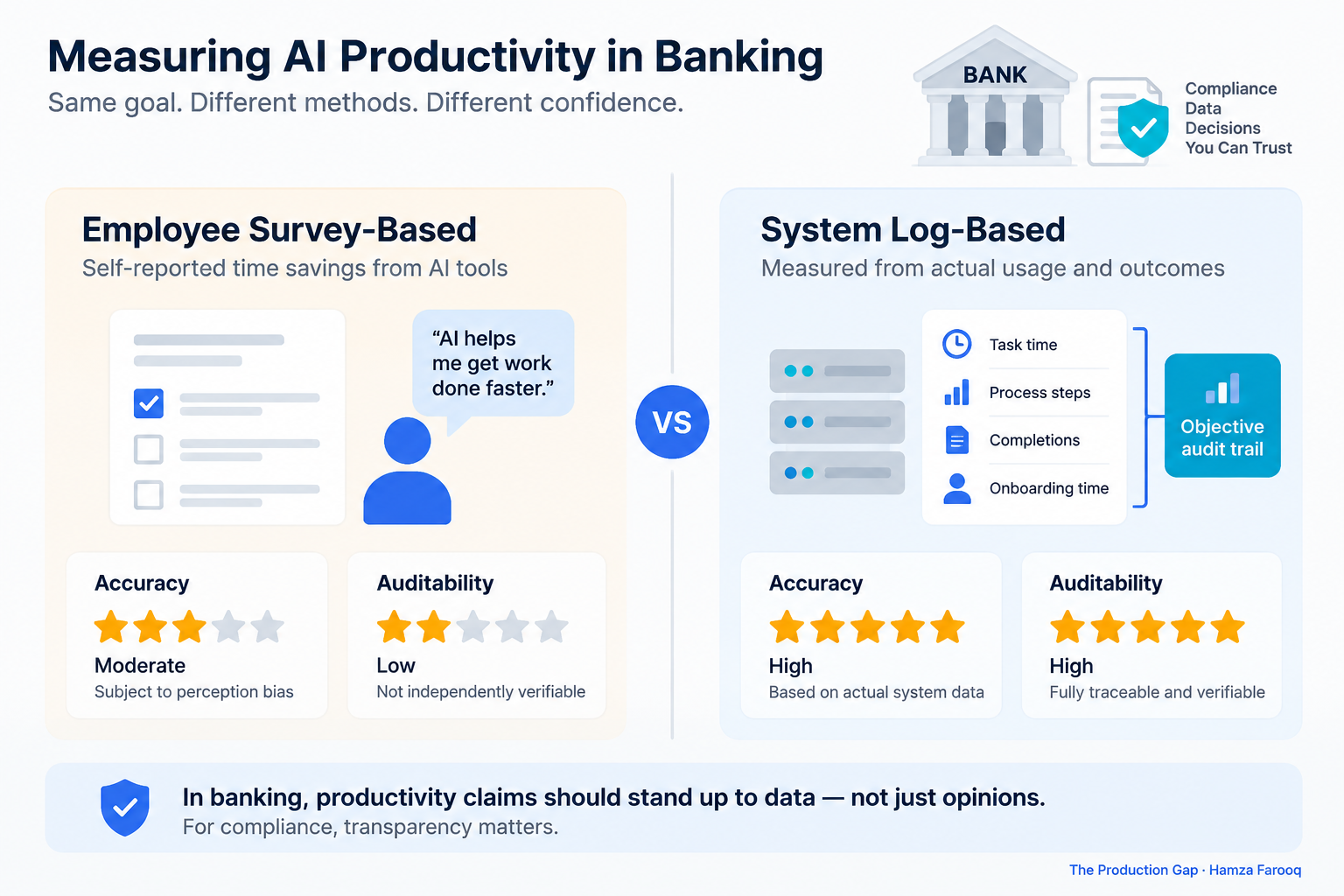
The widely cited 76,000 hours saved (self-reported; methodology not publicly detailed) derives from internal estimates rather than audited operational data, which means it cannot be independently verified or used as a reliable peer benchmark.
The basis for that figure, whether system logs, employee surveys, or a blended methodology, was not detailed in Customers Bancorp's public disclosures. This is the same measurement gap that inflated automation savings claims throughout the earlier RPA wave: survey-based productivity measurement captures what employees believe they saved, not what system logs confirm they saved.
A system-log-based approach would capture actual task-completion timestamps before and after deployment, human override rates, error-and-rework frequencies, and queue-time reductions by loan type, none of which requires asking anyone what they think they saved. Banks should build this measurement infrastructure before deployment, not after: regulators are unlikely to accept survey-derived productivity figures as audit evidence indefinitely.
What does the 95% loan cycle-time cut mean for regulatory compliance and fair lending obligations?
A 95% reduction in commercial loan underwriting cycle time compresses the human review window sharply enough that compliance documentation infrastructure should be built before deployment to address fair lending and explainability obligations.
When loan underwriting cycle time drops by 95%, the window for a human examiner to review, question, or override an AI-influenced credit decision shrinks by a comparable factor. Banks must show what factors the agent weighted, whether those factors are permissible under fair lending law, and whether human override was documented at each step.
| Compliance risk | Why speed amplifies it | Mitigation |
|---|---|---|
| Fair lending | Less time for human adverse-action review | Real-time decision logging by agent step |
| Model risk | Agent reasoning less transparent than scorecard | Explainability layer required pre-deployment |
| Data privacy | Faster processing triggers retention rules sooner | Automated retention policy enforcement |
| Audit trail integrity | Survey-based logs unlikely to satisfy examiners | System-log infrastructure from day one |
Deploying AI to cut loan cycle time without building audit infrastructure first converts efficiency gains into regulatory exposure.
Frequently Asked Questions
What is agentic AI in banking loan processing? Agentic AI refers to systems that independently reason and execute multi-step loan processing tasks, including document collection, verification, underwriting preparation, and compliance checks, without requiring human hand-offs between steps, adapting mid-process to route exceptions on their own.
Why would a bank use an FDE pod model instead of buying AI software? The FDE model delivers proprietary tooling built to a bank's specific workflows, subsidized by vendor interest in the institution as a reference deployment. Traditional licensing typically delivers a generic product requiring significant internal engineering to adapt.
How should banks measure AI productivity savings to satisfy regulatory scrutiny? Banks should replace or supplement employee surveys with system-log-based measurement capturing task-completion timestamps, human override rates, and queue-time reductions by workflow step. These are instruments that can be independently audited and compared across institutions, unlike self-reported hour estimates.
Does a 95% loan cycle-time reduction change a bank's fair lending compliance burden? Yes. Compressing the underwriting window by 95% shrinks the human review window by a comparable factor, intensifying explainability and adverse-action documentation obligations under fair lending law. Banks should build real-time decision logging before deployment, not after.
Conclusion
Customers Bancorp moved from pilot to production by rethinking the vendor relationship, not just the technology. The FDE pod model is available to any regional bank compelling enough to serve as a vendor showcase, but the window is narrowing as vendors convert bespoke arrangements into packaged products. The 76,000 saved-hours figure (self-reported; methodology not publicly detailed) is the industry's measurement problem in miniature: a number that is cited widely and verifiable by no one. Compliance infrastructure for agentic underwriting is lagging deployment velocity, and that is a gap regulators will eventually close from their end.
Before benchmarking against Customers Bancorp's cycle-time figures, audit whether your bank has the system-log infrastructure to measure and prove whatever you deploy. Build that layer first. A regulatory finding moves faster than any AI implementation.
Learn from me
Forward Deployed Engineering Bootcamp for Full-Stack Developers, my Maven cohort. Build and ship complete AI products end to end, from React and Node.js frontends to deployed models with caching and observability. Join the next cohort →
Hire us
Traversaal.ai. We're a team of forward deployed engineers solving the toughest AI problems for Fortune 100 companies: document intelligence, agentic data platforms, and real-time web intelligence, deployed in production. Work with our team to deploy your next agentic ecosystem. Talk to Traversaal.ai →
Join us
Want to solve these problems with us? We're always looking for forward deployed engineers who want to ship production AI. jobs@traversaal.ai
