
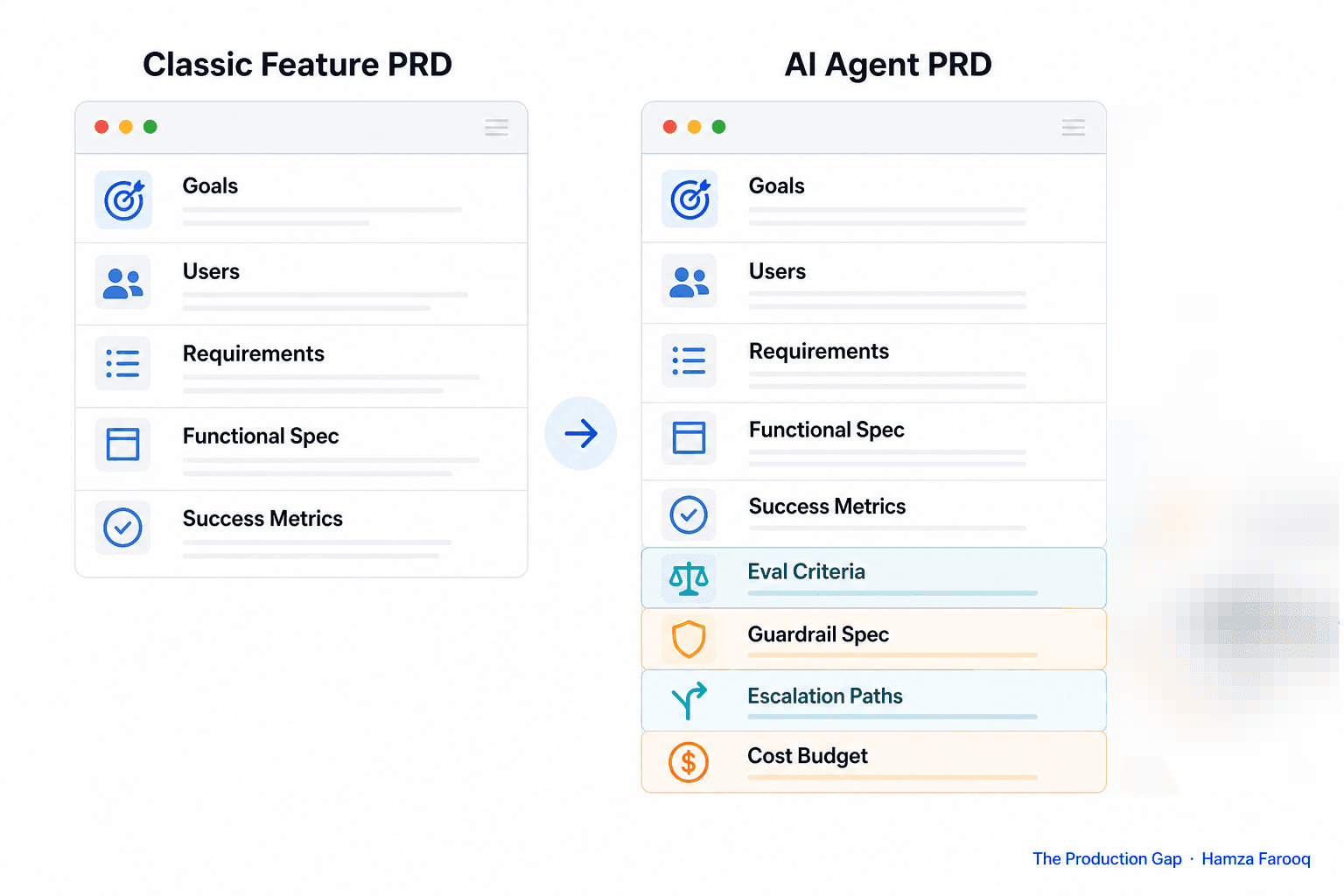
TL;DR: An AI agent PRD needs dedicated sections for eval criteria, guardrails, escalation paths, and cost-latency budgets that standard PRD templates omit. Replace vague outcome language with measurable thresholds, explicit fallback logic, and audit requirements so engineering and safety teams build from the same spec. That structure is what keeps AI agents aligned, testable, and shippable within real business constraints.
🔑 Key Takeaways
- 📋 AI agent PRDs need new sections: Eval criteria, guardrails, escalation rules, and cost budgets are absent from standard specs but required before autonomous agents touch production.
- 🎯 Acceptance criteria must be measurable: "Performs well" is unusable, requirements need specific pass rates, confidence thresholds, and failure ceilings.
- 🚧 Guardrail specs are non-negotiable: Every PRD must list forbidden actions, rate limits, and hard boundaries the agent cannot cross.
- 🧑💼 Escalation paths belong in the PRD: Define exact conditions (low confidence, sensitive data, ambiguous intent) that force a human handoff.
- 💰 Cost and latency are hard constraints: Token spend and response time per invocation belong in requirements, not monitoring dashboards.
- 🔍 Auditability must be specified upfront: Decision traces need a defined schema and retention period before build, not after a failure.
Introduction
A PM at a major enterprise SaaS company shipped an AI agent that sent emails autonomously, then found out three weeks later it had sent 847 emails to the wrong segment. Nobody had defined "wrong" before launch.
By mid-2026, autonomous agents are running in production across Salesforce Agentforce, Microsoft Copilot Studio, and dozens of vertical SaaS platforms. The PRD format hasn't kept up. A classic feature spec assumes binary outcomes; agents ship a distribution of outcomes. That mismatch is why teams retrofit governance after failures instead of before them.
Six sections separate a well-scoped agent PRD from a liability. Most PMs are missing four of them.
What sections does an AI agent PRD need that a classic feature PRD doesn't?
An AI agent PRD requires four sections absent from classic specs: eval criteria, guardrail specification, escalation path design, and cost/latency budgets, each treating non-deterministic behavior as a hard engineering constraint.
A classic PRD asks does this feature do the thing? An agent PRD asks what percentage of the time does it do the right thing, and what happens the other times? Failure ceilings have to be defined before the first API call is made.
| PRD Section | Classic Feature PRD | AI Agent PRD |
|---|---|---|
| Acceptance Criteria | Binary pass/fail | Pass rate thresholds (e.g., ≥92% task completion) |
| Success Metrics | Daily Active Users (DAU), conversion, customer satisfaction score (CSAT) | Task accuracy, hallucination rate ceiling, escalation rate |
| Error Handling | Edge case list | Failure mode taxonomy with probability weights |
| Safety | Basic input validation | Guardrail spec: forbidden actions, rate limits, rollback triggers |
| Cost | Engineering story points | Token budget per invocation, infra cost per workflow run |
| Auditability | Logging (nice-to-have) | Decision trace spec (launch-blocking requirement) |
If a PM can't fill in the bottom four rows before kickoff, the agent isn't ready to be scoped.
How do you write measurable acceptance criteria for non-deterministic AI behavior?
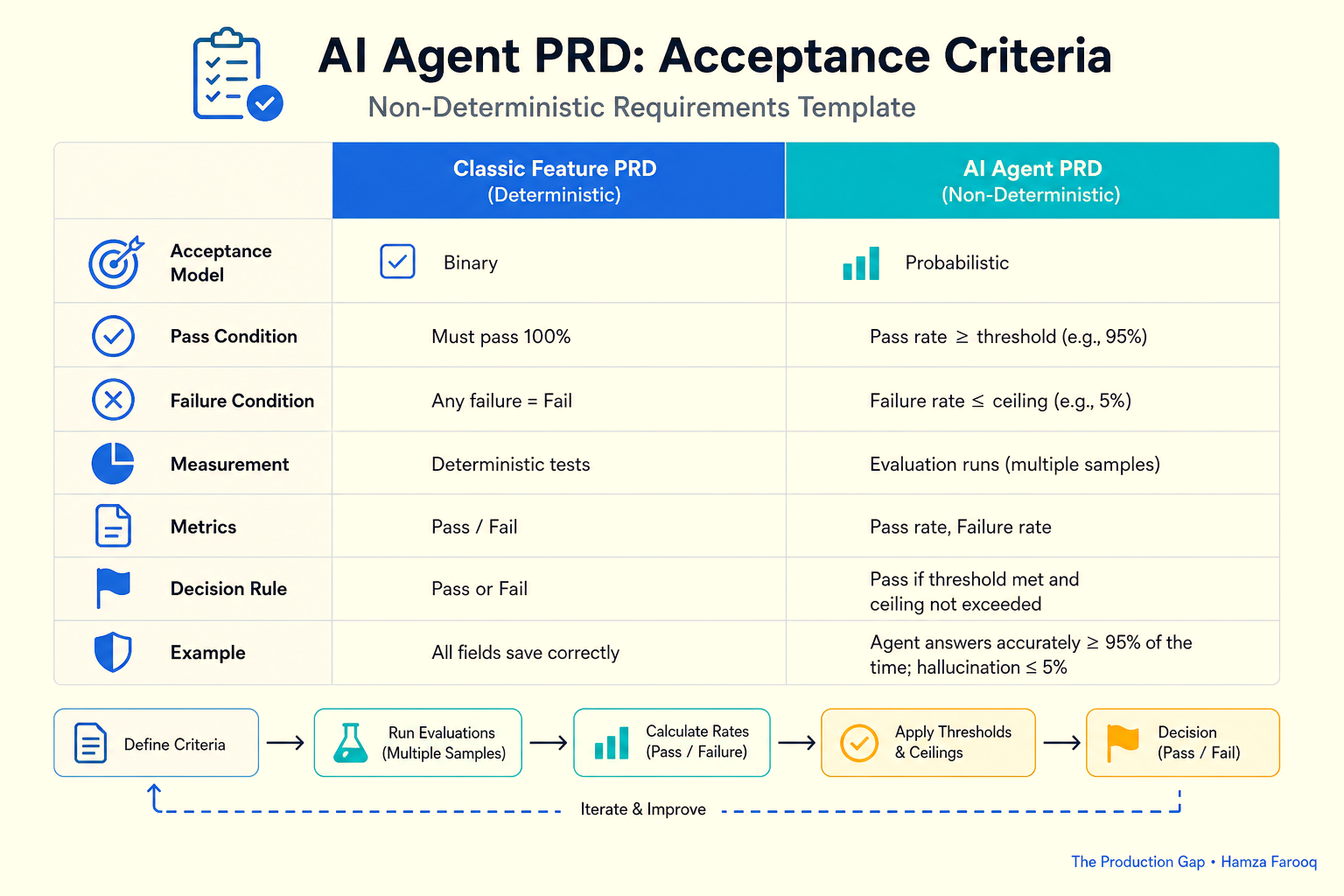
Measurable AI agent acceptance criteria replace binary language with three specific numbers: a minimum task-completion pass rate, a maximum allowable failure rate per failure class, and a confidence threshold below which the agent must not act autonomously.
Offline evals run on a fixed, labeled dataset before deployment. The PRD defines dataset size, labeling methodology, and minimum pass rate. Example: "The email-drafting agent must hit ≥88% accuracy on the 500-sample internal eval set before shadow mode begins." If you can't name that number at kickoff, you have a hope, not a criterion.
Shadow mode criteria define the parallel-run phase where outputs are logged but not executed. Specify minimum duration, the comparison metric (e.g., agent matches human decision in ≥85% of cases), and the divergence ceiling that blocks promotion to live. Shadow mode is not optional for agents touching irreversible actions.
A/B task completion criteria govern the live phase. Define task success precisely, then set the auto-throttle trigger: if failure rate exceeds a defined ceiling over a rolling 48-hour window, the agent pauses automatically. That ceiling belongs in the PRD, not a post-incident runbook.
"The agent should perform accurately" is not a criterion. Name the number or the agent doesn't ship.
How should a PRD specify what actions an AI agent is and isn't allowed to take?
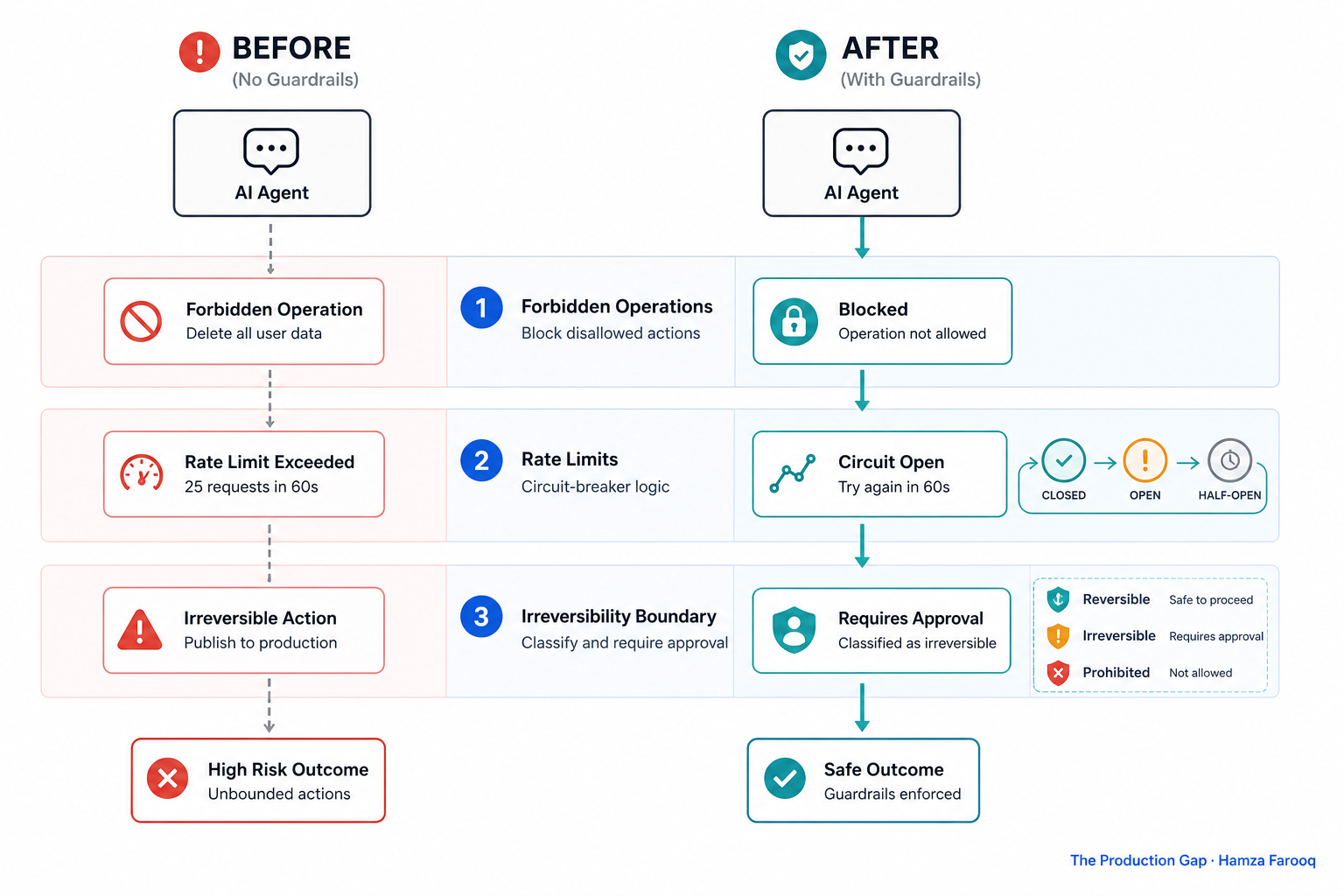
An agent guardrail specification is a hard-coded list of forbidden operations, maximum action rates, and irreversibility boundaries, engineering constraints the agent cannot override, not guidelines it should follow.
Forbidden operations list. Every line must pass one test: can an engineer implement it as an explicit conditional? Example for a CRM agent: - NEVER delete records; create only, update with change log - NEVER send external communications without a human-approved template on file - NEVER query or write to PII-sensitive fields without explicit user session context
Prompt-based guardrails are suggestions, not constraints. Production incidents across multiple enterprise deployments in 2025–2026 confirm that prompt-only safety instructions get bypassed by edge-case inputs. The forbidden operations list must live in code.
Rate limits as requirements. Define maximum actions per minute, per hour, and per workflow run. Example: "Maximum 10 outbound API calls per workflow run; circuit-breaker triggers at 5 consecutive failures." The agent loop pattern (retrying a failing call hundreds of times) is entirely preventable when rate limits are a launch-blocking spec item.
Irreversibility boundaries. Classify every agent action on a reversibility scale: fully reversible (read), partially reversible (draft saved), irreversible (email sent, record deleted). Require explicit human confirmation for any irreversible action above a defined risk tier. What isn't explicitly forbidden is implicitly permitted, and that gap is where production incidents live.
How do you define when an AI agent should escalate to a human, and how do you budget cost and latency per task?
Escalation triggers and cost/latency budgets are launch-blocking requirements, specifying the exact confidence score, data sensitivity flag, or action class that forces a human handoff, alongside hard token spend and response-time ceilings.
Escalation path design covers three trigger categories. Confidence-based: if confidence falls below a defined threshold (e.g., 0.75), the agent pauses and queues for human review. The PM names that threshold before launch, not the model team after. Data sensitivity-based: any workflow touching GDPR special categories or regulated financial records triggers mandatory human-in-the-loop regardless of confidence score. Ambiguous intent-based: if the request doesn't match a canonical intent pattern with sufficient confidence, the agent escalates before acting. The PRD must also define the handoff SLA, how long the human has to respond before the task is abandoned or retried.
Cost and latency budgets are hard requirements the PM owns: - Token budget: Maximum input + output tokens per invocation (e.g., 4,000 tokens). Exceeding budget is a build failure, not a monitoring alert. - Latency ceiling: P95 per single-step action (e.g., ≤3 seconds); P95 per full workflow run (e.g., ≤45 seconds). - Cost ceiling: Maximum dollar spend per 1,000 workflow executions, reviewed monthly by PM and finance.
Auditability closes the loop. Every escalation event, action taken, and budget near-miss must write to an immutable decision trace log with a named schema and retention period. Retrofitting a logging schema into a shipped agent is far more expensive than defining it before build starts.
FAQ
What's the single most important difference between a classic PRD and an AI agent PRD? Success criteria must be probabilistic, not binary. Without a minimum pass rate and maximum failure ceiling, the team has no launch criteria, only opinions.
How do you get stakeholder sign-off when the feature behaves differently every time? Replace binary sign-off with staged promotion gates: stakeholders approve eval criteria and guardrail spec before build, then the agent must pass each gate (offline, shadow, limited live) before advancing.
How detailed does a guardrail spec need to be before engineering starts? Detailed enough that every guardrail is implementable as a hard code check. "Avoid sensitive topics" is a suggestion; "Must not write to any field tagged TIER-2 or above without a confirmed user session token" is a specification.
Do cost and latency budgets belong in the PRD or a separate technical spec? In the PRD, as launch-blocking requirements the PM owns. Token spend and latency directly shape model tier selection, batching decisions, and feature gating. Siloing them into a technical spec produces economics nobody actually approved.
Conclusion
You are not shipping a feature with a pass/fail state. You are shipping a distribution of outcomes, and your job is to define the acceptable shape of that distribution (pass rate floor, failure ceiling, cost bounds, irreversibility limits) before a single sprint is planned.
Pull your current agent PRD and run it against the six-section comparison table. If the bottom four rows are blank or vague, that's the work. Fill them before kickoff.
Learn from me

Agentic AI for Product Managers, my Maven cohort. Learn how to design, evaluate, and ship reliable AI systems: the technical fluency PMs need to lead agentic products, no engineering background required. Join the next cohort →
Hire us
Traversaal.ai. We're a team of forward deployed engineers solving the toughest AI problems for Fortune 100 companies: document intelligence, agentic data platforms, and real-time web intelligence, deployed in production. Work with our team to deploy your next agentic ecosystem. Talk to Traversaal.ai →
Join us
Want to solve these problems with us? We're always looking for forward deployed engineers who want to ship production AI. jobs@traversaal.ai
