
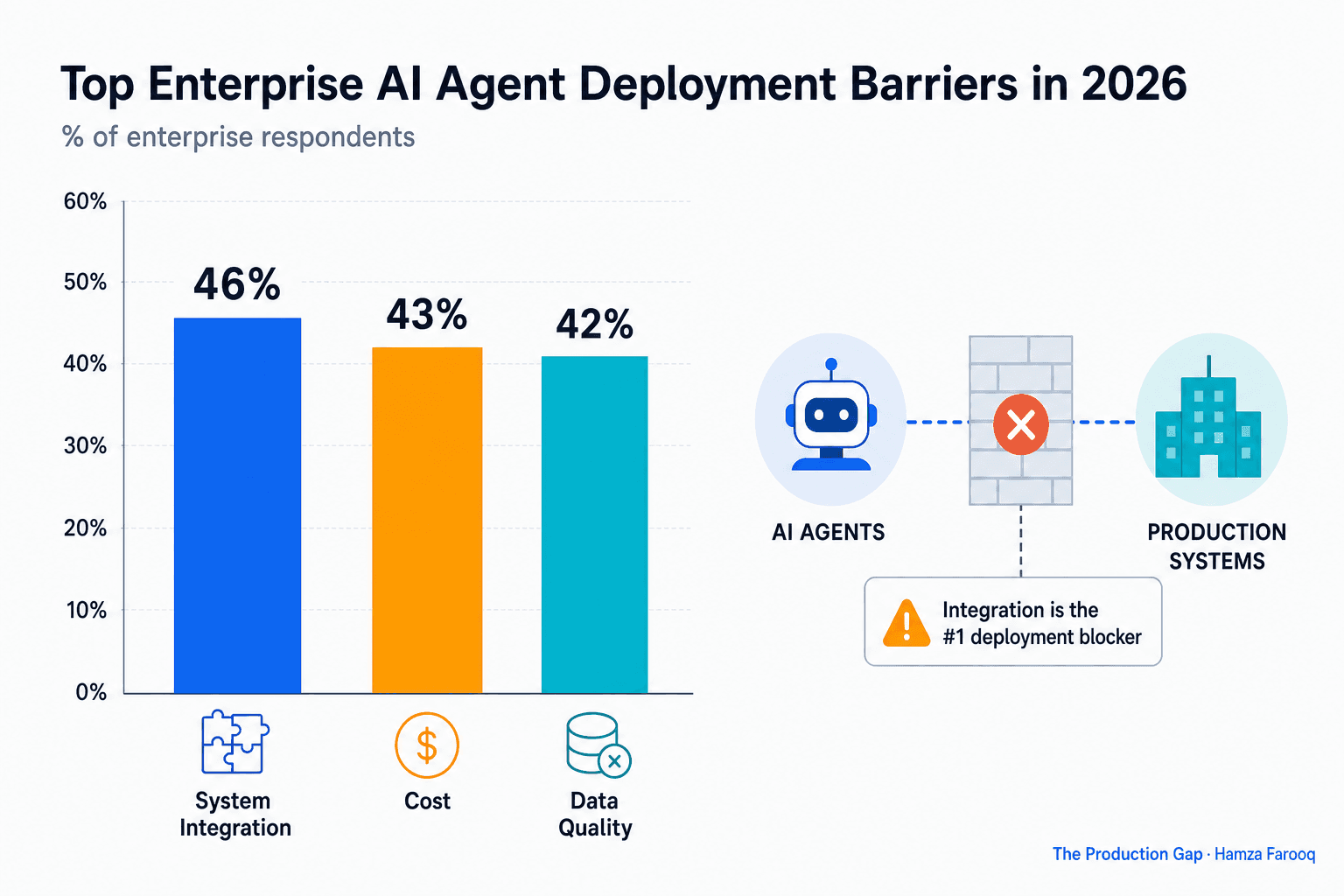
TL;DR: AI agent integration challenges block enterprise deployments more than any other factor because production systems, legacy APIs, authentication layers, data pipelines, and security controls, were never designed for autonomous agents. Connecting an agent to real infrastructure exposes mismatched protocols, undocumented dependencies, and compliance gaps that model selection and prompt engineering cannot solve. The integration layer, not the AI itself, determines whether deployment succeeds or stalls.
Key Takeaways
- Integration beats model as the bottleneck: Demo success is easy. Wiring an agent into real enterprise systems is where nearly every production rollout breaks down.
- Legacy systems were not built for autonomous agents: ERPs, CRMs, and proprietary tools rarely expose the clean, permissioned interfaces agents need to act reliably.
- Auth and permissions create invisible scope creep: Resolving what an agent can read, write, and trigger routinely adds unplanned weeks or months.
- 95% of production rollouts hit serious failures: Most enterprise AI projects stall in the gap between proof-of-concept and real infrastructure.
- Scoping integration complexity is the FDE's first job: Map, tier, and communicate the integration layer, not the model, as the primary risk before quoting any timeline.
- The Integration Surface Audit (ISA) makes scoping repeatable: A four-step audit framework that catches timeline-breaking gaps in week one rather than month four.
Introduction
Practitioners consistently report that integration with existing enterprise systems, not model performance, is what prevents use cases from reaching production. That shift matters: model capability is no longer the constraint. The bottleneck is wiring agents into the ERPs, CRMs, and proprietary APIs that actually run enterprise operations. FDEs who treat this as a pure engineering problem are the ones explaining missed deadlines in month four.
Why do AI agent deployments fail in production even when the model performs well in testing?
AI agent deployments fail in production not because the model is wrong, but because the systems the agent must act on were never designed for autonomous software.
Legacy API problems come in familiar shapes: session auth, XML/SOAP responses, undocumented rate limits, and brittle schemas that change without notice. Agent competence is irrelevant until system access is granted and stable.
If your pre-engagement conversation is still centered on which LLM to use, you are optimizing the wrong variable.
What types of enterprise systems are hardest to connect AI agents to, and why?
The hardest enterprise systems to connect AI agents to are systems of record, ERPs, CRMs, and proprietary data stores, because they were built for human-initiated, session-based interactions, not autonomous agents operating at machine speed.
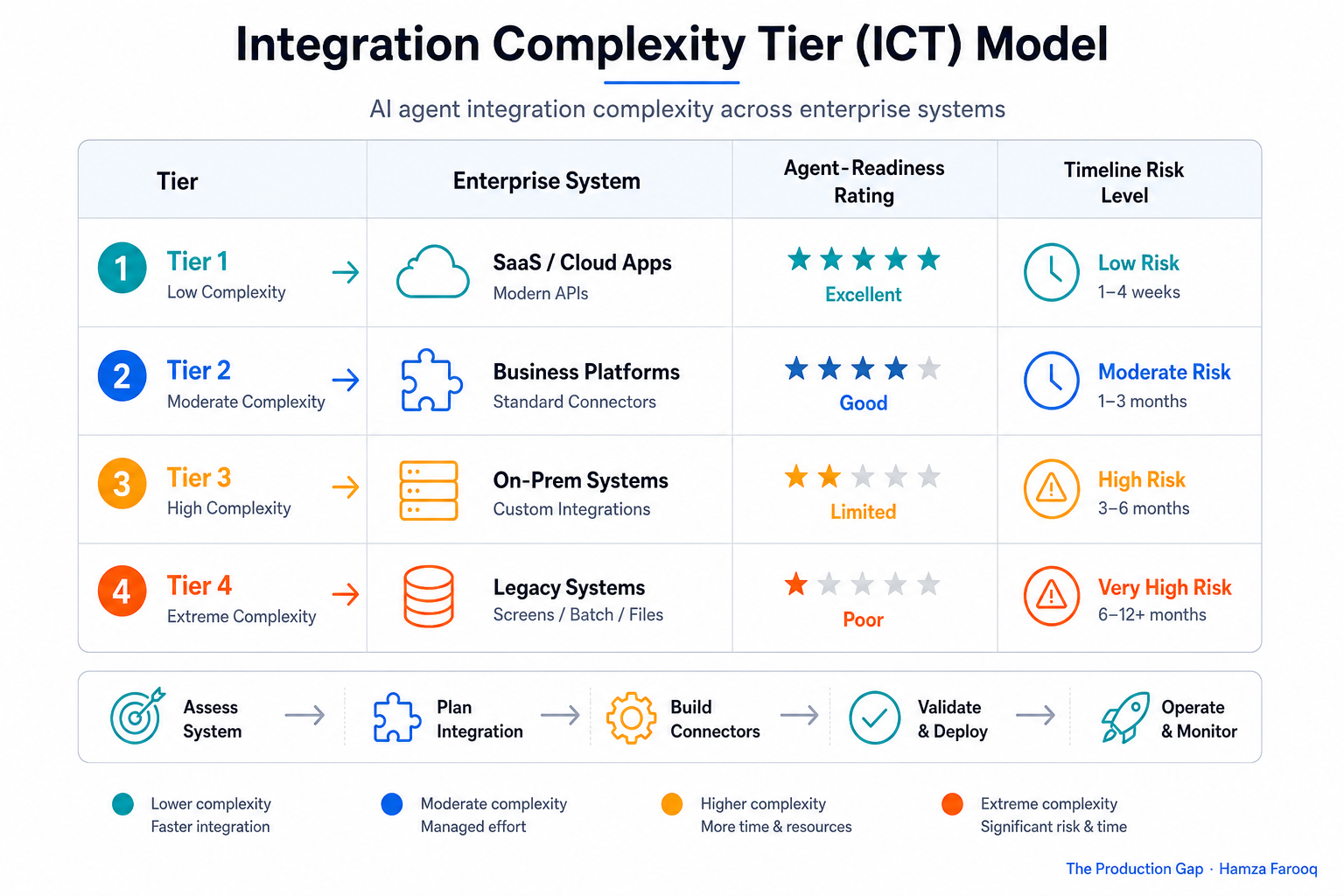
FDEs need a tiered model to communicate complexity before committing to a timeline. The table below is the AI Agent Integration Complexity Tier (ICT) Framework used in this guide.
Table 1: AI Agent Integration Complexity Tiers (ICT Framework)
| Tier | System type | Typical interface | Agent-readiness | Timeline risk |
|---|---|---|---|---|
| Tier 1 | Modern SaaS (Salesforce, Slack) | REST API, OAuth 2.0, webhooks | High | Low (days to weeks) |
| Tier 2 | Mid-gen enterprise (ServiceNow, Workday) | REST/SOAP hybrid, API keys | Medium | Medium (weeks) |
| Tier 3 | Legacy ERP/CRM (SAP, Oracle, custom) | SOAP, session auth, XML | Low | High (months) |
| Tier 4 | Proprietary internal tools / mainframe | No public API, RPA-layer required | None | Critical (months or blocked) |
If you have more than one Tier 3 system in scope, or anything in Tier 4, your timeline needs a multiplier and your risk register needs a dedicated line item.
Why do authentication, permissions, and security reviews add so much time to enterprise agent integration projects?
Auth and permissions add the most hidden time because granting an autonomous agent write access to a system of record requires security review cycles, liability decisions, and system-owner buy-in that no engineer can shortcut.
Three blockers drive most of the calendar delay.
OAuth scoping for agents vs. users. Traditional OAuth flows are scoped to a human session. An agent initiating writes requires a service account or delegation model most security teams have not approved before. Scoping decisions alone can take weeks.
Security review cycles. Penetration testing, data access audits, and CAB approvals do not compress for AI projects. Each system in scope adds its own review queue, and those queues run on governance timelines, not engineering timelines.
Every auth and permissions decision touching a system of record is a governance decision, not just a technical one. FDEs who scope it as purely technical will miss the majority of the actual calendar time it consumes.
How should FDEs scope integration complexity before committing to an agent deployment timeline?
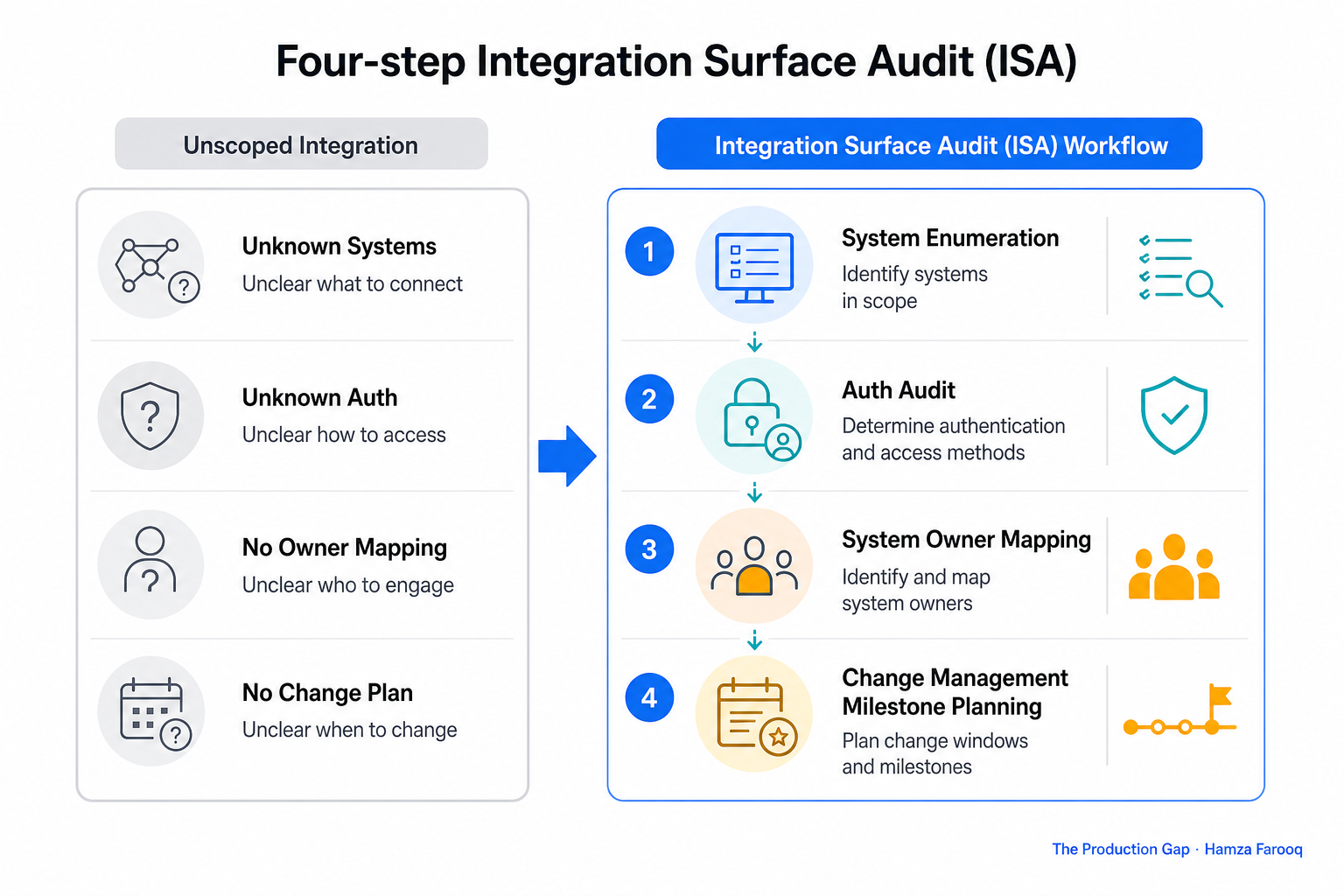
FDEs should scope AI agent integration complexity by running an Integration Surface Audit (ISA), a practical four-step framework used in this guide, that maps every target system to a readiness tier, audits auth requirements per system, and adds explicit change management milestones before any delivery date is agreed.
Step 1, Enumerate the integration surface. List every system the agent must read from or write to. Assign an ICT tier from Table 1. Flag every Tier 3 or Tier 4 system as a timeline risk immediately.
Step 2, Audit auth and permission requirements. For each system: Does a service account exist? Is OAuth delegation supported? Who owns security sign-off? Unanswered questions are risk flags, not to-dos.
Step 3, Identify system owners and map their incentives. If a system owner has no stake in this project's success, escalating to a sponsor who can create that incentive is a project plan milestone, not a footnote.
Step 4, Build change management milestones into the timeline explicitly. CAB approval, security review completion, and system owner sign-off are critical-path items with owners and deadlines, not entries in a risk log nobody reads.
Frequently Asked Questions
What is the most common reason AI agent deployments fail in production?
Integration-layer failure, not model error. As of Q2 , roughly 95% of rollouts hit breaking production issues, with authentication failures and legacy API incompatibility as the two most frequent root causes.
How is connecting an AI agent to enterprise systems different from a traditional API integration?
Agents are autonomous and bidirectional, they initiate actions, make decisions mid-flow, and write back to systems of record without human confirmation. A failed ETL run is replayable; an agent submitting a duplicate purchase order at 3am is an incident.
What organizational factors add the most time to enterprise AI agent integration projects?
Security review cycles, CAB approvals, and system-owner buy-in consistently consume the most calendar time, because they run on governance timelines that engineering acceleration cannot compress. These are structural constraints, not resolvable by adding engineers or working faster.
When should an FDE escalate integration blockers to a client sponsor rather than resolving them at the engineering level?
The moment a blocker is rooted in system-owner incentives or governance accountability rather than technical configuration. Engineering can fix a missing API endpoint. It cannot motivate a system owner who has every reason to protect their ERP and none to open it. Escalation at that point is not a failure, it is the correct project management response.
Conclusion
The AI agent integration problem is the industry's acknowledged number-one deployment blocker, but it is only half a technical problem. The critical path runs through system owner buy-in, security review cycles, and CAB approvals, not lines of code.
FDEs who finish on time run the Integration Surface Audit (ISA) in week one, assign ICT tiers to every system in scope using the framework in Table 1, and treat change management as a delivery milestone before quoting a date. If your next scoping call surfaces more than one Tier 3 system or a missing system owner, you have found the real delivery risk, and the right moment to reset the timeline conversation before the SOW is signed.
Learn from me
Forward Deployed Engineering Bootcamp for Full-Stack Developers, my Maven cohort. Build and ship complete AI products end to end, from React and Node.js frontends to deployed models with caching and observability. Join the next cohort →
Hire us
Traversaal.ai. We're a team of forward deployed engineers solving the toughest AI problems for Fortune 100 companies: document intelligence, agentic data platforms, and real-time web intelligence, deployed in production. Work with our team to deploy your next agentic ecosystem. Talk to Traversaal.ai →
Join us
Want to solve these problems with us? We're always looking for forward deployed engineers who want to ship production AI. jobs@traversaal.ai
