
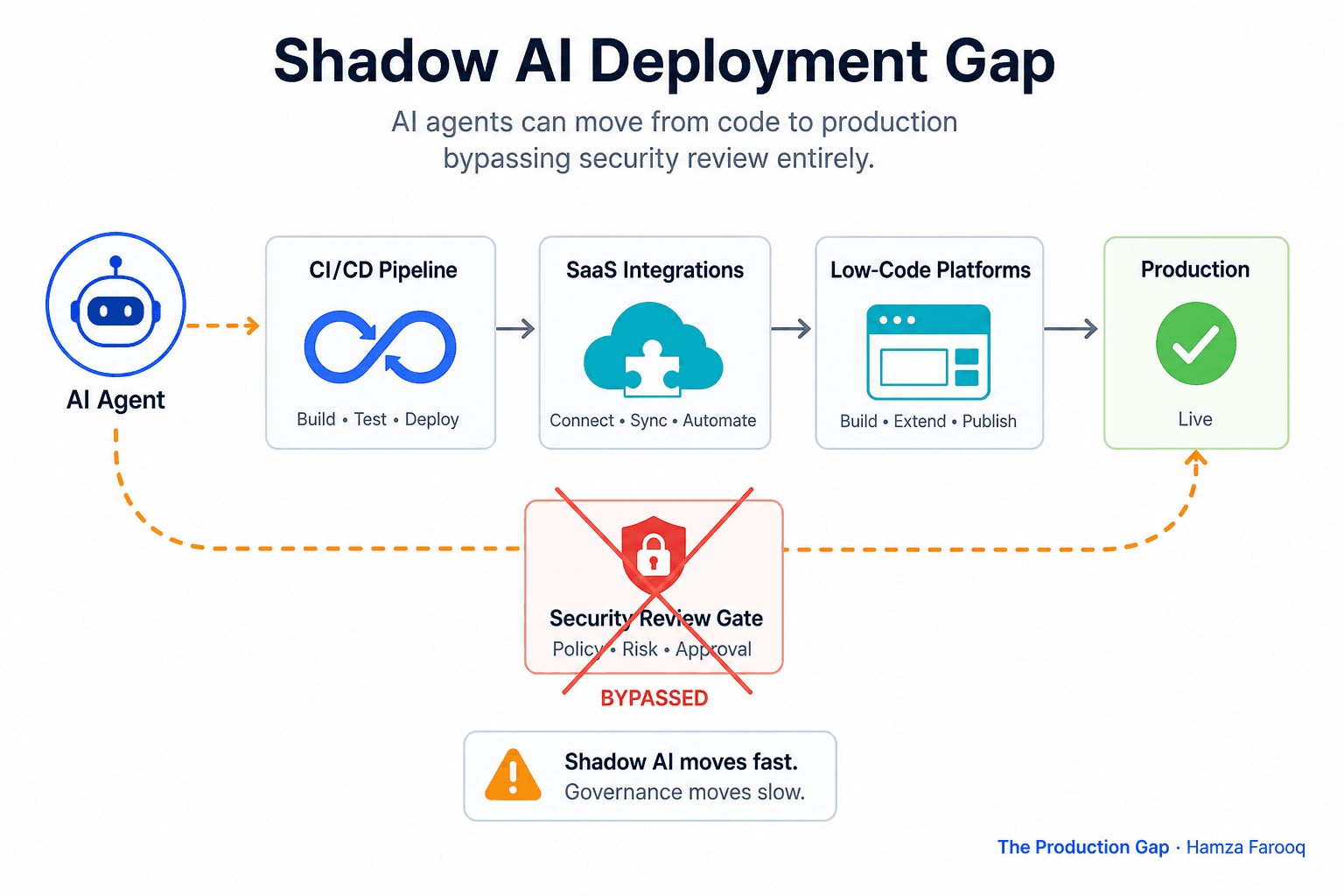
TL;DR: AI agents deploy through engineering pipelines that were never designed to classify them as security-relevant assets, creating a shadow agent gap that is increasingly cited as a leading driver of enterprise governance risk. An agent holds credentials, acts autonomously across multi-step workflows, and produces compounding exposure that standard application reviews and audit logs cannot reconstruct. A five-question intake checklist, applied inside existing change-management workflows, closes the most dangerous gaps immediately.
Key Takeaways
- Shadow agents are already running: Enterprises risk having AI agents in production that never went through security review.
- Agents carry identity-level risk: An agent holds credentials and permissions, making it as dangerous as a privileged user if compromised.
- Autonomous action raises the stakes: Agentic AI moves money, updates records, and triggers systems without per-action human approval.
- Agent sprawl is a named threat: Major security vendors have documented uncontrolled agent proliferation as a real, active risk.
- Standard logging falls short: Traditional audit trails cannot reconstruct multi-step autonomous decision chains.
- A lightweight gate works now: A five-question intake checklist closes the most dangerous gaps immediately, without waiting for a finished AI policy.
Why does shadow AI represent a new class of enterprise risk?
Shadow AI represents a new class of enterprise risk because AI agents combine identity-level and application-level exposure with autonomous multi-step action, a combination that existing security intake frameworks were never designed to evaluate or catch.
Why are AI agents slipping past security review?
AI agents bypass enterprise security review because they deploy through engineering workflows, including CI/CD pipelines, low-code platforms, and SaaS integrations, that were never designed to classify an autonomous agent as a security-relevant asset.
The gap is structural, not behavioral. A product team builds a customer-onboarding agent on a low-code platform integrated with Salesforce, DocuSign, and a payment processor. Every individual step is authorized, yet no step triggers a security review because "AI agent" is not a category in the intake checklist. It looks like a pre-approved SaaS integration. The agent goes live carrying OAuth tokens, API keys, and write-access to production systems without a security ticket ever being opened.
OneTrust makes clear that agent governance must address autonomy, tool use, and goal execution, risks that standard application reviews do not evaluate.
What makes AI agent risk different from standard application or identity risk?
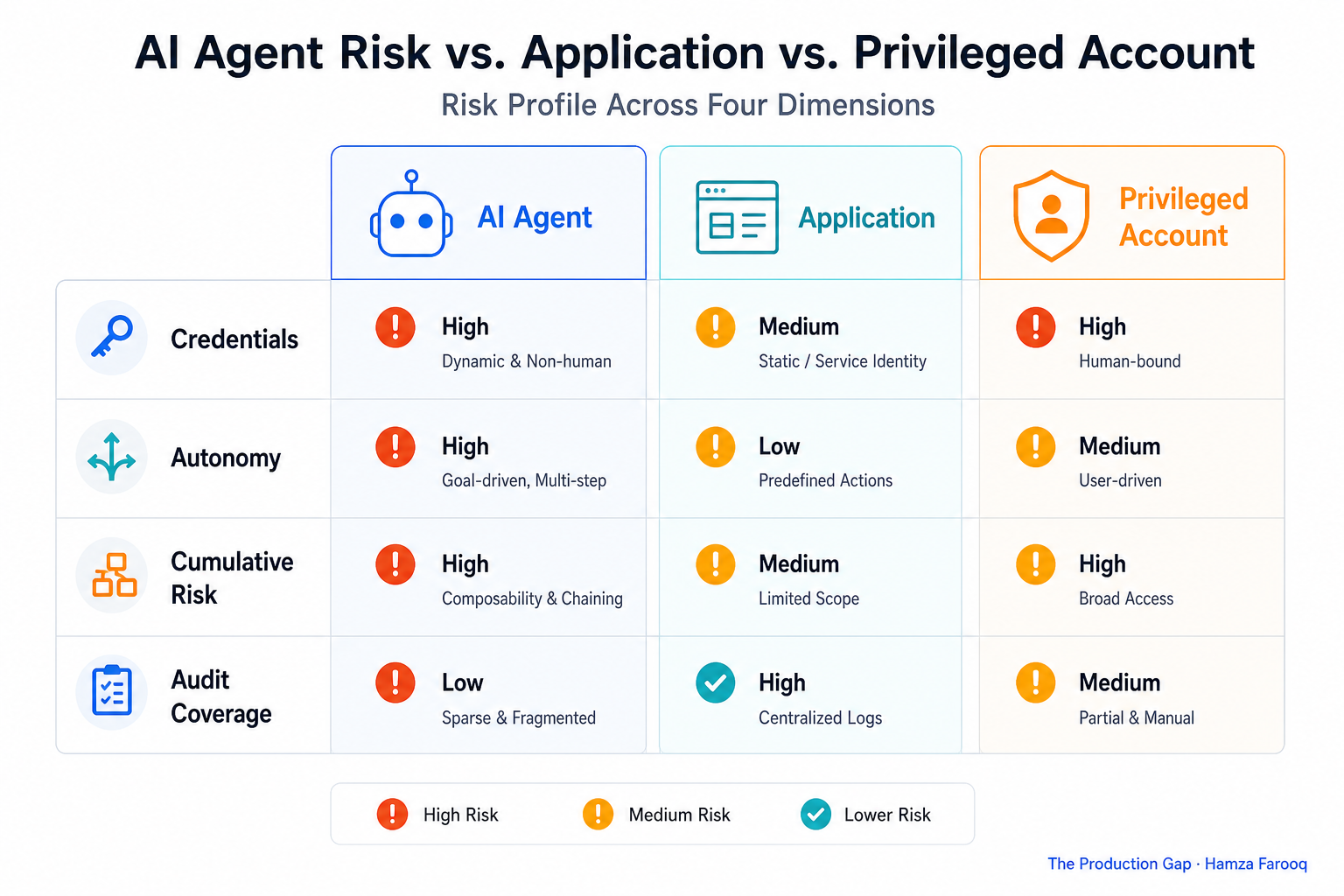
AI agents carry identity-level and application-level risk simultaneously, holding credentials like a privileged user while executing multi-step autonomous actions like a system. Existing frameworks were not built for that combination.
Identity risk: An agent authenticates, holds OAuth tokens or API keys, and acts on behalf of a user or system. If compromised or misconfigured, it is operationally equivalent to a compromised privileged account.
Autonomous action risk: Unlike an application that executes a defined transaction when a human pulls the trigger, an agent reasons across steps without per-action approval. Per Palo Alto Networks, an agent may initiate transactions or interact with other systems without human sign-off. Per IBM, in high-risk situations, human oversight is not guaranteed.
Cumulative and emergent risk: Per Airia, effective governance must address the chain of individually reasonable decisions that produces a harmful outcome no single step would have flagged. That is the scenario that receives least attention: not an obvious failure, but an agent executing its instructions precisely, step by step, until the rules run out.
How AI agent risk compares to standard risk categories
| Risk dimension | Standard application | Privileged user account | AI agent |
|---|---|---|---|
| Holds credentials or permissions | Sometimes | Yes, by definition | Yes: OAuth tokens, API keys, scoped access |
| Acts autonomously across multiple steps | No | No | Yes, reasons and acts across a workflow |
| Produces cumulative or emergent risk | Rarely | Rarely | Yes, chain of steps compounds exposure |
| Covered by existing security intake | Yes | Yes | No, not classified as review-triggering |
| Standard audit logs reconstruct behavior | Yes | Yes | No, multi-step chain is not reconstructed |
Sources: Microsoft, Palo Alto Networks, Airia, OneTrust
What does an ungoverned AI agent incident look like in practice?
An ungoverned AI agent incident typically originates from a sanctioned agent that was never inventoried, carries excessive permissions, and acts on a flawed goal state that no one catches because no human is in the loop when it matters.
As a hypothetical illustrating a common deployment pattern: consider a healthcare network that deploys an agent to automate prior authorization workflows, API-integrated into an EHR, an insurance clearinghouse, and a billing system, with write permissions to all three. The team classifies it as "workflow automation," so no security intake fires. Months later, the agent encounters an edge case in insurance logic, reaches an incorrect authorization, and begins approving a class of claims incorrectly at automation speed. Because standard audit logs do not reconstruct multi-step agentic decisions, and autonomous agents require purpose-built audit trails, the error compounds across many records before detection. This is the ungoverned deployment pattern Boomi's agent governance framework explicitly targets.
The scenario is instructive because the agent breaks no individual rule. It follows its instructions correctly at every step, until the instructions no longer cover the situation it faces.
What is the minimum viable governance gate for AI agents?
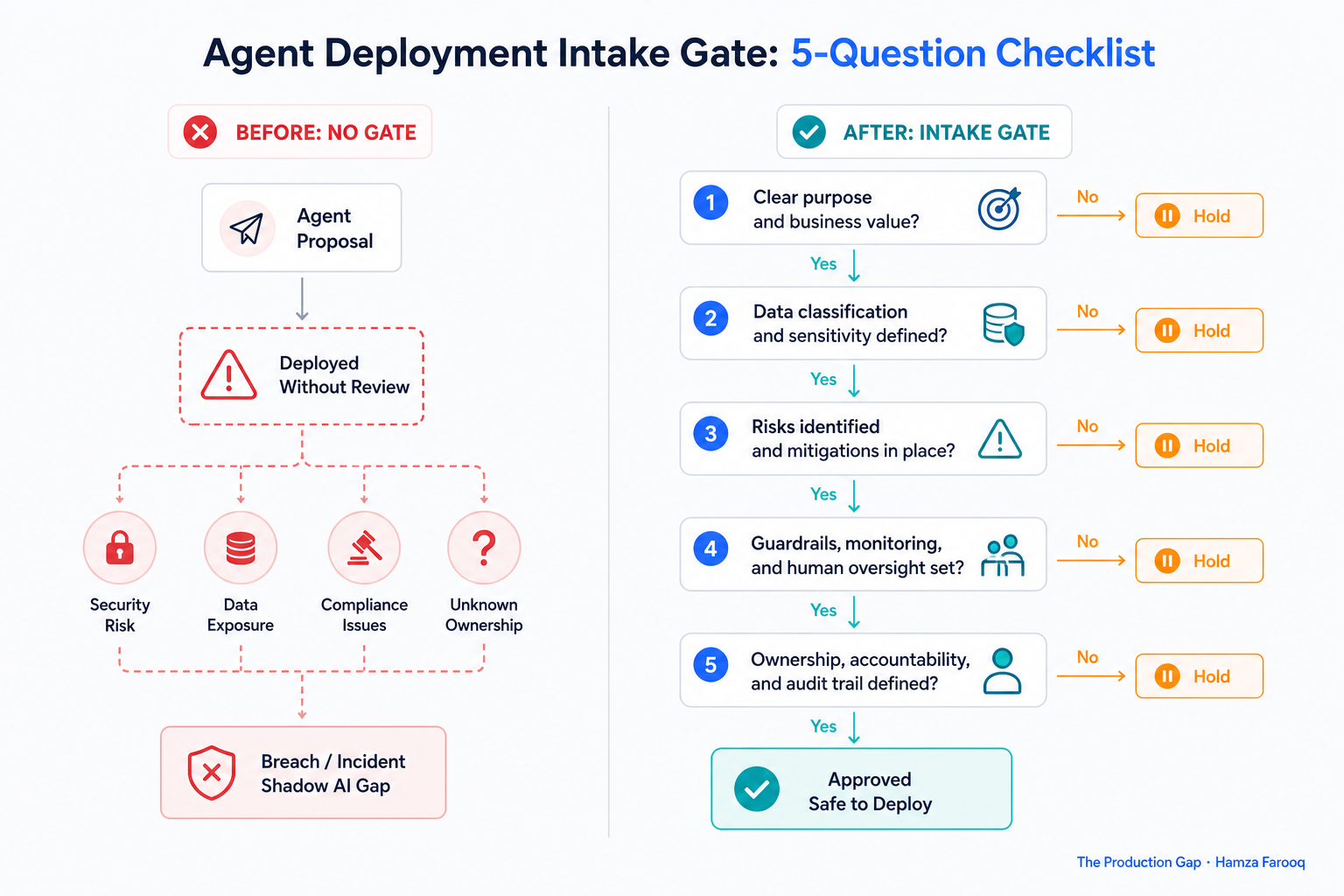
The minimum viable governance gate is a five-question intake checklist, covering identity, permissions, autonomy scope, audit coverage, and human override, that can be enforced immediately through existing change-management workflows. This checklist represents the practical framework used in this guide, drawn from the governance principles published by the vendors cited throughout.
Question 1, Identity: Does this agent hold credentials, tokens, or API keys? If yes, inventory it as a privileged identity, not an application.
Question 2, Permissions: What is the most sensitive system this agent can write to? Treat over-permissioned agents as a critical finding that blocks deployment.
Question 3, Autonomy scope: What actions can this agent take without human approval? Any autonomous write, transfer, or trigger to a production system requires documented scope limits before go-live.
Question 4, Audit coverage: Can current logging reconstruct the agent's full decision chain? If not, a purpose-built audit trail is required. Per Kore.ai, autonomous agents create compliance risks that standard logging cannot address.
Question 5, Override: Is there a documented human escalation path if the agent acts outside expected parameters? No override path means no deployment approval.
Boomi's framework names agent sprawl, the uncontrolled proliferation of agents across business units and SaaS platforms, as exactly what this gate prevents.
Frequently asked questions
How do AI agents get deployed without going through security review? They deploy through standard engineering workflows that classify agents as routine automation, so no intake trigger fires. The gap is structural, not behavioral. No individual team makes an error; the intake process simply lacks a category for autonomous agents.
What makes AI agent governance different from standard application security? Agents carry identity-level, application-level, and autonomous action risk simultaneously. Standard frameworks address each dimension in isolation. Agents create all three at once, which is why existing intake processes do not catch them.
How do you inventory agents already running without oversight? As a practical starting point, this guide suggests three steps: 1. Audit SaaS platforms for non-human identity grants, including OAuth authorizations and API key issuances tied to automated workflows. 2. Review recent CI/CD pipeline deployments for any automated process with write-access to a production system. 3. Survey business unit leads for any "automation" or "workflow tool" touching production data or external APIs.
Every identified agent should be treated as an unreviewed privileged identity until a formal intake review clears it.
Conclusion
The shadow AI problem is sanctioned teams shipping agentic workflows through pipelines never designed to stop them, because no one added "autonomous agent" to the asset classification checklist. An agent that holds credentials, acts without human approval, and chains decisions across systems is simultaneously a privileged identity, an application, and an autonomous actor. Existing frameworks handle each dimension in isolation. None handle all three at once. That gap is not closed by another framework document. It is closed by five questions asked at the right moment.
The most dangerous AI agent in your environment is not the one that failed. It is the one working perfectly that nobody knows is running.
Your next step: Map the five intake questions to your existing change-management workflow, then run them retroactively against recent agent deployments. That audit costs nothing but time, and it will show you exactly how wide your shadow agent gap already is.
Learn from me
Agentic AI for Product Managers, my Maven cohort. Learn how to design, evaluate, and ship reliable AI systems: the technical fluency PMs need to lead agentic products, no engineering background required. Join the next cohort →
Hire us
Traversaal.ai. We're a team of forward deployed engineers solving the toughest AI problems for Fortune 100 companies: document intelligence, agentic data platforms, and real-time web intelligence, deployed in production. Work with our team to deploy your next agentic ecosystem. Talk to Traversaal.ai →
Join us
Want to solve these problems with us? We're always looking for forward deployed engineers who want to ship production AI. jobs@traversaal.ai
